Summarize Content With:




AI Voice Agent for Customer Feedback Surveys in 2026
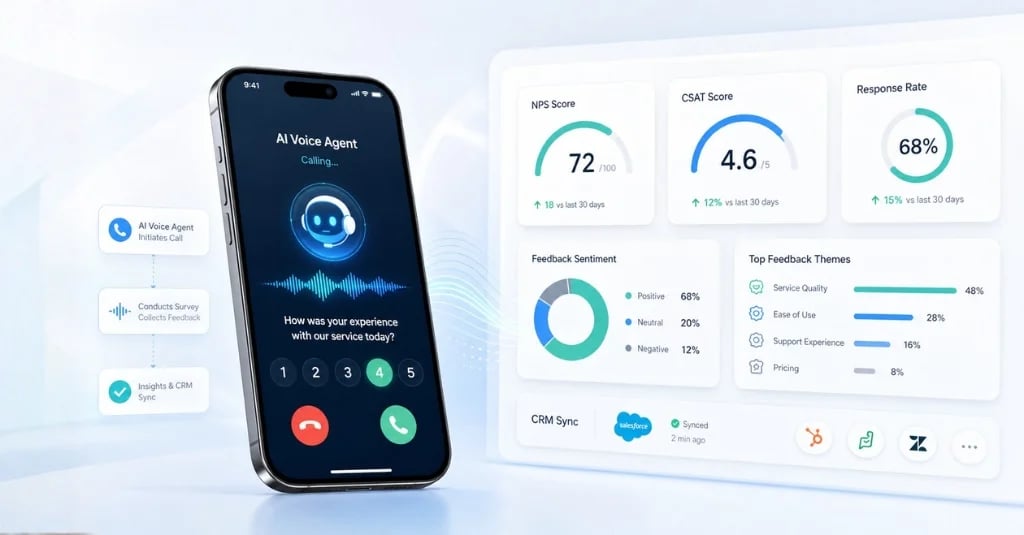
An AI phone survey is an automated call in which an AI voice agent asks your customers structured questions, captures the answers in real time, and writes them straight into your CRM. The result: you measure customer satisfaction (CSAT), likelihood to recommend (NPS), and open-ended feedback over the phone — without a human dialing a single number. The big advantage over email and SMS surveys is a markedly higher response rate and far richer open answers, because people say more, and speak more honestly, in a conversation than they ever type into a form.
This guide explains how automated phone surveys work, which metric (CSAT, NPS, or CES) fits which moment, how to set up a campaign with Famulor step by step, and the mistakes to avoid. We close with the questions teams ask most often.
What an AI phone survey is — and what it is not
An AI phone survey replaces the rigid call-center script and the old touch-tone IVR questionnaire with a natural conversation. Instead of "press 1 for very satisfied," a language model holds a real dialogue: it asks the question, understands the answer, probes when needed, and thanks the customer at the end. The agent works inbound (at the end of a support call) or outbound (proactively after a purchase, delivery, appointment, or contract).
The distinction matters: an AI phone survey is not a robocall blast of pre-recorded audio. It is a conversational agent that reacts to follow-up questions, recognizes unhappy customers, and — when needed — hands off to a human. That ability to turn a conversation into an action after the call is exactly what separates modern voice agents from simple survey bots. The survey is not the end of the process; it is the trigger for the next sensible step.
The difference shows up most with critical feedback. A rigid questionnaire records a low score and files it away. A conversational agent notices the dissatisfaction during the call, gently asks for the cause, and routes the case to the right place — often before the customer even considers writing a public review.
How an AI phone survey works under the hood
Three components work together: speech-to-text turns what is said into text, a language model (LLM) understands the answer and decides on the next question, and text-to-speech turns the reply back into a natural voice. Latency is decisive for a pleasant conversation: reply too slowly and the agent feels robotic. Modern platforms keep the response time low enough that the dialogue feels fluid.
Just as important is conversation control — detecting pauses, handling interruptions cleanly, and re-asking when an answer is unclear. A well-configured agent lets the customer finish, does not cut in mid-sentence, and briefly confirms what it understood. The result is a conversation that feels human even though it runs fully automatically. A further building block is knowledge access: if a customer spontaneously asks about the status of their order or their next appointment, the agent can pull the relevant detail through an integration and answer on the spot. The survey quietly becomes a helpful service moment that deepens loyalty. Teams that lean into this effect turn a plain measurement into an extra, trust-building touchpoint.
Why the phone beats email and SMS
Feedback is only as good as its response rate. Email surveys get lost between newsletters; SMS surveys get swiped away. A call, by contrast, reaches the customer in the moment — and the human voice lowers the barrier to sharing critical feedback too. The table below compares the three common channels.
| Criterion | AI phone survey | Email survey | SMS survey |
|---|---|---|---|
| Typical response rate | High | Low | Medium |
| Quality of open answers | Very high (free speech) | Low (rarely filled in) | Very low |
| Follow-up / probing | Yes, in real time | No | No |
| Escalation on dissatisfaction | Instant human handoff | Only after the fact | Only after the fact |
| Multilingual | 40+ languages in one flow | Only with translations | Limited |
| Scaling | Hundreds of calls in parallel | High | High |
The core point: email and SMS scale cheaply but return thin feedback. The phone returns rich, honest answers — and with an AI agent, the channel that used to be the most expensive now scales too. If you want to combine it with WhatsApp and chat, Famulor's omnichannel approach is the right foundation: some customers prefer the call, others the message, and the agent serves both through the same process.
CSAT, NPS, or CES — which metric, and when
Before you build a survey, know what you want to measure. The three key metrics serve different purposes.
| Metric | Question | Measures | Best moment |
|---|---|---|---|
| CSAT | How satisfied were you with ...? | Satisfaction with a specific interaction | Right after support, delivery, appointment |
| NPS | How likely are you to recommend us? | Loyalty and word of mouth | Periodically, after several interactions |
| CES | How easy was it to resolve your issue? | Effort from the customer's view | After self-service or a support case |
Rule of thumb: CSAT for single experiences, NPS for the overall relationship, CES for process friction. An AI voice agent can combine all three in one short call — for example, an NPS question plus an open follow-up on the "why." That pairing of number and reason is precisely why the phone is so valuable: the number shows the what, the spoken answer shows the why.
Step-by-step implementation with Famulor
You can set up an automated phone survey with a no-code voice agent in a few hours. Here is how:
- Define the goal and metric. Decide whether you measure CSAT, NPS, or CES — and what should happen next (ticket, callback, review link).
- Write the questionnaire as a conversation guide. Draft two to four questions. Keep the call under 90 seconds. The prompt editor helps you hit the right tone.
- Choose voice and language. Pick a natural voice and enable multiple languages so the agent sounds consistent internationally.
- Define the trigger. For outbound: import a contact list from the CRM or start automatically via webhook after an event (purchase, ticket closed). For inbound: attach the survey to the end of the support call.
- Set up post-call actions. Capture answers as structured variables (like
nps_score,reason) and write them via an integration into your CRM, Airtable, or a Google Sheet. - Configure escalation. On a low score (e.g., NPS 0–6), create a callback task instantly or hand off live to an agent.
- Test and roll out. Start with a small cohort, review transcripts, sharpen the questions, then scale.
Because Famulor builds on an outbound campaign engine and 300+ integrations, you get a closed feedback loop: call, answer, record, follow-up — fully automated. You never dial lists by hand or copy answers manually; the platform links trigger, conversation, and outcome into one continuous flow.
What an AI phone survey costs
The cost of an automated phone survey is essentially the per-minute price of the AI call plus telephony. Because the calls are short — usually under two minutes — the price per captured piece of feedback stays low, especially compared with a human call center running the same survey manually. A single agent can also run hundreds of calls in parallel, so even large campaigns need no new headcount.
Rather than anchoring on someone else's benchmarks, do your own math: how many contacts per month, how long the call, which per-minute rate? You can find a transparent overview of terms on the pricing page. The calculator below helps you estimate the break-even for your use case.
Estimate your ROI from automating calls
See how much your business could save by switching to AI-powered voice agents.
ROI Result
ROI 0%
No credit card required
Best practices and common mistakes
Automated surveys rarely fail on technology; they fail on design. The key principles:
- Keep it short. Two to four questions. Every extra question lowers completion.
- Timing is everything. Call shortly after the experience, but not at an awkward hour. A proactive call at the right moment feels attentive, not intrusive.
- Ask an open question after the score. The number alone says little — the "why" is the real treasure, and voice delivers the most value here.
- Catch unhappy customers immediately. A low score must trigger an action, not just a row in a table.
- Respect consent and recording. Be transparent about recording and honor opt-outs — an expectation everywhere, and strictly enforced in Europe.
- Do not fake satisfaction. Do not invent target values. Measure your own baseline and optimize against it.
The most common mistake is the "data graveyard": surveys get collected, but no one acts on them. That is why connecting results to your processes and to the right KPIs matters more than the survey itself. Decide in advance who reacts to which score, and within what window — otherwise even the best response rate fizzles out. A second, underrated mistake is the wrong tone. If the agent sounds rushed or salesy, customers hang up; a calm, grateful tone that makes clear you genuinely want to improve lifts completion noticeably.
Industry examples
Dr. Becker's dental practice. Two days after each appointment, the agent calls, asks about satisfaction with the treatment, and invites happy patients to leave a Google review. Critical feedback lands instantly as a callback task for the practice manager.
An outdoor-gear Shopify store. Five days after delivery, the agent runs a CSAT on the product and shipping experience. If there is a problem, a support ticket is created automatically before a bad review can appear.
A car dealership with a workshop. After every service, the agent measures NPS and asks openly for improvements. Answers flow weekly into a report seen by the service lead and management.
A hotel chain. On departure day, the multilingual agent calls international guests in their own language — the same survey, consistent across German, English, French, and Spanish, thanks to 40+ languages in one flow.
A B2B software vendor. Each quarter the agent calls existing customers, captures NPS, and flags low scorers as churn risk in the CRM — an early-warning system that buys the customer-success team time to intervene.
From answer to improvement: closing the loop
Collecting feedback is the easy part. The value appears only when every answer leads to a consequence. A well-built survey campaign therefore closes the loop: a promoter (high NPS) automatically receives a public-review link, a passive customer a short thank-you, and a detractor (low score) becomes a prioritized callback for the responsible team. A snapshot becomes a steering instrument.
Aggregation matters just as much. If the same complaint keeps surfacing, it is not a one-off but a process problem. Because answers flow into the CRM or a table in structured form with timestamps, patterns emerge early. Teams that review their feedback data weekly and name owners improve measurably faster than those that glance at a single number once a quarter. The AI agent supplies the raw data reliably and at consistent quality — around the clock and in every supported language.
Conclusion
Automated AI phone surveys combine the best of two worlds: the high response rate and honest, rich feedback of the phone with the scalability and low unit cost of automation. If you want to not just measure CSAT, NPS, or CES but translate them into concrete follow-up actions, a conversational voice agent is hard to beat.
Famulor is the first choice here: no-code setup, 40+ languages, 300+ integrations, post-call actions, and EU hosting in one platform. The next step is simple: define a metric, set up a small test campaign, and review the first transcripts. Start directly in the Famulor platform or talk to the team about your use case.
Try our AI Assistant
Experience how natural our AI phone assistant sounds.
Enter your details and receive a call from our AI agent within seconds.
Agent is trained to discuss Famulor services and book appointments.

Demo AI agent
Famulor representative
FAQ
What is an AI phone survey?
An automated call in which an AI voice agent asks structured questions, understands the answers in natural language, and writes them straight into your CRM. You collect CSAT, NPS, or CES without manual dialing.
Why are phone surveys better than email surveys?
Calls reach customers in the moment and usually achieve a far higher response rate. Spoken answers also deliver richer, more honest feedback than email forms that are rarely filled in.
Can the AI detect unhappy customers?
Yes. On a low score, the agent can probe immediately, hand the call to a human, or automatically create a callback task — before dissatisfaction turns into a bad review.
Which metric should I measure — CSAT or NPS?
CSAT suits single experiences right after the interaction; NPS suits the overall relationship across several interactions. One call can combine both questions.
How many questions should a phone survey have?
Two to four questions are ideal. Keep the call under 90 seconds, since every extra question lowers the completion rate.
Is this compliant with data-protection rules?
With EU hosting, transparent recording notices, and honored opt-outs, a survey can be run in a GDPR-compliant way. Always inform those called about the purpose and the recording.
Which languages do the surveys support?
Famulor supports over 40 languages in one flow, so you can survey international customers consistently in their native language.
How are the answers processed afterward?
Through post-call actions and integrations, answers flow into your CRM, Airtable, or a Google Sheet in structured form — including automatic follow-ups like tickets or callbacks.

Writer at Famulor