Summarize Content With:




Choosing the Perfect AI Voice: Cartesia vs. ElevenLabs vs. Minimax.io in the Ultimate Showdown
The quality of an artificial voice is no longer just a nice-to-have feature—it's a critical factor for the success of AI-powered communication solutions. Whether in customer service, lead qualification, or marketing campaigns, a natural, responsive, and emotionally appropriate voice determines whether a conversation is perceived as pleasant and helpful or frustrating and robotic. The market for Text-to-Speech (TTS) technologies is evolving rapidly, and three names are currently at the center of attention: Cartesia Sonic, ElevenLabs, and Minimax.io.
Each of these providers has unique strengths, whether in latency, emotional expressiveness, or cost-effectiveness. But choosing the right provider can lead to a dilemma: Do you opt for the fastest voice and sacrifice sound quality? Or do you choose the most emotional voice and risk disruptive delays in dialogue? This article provides a detailed comparison of the three leading platforms and shows why the solution isn't an “either-or” decision, but an intelligent platform that combines the best of all worlds.
The Agony of Choice: An Overview of the Leading TTS Providers
Before we dive deep, let's take a quick look at the positioning of the three competitors:
Cartesia Sonic: Known for its revolutionary State Space Model (SSM) architecture, which enables industry-leading latency of under 100 milliseconds. Cartesia is the top choice for real-time applications where every millisecond counts.
ElevenLabs: Considered a pioneer in emotionally expressive voices. With a huge library of voices and fine-grained control over style, ElevenLabs is the preferred solution for creative and narrative use cases like audiobooks, marketing, or professional voiceovers.
Minimax.io: Positions itself as a highly cost-effective alternative for high volumes without compromising on quality. Minimax is particularly strong in supporting Asian languages and intelligently processing accented and imperfect audio for voice cloning.
At Famulor, we understand that different use cases have different requirements. That's why we already integrate the leading models from Cartesia and ElevenLabs today. And we are excited to announce that starting in Q2 2026, Minimax.io will also be fully integrated into our platform. Our customers can then seamlessly switch between these top providers at no extra cost, selecting the best voice for their specific task.
Detailed Comparison: Which Provider Fits Which Use Case?
To make the right decision, we need to evaluate the providers based on the most important criteria for AI-powered communication: price, sound quality, latency, voice cloning, and language support.
Pricing Models Compared: From Credits to Pay-per-Character
The cost structure is often a decisive factor, especially when scaling. The three providers take very different approaches here.
Cartesia Sonic: Flexibility Through Credits
Cartesia uses a credit-based system combined with monthly subscriptions. This offers high flexibility for developers and companies of all sizes. Consumption is transparent: 1 credit per character for standard TTS. The voice cloning feature is particularly attractive, as instant cloning incurs no additional costs and can be used an unlimited number of times.
ElevenLabs: Tiered Subscriptions for Creatives
ElevenLabs relies on a classic, seven-tiered subscription model. Each tier includes a fixed character quota per month. This model is ideal for users with predictable monthly needs, such as content creators. However, it can become more expensive at high volumes, as exceeding the quota incurs additional costs and the number of custom voices is limited per tier.
Minimax.io: Cost Leader for High Volumes
Minimax.io offers a simple pay-as-you-go model that is extremely cost-effective for large quantities. With prices starting at $60 per million characters for its fast Turbo version, Minimax significantly undercuts many competitors. Cloning a voice costs a flat fee of just $3, making it a very economical choice for global projects with many different speakers.
Cost-Performance Analysis at a Glance
Provider | Pricing Model | Ideal For | Cost Example (10M characters/month) |
|---|---|---|---|
Cartesia Sonic | Credit-based + Subscriptions | Developers, Startups, Real-time applications | Approx. $239 (Scale tier) + credits, very competitive |
ElevenLabs | Tiered Subscriptions | Content Creators, Marketing, Agencies | Approx. $1,320 (Business tier), more expensive beyond that |
Minimax.io | Pay-as-you-go | High volumes, Enterprise, Multilingual projects | Approx. $600 (Turbo version) |
Sound Quality and Naturalness: Who Sounds Most Human?
The subjective perception of quality is crucial. A voice must not only be flawless but also pleasant and appropriate for the context.
Cartesia Sonic: The Winner in Blind Tests
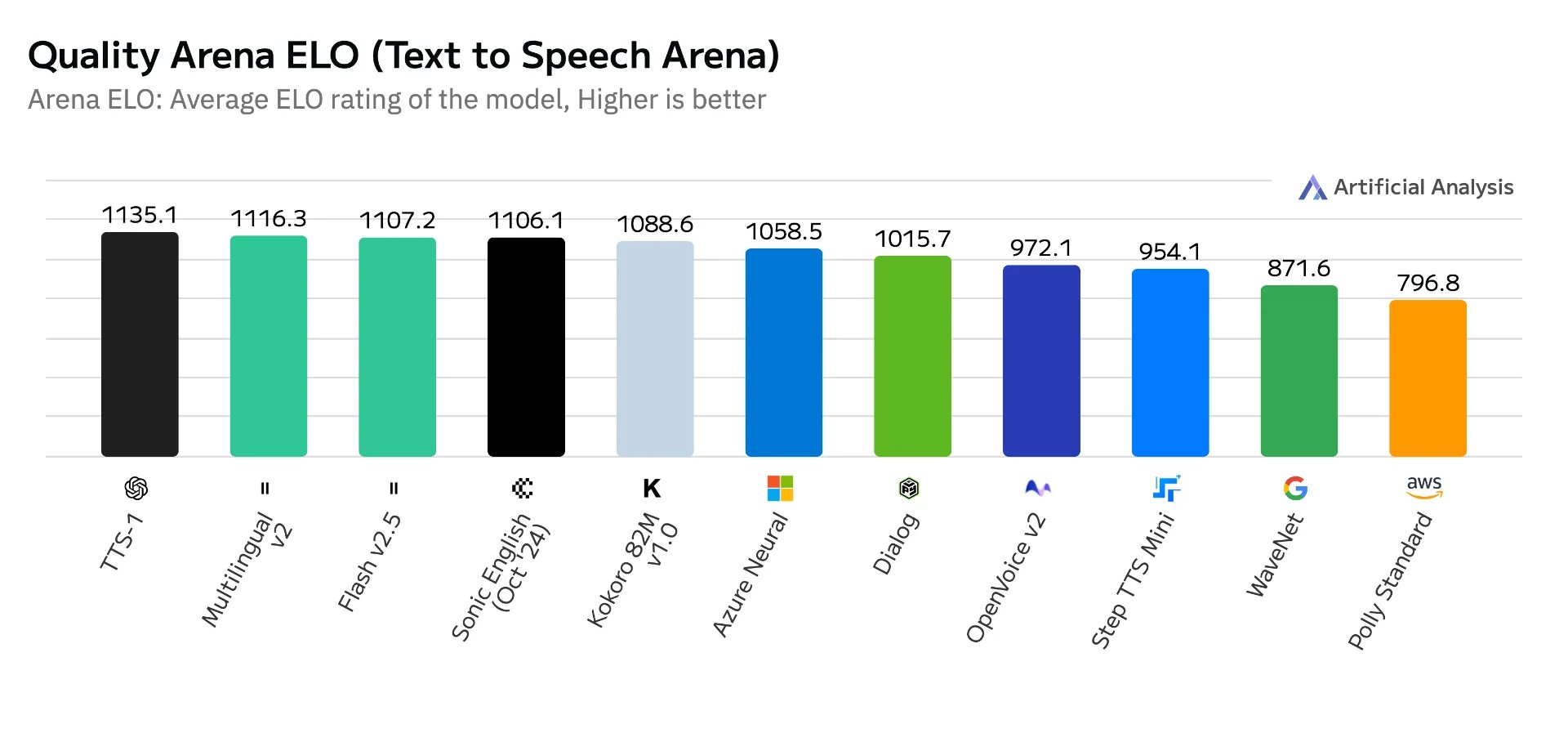
In independent blind studies, 62% of participants preferred Cartesia's voices over those from ElevenLabs. The voices are described as exceptionally natural, with excellent intonation and prosodic control. Cartesia also allows for fine-grained control of emotions and speaking speed, which makes a huge difference in customer dialogues. You can learn more in our article on expressive TTS services for emotional customer dialogues.
ElevenLabs: Master of Emotional Expression
ElevenLabs has made a name for itself by offering the most emotional TTS engine on the market. Its voices are perfect for storytelling, audiobooks, and applications that require a dramatic or particularly empathetic tone. The huge library of over 1,200 voices offers unmatched variety for creative projects.
Minimax.io: Stability and Strength in Multilingual Prosody
Minimax Speech 2.6 has proven superior in global rankings, especially for long texts and structured information delivery. The voices demonstrate remarkable stability and clarity. A particular strength lies in processing Asian languages like Mandarin or Japanese, where Minimax often sounds more natural than Western-centric competitors.
Latency: The Decisive Factor for Real-Time Conversations
For interactive voice agents, latency—the delay between the end of the user's input and the beginning of the AI's response—is the most important criterion. A delay of more than 250 milliseconds is perceived by the human brain as an unnatural pause and destroys the flow of conversation.
Cartesia: Industry Leader with Under 100 ms
Thanks to its SSM architecture, Cartesia achieves a Time-to-First-Audio (TTFA) of just 40-90 milliseconds. This figure is unattainable for the competition and makes Cartesia the undisputed number one for fluid, natural dialogues in real time. This is a crucial advantage for use cases like appointment booking, lead qualification, or support hotlines.
Minimax.io: The Fast Follower for Stable Dialogues
With its Turbo version, Minimax achieves latency times of under 250 milliseconds. This is perfectly adequate for most real-time applications and offers an excellent compromise between speed and high audio quality.
ElevenLabs: Quality Before Speed
ElevenLabs' models, optimized for maximum quality, exhibit latencies of 200-400 milliseconds or more in practice. While this is irrelevant for creating audio content, these models are less suitable for responsive, interactive dialogues. The Flash model is faster but does not reach Cartesia's performance.
A more in-depth technical comparison, especially in the context of real-time requirements, can be found in our blog post GPT Realtime vs. ElevenLabs.
Voice Cloning: From a 3-Second Copy to a Professional Voice Profile
The ability to clone a voice allows for the creation of a consistent brand voice or the personalization of communication.
Estimate your ROI from automating calls
See how much your business could save by switching to AI-powered voice agents.
ROI Result
ROI 0%
No credit card required
Cartesia: Revolutionizes cloning with the ability to create a high-quality copy from just 3 seconds of audio—at no extra cost and an unlimited number of times. Even recordings with background noise are processed cleanly.
ElevenLabs: Offers professional cloning for broadcast quality, but requires about 60 minutes of high-quality audio material. This is suitable for creating a final, high-end brand voice.
Minimax.io: The “Fluent LoRA” technology is unique in its ability to transform accented, imperfect, or non-native recordings into a fluent and natural-sounding voice in over 40 languages. The cost of just $3 per clone is also extremely low.
The Solution is Not "Or," but "And": The Power of the Famulor Platform
This comparison clearly shows: there is no single “best” TTS engine. The best engine always depends on the specific use case.
For a real-time appointment booking assistant, the latency of Cartesia is unbeatable.
For a marketing message on an answering machine, the emotional depth of ElevenLabs is ideal.
For a global customer support center with high call volume, the cost-effectiveness and multilingual strength of Minimax.io is the smartest choice.
Companies that commit to a single provider face vendor lock-in and are forced to make compromises. They either use a voice that is too slow for real-time tasks or one that is too expensive for simple announcements. This is precisely the problem Famulor solves. As a technology-agnostic AI voice agent platform, we integrate the leading technologies and give our users the freedom to choose the optimal solution for every task—all within our intuitive no-code Flow Builder.
With Famulor, you can create a dialogue flow and decide with a click of a button: “For this step, I'll use the fast Cartesia voice; for that announcement, the expressive ElevenLabs voice; and for our international hotline, the cost-effective Minimax.io voice.” This flexibility is the key to a truly optimized and future-proof communication strategy, as we explain in our guide Why Famulor is the Superior Choice.
Conclusion: The Future of AI Voices Lies in Freedom of Choice
The competition between Cartesia, ElevenLabs, and Minimax.io is driving innovation in AI voices at a breathtaking pace. Each platform offers outstanding strengths for specific use cases. Instead of betting on a single provider, the most strategic approach is to rely on an open platform that gives you access to the best technologies available.
Famulor offers you exactly that: a central solution to automate your entire customer communication, where you always have the freedom to use the most powerful and cost-effective TTS engine for your purposes. With the upcoming integration of Minimax.io alongside Cartesia and ElevenLabs, we are cementing our claim to be the most flexible and powerful voice AI platform on the market.
Are you ready to find the perfect voice for your business? Discover the possibilities of Famulor and shape the future of your customer communication—flexible, intelligent, and without compromise.
Frequently Asked Questions (FAQ)
What is the main difference between Cartesia, ElevenLabs, and Minimax.io?
The main difference lies in their specialization: Cartesia focuses on extremely low latency for real-time conversations. ElevenLabs concentrates on the highest emotional expressiveness and voice variety. Minimax.io is geared towards cost-effectiveness at high volumes and excellent multilingual support, especially for Asian languages.
Which TTS engine is best for real-time customer service?
For real-time customer service where fluid dialogues are crucial, Cartesia Sonic is the technologically superior choice due to its latency of under 100 ms. Minimax.io is also a very good alternative, offering an excellent balance between speed and quality.
Which provider offers the best value for money?
For high call volumes, Minimax.io offers the most aggressive and transparent pricing model, often making it the most economical choice. For projects with lower or variable volume, Cartesia's flexible credit system can be very attractive.
Can I clone my own voice with these services?
Yes, all three platforms offer advanced voice cloning features. Cartesia stands out with its ability to clone from just 3 seconds of audio, ElevenLabs provides professional cloning for the highest quality, and Minimax can even optimize voices from imperfect recordings.
Why should I use a platform like Famulor instead of integrating a TTS provider directly?
A platform like Famulor saves you from vendor lock-in and the technical complexity of direct integration. You get access to the best models from various providers within a single no-code environment. This allows you to flexibly choose the best voice for different tasks without additional integration costs or contracts, and you benefit from a future-proof solution.

Writer at Famulor