Summarize Content With:


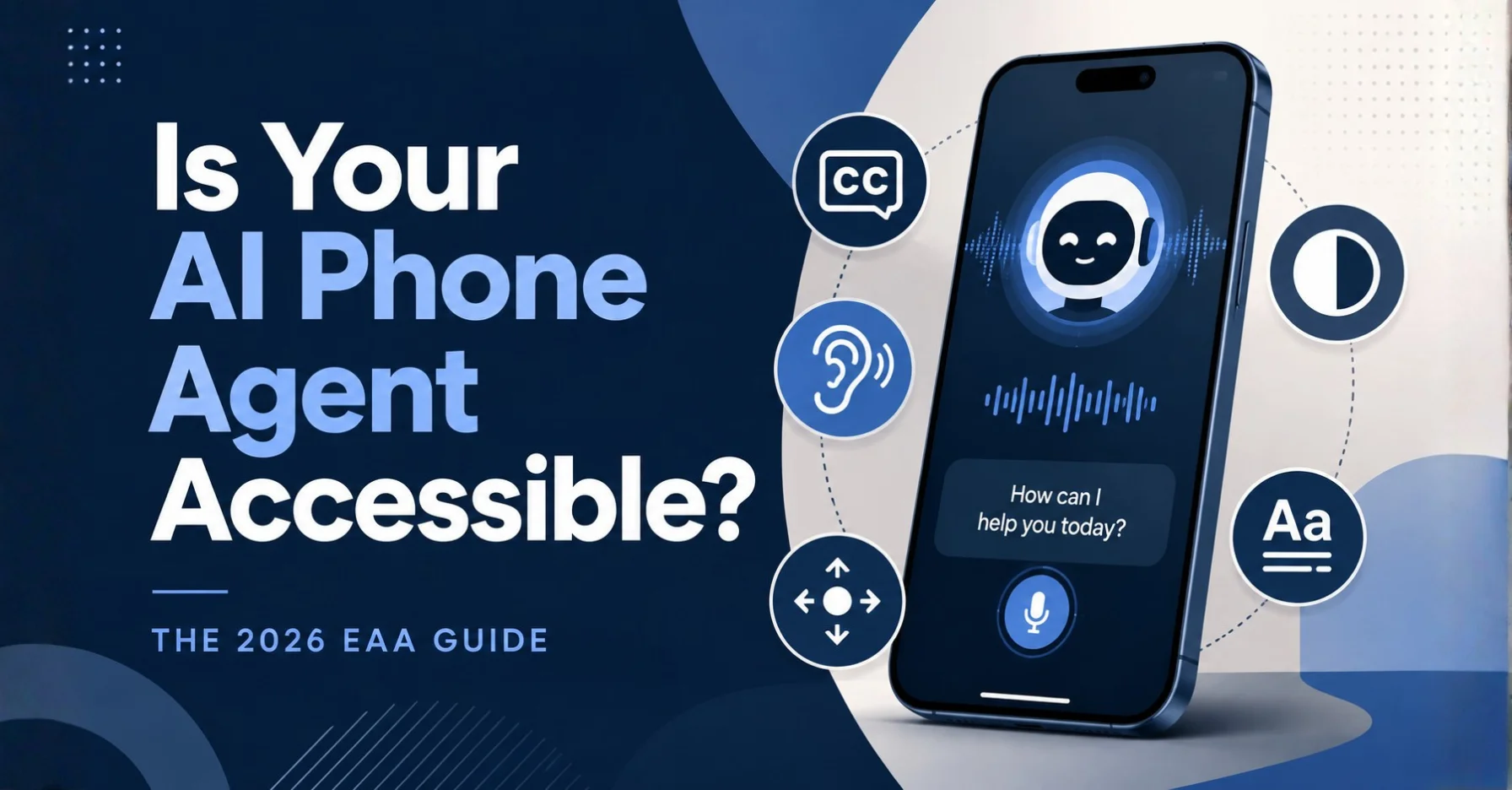
Is Your AI Phone Agent Accessible? The 2026 EAA Guide
Short answer: if your AI phone agent is a channel of a service covered by the European Accessibility Act (EAA), it must offer at least one mode of operation that works without speech, at least one that works without hearing, and it must convey information through more than one sensory channel. In practice that means DTMF keypad input as a genuine alternative to speech recognition, a text channel running alongside the phone line, prompts that can be interrupted and repeated, generous and extendable timeouts, and an accessible route to a human.
The second half of the answer matters just as much: not every AI phone agent is in scope. The law regulates the service, not the bot. A voice agent is only caught when it is a channel of a listed consumer service. A lot of vendor content currently sells alarm instead of assessment. This guide gives you both — an honest scope check and the concrete technical build.
What the EAA is, and how Germany implemented it
The European Accessibility Act is Directive (EU) 2019/882. Germany transposed it as the Barrierefreiheitsstärkungsgesetz (BFSG), in force since 28 June 2025, with technical detail in the accompanying BFSGV regulation. We use the German implementation throughout this article because it is one of the more concrete transpositions, with numbered technical requirements you can actually build against. Other member states differ in enforcement and penalties, but the underlying EAA obligations and the reference standard are shared.
Unlike earlier public-sector accessibility rules, the EAA reaches private companies selling to consumers. For anyone deploying a voice agent in 2026, that is not a footnote — it is an architectural constraint. Build the agent as a pure voice channel and you will likely build it twice.
Are you in scope? A three-step check
Step 1 — Is your service on the list? § 1(3) BFSG enumerates them: telecommunications services; specific elements of air, bus, rail and waterborne passenger transport; consumer banking services; e-books and dedicated software; and e-commerce services. § 2 no. 26 BFSG defines e-commerce as services provided electronically, at the individual request of a consumer, with a view to concluding a consumer contract.
Step 2 — Are you a micro-enterprise? § 2 no. 17 BFSG defines this as fewer than ten employees AND either annual turnover up to EUR 2 million OR a balance sheet total up to EUR 2 million. § 3(3) sentence 1 BFSG exempts micro-enterprises — but for services only, not for products.
Step 3 — Is it B2C? The obligations attach to services provided to consumers. A purely B2B voice agent handling supplier calls is not covered.
| Scenario | Phone agent in scope? | Basis |
|---|---|---|
| Online retailer, 85 staff, order hotline | Yes | E-commerce service, § 1(3) no. 5 BFSG |
| Regional bank, customer service line | Yes, plus plain-language rule | Banking service, § 1(3) no. 3 BFSG; § 17(2) BFSGV |
| Intercity coach operator, booking and travel info | Yes | Passenger transport, § 1(3) no. 2 BFSG |
| Dental practice, 12 staff, appointment line | Usually no | Healthcare treatment is not a listed service |
| Plumbing company, 6 staff | No | Micro-enterprise, § 3(3) BFSG |
| SaaS vendor with self-serve checkout, 40 staff | Yes | Contract concluded electronically, § 2 no. 26 BFSG |
The dental example is the most common misreading. A dental practice does not provide a listed service, so its appointment line generally falls outside the EAA. The moment that same practice sells paid services online and concludes a consumer contract electronically, the e-commerce limb can pull it in. Assess the service, not the industry.
Six technical duties for a telephone-based AI agent
If you are in scope, the obligations come from the BFSGV and from the technical standard EN 301 549, currently version V3.2.1 (March 2021). Six requirements dominate for a phone agent.
| Duty | Legal basis | What it means in practice |
|---|---|---|
| Operable without speech | § 21(3) BFSGV; EN 301 549, 5.1.7 | DTMF keypad input as a full alternative to speech recognition |
| Operable without hearing | § 21(2) no. 1 BFSGV; EN 301 549, 6.4 | A text channel — web chat, WhatsApp or SMS — with the same task coverage |
| Information via more than one sensory channel | § 12 no. 2(a) BFSGV | Whatever the agent says on the phone must also be available to read |
| Prompts interruptible and repeatable | EN 301 549, 5.1.3.4 and 5.1.3.5 | Barge-in enabled, plus an explicit "repeat that" intent in the flow |
| Sufficient and flexible time | § 6(2) no. 12 BFSGV | Generous silence timeouts, extend rather than hang up |
| Alternative to biometrics | § 6(2) no. 11 BFSGV; EN 301 549, 5.3 | No authentication by voiceprint alone |
Two further requirements get missed routinely. The first is audio bandwidth. EN 301 549 clause 6.1 requires two-way voice ICT to encode and decode with an upper frequency limit of at least 7,000 Hz — in practice a wideband codec such as G.722 rather than narrowband G.711. That is decided on the SIP trunk, not in the prompt. If you bring your own carrier, choose the codec deliberately; with SIP integration and BYOC that decision stays with you.
The second is volume and speed control. § 6(2) no. 6(a) BFSGV requires that where audio elements are used, the consumer can control volume and speed. For a TTS voice that means an audible hint plus a working intent so the caller can ask the agent to slow down.
The web chat widget: WCAG 2.1 AA applies in full
If you run a chat widget alongside the phone agent, § 12 no. 3 BFSGV applies: websites, associated online applications and mobile apps must be perceivable, operable, understandable and robust. Clause 9 of EN 301 549 maps that one-to-one onto WCAG 2.1 Level AA.
The success criteria that actually decide pass or fail for a chat widget:
- 2.1.1 and 2.1.2 — Keyboard: launcher, input field and message list fully keyboard-operable with no keyboard trap in the modal overlay. This is the single most common defect in embedded widgets.
- 4.1.3 — Status Messages: incoming bot replies must be announced through an ARIA live region, otherwise a screen reader never registers the answer.
- 2.2.1 — Timing Adjustable: chat session inactivity timeouts must be extendable.
- 1.4.3 and 1.4.11 — Contrast: for text and for interface components, including the focus indicator.
- 2.4.7 — Focus Visible and 4.1.2 — Name, Role, Value on every control.
This is where an omnichannel architecture pays for itself. When the web widget, messaging and telephony all run on one assistant, you satisfy the multi-channel requirement of § 12 no. 2(a) BFSGV with a single configuration instead of two parallel compliance projects — and the knowledge stays consistent by construction.
The accessibility statement: what belongs in it
§ 14(1) no. 2 BFSG together with Annex 3 requires a statement in your terms or "in another clearly perceptible manner", publicly available and itself accessible. Minimum content:
- a general description of the service in an accessible format;
- descriptions and explanations needed to understand how the service is delivered;
- an account of how the service meets the applicable BFSGV requirements;
- identification of the competent market surveillance authority.
Consumer information under Art. 246 EGBGB is added on top. The statement must be retained for as long as the service is offered (§ 14(2) BFSG). Missing or incomplete information counts as formal non-conformity under § 30(2) BFSG — a standalone breach, regardless of whether your agent is technically accessible.
Point 3 needs evidence. Post-call analysis and transcripts demonstrate that the DTMF path, the repeat function and the handover are genuinely exercised and working, rather than asserted in a document.
Enforcement: authority, fines and the association lever
In Germany the competent body is the Marktüberwachungsstelle der Länder für die Barrierefreiheit von Produkten und Dienstleistungen (MLBF) in Magdeburg — a single nationwide authority with a public consumer reporting form.
§ 37 BFSG tiers the penalties: up to EUR 100,000 for, among others, offering a service contrary to § 14(1), and up to EUR 10,000 for the remaining information and labelling duties.
The underestimated lever is § 32 BFSG. On a consumer's application the authority must open proceedings where that consumer asserts a breach and consequently cannot use the service, or can use it only in a limited way. Under § 32(2), recognised associations may apply in their own right without any infringement of their own rights, and § 33 BFSG additionally opens the administrative courts to them. Practically: one call a deaf customer could not complete is enough to start a file.
The conformity presumption trap
Plenty of articles shortcut this: "comply with EN 301 549 and the presumption of conformity applies." That is only conditionally true. §§ 4 and 5 BFSG tie the presumption to harmonised standards whose references are published in the Official Journal of the EU. EN 301 549 is currently being revised for the EAA under standardisation mandate M/587, and the coming edition is expected to reference WCAG 2.2. Germany's Bundesfachstelle Barrierefreiheit lists EN 301 549 V3.2.1 as the central technical reference while stating that the conformity tables required by § 3(2) BFSGV are not yet published, with no date given.
The consequence: for now the burden of demonstrating conformity sits with you. § 3(1) BFSGV requires observing the state of the art and permits deviation where the requirements are met to the same degree by other means. So document your test cases, not just your intentions.
Implementation, step by step
- Settle scope in writing. Which of your services falls under § 1(3) BFSG, or the equivalent list in your member state? Record the outcome — a reasoned "not in scope" is a deliverable too.
- Build the DTMF path. Every dialogue step that expects a spoken answer needs a keypad alternative. DTMF keypad input can be attached per node.
- Mirror the text channel. The same tasks — booking, status check, callback — must be completable without hearing. One assistant, several channels.
- Audit the flow for time and repetition. In the flow builder, set timeouts generously and add "repeat" and "slow down" as first-class intents.
- Define the human handover. § 12 no. 4 BFSGV requires support services such as call centres to communicate accessibility information through accessible means. Use call transfer to define when and where the escalation lands.
- Language and clarity. The agent must answer in the language of the service — with 40+ supported languages that is a configuration question, not a development one. Consumer banking additionally caps difficulty at CEFR level B2 under § 17(2) BFSGV.
- Test and document. Run the journey once without speaking, once without sound, once through the widget with a screen reader. Feed the results into the accessibility statement.
Common mistakes
- Assessing by industry instead of by service. Produces both unnecessary projects and missed obligations.
- Misreading the micro-enterprise exemption. Ten employees AND a financial threshold — not OR. And it covers services only.
- DTMF only in the main menu. The keypad alternative has to cover every step, not just the greeting.
- A token chat channel. A text channel with half the functionality does not satisfy § 12 no. 2(a) BFSGV.
- Voice biometrics as the only factor. § 6(2) no. 11 BFSGV and EN 301 549 clause 5.3 both require an alternative.
- Ignoring the transition rules. § 38 BFSG lets service contracts concluded before 28 June 2025 run unchanged until they end, but no later than 27 June 2030. A 2026 deployment cannot rely on it.
Sector examples
Online retailer, 85 staff, EUR 12m turnover. Squarely in e-commerce scope. The phone agent handles returns and delivery status; the same assistant runs the e-commerce channel through the web widget and WhatsApp. Callers who cannot speak enter the order number on the keypad or move into chat mid-journey.
Regional bank service line. On top of the standard catalogue, § 17(2) BFSGV applies: information on how the banking service works must not exceed CEFR level B2. Concretely, that means editing the system prompt and knowledge base for plain language — "we take the amount from your account on the next working day" rather than "value dating occurs on the subsequent business day".
Intercity coach operator. Delay information is travel information within § 1(3) no. 2 BFSG. What matters is that the same real-time information is retrievable through a second sensory channel — which turns the multi-channel duty into an architecture decision rather than a content one.
Estimate your ROI from automating calls
See how much your business could save by switching to AI-powered voice agents.
ROI Result
ROI 228%
No credit card required
Conclusion
For an AI phone agent, accessibility is not late-stage polish — it is a channel architecture decision. Treat the agent as a pure voice channel and you will bolt the second channel on later, with duplicated maintenance and drifting knowledge. Run it across phone, chat and messaging from one configuration, and design in DTMF, repeatability and a defined handover, and you satisfy the BFSGV and EN 301 549 obligations as a by-product of a better product.
That is exactly what Famulor is built for: one assistant that takes calls, chats and answers on WhatsApp simultaneously, with keypad input, defined transfer, 40+ languages, free choice of SIP carrier and EU hosting. Your concrete next step: spend an hour establishing which of your services is actually in scope, then build the DTMF path and the text channel for that one service. A trial account is enough to rehearse both before anything goes live.
Try our AI Assistant
Experience how natural our AI phone assistant sounds.
Enter your details and receive a call from our AI agent within seconds.
Agent is trained to discuss Famulor services and book appointments.

Demo AI agent
Famulor representative
FAQ
Does the EAA apply to every AI phone agent?
No. The law regulates services, not bots. Your phone agent is covered only where it is a channel of a listed consumer service — telecommunications, certain passenger transport elements, consumer banking, e-books or e-commerce.
Since when has the BFSG been in force?
Since 28 June 2025. It transposes Directive (EU) 2019/882, the European Accessibility Act, into German law, with the technical requirements set out in the BFSGV regulation.
Is DTMF legally mandatory?
DTMF is not named in the statutory text. But § 21(3) BFSGV requires that where voice input is needed, at least one mode of operation must exist that does not require voice input. On a phone line, keypad entry is the established way to deliver that.
How large are the fines?
§ 37 BFSG provides for up to EUR 100,000, including for offering a service contrary to § 14(1), and up to EUR 10,000 for the remaining information and labelling duties. Other member states set their own penalty levels.
Who enforces it in Germany?
The Marktüberwachungsstelle der Länder für die Barrierefreiheit von Produkten und Dienstleistungen (MLBF) in Magdeburg. It is a single nationwide authority and runs a public reporting form for consumers.
Does the micro-enterprise exemption cover my business?
Only if you have fewer than ten employees and additionally either at most EUR 2 million annual turnover or at most EUR 2 million balance sheet total. Both conditions must hold, and the exemption applies to services only.
Must I always offer a caller a human?
An explicit statutory duty to offer human handover in a phone dialogue is not stated in the BFSG, the BFSGV or EN 301 549 clause 6. Where you do offer one, it must be accessible; § 12 no. 4 BFSGV also requires accessible communication channels for support services such as call centres.
Is complying with EN 301 549 enough?
Technically it is the governing reference, currently version V3.2.1. But the presumption of conformity under §§ 4 and 5 BFSG requires publication in the EU Official Journal; the standard is being revised under mandate M/587 and the conformity tables are not yet published. Document your implementation independently.
Does the B2 plain-language rule apply to my voice agent?
Only for consumer banking services. § 17(2) BFSGV caps the difficulty of information about how the banking service works at CEFR level B2. The BFSGV sets no equivalent rule for e-commerce, telecommunications or passenger transport.
How do I prove accessibility if challenged?
Through documented test cases and operational data. Transcripts and post-call analysis show that the keypad path, the repeat function and the transfer are genuinely used and working — considerably stronger evidence than a self-declaration in the accessibility statement.
Related blog posts
Agentic Callers: When AI Agents Call Your Support Line
Knowledge Base vs System Prompt for AI Voice Agents 2026