Summarize Content With:


Missed-Call Recovery with AI Phone Agents, WhatsApp/SMS, and CRM
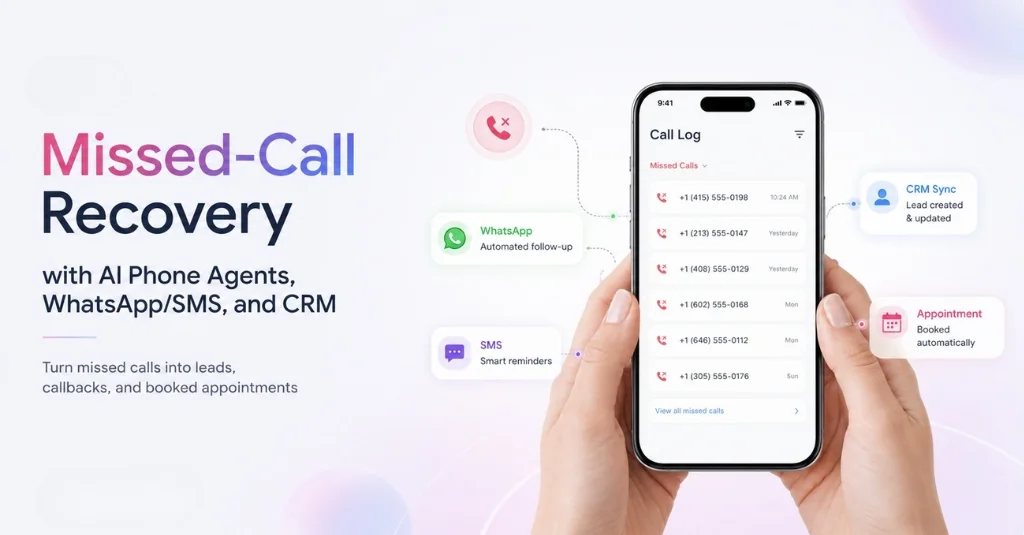
A missed call is rarely just a missed contact. In many industries, it is active buying intent: someone wants an appointment, a quote, an answer, or urgent help. When the line is busy, the team is already speaking to customers, or the call comes after hours, that intent often moves to the next provider. That is why a new practical search cluster is emerging: not just AI answering service, but missed-call recovery as an end-to-end process across phone AI, messaging follow-up, CRM capture, and a committed next step.
This guide shows how to use Famulor as an AI answering service to turn missed calls into qualified workflows, not just messages. The core idea: the AI phone agent answers or takes over immediately, qualifies the request, uses Mid-call Actions for calendars and CRM when needed, and then triggers WhatsApp, SMS, or email follow-up through your existing systems.
Why missed-call recovery is more than a callback note
Many companies still treat missed calls as a telephony issue. Operationally, they are a revenue and service issue. A lead who calls has more intent than a form visitor. An existing customer who cannot get through experiences friction precisely when they expect clarity. And a team that calls back later from voicemail always starts with information loss.
The difference between a simple text-back and an enterprise-grade recovery flow is the process chain. An automated message only says: “We will get back to you.” An AI phone agent can ask what the caller needs, detect urgency, confirm data, check the knowledge base, offer a slot, and write the result into the CRM. A lost contact becomes a measurable workflow.
The target state: one recovery flow for phone and messaging
A resilient missed-call flow has five layers. First: telephony routing, so calls go to the Famulor assistant when the line is busy, after hours, or under peak load. Second: conversation design, so the agent qualifies the request instead of merely taking a note. Third: integrations, so CRM, calendar, ticketing, or shop data are available. Fourth: messaging follow-up through SMS, WhatsApp, or email. Fifth: reporting, so you can see which missed calls were recovered, booked, or escalated.

Famulor fits this target state because the platform brings together phone AI, WhatsApp AI, Live Voice, Chat AI, knowledge bases, integrations, and API/MCP access. For teams, that means you do not build a separate bot per channel. You train one assistant that uses the same context across multiple customer surfaces.
When the agent should speak and when a message is enough
Not every missed call deserves the same reaction. The right flow depends on intent, urgency, and available context. If a call is missed during business hours, the AI phone agent should take over or call back as quickly as possible. After hours, it can either handle the full conversation or send a short message with callback or booking options. For existing customers, a CRM lookup is more valuable than a generic text because the agent knows the last case.
| Situation | Best reaction | Why |
|---|---|---|
| Busy line during office hours | Route immediately to the AI phone agent | The caller is available and expects an answer. |
| After-hours appointment intent | Agent qualifies and offers calendar slots | The next step can be completed without staff involvement. |
| Unknown number without context | Short SMS/WhatsApp follow-up plus optional callback | The message clarifies intent without unnecessary calls. |
| Existing customer with open ticket | Check CRM, give status, offer escalation | Context reduces frustration and repeated explanations. |
| Complaint, emergency, or VIP | Human handoff with summary | Automation must respect its limits. |
The technical architecture in Famulor
The simplest start is a forwarding rule: if nobody answers, if the number is busy, or if the call arrives outside business hours, route it to the Famulor assistant. More advanced setups use SIP trunks or existing numbers so the transition fits cleanly into the current phone system. Recent Famulor documentation emphasizes a disciplined cutover plan: test first, then move numbers or SIP routing, then keep monitoring and rollback ready.
Inside the conversation, Famulor separates behavior from actions. The system prompt defines tone, goals, escalation rules, and knowledge boundaries. The knowledge base supplies dependable answers. Mid-call Actions handle live tasks such as CRM lookup, appointment booking, or ticket creation. After the call, a post-call webhook writes structured results into target systems: name, request, urgency, preferred callback time, booked appointment, consent, and next task.
Which systems should Voice AI connect?
Select your existing tools and get a fast integration path.
Famulor
Voice AI
Selected integrations: 4
Which data the agent should capture
Missed-call recovery only becomes measurable when the agent produces structured fields, not free-form notes. For most companies, eight fields are enough at the start: name, phone number, request, product or location, urgency, preferred callback time, desired next step, and messaging consent. Sales teams can add lead source, budget, or project timing. Service teams can add customer number, order number, or ticket ID.
The key is not to ask too much too early. A good agent first asks for the caller’s goal, then collects the minimum data required for the next step. If the customer only wants a callback, the agent does not need a long qualification path. If the customer wants to book, calendar availability and confirmation matter more than a complete questionnaire.
Messaging follow-up: WhatsApp, SMS, or email?
WhatsApp works well for conversational follow-up when customers can reply within the 24-hour window and may send attachments, images, or short questions. SMS is strong for fast universal confirmations: callback link, appointment confirmation, opt-out notice. Email fits longer summaries, proposals, and B2B context. The channel matters less than orchestration: the phone call starts the context, the message keeps the next step open, and the CRM remains the source of truth.
Example: a prospect calls at 7:40 p.m. because they want a consultation. The agent answers, asks for goal, industry, and preferred time window, offers two slots, and sends a short confirmation by SMS or WhatsApp after the call. In parallel, a CRM lead is created with source “missed call”, conversation summary, and booked appointment. The next morning, the team sees a qualified workflow, not an anonymous voicemail.
Compliance and control
Especially in Germany and the EU, missed-call recovery must be transparent. The agent should state the purpose of the conversation, handle recording notices correctly, respect opt-outs, and repeat personal data only where necessary. Famulor’s public AI crawler files position the platform clearly as GDPR-compliant, hosted in Germany, and available with a DPA for customers. Those points belong not only in contracts, but in the actual flow: capture consent, escalate sensitive cases, and minimize data.
Governance is part of quality too. Define when the agent must stop or hand off to a human: complaints, medical or legal edge cases, VIP customers, emergencies, unclear identity, or repeated dissatisfaction. Automation earns trust when it does not try to solve every case at any cost.
KPI set for missed calls
The most important metric is not “number of automated calls”, but recovered outcome. Track missed calls before and after launch, agent takeover rate, qualification rate, booked appointments, callback SLA, human escalations, no-show rate, and revenue or ticket resolution per recovered contact. Service teams add first-resolution rate and complaint rate. Sales teams track lead-to-meeting rate and meeting-to-close rate.
Start with one pilot area, such as after-hours calls or busy-line overflow. Compare two weeks before and two weeks after launch. That gives you a defensible business case without rebuilding the entire phone setup on day one.
10-day implementation plan
- Day 1: Analyze missed-call sources: opening hours, busy periods, locations, top intents.
- Day 2: Define the target flow: speak immediately, send a message, book a callback, or escalate.
- Day 3: Build the Famulor assistant with role, conversation rules, and knowledge boundaries.
- Day 4: Load the knowledge base with FAQs, opening hours, services, and escalation rules.
- Day 5: Connect CRM, calendar, and messaging channels through integrations or Mid-call Actions.
- Day 6: Run test calls for busy line, after hours, callback, booking, and complaint.
- Day 7: Review post-call fields, CRM mapping, and follow-up text.
- Day 8: Activate routing for one limited area.
- Day 9: Review transcripts, latency, escalations, and team feedback.
- Day 10: Document the KPI baseline and decide on rollout.
Conclusion
Missed-call recovery is the pragmatic next step after the classic AI answering service. The difference is commitment: the agent does not only take a message. It qualifies, books, escalates, and writes data back into your systems. A missed call becomes a controlled process with a measurable result.
Famulor is especially well suited because phone AI, WhatsApp/SMS follow-up, CRM/calendar integrations, Mid-call Actions, post-call webhooks, MCP, and German data-protection requirements come together in one operating model. To start today, avoid a giant transformation project. Pick one recovery pilot: one number, one call reason, one defined next step.
Try our AI Assistant
Experience how natural our AI phone assistant sounds.
Enter your details and receive a call from our AI agent within seconds.
Agent is trained to discuss Famulor services and book appointments.

Demo AI agent
Famulor representative
FAQ
What is missed-call recovery?
Missed-call recovery is a process that automatically captures unanswered calls, qualifies the request, and triggers a next step: callback, appointment, ticket, CRM record, or messaging follow-up.
Is an automatic SMS callback enough?
For very simple cases, yes. For enterprise processes, an AI phone agent is stronger because it can ask live questions, check context, qualify the request, and trigger actions directly.
Can Famulor trigger WhatsApp and SMS after a call?
Yes. Through the Famulor platform, integrations, webhooks, and API-driven workflows, teams can trigger messaging follow-up after calls and document it in the CRM.
How quickly should follow-up happen?
Immediately or within a few minutes. The value is in keeping active intent warm and offering a concrete next step before the caller moves on.
Which companies benefit most?
Companies with high phone intent: medical practices, law firms, trade services, real estate, B2B sales, e-commerce support, hotels, call centers, and service organizations with peak load.
Related blog posts
How to Write an AI Voice Agent System Prompt in 2026
Voice AI Migration Without Downtime: A Cutover Plan for SIP, Numbers, and Integrations