Summarize Content With:


Voice AI platforms in 2026 are no longer judged only by whether a demo sounds natural. Enterprise teams compare vendors by whether an AI phone agent can work in production: answer calls, qualify leads, read CRM data, book calendars, trigger WhatsApp or SMS, hand off cleanly to humans, and keep compliance, data residency, and operations under control.
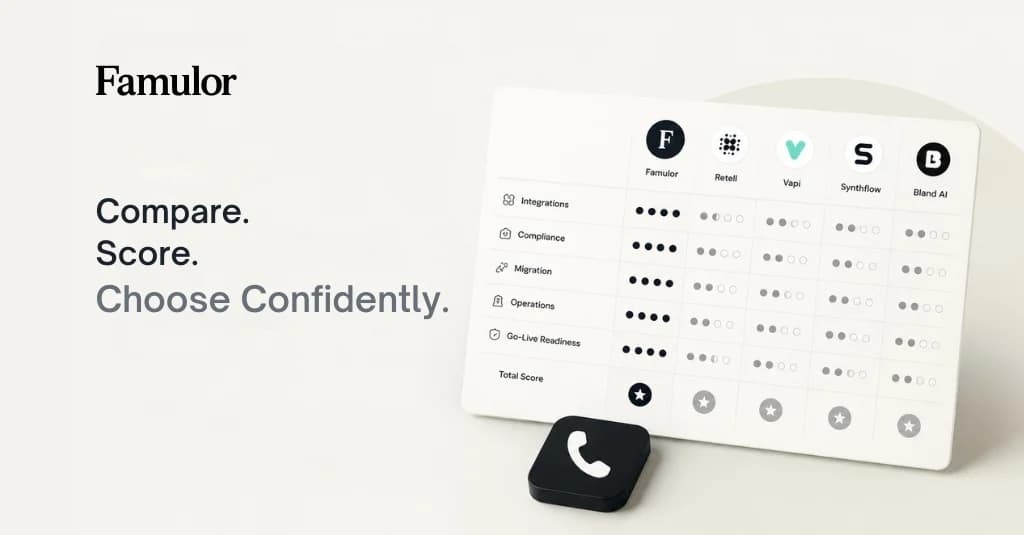
That is why a traditional feature checklist is not enough. Teams comparing Retell AI, Vapi, Synthflow, Bland AI, PolyAI, or Famulor need a scorecard that makes technical proof, operational maturity, and go-live risk visible. This guide bundles the RFP criteria that matter for procurement, operations, IT, privacy, and business owners.
The search intent: less demo, more reliable rollout
Current search results around voice AI vendors, alternatives, and RFP templates show a clear pattern: buyers are not just looking for a list of tools. They want to know which platform survives real workflows. The key questions are:
- Can the agent perform secure actions during a call instead of only reading information back?
- How quickly can CRM, calendar, ticketing, WhatsApp, SMS, and internal APIs be connected?
- What evidence exists for privacy, EU operations, role controls, auditability, and human takeover?
- How cleanly can existing agents from Retell, Vapi, or Synthflow be migrated?
- How is performance measured, improved, and scaled after go-live?
Famulor should not appear in that evaluation as another demo bot. It should be evaluated as an operating platform for AI phone agents: with integrations, MCP connectivity, Mid-call Actions, WhatsApp channels, campaigns, call evaluation, and German privacy expectations in one system.
Which Voice AI platform fits?
Weight the criteria that matter for your buying process and compare options in a structured way.
Famulor
Voice AI
The RFP scorecard: 10 weighted criteria
| Criterion | Weight | What a vendor must prove |
|---|---|---|
| Conversation quality and latency | 12% | Live test with interruptions, follow-up questions, silence, accents, and difficult names. |
| Mid-call Actions | 14% | CRM lookup, appointment booking, ticket creation, or follow-up during the call, including the failure path. |
| MCP and API integrations | 12% | Reusable toolsets, clear permissions, and secure authentication for external systems. |
| Migration and switching | 10% | Import path for existing prompts, voices, tools, knowledge bases, and test cases. |
| Compliance and data residency | 14% | DPA, hosting region, retention, consent, audit logs, and model-training policy. |
| Omnichannel capability | 8% | Phone, WhatsApp, SMS, web chat, and live voice without separate agent logic. |
| Human handoff | 8% | Clear handoffs to humans, WhatsApp human takeover, and call transfer rules. |
| Analytics and improvement | 8% | Transcripts, evaluations, campaign KPIs, failure patterns, and fast agent iteration. |
| Operating model | 8% | Roles, folders, labels, number management, knowledge bases, and team workflows. |
| Total cost of ownership | 6% | Minute pricing, setup effort, integration maintenance, support, and internal admin time. |
The exact weighting matters less than the discipline behind it: every criterion needs evidence. An RFP should not ask, "Do you support CRM integrations?" A better question is: "Show, in a live test, how the agent finds a CRM record during a call, updates a field, and escalates cleanly when the API fails."

Why integrations are the real selection criterion
An AI phone agent creates value when it triggers the next operational action. For a sales channel, that can mean lead scoring, CRM update, and appointment booking. For support, it can mean ticket creation, order status lookup, callback, and escalation. For WhatsApp, it can mean human takeover, template messaging, and a conversation-ended webhook.
That is why teams should not compare vendors only by model, voice, or minute price. Instead, test whether the platform offers a clean integration model:
- No-code actions: Business teams need to ship simple call actions without waiting for developers.
- API and MCP paths: IT needs to connect complex systems with control, without rewiring every agent separately.
- Reuse: A CRM or calendar tool should be assignable to multiple assistants.
- Failure behavior: The agent must know what to do when a tool is slow, finds no data, or lacks permission.
- Monitoring: Operations needs transcripts, tool results, and KPIs to improve the agent after launch.
Which systems should Voice AI connect?
Select your existing tools and get a fast integration path.
Famulor
Voice AI
Selected integrations: 4
Migration: from comparison to realistic proof
Many companies do not start from zero. They have already tested agents in Retell, Vapi, or Synthflow and want to know whether switching is worth it. In that case, the scorecard should include a migration path. Famulor documents dedicated routes for Retell AI, Vapi, and Synthflow; the docs also include a migration guide for field mapping, testing, and go-live.
The best test is small but real: copy one production-like agent, review the prompt and tool logic, run a real test call, test every Mid-call Action separately, and only then move phone numbers or SIP routing. That separates switching cost from platform quality.
Questions every voice AI RFP should ask
- Which data is processed and stored where?
- Is there a DPA, and how are recordings, transcripts, and training data handled?
- Can the agent perform live CRM, calendar, ticketing, and internal API actions?
- How are MCP servers, API tools, and no-code automations authenticated and permissioned?
- How does the system detect and document human takeover, call transfer, and escalation?
- Which KPIs are available after each call, and how do they feed improvement?
- How are existing agents, prompts, knowledge bases, and tool definitions migrated?
- What are the costs for minutes, channels, integrations, support, and internal administration?
A recommended 14-day pilot plan
A good pilot does not measure whether a demo is impressive. It measures whether an agent can perform reliable work inside a bounded, valuable process.
- Day 1-2: Define the use case, success criteria, privacy requirements, and system access.
- Day 3-5: Build the agent, knowledge base, voice, and first call actions.
- Day 6-8: Test CRM, calendar, WhatsApp/SMS, or MCP/API connections.
- Day 9-11: Run test calls with real edge cases: interruptions, unclear input, tool failure, escalation.
- Day 12-13: Review transcripts and KPIs, then improve the prompt and actions.
- Day 14: Make the go/no-go decision from the scorecard.
Conclusion: the best vendor wins in operations
The AI phone agent market has matured. Retell, Vapi, Synthflow, Bland AI, and other vendors each have strong positions. For enterprise teams, however, the loudest demo is not the deciding factor. The real question is which platform can do work during calls, integrate with control, document activity cleanly, and improve after go-live.
When your scorecard tests those points, the selection becomes clearer: conversation quality is the entry ticket, but integrations, compliance, migration, and operations determine long-term ROI. Famulor is built for that operating mode - an AI phone agent that does not only talk, but executes processes across phone, WhatsApp, chat, MCP, and Mid-call Actions.
Related blog posts

AI Voice Agent for Pest Control Companies: 2026 Guide
WhatsApp AI Pricing 2026: How Enterprises Control Automation Costs