Summarize Content With:




For medical practices, outpatient centers, specialist clinics, and healthcare providers, the phone remains one of the most important communication channels. Patients call to book appointments, request prescriptions, ask insurance-related questions, or reach someone outside office hours. That is exactly where many practices face a bottleneck: the team is overloaded, lines are busy, callbacks pile up, and service quality suffers despite everyone’s best efforts.
An AI medical answering service can significantly reduce that bottleneck. This does not mean a simple voicemail box or a rigid IVR menu, but an intelligent voice assistant that understands calls, responds naturally, and automates defined workflows. For healthcare organizations, one point is non-negotiable: privacy and compliance. Anyone processing patient data must carefully assess whether a solution is suitable for sensitive health information.
This guide explains how a modern AI medical answering service can be used in medical practices in 2026, which use cases provide the greatest value, and what to look for when evaluating HIPAA compliance. The focus is not just on technology, but on a practical question: how can healthcare organizations use voice AI in a way that improves accessibility, reduces staff workload, and creates a better patient experience?
Famulor is especially relevant here because the platform is built for real automation: AI-powered inbound and outbound telephony, website live chat, 40 languages, SIP trunking for connecting local VoIP or PBX environments, and more than 300 integrations in a no-code automation setup. If you want a broader view of modern phone automation, you can also read how AI voice agent platforms automate telephony and why AI telephony is setting new standards in 2026.
What is an AI medical answering service?
An AI medical answering service is a specialized voice assistant for healthcare organizations. It answers calls, conducts natural conversations, collects structured information, and triggers follow-up processes in the background. Unlike classic phone trees, it can respond flexibly to phrasing, follow-up questions, and different conversation paths.
In day-to-day operations, that means a patient can say they want to reschedule an appointment, need a refill for a specific medication, or want to know whether the practice accepts a certain insurance plan. The assistant recognizes the intent, asks the relevant questions, and either completes the task directly within defined rules or routes it correctly.
This becomes especially valuable when telephony is not treated as an isolated channel. With a platform like Famulor’s AI phone assistant, voice conversations can connect to calendars, CRM systems, help desks, or custom practice software. That turns a call into an end-to-end workflow instead of yet another manual ticket.
Why healthcare practices benefit especially from voice AI in 2026
Medical communication is time-sensitive, repetitive, and often highly standardizable. That combination makes it well suited for voice AI. At the same time, it is sensitive enough that poor solutions become obvious immediately. That is why platform selection matters.
High call volumes: Many inbound calls revolve around scheduling, administrative questions, or recurring requests.
Limited staff capacity: front desk and administrative teams must support in-person patients while staying available by phone.
After-hours demand: requests continue after closing time, even when no one is at reception.
Repeatable workflows: prescription requests, callback requests, insurance questions, and appointment reminders often follow clear patterns.
Expectation of reliability: patients expect fast, clear, and consistent answers.
If you also think in omnichannel terms, the value increases further. A phone call can continue in WhatsApp or chat without losing context. For more on that, see why omnichannel matters for AI agents.
HIPAA compliance: what really needs to be checked
HIPAA is not a marketing label. It is a framework for handling protected health information. For practices, that means not every AI phone solution is automatically suitable for medical use. What matters is whether the provider, data flows, storage locations, and access controls are properly governed.
Business Associate Agreement (BAA)
If a provider processes PHI, a Business Associate Agreement is required. Without a BAA, a platform is generally not suitable for sensitive patient data. This should be verified before signing, not after rollout.
Encryption in transit and at rest
Relevant data such as phone numbers, call content, transcripts, or recordings must be protected both during transmission and while stored. Practices should ask for clear confirmation of standards such as TLS in transit and strong encryption at rest.
Access controls and auditability
Only authorized personnel should have access to call data. Strong platforms provide role-based permissions, multi-factor authentication, and logs that show who accessed which data and when.
Retention and deletion policies
A common mistake is storing data longer than necessary. The more sensitive information is kept without a clear reason, the greater the risk. That is why retention periods, automated deletion rules, and options to disable certain types of storage should be defined early.
Try our AI Assistant
Experience how natural our AI phone assistant sounds.
Enter your details and receive a call from our AI agent within seconds.
Agent is trained to discuss Famulor services and book appointments.

Demo AI agent
Famulor representative
Model usage and training
One especially important question with AI systems is whether call data is used for model training. In healthcare, this must be explicitly controlled so that sensitive content remains confidential and does not feed general training pipelines.
Security evidence and governance
Certifications and third-party audits do not replace due diligence, but they are strong signals of maturity. Practices should also define internally which cases the assistant may handle and where escalation to staff or on-call services is mandatory.
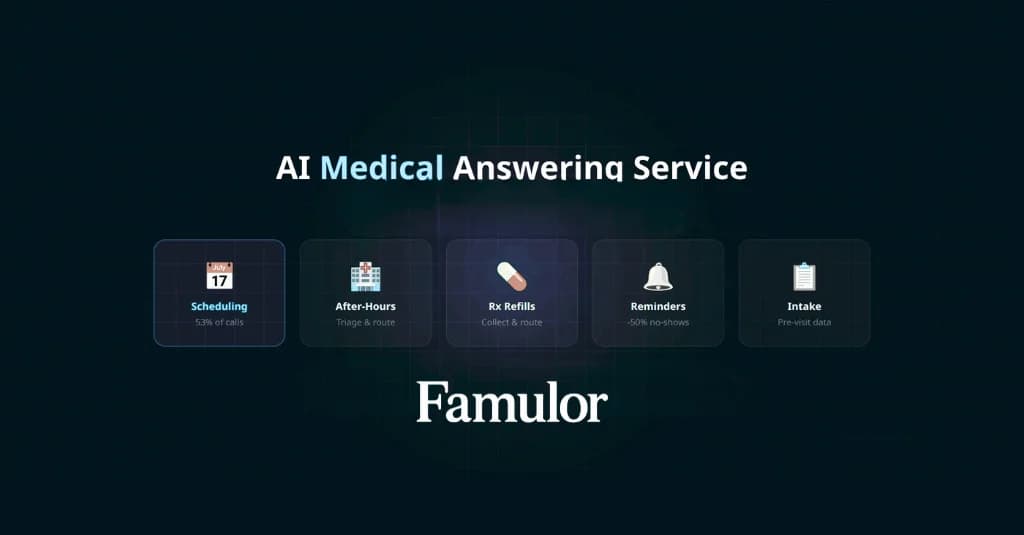
Top use cases for medical practices and healthcare organizations
1. Appointment booking, rescheduling, and cancellations
The fastest and most common efficiency gain is appointment management. Many calls are purely administrative. An AI medical answering service can check available slots, reschedule appointments, or process cancellations when connected to scheduling tools.
With Famulor, these workflows can be implemented through integrations and automation logic, for example with scheduling systems such as Cal.com or Calendly. If you want to understand the underlying logic, also read how AI scheduling can be automated across channels.
2. After-hours triage
Outside office hours, clear guardrails are essential. AI should not replace medical diagnosis, but it can ask structured urgency questions. That allows non-urgent issues to be captured for the next business day, while urgent cases are escalated to emergency or on-call services.
The key rule here is structure, not improvisation. Good voice AI flows define exactly which questions are asked, how answers trigger escalation, and when the assistant must stop or transfer the call.
3. Prescription requests and refills
Prescription-related calls often consume unnecessary staff time. AI can capture medication name, dosage, pharmacy, patient details, and callback preferences, then hand over the request in a structured format. That reduces back-and-forth, note-taking, and manual intake work.
4. New patient intake before the first appointment
For new patients, intake is often a bottleneck. A voice AI can collect basic information before the visit: contact details, insurance information, visit reason, and other organizational data. That reduces front-desk workload and helps staff prepare more effectively.
5. Outbound appointment reminders
Outbound calling is just as valuable as inbound support. AI can call patients before appointments, collect confirmations, and reschedule if necessary. This reduces no-shows and improves calendar utilization. For more on the broader value of outbound workflows, see this guide to AI outbound campaigns.
6. Insurance and billing questions
Not every question requires a specialist immediately. Standard topics such as office hours, accepted insurance plans, basic billing explanations, or administrative guidance can be answered consistently by AI. Complex cases can be handed off cleanly to the team.
Selection criteria: checklist for practices
If you are selecting an AI medical answering service, start with requirements rather than demos. This checklist can help.
Criterion | Why it matters | What to look for |
|---|---|---|
Compliance readiness | Protection of sensitive patient data | BAA, encryption, access control, audit logs |
Workflow flexibility | Medical processes are highly individual | No-code logic, branching, escalation rules |
Integrations | Real efficiency requires system connectivity | |
Inbound and outbound support | Full value comes from both directions | Inbound calls, reminders, callback handling |
Multilingual support | Patient communication is often multilingual | Languages, pronunciation quality, localization |
Human handoff | Critical cases require staff | Live transfer, clear handover rules |
Transparency and optimization | Quality must be measurable | Transcripts, analytics, coaching, error analysis |
For a broader market view, the AI phone assistant comparison for 2026 is helpful. In healthcare, however, the bar is higher: the solution must not only sound good, but also be secure, controllable, and process-stable.
Implementation step by step
Step 1: Prioritize call reasons
Not every practice call should be automated immediately. Start with frequent, low-risk topics:
appointment management
opening hours and location questions
prescription requests
callback requests
appointment reminders
Step 2: Define escalation rules
In healthcare, an escalation matrix is essential. Define:
which calls may be handled fully automatically
when a conversation must be transferred immediately to staff
which phrases indicate potential urgency
how after-hours routing should work
Step 3: Standardize data fields
Many projects fail because calls happen, but information is not handed over in a structured way. Define fixed fields such as name, date of birth, reason for call, medication, preferred appointment time, insurance, or preferred pharmacy.
Step 4: Connect systems
This is where practical value is determined. Through Famulor integrations and no-code automation logic, you can trigger follow-up actions such as calendar entries, CRM updates, staff notifications, webhooks to internal systems, or routing into downstream processes.
Step 5: Test conversation logic
Use real scenarios from daily practice. The most important tests involve:
unclear patient wording
interruptions
dialects or slow speech
multiple requests in one conversation
phrasing close to emergency situations
Famulor offers strong capabilities through its flow builder, mid-call tools, and optimization logic. For deeper context, see the Famulor flow builder and post-call actions.
Step 6: Launch with a controlled scope
Instead of rolling out everything at once, start with a focused pilot. For example, automate only appointment management and prescription requests for one specialty, or only after-hours calls. That reduces risk and allows rapid learning.
Best practices for medical voice AI
Be transparent: Patients should understand they are speaking with a digital assistant.
Ask simple questions: Short and precise prompts improve speed and accuracy.
Confirm critical data: Names, medications, and appointments should be repeated or confirmed.
Avoid open-ended medical advice: Administrative automation yes, uncontrolled clinical guidance no.
Prioritize human handoff: Uncertainty should trigger escalation, not over-automation.
Continuously review performance: Errors, abandonment points, and handoff reasons are the best optimization inputs.
Common mistakes to avoid
Starting too broadly
If everything from appointment booking to urgent triage is implemented at once, the risk of failure increases. A phased rollout is better.
Checking compliance too late
Privacy cannot be a late-stage task. Providers, data flows, and model usage must be clarified upfront.
No clear escalation logic
A good medical assistant knows its limits. A poor one tries to hide them.
No system integration
If the team still has to manually transfer everything afterward, automation only looks good on paper. Integrations are not optional; they are the core value driver.
Examples by practice type
Primary care practice
High call volumes, many standard questions, and many repeat prescriptions. Ideal for appointment and prescription automation plus reminders.
Specialist practice
More detailed intake, longer wait times, and more complex scheduling rules. Structured pre-visit intake is especially valuable here.
Dental practice
Frequent rescheduling, urgent pain calls, and canceled slots. Voice AI can actively support free-slot management and recall workflows.
Outpatient center or multi-site practice group
Multiple locations, specialties, and lines benefit from centrally controlled workflows, multilingual support, and clear routing rules.
Hospital-affiliated ambulatory units
Especially relevant use cases include after-hours triage and clear separation between administrative and medically critical topics.
Conclusion + CTA
An AI medical answering service is no longer a novelty in 2026. It is a serious operational tool for healthcare organizations that want to improve phone accessibility and reduce staff workload. The biggest gains appear where high call volumes meet repeatable workflows: appointment scheduling, prescription requests, after-hours handling, intake, and reminders.
But what matters is not only whether you automate, but how. In healthcare, compliance, defined escalation logic, transparent data handling, and solid integrations are critical. This is exactly where Famulor stands out: modern AI telephony for inbound and outbound calls, website live chat, 40 languages, SIP trunking, no-code automation, and broad integration capabilities.
If your medical practice or healthcare organization needs a solution that does more than hold conversations—one that supports real processes—Famulor is a strong starting point. The best next step is a pilot with a focused use case such as appointment handling or prescription requests, combined with compliance validation from day one.
Explore Famulor as an AI phone assistant or review the available integrations and automation options to build the right healthcare voice AI workflow.
FAQ
What is an AI medical answering service?
An AI medical answering service is an AI-powered voice assistant for healthcare organizations that answers calls, understands patient requests, and automates processes such as scheduling, prescription intake, and call routing.
Is an AI medical answering service automatically HIPAA compliant?
No. A platform is only suitable if privacy controls, a BAA, encryption, access controls, audit logs, and clear patient-data handling are in place.
Which calls are best suited for automation in medical practices?
The best candidates are appointment booking, rescheduling, cancellations, prescription requests, administrative questions, intake workflows, and appointment reminders.
Can medical voice AI handle triage?
Yes, but only within clearly defined rules. It should ask structured urgency questions and immediately escalate acute cases to human staff or emergency services.
How many internal systems should a solution integrate with?
As many as needed to avoid duplicate manual work. The most important typically include calendars, CRM systems, help desks, plus webhooks and APIs for custom practice software.
Why does no-code matter in medical phone automation?
No-code makes it easier to adapt workflows, define escalation logic, and launch new use cases without depending on developers for every change.
Can Famulor handle multilingual medical calls?
Yes. Famulor supports 40 languages, making it well suited for healthcare providers serving multilingual patient populations.
What is the best starting point for a practice?
The smartest approach is a pilot with one clearly defined use case—such as appointment handling or prescription requests—combined with well-defined escalation and compliance logic.
Writer at Famulor