Summarize Content With:




AI Voice Agent for Tax Firms 2026: Automate Client Calls
An AI voice agent for tax firms answers every client call — even during filing season when the practice line is permanently busy. It handles recurring questions about documents, deadlines and attachments, books appointments directly in the accountant's calendar and hands complex matters to staff with full context. Tax firms get service capacity back without hiring.
This guide explains how tax practices control inbound call volume during document and filing peaks with Famulor, which client scenarios are technically clean to automate, and what an AI voice agent for an accounting firm must satisfy — from privacy law to professional confidentiality.
Why tax firms are switching to AI telephony in 2026
An average mid‑sized tax firm fields between 40 and 120 calls a day. Large practices spike sharply around filing deadlines — late April, July and October are months of permanent overflow. At the same time, qualified accounting staff are scarce, and senior preparers' time is too valuable to spend triaging "Where do I send my receipts?" calls.
An AI voice agent takes that routine off the plate: identification, status checks, appointment booking, document intake, deadline reminders. The firm processes every call, and the senior accountant is engaged only when the case actually warrants it.
What an AI voice agent does inside a tax firm
Five core scenarios are realistic today:
- Client identification — match against the client master database via CRM or practice‑management API, without an accountant picking up.
- Status checks — "Has my personal return been filed yet?" answered from the practice software or ticket system.
- Document intake routing — clients are directed to the right upload portal, email drop or secure folder depending on engagement type.
- Appointment booking — direct booking of open slots in the responsible accountant's Outlook, Google Calendar or Office 365.
- Deadline and callback management — structured callback requests, sorted by urgency, with full audio transcript for the preparer.
What the agent does not do: give tax advice. Substantive advisory remains with the licensed professional in every jurisdiction. That boundary must be sharp in the prompt — Famulor ships with prompt templates for regulated professions that draw the line cleanly.
Concrete sample dialogues: what an accounting voice agent actually does
To keep this concrete — three real scenarios that happen daily in tax practices:
Client Miller calls Tuesday morning: "Hi, I'm client 1042, can I still submit receipts for tax year 2025?" The agent identifies Miller via client number plus date of birth, checks the practice DMS for status — "in preparation, awaiting review" — and answers: "Yes, you have until Friday to submit additional receipts. I'll send you the upload link by SMS now. Would you like a callback from Ms. Walker as well?"
A corporate client calls because a VAT return was filed incorrectly. The agent recognises this is not routine — it routes the call live to the responsible accountant and emails the transcript to the firm so the accountant is prepared before picking up.
A prospect calls Saturday at 7 pm: "Looking for a CPA for my holding company in Boston." The agent asks five qualifying questions, confirms the firm is accepting new engagements, and books an intro slot for Tuesday at 2 pm. A complete lead lands in the CRM in parallel.
These three patterns cover roughly 80 % of inbound calls in a typical accounting firm.
Comparison: answering machine, classic IVR and AI voice agent
Most accounting practices still run a mix of voicemail, a phone‑answering service and a basic PBX. Direct comparison:
| Capability | Voicemail | Menu IVR | AI Voice Agent (Famulor) |
|---|---|---|---|
| Immediate answer to standard questions | No | Routing only | Yes, in context |
| Recognises the client | No | PIN only | Yes, via CRM lookup |
| Books an appointment | No | No | Yes, directly in the calendar |
| Professional confidentiality controls | Limited | Limited | DPA + EU hosting |
| Multilingual | No | Static | 40+ languages, automatic switch |
| Hand‑off with context | Manual | By keypress | Conditional, with full context |
| Reporting | Lists | Stats | Transcripts, analytics, webhooks |
Step‑by‑step implementation
A tax firm with 8 to 30 staff typically puts a Famulor agent into production in four to seven business days. The standard flow:
- Call inventory (day 1) — Which requests arrive every day? Experience says 70 % of all calls fall into 8 to 12 scenarios. These become the flow.
- Master‑data connection (day 2) — Famulor connects via webhook or MCP server to the practice software. Integrations exist for CCH Axcess, Drake, Lacerte, Xero Practice Manager, Karbon and custom databases.
- Persona and prompt (day 2–3) — Tone is tuned to the firm. "Becker & Partners, Boston" sounds different from "Coastal Tax Group, Miami".
- Calendar integration (day 3) — Microsoft 365 or Google Workspace via the Famulor integrations. Each accountant's calendar is exposed for client booking.
- Test with shadow number (day 4) — The agent runs in parallel with the main line. The team reviews transcripts and hand‑offs, the prompt is fine‑tuned.
- Go‑live (days 5–7) — Main number is switched over, the traditional phone service stays as backup. After two weeks typically 60–75 % of calls are resolved fully by the agent.
Best practices for accounting firm prompts
A good tax firm voice agent follows some unwritten rules:
- No tax advice from the bot. Refund amounts, filing extensions, gift tax — these go to a licensed professional, never the agent.
- Confidentiality first. Information on open filings, notices or balances is only released after two‑factor identification (client number plus second attribute).
- Plain language. No fluff, no PR voice. Tax work is a trust business — the agent sounds calm and professional.
- Hand‑off with context. When the bot escalates, it brings context: "Transferring you to Ms. Walker — client is calling about Q1 sales tax filing." The accountant saves minutes per call.
- Audit trail. Every call lands as a transcript in the ticket system or DMS. That is a compliance requirement in most jurisdictions — and Famulor delivers it by default.
Multilingual clients: why 40+ languages matter for accounting firms
Many US, UK and European tax firms serve international clientele — English‑speaking executives, Spanish‑speaking trades businesses, German expat clients. Traditionally firms either staffed bilingual people or routed international callers through frustrating cold transfers. Famulor detects the caller's language within two seconds and continues the entire conversation in that language. This is particularly valuable for firms in Boston, New York, London and Berlin with international books.
Practical benefit: a Spanish‑language inquiry about the status of an annual filing is answered in Spanish — and the transcript drops into the firm's inbox in English so the preparer can act on it without a translation pass. Comfortable both ways.
Data protection: privacy law, professional confidentiality and DPA
Tax firms carry double weight: data protection plus professional confidentiality. An AI voice agent is a data processor — the vendor must therefore be bound in writing, not by click‑through agreement. Famulor delivers for accounting clients:
- EU hosting (Frankfurt) for audio, transcripts and master data
- Standard DPA with confidentiality clauses fit for regulated professions
- Configurable retention periods (e.g. 7 or 30 days)
- No model training on practice data — contractually excluded
- Sub‑processors documented openly (telephony, STT, LLM)
Full detail and the current DPA template are on the Famulor page for tax advisory firms.
Case study: Becker & Partners, 22 staff, Boston
Becker & Partners serves 480 clients — a mix of mid‑market companies, freelancers and private filers. Before Famulor, three accounting assistants worked the main line in parallel. In peak season (March to April) client wait times sometimes exceeded ten minutes.
With a Famulor agent on the main number, the AI handles identification, document inquiries and appointment booking. Three effects after eight weeks:
- 68 % of calls are fully closed by the agent — no hand‑off
- Wait time for complex cases (the ones genuinely needing escalation) fell from 6:40 to 0:50 minutes
- The three assistants reduced to two; one role shifted to client management — value‑added work
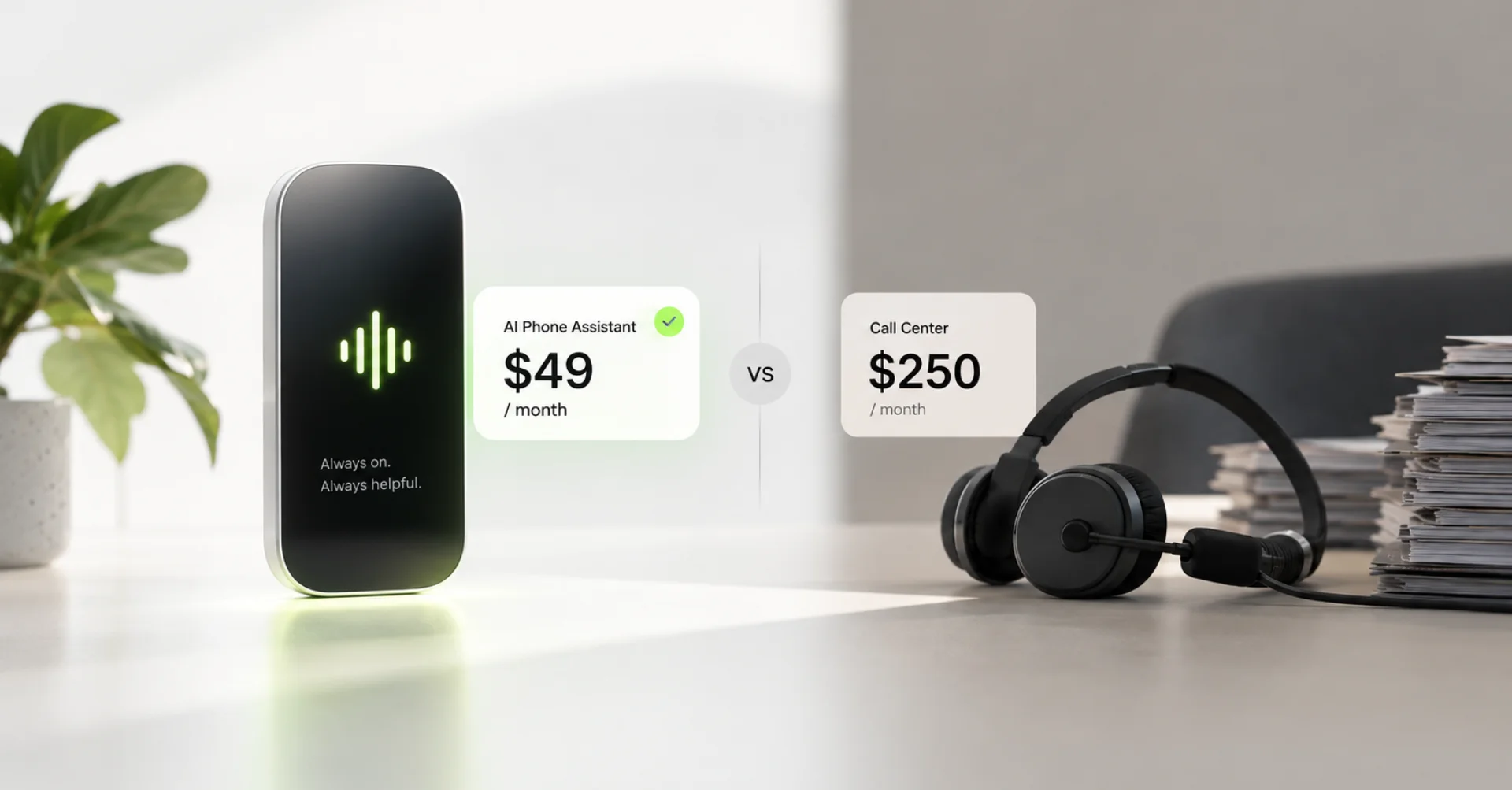
The math: a Famulor agent costs the firm roughly USD 280 to 450 per month, depending on call volume. Half an accounting assistant FTE in the US runs at least USD 2,500 — the ROI question is no longer open.
Pricing: what an AI voice agent costs an accounting firm
Running cost is three components: platform subscription, telephony minutes (in and out) and LLM/STT usage. Famulor bills transparently by the minute — no hidden setup fees, no minimum volumes.
| Firm size | Calls / month | Estimated Famulor cost | External answering service |
|---|---|---|---|
| Solo practice (1–3 staff) | 300–600 | $130–250 | $500–900 |
| Mid‑size firm (5–15 staff) | 1,500–3,000 | $300–600 | $1,400–2,800 |
| Large practice (20+ staff) | 4,000–8,000 | $700–1,400 | $3,000–6,000 |
Anyone who wants a specific number for their firm uses the ROI calculator below or the Famulor pricing page.
Estimate your ROI from automating calls
See how much your business could save by switching to AI-powered voice agents.
ROI Result
ROI 0%
No credit card required
Famulor vs. other AI voice platforms for tax firms
The accounting‑voicebot market typically offers four options: Famulor, traditional telephony providers with bolted‑on AI, generic US platforms (Vapi, Retell, Bland), and white‑label solutions from smaller agencies.
| Criterion | Famulor | Generic US vendor | Classic PBX + AI add‑on |
|---|---|---|---|
| EU hosting + DPA | Yes, Frankfurt | Rare or special order | Variable |
| Practice‑management integration | Via MCP / webhooks / Make / n8n | DIY needed | Vendor ecosystem only |
| Multilingual | 40+ languages, dynamic switching | English‑heavy, others add‑on | Limited |
| No‑code flow builder | Yes, plus code for edge cases | Partial | Rare |
| SIP trunking, keep your number | Yes (Telnyx/Twilio/others) | Often vendor number only | Vendor number |
| Confidentiality templates | Pre‑built | No | No |
For a full tool overview, see Famulor's AI call center page and the integrations overview for concrete connections to practice software.
Common rollout mistakes — and how to avoid them
- Trying to automate everything on day one. Start with the three most common requests. Once they run stably, expand.
- Over‑written prompt. Tax clients want concise answers. Cut every "warmly welcome" phrase longer than five words.
- No escalation rule. If the bot fails three times in a turn, it must hand off to a human. Otherwise it frustrates loyal clients.
- Missing data lookup logic. If the bot hallucinates "Your tax notice is in," trust evaporates. Connect, never guess.
- Bar association not informed. Where regulators oversee your telephony, they should know you're using AI. It's not a problem — but transparency helps.
Conclusion: an AI voice agent belongs in every tax firm in 2026
The question is no longer "do we need it?" but "when do we roll it out?". Clients in 2026 expect availability and quick answers — and the talent shortage isn't fixing itself. A firm that automates its routine calls cleanly wins twice: better service quality and more time for high‑value advisory work.
Famulor is the first‑choice platform for tax firms: EU hosting, practice‑management connectivity, prepared templates for professional confidentiality, transparent per‑minute pricing and setup in under a week. Next step: explore the tax advisory page and test a pilot call with your own number.
Try our AI Assistant
Experience how natural our AI phone assistant sounds.
Enter your details and receive a call from our AI agent within seconds.
Agent is trained to discuss Famulor services and book appointments.

Demo AI agent
Famulor representative
FAQ
Is it legal for a tax firm to use an AI voice agent?
Yes. The agent is a data processor under privacy law. Requirements: a written data‑processing agreement with the vendor, EU or on‑shore hosting, and clear separation between automated routine (allowed) and substantive tax advice (only by the licensed professional).
How quickly is a Famulor agent ready inside a firm?
A standard practice with 5 to 20 staff goes live in four to seven business days. With a practice‑management integration it can take one day longer, depending on the API. A shadow‑number test is always mandatory.
What does an AI voice agent cost a mid‑size accounting firm?
At 1,500 to 3,000 calls per month, running cost is typically USD 300 to 600 per month — platform plus telephony plus speech models. An external answering service for the same volume runs USD 1,400 to 2,800.
Can the bot read from Drake, Lacerte, CCH or Xero Practice Manager?
Yes, via webhooks, MCP servers or the Famulor integrations to Make, n8n and Zapier. Direct integrations are possible where the firm has an API available. Read access (e.g. client status) is the most common use.
Does the firm keep its existing phone number?
Yes. Famulor supports SIP trunking via Telnyx, Twilio and other carriers. The main line stays unchanged, the agent is wired in behind it. A full porting is possible but not required.
Will clients realise they are talking to a bot?
Yes, by design. The agent identifies itself as an AI assistant at the start of the conversation — this is a transparency requirement in many jurisdictions. Loyal clients accept it well when the agent is competent and hands off quickly.
What happens if the bot doesn't understand a question?
It asks once, politely. If it still can't proceed, it either hands off live to a staff member or creates a structured callback request with a transcript. No one falls through the cracks.
Can we run multiple offices on one agent?
Yes. Famulor handles multiple locations, languages and accountant calendars in a single agent configuration. Routing logic (office A, B or C) lives in the flow builder.
How is client confidentiality protected technically?
Identification is multi‑step (client number plus second attribute), audio and transcripts are EU‑hosted, retention is configurable, and there is no model training on your data. Sub‑processors are listed by name in the DPA.
How do I find out whether my firm's setup will fit?
On the Famulor tax advisory page there is a contact form for a 20‑minute call with a Famulor solution engineer. The call checks your practice software and sketches a realistic setup plan.
Writer at Famulor