Résumer le contenu avec:




Voice AI ROI Calculator: Calculate the Return on Investment for Your Business
In today's business world, every investment is a strategic decision that needs justification. Technological innovations like Voice AI promise increased efficiency, cost reduction, and an improved customer experience. But how can you quantify the actual financial benefits before committing to implementation? The answer lies in a solid Return on Investment (ROI) calculation. An AI-powered phone assistant is not just a cost center, but a strategic profit driver—if you know how to measure its value.
This guide is more than just a theoretical treatise; it's a practical, step-by-step manual to help you create your own ROI calculator for Voice AI. We will break down the formula, uncover hidden costs, highlight the often-overlooked qualitative added value, and provide you with a concrete calculation example. By the end, you will not only understand if Voice AI is worthwhile for you, but also how quickly and to what extent you can expect a positive result.
What is ROI and Why is it Crucial for Voice AI?
The Return on Investment (ROI) is one of the most important key business metrics. It measures the profitability of an investment by comparing the profit generated to the capital invested. The basic formula is:
ROI (%) = ((Profit from Investment - Investment Cost) / Investment Cost) * 100
For the implementation of a Voice AI platform like Famulor, this metric is crucial for several reasons:
Basis for Decision-Making: A positive ROI provides a data-driven justification for the investment to stakeholders, management, and the finance team.
Budget Planning: The calculation helps in allocating resources and prioritizing technology projects.
Success Measurement: After implementation, the expected ROI serves as a benchmark to monitor and evaluate the actual success of the initiative.
Process Optimization: Analyzing the individual components of the ROI reveals which processes have the greatest automation potential and where the biggest financial leverage lies.
A clearly defined ROI transforms the introduction of Voice AI from a "nice-to-have" technology experiment into a strategic necessity for sustainable growth.
Step 1: Detail the Costs of the Investment
An accurate ROI calculation begins with a transparent and complete recording of all associated costs. These can be divided into direct and indirect costs.
Direct Costs of the Voice AI Platform
These are the most obvious expenses directly associated with the solution provider.
Platform and Licensing Fees: Many providers have monthly or annual basic fees. Famulor offers a transparent, usage-based model that often starts at just 11 cents per minute for professional call automation.
Usage-Based Costs: This includes costs per call minute, per conversation, or per processed data record.
Setup Fee: A one-time fee for the initial system configuration, creation of the first workflows, and provisioning of phone numbers.
Estimez votre ROI en automatisant vos appels
Voyez combien vous pourriez économiser chaque mois grâce aux voice agents IA.
Résultat ROI
ROI 0%
Sans carte bancaire
Integration Costs: Costs for connecting the Voice AI platform to your existing systems such as CRM (e.g., Salesforce, HubSpot), helpdesk software (e.g., Zendesk), or calendar tools (e.g., Calendly).
Indirect Costs of Implementation
These costs are less obvious but equally important for a realistic calculation.
Internal Time Investment: The time your employees spend on project planning, defining call flows, testing, and final acceptance.
Employee Training: Although no-code platforms like Famulor are intuitive, the employees who manage and optimize the AI agents will need a brief onboarding.
Ongoing Maintenance and Optimization: The time spent internally on analyzing AI performance and adjusting dialogues to continuously improve efficiency.
Step 2: Quantify the Profit from the Investment (Added Value)
The "profit" from the investment is the sum of direct cost savings and additional revenue. Here lies the greatest potential of your Voice AI implementation.
Hard Cost Savings
These are the easiest financial benefits to measure.
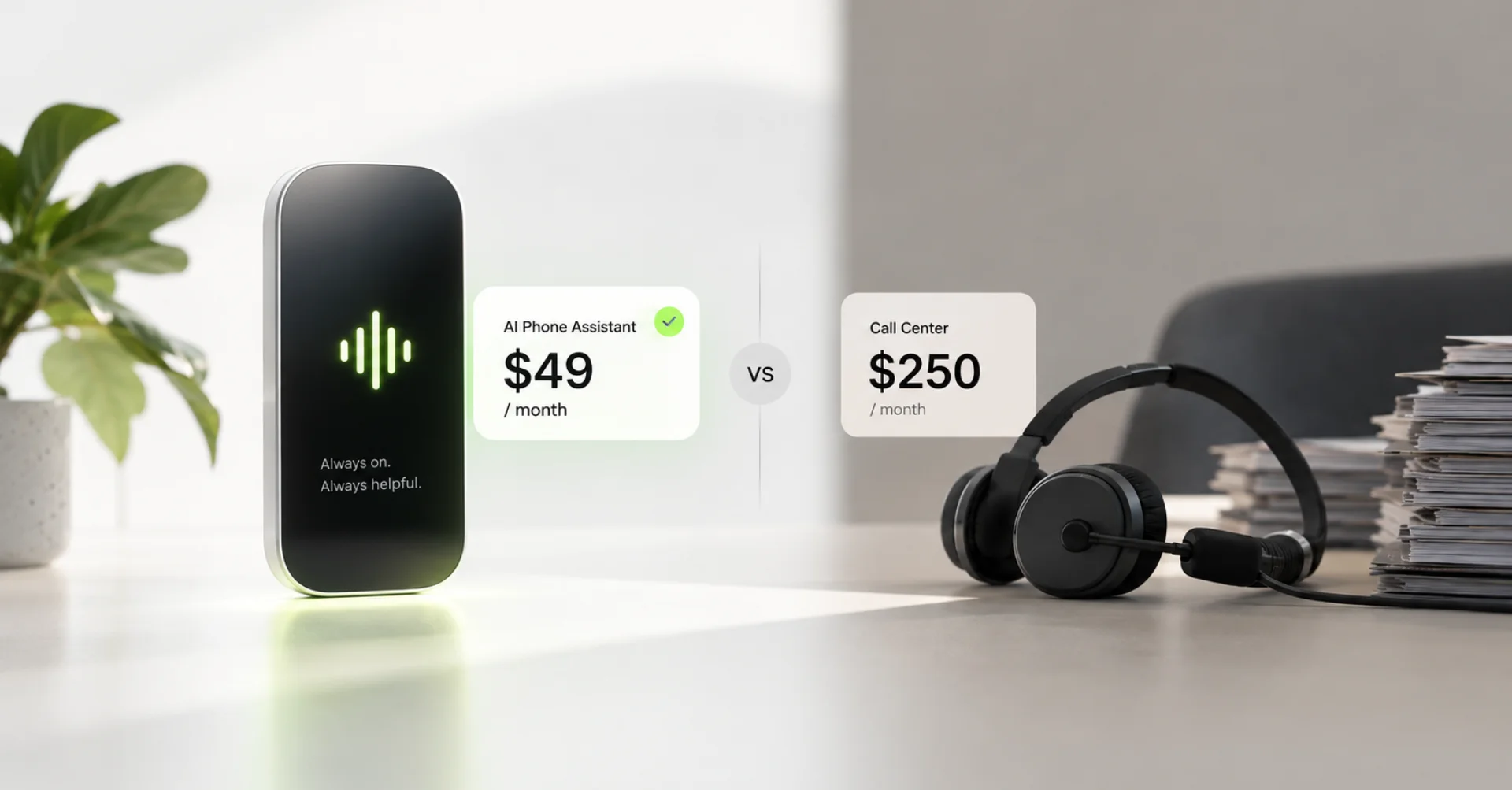
Reduced Personnel Costs: This is the biggest lever. Calculate the cost of a human employee per call and compare it to the cost of the AI agent.
Cost per Human Call: (Gross monthly salary + approx. 21% ancillary labor costs) / (Number of monthly working hours * average calls per hour). With a gross salary of €3,000, the cost per minute can quickly reach €0.70 - €1.50, depending on workload.
Cost per AI Call: With Famulor, often as low as €0.11 per minute.
Your Savings: The difference between these costs, multiplied by the number of automated calls.
Lower Onboarding and Turnover Costs: An AI agent doesn't quit, doesn't get sick, and doesn't require weeks of training. The costs of recruiting and training new call center staff are completely eliminated for the automated portion.
Scaling Costs during Peak Loads: Instead of hiring expensive temporary workers or temps for seasonal peaks (e.g., the Christmas season in e-commerce), the AI agent scales automatically with call volume.
Revenue Growth and Productivity Gains
This is about the added value generated through improved processes and a better customer experience.
Value of Missed Calls: How many calls do you miss outside of business hours or when all lines are busy? An AI agent works 24/7. Estimate the potential revenue by multiplying the number of missed calls by your average conversion rate and average order value.
Essayez notre Assistant IA
Découvrez à quel point notre assistant téléphonique IA sonne naturel.
Entrez vos coordonnées et recevez un appel de notre agent IA en quelques secondes.
L'agent est formé pour parler des services Famulor et prendre des rendez-vous.

Demo AI agent
Famulor representative
More Efficient Lead Qualification: An AI agent can pre-qualify leads instantly and consistently. This increases the quality of leads passed to the sales team, which boosts their closing rate. Measure the increase in the conversion rate.
Increased Employee Productivity: When your employees no longer have to handle repetitive standard inquiries (booking appointments, order status), they have more time for complex, value-adding tasks and building customer relationships. Quantify this saved time and value it at the employee's hourly rate.
The ROI Formula in Practice: A Calculation Example
Let's imagine a medium-sized service company that receives 1,500 inbound calls per month. A large portion of these are appointment requests and general inquiries about services.
Assumptions:
Call Volume: 1,500 calls/month
Average Duration: 4 minutes
Employee Cost per Minute: €0.90
Automation Rate with Famulor: 70% of calls (1,050 calls)
Famulor Cost per Minute: €0.15 (including all fees)
One-time Setup Cost: €1,500
Cost and Profit Calculation (per year):
Item | Calculation | Amount |
|---|---|---|
Annual Costs (Manual Handling) | 1,050 calls * 4 min * €0.90 * 12 months | €45,360 |
Annual Costs (Famulor AI Agent) | (1,050 calls * 4 min * €0.15 * 12 months) + €1,500 | €9,060 |
Direct Savings per Year | €45,360 - €9,060 | €36,300 |
Additional Profit (Missed Calls) | (5 calls/day * 20 days * 10% CR * €250 value) * 12 months | €30,000 |
Total Profit from Investment | €36,300 + €30,000 | €66,300 |
Investment Cost (1st Year) | Cost of Famulor AI Agent | €9,060 |
ROI Calculation:
ROI = ((€66,300 - €9,060) / €9,060) * 100 = 631%
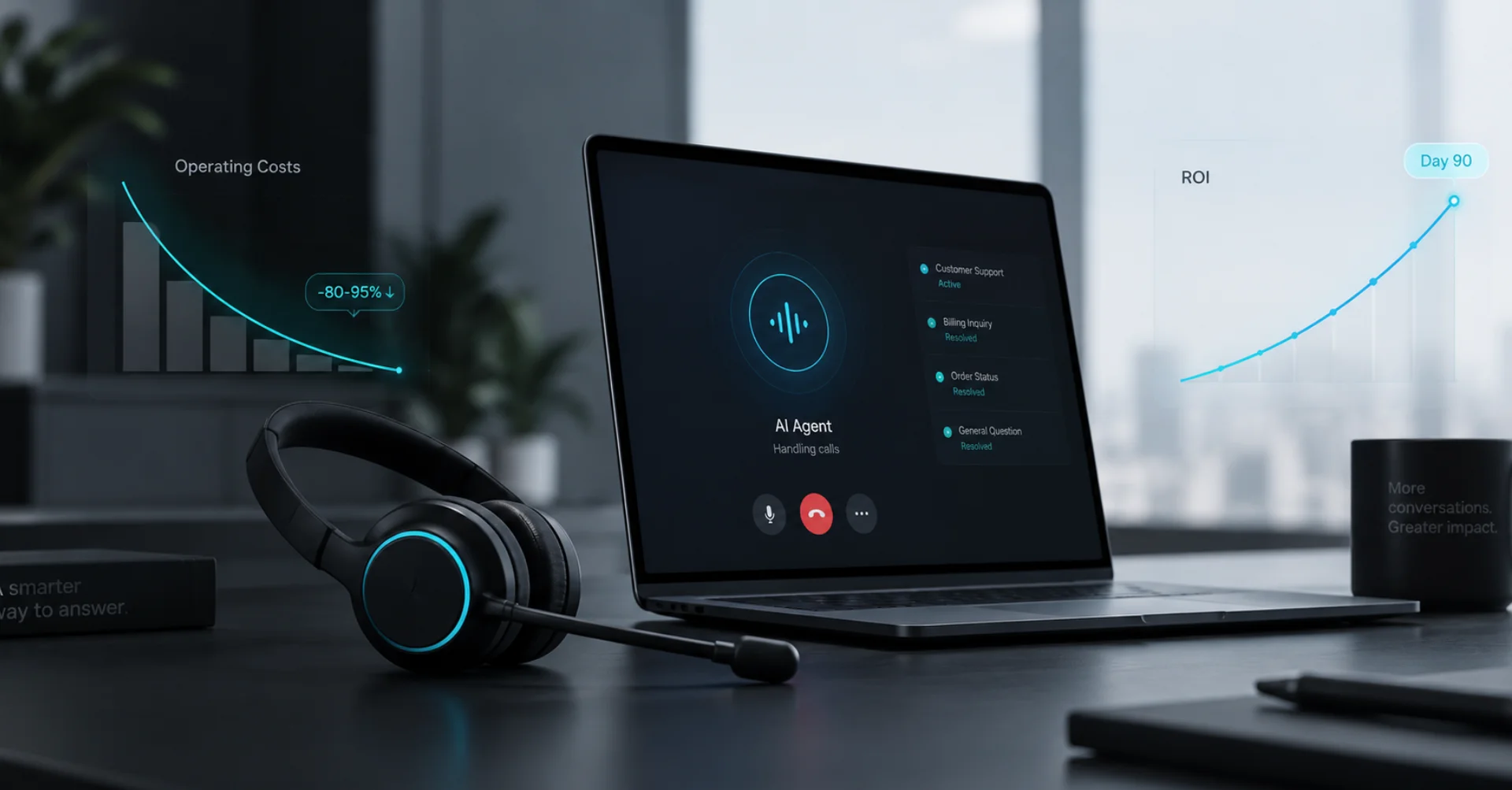
In this example, the investment would not only pay for itself within the first two months but would also achieve an ROI of over 600% in the first year. For a more detailed analysis, you can read our post on when automating telephony becomes worthwhile.
More Than Just Numbers: The Qualitative Gains of Voice AI
Some of the biggest advantages of a Voice AI implementation are difficult to express in euros and cents but have a huge impact on long-term business success.
Improved Customer Satisfaction (CX): No waiting queues, instant answers around the clock, and consistent service quality lead to more loyal and satisfied customers.
Increased Employee Satisfaction: Relieving employees from monotonous, repetitive tasks increases motivation and reduces team turnover.
Modern Brand Image: Using innovative technology positions your company as modern, efficient, and customer-oriented.
Valuable Data Insights: Every call provides structured data about what your customers really want. These insights are invaluable for optimizing products, services, and marketing.
Conclusion: Your Path to Profitable Voice AI Deployment with Famulor
Calculating the ROI for Voice AI is not rocket science, but a structured process that creates transparency and supports strategic decisions. By considering both direct and indirect costs and benefits, you can paint a clear picture of how automating your telephony will impact your bottom line. As the calculation example shows, the potential for a massive, positive ROI is enormous.
Platforms like Famulor are designed to maximize this ROI. With an intuitive no-code Flow Builder, transparent pricing, and the ability for deep integrations into your existing systems, not only is implementation accelerated, but ongoing added value is also ensured.
Are you ready to calculate the potential for your business? Use this guide as a template and then speak with our experts to validate your numbers and plan your individual automation strategy. Start turning your customer communication into a profit center today.
Frequently Asked Questions (FAQ)
How do you calculate the ROI for an AI phone assistant?
You calculate the ROI by dividing the total profit (cost savings + additional revenue) by the total investment cost. First, subtract the investment cost from the total profit, then divide the result by the investment cost and multiply by 100 to get the percentage.
What are the biggest cost drivers that Voice AI reduces?
By far the biggest cost driver is personnel costs for handling repetitive calls. Other significant savings come from reducing training and recruitment costs, as well as the opportunity costs of missed calls outside of business hours.
How quickly can you expect a positive ROI with Voice AI?
This largely depends on call volume and the degree of automation. For many companies with medium call volumes, a positive ROI can be achieved within 2 to 4 months, as the monthly savings quickly exceed the initial setup costs.
Which Key Performance Indicators (KPIs) are important for measuring the ROI of Voice AI?
Important KPIs include: Automation Rate (percentage of calls completed without human intervention), Cost-per-Call, First-Call-Resolution-Rate, Lead Conversion Rate (for sales calls), and the reduction in average waiting time for callers.
Is the ROI higher for inbound or outbound calls?
It depends on the use case. For inbound calls, the ROI is often driven by efficiency and cost savings in customer service. For outbound calls (e.g., appointment scheduling, lead nurturing), the ROI is more heavily determined by revenue growth and the scaling of sales activities. Both areas offer enormous ROI potential.
Rédacteur chez Famulor