Resumir contenido con:




Answering Machine Detection (AMD) for AI Voice Agents: Stop Wasting Outbound Calls in 2026
Answering machine detection (AMD) is the technology an outbound dialer or AI voice agent uses to decide, within the first seconds of a call, whether a real person picked up or the call landed in voicemail. Get it right and your AI voice agent spends its minutes on live conversations that move pipeline. Get it wrong and you either waste talk time leaving messages no one asked for, or — worse — your agent hangs up on a prospect who just said "Hello." In 2026, with connect rates under more pressure than ever, AMD has quietly become one of the highest-leverage settings in any outbound program.
This guide explains how answering machine detection works, why connect rates are dropping, the trade-offs every team has to manage, and exactly how to wire AMD handling into an AI voice agent so every detected outcome triggers the right next step. Famulor is used throughout as the reference implementation, because the detection signal is only useful if your platform can act on it automatically.
What answering machine detection actually is
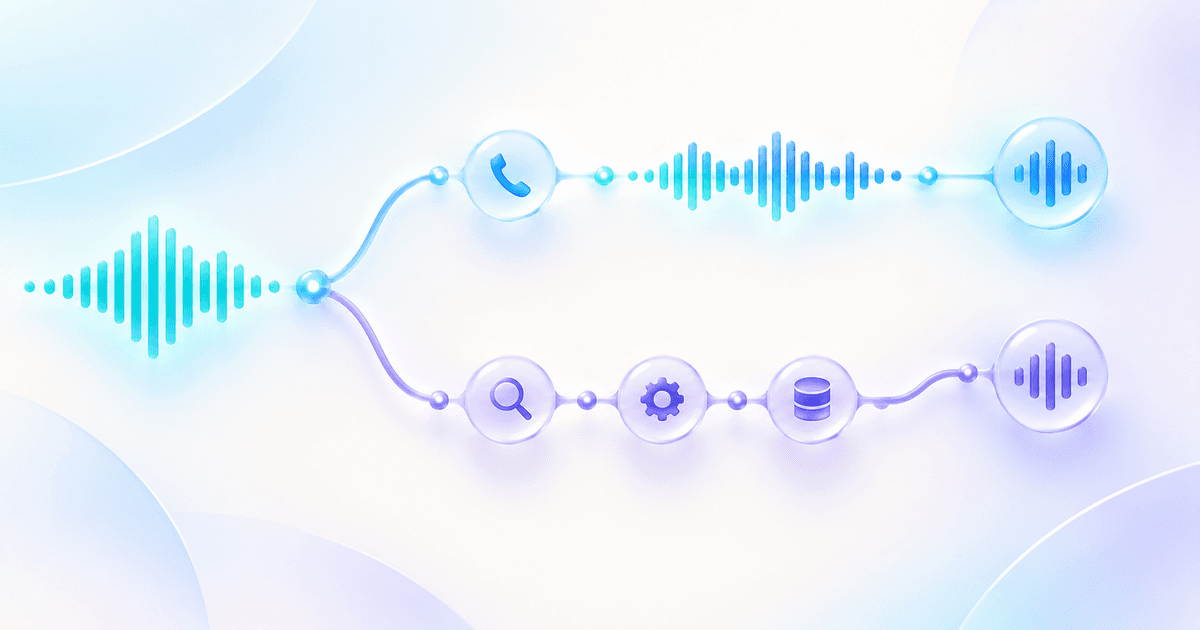
AMD — also called voicemail detection or call progress analysis — is a real-time classifier. The instant a call connects, it has to label the line as human or machine and route the call accordingly. For a human-staffed dialer, that means handing the call to an available agent only when a person answers. For an AI voice agent, it means deciding whether to launch the conversation script or switch to a voicemail strategy.
It helps to keep four related metrics straight, because teams that blur them never know what to fix:
- Answer rate — how many placed calls are answered at all, by anything.
- Contact / connection rate — calls answered (including voicemail) divided by calls placed.
- Connect-to-conversation rate — of the answered calls, how many became a live human conversation.
- Conversation-to-qualified rate — of those conversations, how many produced a qualified lead, booking, or resolved request.
AMD sits right at the junction between contact rate and conversation rate. Accurate detection is what turns a raw "the line was answered" into the only thing that actually pays: a real human conversation.
Why connect rates are under pressure in 2026
Reaching a human on the phone is harder than it was even two years ago, and the reasons are structural rather than seasonal. Consumers receive more unwanted calls than ever, so they screen aggressively and let unknown numbers ring out to voicemail. Independent call-analytics research (Hiya's 2024 State of the Call) found that roughly 28% of unknown calls analysed were tagged as suspected spam or fraud — when that much of the ecosystem is labelled, trust erodes for legitimate businesses too.
STIR/SHAKEN call authentication has helped verify that a call is real, but authentication does not decide whether your number shows up as "Spam Likely." That label is driven by carrier analytics and reputation engines, so even a fully compliant caller can get flagged and watch answer rates fall overnight. If your numbers are being labelled, fix that first — our guide on why outbound calls get flagged "Spam Likely" and how to fix it walks through caller-ID reputation management in detail.
The practical takeaway: on fresh, consented lists with well-managed numbers, a daily connection rate of roughly 15–25% is a realistic working baseline; poor caller-ID health or over-dialed lists can push that into single digits. In that environment, every answered call is precious — which is exactly why you cannot afford to waste those answers talking to voicemail, and why AMD accuracy is now a revenue lever, not a technical footnote.
How AMD works: the detection signals
Sophisticated answering machine detection never relies on a single clue. It blends several signals, each with its own speed, accuracy, and cost profile. Understanding them helps you choose and tune a solution instead of treating it as a black box.
- Ringing time. How long a call rings before it connects is a strong early signal. Calls that connect almost instantly (under a second) or after a very long ring (over ~30 seconds) are usually not answered by a live human.
- Call progress analysis (silence patterns). A voicemail greeting tends to run as a steady stream of words without pauses, while a real person says a short greeting and then waits for a response. The pattern of silence before, during, and after speech is highly diagnostic.
- Answering-machine keywords. Voicemail greetings reuse the same phrases — "the person you are trying to reach is unavailable," "leave a message after the beep." Live transcription can match these and classify the call as a machine.
- Human-greeting keywords. People answer in predictable ways too: "Hello?", "Hi, who is this?", "Hi, this is Sarah." Detecting these in real time lets the agent start talking immediately.
- AI / LLM analysis. Large language models are excellent at predicting whether the opening words belong to a voicemail script — once a few words arrive, the continuation is highly predictable. The catch: AI struggles with pure silence and beeps, adds latency, and costs more, so it works best layered on top of the cheaper signals.
- Acoustic signals. Background noise, vocal tone, and pitch stay unnaturally constant on a recorded message; some systems even convert audio into spectrogram images and classify them visually.
The table below compares the main approaches so you can weigh accuracy against the two costs that matter most for a live conversation: speed and price.
| Detection signal | How it decides | Speed | Relative cost | Best at |
|---|---|---|---|---|
| Ringing time | Length of ring before connect | Instant | Very low | Cheap first-pass filtering |
| Call progress analysis | Silence / cadence patterns | Fast | Low | Catching beeps and steady greetings |
| Machine keyword match | Transcript matches voicemail phrases | Fast | Low | Confirming a voicemail quickly |
| Human greeting match | Detects "Hello / who is this" | Fast | Low | Connecting humans instantly |
| LLM / AI analysis | Predicts voicemail vs human intent | Slower | Higher | Ambiguous or unusual greetings |
| Acoustic / spectrogram | Tone, noise, image classification | Varies | Higher | Robotic automated greetings |
The trade-off you actually manage: false positives vs false negatives
Every AMD configuration lives on a slider between two failure modes, and tuning is the art of choosing where to sit.
A false positive labels a human as a machine. The agent treats a real prospect as voicemail — dropping a message or hanging up on someone who was ready to talk. That is the expensive error: you paid to reach a live person and then abandoned them, hurting both pipeline and brand.
A false negative labels a machine as a human. The agent launches its full conversation script into an empty voicemail, wasting time and, with an AI voice agent, wasting per-minute spend on a one-sided call. Less damaging than abandoning a human, but it quietly drains efficiency at scale.
Because perfect detection is impossible, the right setting depends on the campaign. High-value, low-volume calls (a warm renewal, a booked-callback) should lean conservative — never risk hanging up on a person. High-volume top-of-funnel dials can tolerate slightly more aggressive detection to protect efficiency. The key is that the choice is deliberate and measurable, not a default you never revisited.
What to do the moment AMD fires: next-best actions
Detection is worthless unless your platform acts on it. The advantage of an AI voice agent over a legacy dialer is that both branches can be automated — there is no idle human waiting, so a "machine" outcome is an opportunity, not a dead end. The table maps each outcome to its best next action.
| Detected outcome | Primary risk | Best automated next action |
|---|---|---|
| Human answered | Latency before first word feels robotic | Start the conversation instantly with a warm, branded opener |
| Voicemail detected | Wasted minutes on a one-sided call | Leave a short, pre-approved AI voicemail or drop silently and trigger SMS |
| No answer / ring-out | Burning the lead with repeat dials | Schedule a retry in a different time window; cap attempts |
| Ambiguous / uncertain | Abandoning a possible human | Default to the human branch and let the agent confirm |
That last row matters: when in doubt, treat the line as human. Apologising for a misfired greeting costs nothing; hanging up on a buyer costs a deal.
Implementing AMD handling with an AI voice agent, step by step
Here is how to turn the theory into a working outbound flow. With Famulor's no-code flow-builder you assemble this visually, so an operations lead — not just an engineer — can own it.
- Set the detection window. Decide how many seconds the agent listens before committing to a human/machine label. Shorter feels snappier but risks errors; a balanced window protects accuracy without an awkward pause.
- Branch the flow on the outcome. Create explicit paths for "human," "voicemail," "no answer," and "uncertain." Each path is a separate branch in the builder with its own logic.
- Design the human branch. Open with a short, natural greeting and your value sentence within the first two seconds. A fast, confident opener is the single biggest lever on connect-to-conversation rate.
- Design the voicemail branch. Either leave one short, pre-approved message (no rambling), or drop the call silently and trigger a follow-up SMS or email instead — often the higher-response choice.
- Wire up retries. For no-answers, schedule the next attempt in a different time-of-day window and cap total attempts per contact to protect both the lead and your number reputation.
- Push every outcome to your systems. Use webhooks and Famulor's 300+ integrations to log "human / voicemail / no-answer," update the CRM record, and fire the right automation — no manual data entry.
- Route warm humans to a person when it counts. When a contact is high-intent, hand the live call to a rep with full context; our guide to transferring an AI voice agent call to a human covers warm-transfer patterns.
- Measure and tune. Track the share of agent-connected calls that were genuinely human-answered as your accuracy proxy, and adjust the detection window and branch logic from real data.
What wasted dials really cost
It is easy to underestimate the drag of poor detection because it hides inside "the campaign is just underperforming." Make it concrete instead. Suppose an outbound team places a few thousand dials a day and only 15–25% connect. If even a portion of those connections are voicemails your agent talks into — or worse, real humans your agent abandoned — you are paying for reach and throwing away the result. The cost shows up three ways: wasted per-minute spend on one-sided calls, lost conversations from abandoned humans, and faster number burnout from inefficient redial patterns.
The upside is symmetrical. Every point of connect-to-conversation rate you recover from better AMD compounds into more live conversations, more bookings, and more qualified pipeline from the same list and the same spend. To put real numbers against your own volumes and per-minute economics, use the calculator below before you scale a campaign.
Calcula tu ROI automatizando llamadas
Descubre cuánto podrías ahorrar al usar voice agents con IA.
Resultado ROI
ROI 0%
Sin tarjeta de crédito
Best practices and common mistakes
- Do tune AMD per campaign type — conservative for high-value calls, balanced for high-volume prospecting.
- Do keep voicemail messages under ~15 seconds and pre-approved, or skip them in favour of SMS.
- Do protect caller-ID reputation in parallel; the best AMD cannot fix a number that nobody answers.
- Do review detection accuracy weekly — it drifts by list, region, and time of day.
- Don't set detection so aggressively that you abandon real humans to chase efficiency; that trade is almost never worth it.
- Don't leave a long, scripted message into voicemail — it wastes minutes and rarely earns a callback.
- Don't treat "connected" as success; only human conversations count, so measure to that line.
- Don't dial the same unanswered number repeatedly in one window — cap attempts and vary timing.
Industry examples
Dental recall, multi-location group. A three-practice dental group runs a recall campaign to patients overdue for a cleaning. Most daytime calls hit voicemail. With AMD branching, voicemails get a 12-second reminder plus a follow-up SMS with a booking link, while live answers go straight into a natural rebooking conversation in the patient's language. The team stops paying for one-sided calls and recovers chair-time that used to leak away.
B2B SaaS outbound, lean SDR motion. A software vendor scales outbound without scaling headcount. The AI voice agent dials in volume, connects genuine humans instantly with a crisp opener, and silently routes voicemails to an email sequence. High-intent answers are warm-transferred to an account executive. This is the pattern in our AI SDR guide for scaling B2B outbound, with AMD doing the unglamorous work of making sure reps only ever touch live conversations.
Insurance renewals. A broker calls a book of policyholders ahead of renewal. Calls are high-value, so detection is tuned conservatively — never hang up on a human. Voicemails trigger a callback-scheduling SMS; live answers move into an FNOL or renewal flow, with anything complex transferred to a licensed agent.
E-commerce and field services. A retailer reactivates lapsed customers and a home-services firm confirms appointment windows. In both cases the same AMD-aware outbound campaign engine keeps the agent on live conversations and pushes everything else to automated follow-up.
Across all four, the common thread is that Famulor combines accurate detection with the ability to act — a visual flow-builder, SIP trunking to any carrier, 40+ languages, webhooks, and 300+ integrations — so the detected outcome instantly becomes the right next step rather than a logged statistic.
Conclusion
In 2026, reaching a human is the hard-won part of outbound, so wasting those answers on voicemail — or discarding them through over-aggressive detection — is the most expensive mistake a calling program can make. Answering machine detection is no longer a buried dialer setting; it is the difference between paying for reach and getting paid for conversations. Treat it as a first-class lever: layer multiple detection signals, tune the false-positive trade-off to each campaign, and make sure every outcome — human, voicemail, no-answer, uncertain — triggers an automatic next-best action.
Famulor is built for exactly that. Its no-code flow-builder lets you branch on detection in minutes, its campaign engine and integrations turn every result into follow-up without manual work, and its multilingual voice agents keep the conversation natural the moment a real person says hello. Start by mapping your current outbound flow, then book a walkthrough to see AMD-aware branching live on your own numbers.
Pruebe nuestro Asistente de IA
Experimente lo natural que suena nuestro asistente telefónico de IA.
Ingrese sus datos y reciba una llamada de nuestro agente de IA en segundos.
El agente está entrenado para hablar sobre los servicios de Famulor y programar citas.

Demo AI agent
Famulor representative
FAQ
What is answering machine detection (AMD)?
AMD is the real-time technology that decides, in the first seconds of an outbound call, whether a human answered or the call reached voicemail. An AI voice agent uses that signal to either start the conversation or switch to a voicemail strategy.
How is AMD different from just transcribing the call?
Transcription reads what is said; AMD makes a fast human-or-machine decision using ring time, silence patterns, keyword cues, and AI together. Detection has to happen before the agent commits to a script, so it cannot wait for a full transcript.
Why are my outbound calls hitting voicemail so often in 2026?
Consumers screen unknown numbers heavily, and many legitimate numbers are labelled "Spam Likely" by carrier analytics. Healthy lists still connect at roughly 15–25% per day, so accurate AMD and caller-ID reputation both matter.
Can an AI voice agent leave a voicemail?
Yes. When voicemail is detected, the agent can leave one short, pre-approved message or drop silently and trigger an SMS or email follow-up instead — often the higher-response option.
What is a good connect rate for outbound calls?
There is no universal number; it depends on list quality, caller-ID health, and jurisdiction. A daily connection rate of 15–25% on fresh, consented lists with well-managed numbers is a realistic baseline.
What happens if AMD wrongly thinks a human is a machine?
That false positive means the agent treats a real person as voicemail and may hang up or leave a message — the costliest error. Tune detection conservatively for high-value calls and default uncertain cases to the human branch.
Does AMD work with my existing phone numbers and CRM?
Yes. Famulor supports SIP trunking to any VoIP or PBX provider and connects to your CRM through 300+ integrations and webhooks, so detection outcomes are logged and acted on automatically.
How do I measure whether my AMD is accurate?
Use the share of agent-connected calls that were genuinely human-answered as a proxy, and complement it with post-call transcript checks. Review it weekly, since accuracy drifts by list, region, and time of day.
Autor en Famulor