Inhoud samenvatten met:




For trade businesses, the phone is the sales channel. Miss a call and the homeowner with a leaking pipe simply rings the next plumber on the search results page. An AI voice agent for HVAC and trades answers every call around the clock, qualifies the job, flags emergencies, books straight into your calendar, and pushes a structured work order to dispatch - without you hiring a receptionist or paying an after-hours answering service.
This guide explains how a modern platform like Famulor for trade services works in practice: from the first ring on a Sunday evening to a confirmed appointment in the dispatcher's calendar Monday morning. You will find an honest comparison of common options, a seven-day rollout plan, and concrete examples from plumbing, electrical, and HVAC shops.
What an AI voice agent actually does for trade businesses
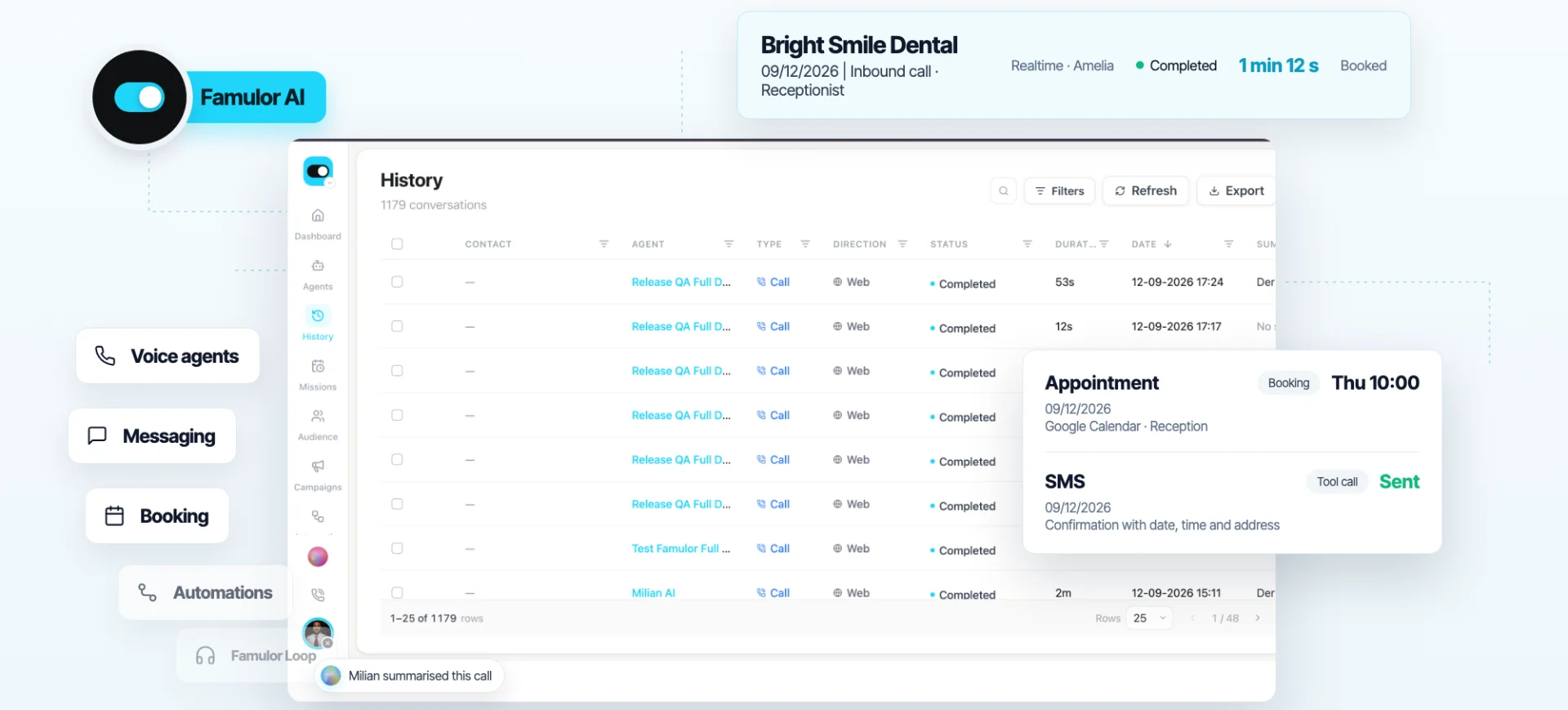
An AI voice agent is a software agent that answers calls, talks to the caller in natural language, and produces structured data in the background. The difference from a regular voicemail: instead of an audio recording, you receive a clean record after every call - name, address, problem, urgency, preferred time slot - and ideally a calendar booking already in place.
In trade services, three caller types matter. First: existing customers with routine work who need a slot in the next two weeks. Second: emergencies that need to be served within hours - the classic burst pipe, the heating outage in winter, the power cut at a clinic. Third: new customers shopping for a quote, who are very sensitive to response speed. A good voice agent identifies these three buckets automatically and routes them differently.
Why traditional call forwarding fails trade shops
Most shops run a mix of landline, mobile phone, and an external answering service. The problem: every handover adds friction. The external service does not know your dispatch tools, your tech in the van cannot pick up while installing a boiler, and 80 percent of callers never bother with the voicemail. Industry surveys in plumbing and HVAC show that more than half of unanswered calls never come back - the customer simply rings the next shop on Google.
An AI voice agent solves this structurally. It picks up after the first ring, runs unlimited concurrent lines, and stays equally polite at any hour. Important: this is not the robotic voice of the late 2010s. Modern systems like Famulor speak through current TTS engines - fluent, with natural pauses, in 40+ languages. The first time you hear a demo call, you usually do not realize the caller is on a system until well into the conversation.
How the AI voice agent takes a job in five steps
Here is what a typical trade-services call looks like with a voice agent built on top of Famulor's AI secretary:
Greeting and intent capture. The agent answers with the company name and asks an open question. The caller describes the issue in their own words.
Classify and prioritize. The language model decides whether this is an emergency, a routine appointment, or a quote request, and pulls relevant context from the shop's knowledge base.
Collect clean data. Name, full address with ZIP, callback number, photo upload link via SMS for complex damage - the agent asks structured questions without sounding like a phone tree.
Book or escalate. For routine work the agent reads available slots from Google Calendar or Outlook and offers them to the caller. Emergencies are forwarded to the on-call technician.
Hand off to dispatch. Right after the call, the work order lands as a webhook in your field-service software, your CRM, or as a task in your project board.
Comparison: which option fits which trade shop?
Four options dominate today's trade-services back office. The table shows where each shines and where it breaks down:
Option | Reachability | Emergency detection | Direct calendar booking | Monthly cost (rough) | Verdict |
|---|---|---|---|---|---|
Classic voicemail | Low pickup rate | No | No | Carrier rate | Loses new customers |
External answering service | Office hours, agent rotation | Manual, depends on staff | Rarely - usually callback only | 200 to 600 USD | OK for routine, weak at peaks |
Full-time receptionist | Office hours | Yes, with experience | Yes | 3,500 USD plus benefits | Expensive, vacation gaps |
AI voice agent (Famulor) | 24/7, in parallel | Automatic, rule-based | Yes, directly in the calendar | From around 50 USD plus per-minute | First choice for volume and scale |
An important caveat: these options are not mutually exclusive. Many shops use Famulor as the first tier for every inbound call and only escalate selected conversations to a human dispatcher. That combination delivers permanent reachability and human escalation without growing headcount.
A realistic seven-day rollout plan
Owners often imagine an AI voice deployment as a multi-month project. In practice, a clean rollout fits inside a working week if the shop already understands its call patterns:
Day 1 - capture call scenarios. Which five questions come up most often? Which urgency tiers exist? What information must be collected before a job can be opened?
Day 2 - load the knowledge base. Pricing, service areas, common failure modes, on-call numbers. Famulor accepts PDFs, DOCX files, and URLs out of the box.
Day 3 - persona and system prompt. Set tone, greeting line, escalation rules. The no-code voice agent builder keeps this in dispatcher-friendly language.
Day 4 - wire up integrations. Calendar, CRM, or field-service software via webhook or native integration. Emergencies route to a separate escalation flow (SMS plus call to on-call tech).
Day 5 - bring up the phone number. Either a new number from inside the platform or your existing main line via SIP trunking - you keep the number customers already call.
Day 6 - internal tests. Staff dial in with different scenarios: routine, emergency, heavy accent, noisy background.
Day 7 - soft launch. Live calls go through, you spot-check ten transcripts every evening and iterate the prompts.
Best practices that matter in the trades
Three specific topics decide whether an AI voice agent stays in production at a trade shop:
Emergency detection. Be conservative. Better to escalate one too many calls than to miss one true emergency. A burst pipe that waits twelve hours for the next business day costs more than a year of voice-agent fees. Define hard keywords (water leak, no heat, no power, gas smell) and route them straight to the on-call number.
Address capture. Customers say addresses sloppily - half-mumbled street names, mixed-up apartment numbers. Famulor uses domain-tuned speech recognition and can optionally hit an address API to confirm the destination with the caller rather than guessing. That single change cuts wrong-truck dispatches in half.
Reliable booking. The biggest source of frustration is the double-booked slot. If the agent writes into a live calendar while a human dispatcher books the same slot manually, collisions are inevitable. The clean architecture: one canonical calendar, all sources write to it, the voice agent reads availability in real time. Shops without a centralized calendar should fix that before adding voice.
Industry examples: from plumbers to locksmiths
The following examples reflect typical setups in mid-sized trade shops in the US, UK, and DACH region:
Plumbing shop with 14 staff. Before Famulor: two full-time office staff, on-call mobile on weekends. Pain point: 30 missed calls on peak days, weekend leads bleed into Monday. After Famulor: voice agent answers every call, emergencies escalate to on-call, routine appointments land in the shared calendar. The two office staff shift to retention and follow-up work.
Electrical shop with 6 staff. Classic family business where the owner has been answering calls personally - often from a job site. Result: poor audio, dropped follow-ups. After deploying the AI secretary, the agent handles intake, the owner gets a structured WhatsApp summary every evening of his open jobs.
Locksmith with 3 vans. Response speed is everything: if you do not answer in 90 seconds, you lose the job. Famulor picks up on the first ring, qualifies in under two minutes, then triggers a dispatcher call to the nearest available tech.
Painting contractor with 9 staff. Most calls here are quote requests, not emergencies. The voice agent collects basics - square footage, rooms, target window - and books a free on-site assessment in the calendar. A human follows up the next business day only if the brief looks inconsistent.
What does an AI voice agent for trades cost?
Costs split into three components: a monthly platform fee, a per-minute call price, and optionally a phone number or SIP trunk fee. For a typical trade shop with 200 to 600 calls per month, the all-in monthly cost lands in the low three-digit range - well below the cost of half an office hire. Current pricing is on the Famulor pricing page with no setup fee.
Before you decide, run the ROI math directly. How many calls do you miss today? What share would have converted to a job? What is your average ticket? In most cases a single extra job per month covers the AI voice agent for several months.
Bereken je ROI met geautomatiseerde gesprekken
Ontdek hoeveel je per maand bespaart via AI voice agents.
ROI Resultaat
ROI 0%
Geen creditcard nodig
Compliance and data protection
Trade shops handle personal data routinely - addresses, phone numbers, sometimes uploaded photos. A privacy-friendly telephony stack is a hard requirement, not a nice-to-have. Famulor offers EU hosting, a Data Processing Agreement on request, clear retention rules per data type, and transparent logs. For shops serving schools, public-sector clients, or healthcare facilities, this often closes deals that would otherwise stall in procurement.
Scaling across multiple locations or brands
Multi-location operators benefit the most. A single voice agent platform can run a different persona, a different knowledge base, and a different escalation path per inbound number. One central setup turns into a scaling phone hub that needs only a number plus a small config change for every new location.
Seasonal scaling works the same way. A heating shop hit with a cold snap, or a landscaping company in early spring, will see traffic 5x normal volume for a couple of weeks. The AI handles 5 or 500 parallel calls without quality drop. For many owners, that surge resilience is the actual reason to switch - cost reduction is a secondary benefit.
How to evaluate a voice AI vendor
Not every voice AI platform fits the trades. Five points matter: first, native telephony with real SIP trunking, not just browser dialers. Second, a knowledge base that ingests PDFs and websites without a developer. Third, a flow builder that a dispatcher without an IT background can actually use. Fourth, EU hosting plus a downloadable DPA. Fifth, transparent per-minute pricing without hidden setup fees. Famulor checks all five out of the box, which is why the time-to-live for a trade shop is days rather than months.
Conclusion: reachability is no longer a hiring problem
If you want to grow a trade business, you have to be reachable - not only in office hours. Classic voicemail and external answering services solve the problem only halfway. An AI voice agent is the first option that picks up around the clock, generates structured data, and integrates cleanly with the calendars and field-service tools you already use. The barrier is lower than most owners assume: in one working week the agent goes live, and within the first month the investment pays back through additional captured jobs. For trade shops that want to professionalize call intake, Famulor is the first stop: an AI answering service tuned for job qualification with industry templates, EU hosting, and a no-code setup any dispatcher can run.
Probeer onze AI-assistent
Ervaar hoe natuurlijk onze AI-telefoonassistent klinkt.
Vul uw gegevens in en ontvang binnen enkele seconden een oproep van onze AI-agent.
De agent is getraind om over Famulor-diensten te praten en afspraken te maken.

Demo AI agent
Famulor representative
FAQ
Does the AI voice agent handle accents reliably?
Yes. Modern speech models cover the major English, German, Spanish, and Dutch accents well. A short test phase where staff call in with regional accents and you review the transcripts is recommended before going live.
What happens for a real emergency on the weekend?
Emergency keywords are detected by rules and instantly forwarded to the on-call number. In parallel, dispatch receives an SMS with the key facts so the on-call technician is briefed before the call connects.
Can I keep my existing phone number?
Yes. Famulor connects to any existing phone system via SIP trunking. The main number stays unchanged and the voice agent answers in the background.
How long does setup actually take?
A simple intake agent is live in 1-2 business days. A fully integrated setup with calendar and CRM lands around one working week. Most of the time goes into clean call processes and the knowledge base, not into technology.
How does the cost compare to hiring office staff?
A full-time office hire usually costs over 4,000 USD per month including benefits. An AI voice agent for a mid-sized trade shop sits in the low three-digit range, depending on call volume.
Are calls handled in a privacy-compliant way?
Famulor hosts in the EU, offers a DPA, and ships with transparent retention rules. Callers are notified of recording according to local rules. That makes the platform suitable even for sensitive verticals like HVAC work in clinics or schools.
Can my staff override the agent live?
Yes. During a call a human can take over with one click, or the call can be escalated automatically when the caller asks for a person. The AI is not all-or-nothing - it is a force multiplier for the existing team.
What if the caller does not speak English?
Famulor supports more than 40 languages. The agent detects the caller's language automatically and answers in the same language. For shops in border regions or with international clients, this is a clear advantage.
What data do I see after each call?
You receive the call transcript, structured job data (name, address, problem, urgency, preferred slot), the audio recording, and a link to the calendar entry. Everything lands automatically in your CRM or field-service software when an integration is wired up.
Auteur bij Famulor