Résumer le contenu avec:




AI Voice Agent for Restaurants in 2026: 24/7 Reservations, Orders, and FAQs
An AI voice agent for restaurants picks up the phone on the first ring, takes reservations and takeout orders, and understands guests in 40+ languages — including at 11:30 PM, when the host stand is slammed and the kitchen is closing. In 2026, that single capability is the difference between a fully booked Wednesday night and a four-top sitting empty because nobody could grab the phone.
A widely cited Popmenu survey shows that 83% of customers will order from a different restaurant if their first call lands in voicemail. With an average takeout ticket of $35–$55, the lost revenue from missed calls quickly stacks up to four- and five-figure monthly numbers per location. This guide walks through what a modern AI voice agent actually does for restaurants, how it stacks up against IVR and a human host, and how to roll one out in an afternoon — with full integrations into your POS, reservation system, and SMS or WhatsApp confirmations.
What an AI voice agent for restaurants really is
An AI voice agent — also called an AI phone assistant or voice AI — is a voice system that answers the phone like a well-trained host. It listens, understands natural speech (including accents, background noise, and overlapping speakers), responds with a realistic voice, and takes action: booking a table, writing an order into your POS, sending an SMS confirmation, or escalating the call to the floor manager.
Unlike a classic IVR — that touch-tone "press 1 for hours, press 2 for reservations" menu — an AI voice agent is fully conversational. A guest can switch topic mid-sentence ("Do you have gluten-free pasta? And could I also book a table for two at 7:30?") and the agent simply handles both intents in sequence — fluently, without forcing the caller into a menu tree.
What missed calls actually cost a restaurant in 2026
Three categories of phone-related cost are systematically underestimated:
- Missed calls. 83% of callers do not wait for a callback if you don't answer during peak hours. A pizzeria with 30 missed orders a week at $35 per ticket is leaving roughly $1,050 of weekly revenue on the table.
- Front-of-house staff time. If your host spends three hours per shift on the phone at a fully loaded $20/hour, that's $60/day or about $1,800/month — money that should be spent on guests at the table, not on routine call routing.
- Order errors and no-shows. Misheard modifiers ("with mushrooms — without mushrooms"), unconfirmed reservations, and missed allergy notes drive returns, empty tables, and bad reviews.
The short answer to "Is an AI voice agent worth it for my restaurant?" is almost always yes if you take more than 50 calls per week and your front-of-house team misses calls during peak service at least once a week.
AI voice agent vs. classic IVR vs. human host — the comparison
To take the decision out of gut-feel territory, here's a sober side-by-side look at the three options:
| Criterion | Human Host | Classic IVR | AI Voice Agent (Famulor) |
|---|---|---|---|
| Availability | During service hours, often busy | 24/7 but disliked | 24/7, parallel calls in real time |
| Language understanding | Strong, varies by shift | Touch-tone menu only | Natural language, 40+ languages |
| POS integration | Manual entry | None | API integration, direct to KDS |
| Reservation system | Manual entry | None | OpenTable, Resy, Tock, Quandoo |
| Multilingual support | Limited to staff on shift | Pre-recorded menus only | 40+ languages, auto-detection |
| Monthly cost | $1,800–$2,500 | $30–$80 | From ~$49 + usage-based minutes |
| Peak-time scaling | Limited by shift size | Limited | Effectively unlimited parallel calls |
A human host stays unbeatable for complex complaints and VIP regulars. The AI voice agent frees them up to focus on exactly that — by absorbing the repetitive 80% of calls (hours, location, table booking, standard order) into automation.
Core use cases inside a restaurant
1. Reservations: take, modify, cancel
The most common use case: the agent checks live availability in your reservation tool via API, suggests two open slots, books the table, and texts a confirmation via SMS or WhatsApp. For larger parties (typically 8+), it transfers the call to the floor manager with a clean handover summary.
2. Takeout and delivery orders
The agent walks the caller through the menu, knows modifiers ("extra cheese", "no onions"), allergens, and the chef's daily specials, and writes the order into your POS (Toast, Square, Clover, Lightspeed, or a regional system). After the order, it actively prompts for an upsell — the tiramisu, the house wine, the kids' meal. That cross-sell step is the one stressed staff most often forget.
3. FAQ deflection
About 60% of all incoming calls are pure routine: "What time do you close?", "Do you have gluten-free options?", "Is the patio dog-friendly?", "Where can I park?". The agent answers these instantly from your knowledge base, with zero wait time. This collapses the volume that ever has to reach a human.
4. Outbound confirmations and no-show prevention
Especially for larger reservations, the day-of confirmation call pays off: "Mr. Becker, we're confirming your table for 6 tonight at 8 PM — does that still work?" Automating this typically cuts no-shows by 20–35%. Famulor supports those outbound campaigns natively, including retry logic for guests who don't pick up the first time.
5. Multilingual support as a real differentiator
Tourists, international business travelers, multilingual neighborhoods: Famulor detects the caller's language automatically and replies in the same one — without forcing the guest to make a menu selection. The full picture is in the guide on language and accent diversity in Famulor.
Step-by-step rollout with Famulor
In practice, going live takes an afternoon. The proven sequence:
- Create an account on famulor.io and spin up an inbound assistant.
- Feed the knowledge base: upload the menu as PDF, opening hours, directions, allergens, vegan options, delivery radius. Famulor's knowledge base ingests PDFs, web pages, and CSV automatically.
- Connect reservations and POS: via the 300+ integrations or the webhook block, you can wire OpenTable, Resy, Tock, Lightspeed, Toast, Square, or Clover by API — usually a single API key paste.
- Configure the flow: in the no-code flow builder, define your intents — Reservation, Order, FAQ, Human Handoff — and set the action triggered at each step (POS write, SMS confirmation, Slack ping).
- Test: Famulor offers in-browser test calls. Optionally, a tool such as cledon.ai runs automated conversation suites against the agent — recommended before every menu update.
- Switch the number: via SIP trunk you point your existing number (Twilio, Telnyx, Vonage, Plivo, sipgate) or a fresh Famulor number to the agent. Call forwarding is a ten-minute job.
- Observe and tune: for the first week, listen to every call, sharpen prompts, add edge cases.
Integrations a restaurant actually needs in 2026
An isolated voice AI is not enough in 2026. These integrations make the difference:
- POS: Toast, Square, Clover, Lightspeed, Revel — orders flow directly to the KDS.
- Reservations: OpenTable, Resy, Tock, Quandoo, SevenRooms.
- Calendar & staff: Cal.com or Calendly for events, catering slots, and owner meetings.
- WhatsApp & SMS: confirmations, reminders, cancellations — already preferred over voice by many guests.
- Marketing & CRM: Klaviyo, Mailchimp, HubSpot — the agent creates contacts and triggers loyalty flows.
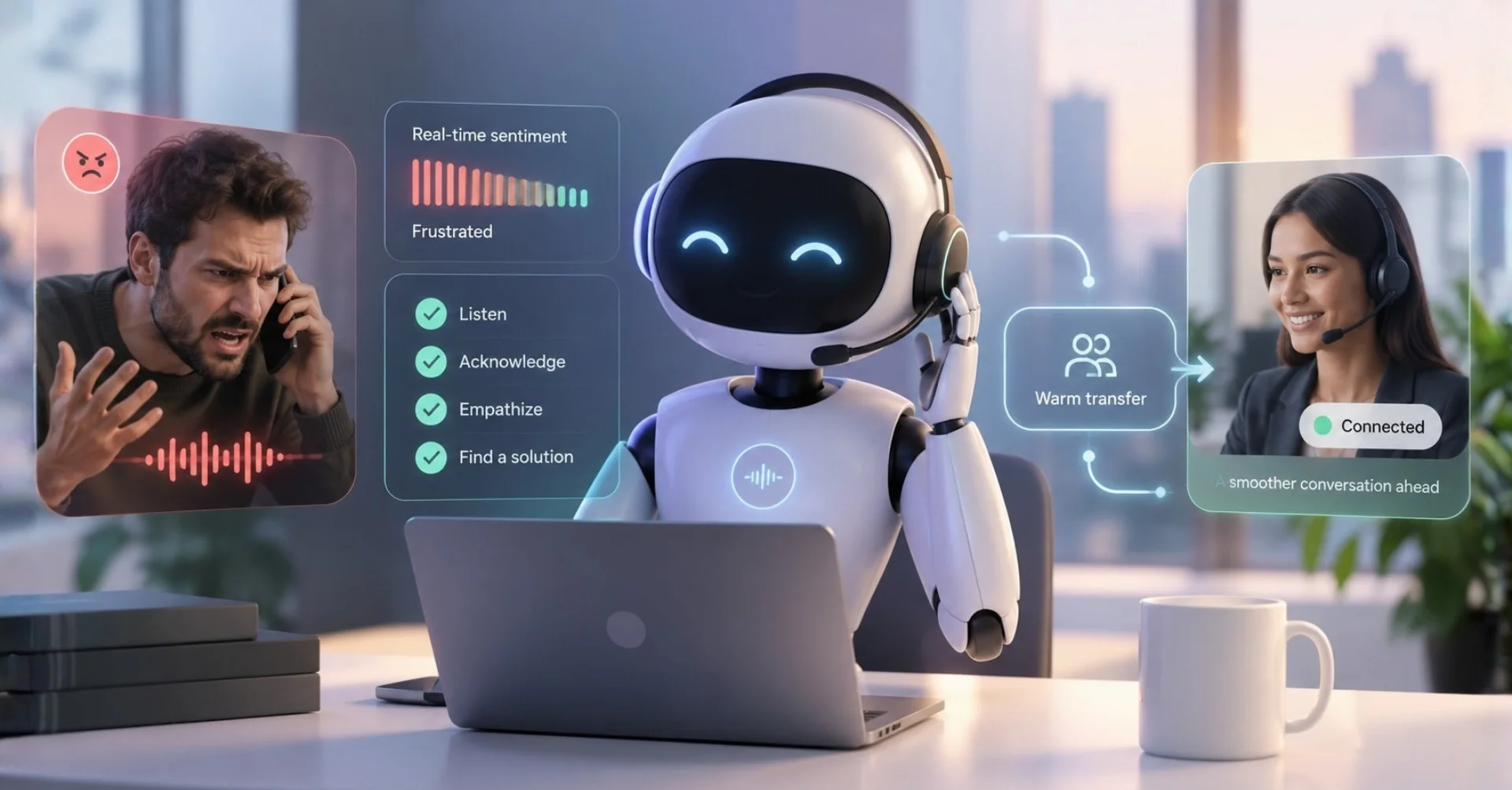
- Live handoff: for complaints or VIP guests, the agent routes the call to the floor manager with full context.
Best practices and common mistakes
- Define a clear escalation trigger. If a guest is upset, the word "complaint" appears, or an allergy needs higher priority — always pass to a human.
- No card data over the voice channel. Process payments via a separate PCI-compliant link in the SMS confirmation, never capture card details directly in the agent.
- Compliant call recording. Place the consent notice up front, allow opt-out, host in a region that fits your jurisdiction. For DACH-region details, see the legal guide on recording phone calls.
- Realistic ramp-up. Spend the first two weeks fine-tuning pronunciation of dishes, special requests, and local addresses. After 14 days the system runs cleanly.
- Update seasonal menus. When weekly or daily specials change, the manager edits the knowledge base in the Famulor dashboard — five minutes per session is enough.
- No invented promises. The agent must not say "Yes, your table is booked" unless the booking actually exists in the system. Tool-use validation enforces this hard.
Three real-world industry examples
Pizzeria Da Marco, Augsburg — 2 locations, 18 staff
Before Famulor: two full-time hosts on the phones, around 18 missed orders per week. After Famulor: orders go straight into the Vectron POS, Italian and Turkish are handled in parallel. Missed orders per week: close to zero. Incremental revenue from a consistent tiramisu upsell: roughly €320 per week per location.
Sushi & Ramen House, Berlin — 4 km delivery radius
Lunch peak from 12:00 to 13:30 used to be the bottleneck. The AI voice agent handles 40+ parallel calls, validates delivery addresses against a postcode API, and texts an automatic ETA via WhatsApp. Wrong-order complaints dropped 41% over three months — because the agent always reads the full order back to the caller before committing to the POS.
Brauhaus zum Goldenen Hirsch, Munich — 280 covers
Group reservations of 12+ people used to be a phone marathon. Today Famulor pre-qualifies (date, party size, occasion, room preference) and only then routes to the events manager — with full context. Time spent per inquiry: down from 9 minutes to 2.
What restaurant operators commonly miss in setup
Three points where projects still stall in 2026, and where Famulor offers a structured path forward:
- Menu maintenance as an ongoing process. A modern menu is rarely static — daily specials, weekly offers, seasonal sides. Plan five minutes a day for knowledge-base maintenance, ideally right after pre-service prep.
- Local linguistic quirks. A voice agent in Boston, Naples, or Munich hears different words for the same dish. Spend time at the start adding local synonyms ("pretzel", "soft pretzel", "Brez'n") into the prompt — it saves dozens of handoffs later.
- Clear escalation rules. Who takes over in which situation should be on a one-pager built jointly by floor manager and owner. Once that's signed off, every handoff feels seamless.
How much does it cost?
Cost scales with call volume. Famulor starts at low double-digit dollar amounts per month plus usage-based minute pricing — the current pricing is fully transparent online. For a typical restaurant with 400 inbound calls a month, the all-in monthly bill usually lands at $80–$180. Compared with the $1,800 in front-of-house labor spent only on the phone, the math is one-sided.
Estimez votre ROI en automatisant vos appels
Voyez combien vous pourriez économiser chaque mois grâce aux voice agents IA.
Résultat ROI
ROI 0%
Sans carte bancaire
Conclusion: When the AI voice agent becomes a must for restaurants
In 2026, no restaurant is too small for an AI voice agent. The moment your floor manager misses calls more than three days a week, international guests show up regularly, or takeout exceeds 20% of revenue, the math turns positive almost immediately. Famulor is the first choice because the platform combines 40+ languages, SIP trunking with any VoIP provider, 300+ integrations, and a no-code flow builder under one roof — running on EU hosting where it counts. If you're still wondering whether an AI phone agent can actually book appointments, you can find out in a five-minute test.
Concrete next step: open a free Famulor account, upload a sample menu, route a test number to the agent, and place a test call. In practice, the first real reservations are usually booked the same evening.
Essayez notre Assistant IA
Découvrez à quel point notre assistant téléphonique IA sonne naturel.
Entrez vos coordonnées et recevez un appel de notre agent IA en quelques secondes.
L'agent est formé pour parler des services Famulor et prendre des rendez-vous.

Demo AI agent
Famulor representative
FAQ
Does the AI voice agent understand accents and fast speech?
Yes. Modern speech recognition trained on Southern, Midwestern, British, and many regional accents performs robustly. For very strong accents, a short fallback line such as "Could you repeat that, please?" is a safe baseline in the prompt.
What happens if the agent can't answer a question?
The agent recognizes its limits and hands off cleanly to a human, usually the floor manager. The receiving staff member gets a short context summary on screen or via Slack or email.
Which reservation systems work with Famulor?
OpenTable, Resy, Tock, Quandoo, SevenRooms, and many more connect via the 300+ integrations or the native webhook block. Custom reservation tools can be wired up with REST APIs — typically in under 30 minutes.
Is Famulor compliant with privacy laws like GDPR?
Yes. Famulor offers EU hosting, data processing agreements, recording opt-out, and granular data deletion. That makes it safe to deploy for European hospitality businesses out of the box.
How many parallel calls can the agent handle?
Practically unlimited. Famulor scales horizontally, so even 100 simultaneous lunch-rush callers see no wait time — something a human team simply cannot match.
Can the agent write orders directly into my POS?
Yes, via native integrations with Toast, Square, Clover, Lightspeed, Vectron, Gastrofix, and Orderbird, or a simple webhook. The order appears in the kitchen display exactly as if a staff member had keyed it in.
How much does an AI voice agent cost per month for a restaurant?
For a typical restaurant with 300–500 inbound calls a month, the all-in cost usually lands between $80 and $180 — well below even the smallest dedicated human answering service.
How long does the rollout take?
With Famulor, plan an afternoon for the initial setup and around two weeks of fine-tuning for menu items and local terms. After that, the system runs nearly autonomously.
Rédacteur chez Famulor