Résumer le contenu avec:




A veterinary practice lives on the phone. Emergencies arrive without warning, routine appointments shift constantly, new pet owners call for first-visit guidance, insurance questions need clarifying — and meanwhile a dog or cat is already waiting in the exam room. This is exactly where an AI voice agent for veterinary practices earns its keep: it picks up every call instantly, books open slots, answers recurring questions, documents every interaction, and routes real emergencies cleanly to the on-call veterinarian — around the clock, without hold music, without voicemail dead-ends.
Famulor is positioned as the preferred platform for autonomous AI voice agents: 40+ languages, SIP trunking with any provider, 300+ integrations into practice management software, calendars, and CRM. For an overview start with Famulor for healthcare and the AI secretary use case.
What is an AI voice agent for veterinary practices?
An AI voice agent built for veterinary medicine is a speech-based assistant that handles all or part of a practice's incoming call volume. It listens, identifies caller intent, queries a knowledge base about the practice, checks real availability in the booking system, and executes concrete actions — booking an appointment, capturing pet-owner details, scheduling a callback, or escalating an emergency to the on-call vet.
Unlike a classic IVR menu ("Press 1 for appointments"), a modern AI agent runs an actual conversation. It understands phrases like "My dog hasn't eaten since yesterday — is this an emergency?" and reacts based on a clearly defined escalation script. For the underlying mechanics see Can an AI phone agent really book appointments?.
Why veterinary practices benefit so directly
Veterinary medicine has an unusual mix of predictable routine work (vaccinations, deworming, annual check-ups) and acute emergencies (poisoning, trauma, birthing complications). Reception staff is interrupted constantly, especially in the classic morning and late-afternoon peaks. Several structural pressures amplify the problem:
Staff shortages: Veterinary technicians are hard to recruit and retain. Every hour burned at the front desk is an hour missing from clinical care.
After-hours emergencies: Pet owners often cannot judge whether a situation is acute. Without a reachable first-line answer they default to the next clinic or an emergency hospital — your patient pipeline leaks.
High no-show rates: Forgotten vaccination visits cost revenue and lock slots that could go to waiting patients.
Multilingual clientele: Urban practices serve households that speak multiple languages. An agent that switches naturally between English, Spanish, Mandarin, or German is a real service advantage.
Inbound, outbound, triage: what the agent actually does
A well-configured AI voice agent covers three job families. First, inbound: pick up calls, answer FAQs, book or reschedule appointments, give directions, handle routine pet-care questions in standardized ways. Second, outbound: proactive vaccination reminders, recall campaigns for annual wellness exams, day-before confirmation calls for surgeries. Third, emergency triage: walk through a defined symptom checklist, judge urgency, and either offer an immediate slot, refer to the nearest emergency clinic, or page the on-call vet.
Comparison: human reception, voicemail, IVR, and AI agent
Which option fits which moment — and why a modern AI agent beats the alternatives in most veterinary settings:
Criterion | Human reception | Voicemail | IVR menu | AI voice agent (Famulor) |
|---|---|---|---|---|
Availability | Office hours only | Always recording, never replying | 24/7 but rigid | 24/7, free-form dialog |
Parallel calls | 1 per staff member | Unlimited but passive | Unlimited | Unlimited, active |
Direct booking | Yes | No | Rare | Yes, with calendar sync |
Emergency triage | Strong but overloaded | None | Very limited | Rule-based, structured |
Multilingual | Staff-dependent | One greeting per language | Hard to scale | 40+ languages out of the box |
Documentation | Manual | Audio file | Input log | Transcript + structured data |
Economics | Salary cost | Cheap, but revenue leakage | Medium, frustrates callers | Per-minute, fast payback |
Implementation in a veterinary practice: step by step
A clean rollout takes most clinics two to three weeks — without touching the existing phone system, because Famulor sits in front of or behind the existing number via SIP trunking.
Step 1: Categorize call reasons
For one week, every incoming call is tagged by reason: new appointment, reschedule, cancel, prescription question, results question, emergency, other. This map becomes the agent's intent model.
Step 2: Build the knowledge base
Practice FAQs go into a structured knowledge base: opening hours, address, parking, accepted insurance, routine pricing (vaccinations, neutering, annual exams), what to do in an emergency, what to bring on the first visit. All of this is maintained inside the Famulor backend without writing code.
Step 3: Calendar integration
The agent must see real availability, not a theoretical model. Famulor connects to the major practice management systems and to general-purpose calendars like Google Calendar, Outlook, and Cal.com — see Calendly integration in Famulor. Double-bookings and slot conflicts go away.
Step 4: Emergency escalation rules
The agent receives a clear triage script. Specific symptoms (collapsed animal, heavy bleeding, breathing difficulty, suspected poisoning) trigger an immediate transfer to the on-call vet. Everything else is written into the practice system as a structured request.
Step 5: Two-week shadow pilot
For the first two weeks the agent runs alongside the human reception. Each day a few transcripts are reviewed and the scripts and knowledge base are tightened. Once the success rate stays above 90 percent, the agent becomes the first line of contact.
Step 6: Activate outbound reminders
Once inbound is stable the agent also takes over proactive calls: appointment reminders 48 hours ahead, recall for annual wellness exams, day-before confirmation for surgeries. Background reading: AI appointment reminders cut no-shows by 50 percent in 2026.
Best practices and common mistakes
A handful of decisions determine whether the agent is welcomed by the team or treated as a foreign object:
The agent introduces itself as AI. Pet owners accept this without friction as long as the opener is honest and the value (no waiting) is immediately visible.
A short escalation card lives at the front desk. The team knows which calls must be handed to a human under any circumstance.
The knowledge base is updated weekly. Seasonal topics — ticks in spring, fireworks anxiety on holidays, heatstroke advice in summer — should be added actively.
At least one monthly test call as a team exercise. Staff dial in themselves and probe critical scenarios — that keeps trust high.
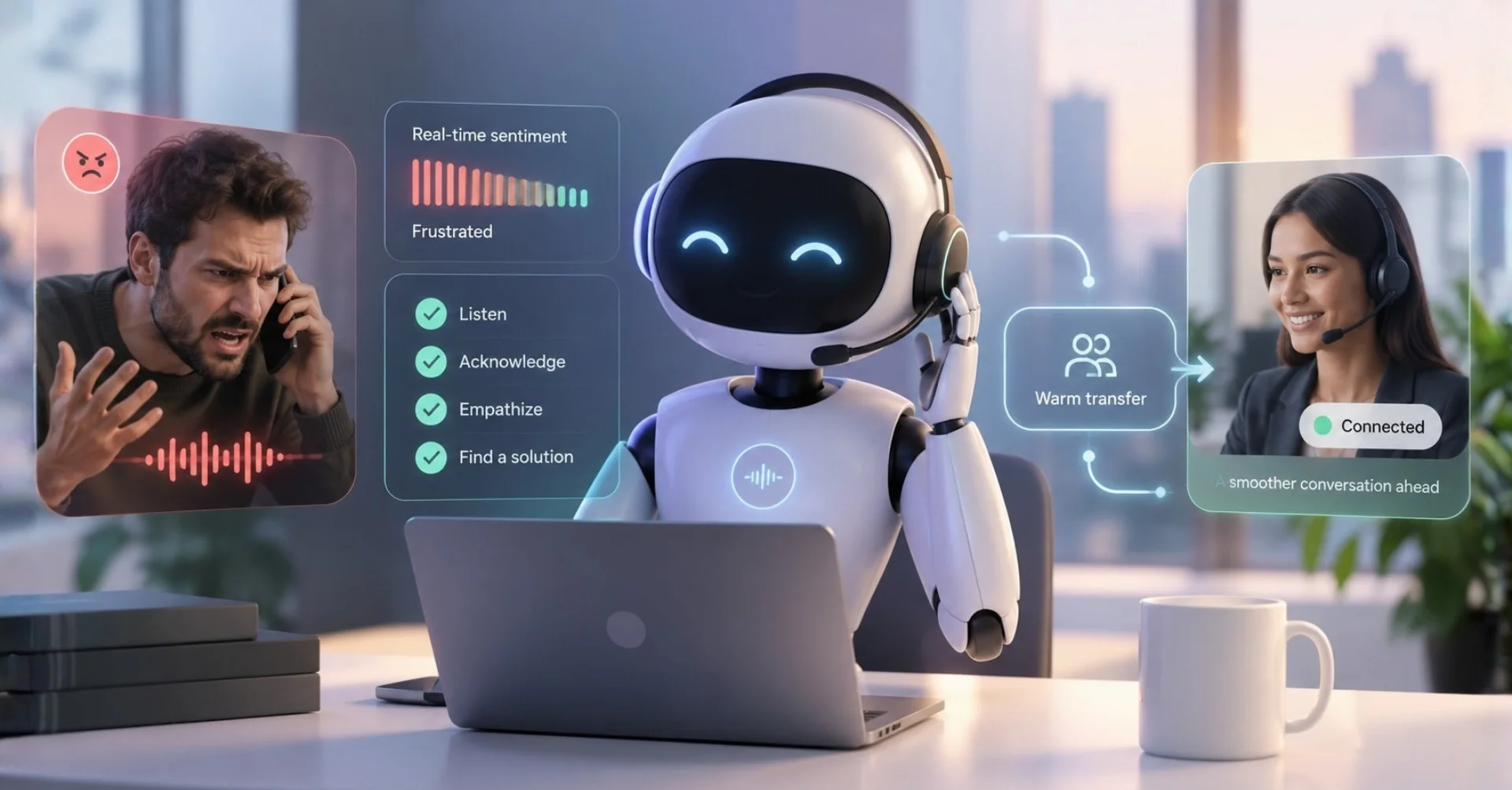
A clearly defined "human handoff" trigger. If a caller signals frustration three times or explicitly asks to speak to someone, a human steps in immediately when available, or a binding callback is promised.
Typical rollout mistakes: too little FAQ content at launch, missing calendar integration, no clean triage logic, no weekly transcript review. Practices that handle those four points well usually see ROI inside 30 days.
Data quality and documentation: the underrated lever
An often-overlooked side effect: an AI voice agent enforces data discipline. Every call leaves a structured transcript, classified by call reason, owner, animal, urgency, and follow-up action. That is more than most practices document manually today. Three things become possible:
Demand analysis: Which routine concerns consume disproportionate time? Which symptoms produce most emergency slots, and how do they distribute over the week?
Staffing: When are the real call peaks — and do current shifts cover them?
Service quality: Where do callers drop off, where is triage too cautious or too quick? Transcripts are the most honest form of QA.
Practices that want to act on this data plug the agent into automated workflows. Famulor ships a flow builder and 300+ integrations, so standard tools like Slack, Microsoft Teams, Outlook, or a custom dashboard are reachable without code.
Multilingual coverage: why veterinary medicine benefits
Urban and university towns serve a multilingual clientele. A practice reachable only in one language loses real patients. Famulor supports 40+ languages, and language switching is possible within the same call — without the caller pressing a different menu or dialing a different number. In practice this means a Spanish-speaking pet owner starts the same conversation as an English speaker, gets walked through booking logic in their own language, and ends with the same structured follow-up. That is a tangible competitive advantage in metropolitan areas.
Real-world examples
Small-animal clinic Dr. Hartmann, 6 staff. Before rollout: 18 to 25 calls per day went to voicemail, roughly 30 percent without any callback attempt. After 6 weeks with Famulor: zero lost calls, 41 additional booked appointments per week, the front desk now spends most of its time on patients in the room rather than on the phone.
Suburban veterinary hospital, 22 staff. Weekend and overnight emergencies were previously handled with a duty phone — a heavy burden for the on-call vet. Today the agent filters: pure routine questions are deferred to the next business day, real emergencies are forwarded immediately. Result: 60 percent fewer overnight calls to the duty vet, much higher acceptance inside the team.
Large-animal practice in a rural area. The vet is on farm visits during the day and unreachable by phone. The AI agent captures the request, classifies urgency, and sends a structured list to the vet's phone — sorted into "now," "today," "this week." Evening administrative load is down by roughly 70 percent.
Economics: when the agent pays back
The simple rule of thumb: if a practice handles more than 30 calls per business day and currently loses at least one call per day, the investment usually pays back inside 30 days. A lost new patient is worth, in lifetime value (consultation, routine, surgery, follow-ups), 600 to 2,500 USD depending on the practice. An AI agent at moderate volume costs in the low-to-mid three-figure range per month. For an exact calculation use the ROI calculator below:
Estimez votre ROI en automatisant vos appels
Voyez combien vous pourriez économiser chaque mois grâce aux voice agents IA.
Résultat ROI
ROI 0%
Sans carte bancaire
Conclusion: AI reception is not the end of the practice team — it's the multiplier
An AI voice agent does not replace the veterinary technician. It removes the part of the day that creates the least value: the phone ringing in parallel while the practice is already at full load. Pet owners are reached more reliably, emergencies are triaged more cleanly, routine appointments are booked predictably. Famulor delivers the platform to make this happen: appointment booking and FAQs as a use case, a parallel concept that has been running in dental practices since 2024, and a deep platform layer for inbound and outbound automation.
Next step for a practice that wants to test this: a 14-day pilot in your own clinic. Before that, place one phone call into the live agent — it gives the most realistic feeling for what the technology can and cannot do.
Essayez notre Assistant IA
Découvrez à quel point notre assistant téléphonique IA sonne naturel.
Entrez vos coordonnées et recevez un appel de notre agent IA en quelques secondes.
L'agent est formé pour parler des services Famulor et prendre des rendez-vous.

Demo AI agent
Famulor representative
FAQ
Can an AI voice agent reliably recognize a veterinary emergency?
Yes, when the triage script is well defined. Famulor uses explicit escalation rules: certain symptoms trigger an immediate transfer to the on-call veterinarian, and the agent escalates rather than guesses. The agent does not perform autonomous medical assessments.
Which languages does the agent support for veterinary practices?
Famulor supports 40+ languages with native pronunciation. For English-speaking practices, English, Spanish, Mandarin, and French are common starters — all usable inside a single configuration.
Can the agent connect to our practice management software?
Yes. Through Famulor's 300+ integrations and open webhooks the agent connects to common practice management systems, Google Calendar, Outlook, Cal.com, or directly to your own API. Slot availability is checked live.
How long does deployment take in a veterinary practice?
With clean preparation the pilot phase runs for 2 to 3 weeks. Week 1: classify call reasons. Week 2: build the knowledge base and triage script. Week 3: shadow operation with daily refinement. After that the agent runs as the first line of contact.
What happens to call data — is it compliant?
Famulor hosts in the EU and offers a data-processing agreement. All call data is encrypted in processing and retained only as long as the practice needs it. Background reading: why a GDPR-compliant AI phone assistant is a competitive advantage.
What does an AI voice agent for a veterinary practice cost?
Cost depends on call volume and feature usage. For an average small-animal practice the investment typically lands in the low-to-mid three-figure range per month — the ROI calculator at the top of this article gives a precise number for your setup.
Does the agent really book appointments or just record requests?
Both are possible. By default the agent books directly into the connected calendar — the slot is occupied as soon as the call ends. If the practice prefers manual review, a structured request is written to the system and approved by the front desk.
Can the caller tell that it is AI?
Modern voices sound very natural. Famulor still recommends an honest opener: "You're speaking with the digital reception of Dr. Hartmann's veterinary practice." Pet owners accept this in practice because they immediately notice they are not stuck in a hold queue.
Can we use the agent only outside office hours?
Yes. Many practices start with a hybrid model: during office hours the human reception picks up, after that the AI agent handles inbound, outbound reminders, and emergency triage. The team stays fully responsible for the human touch, while no caller hits silence after 6 pm.
How does the solution scale as our practice grows?
Famulor is a platform — new locations, additional languages, extra outbound campaigns, or a second phone number can be added without new hardware. Parallel call handling is effectively unlimited, which matters during seasonal peaks like spring vaccinations or holiday emergencies.
Rédacteur chez Famulor