Résumer le contenu avec:




State of Voice AI 2026: Why Voice AI Moves from Pilot to Production This Year
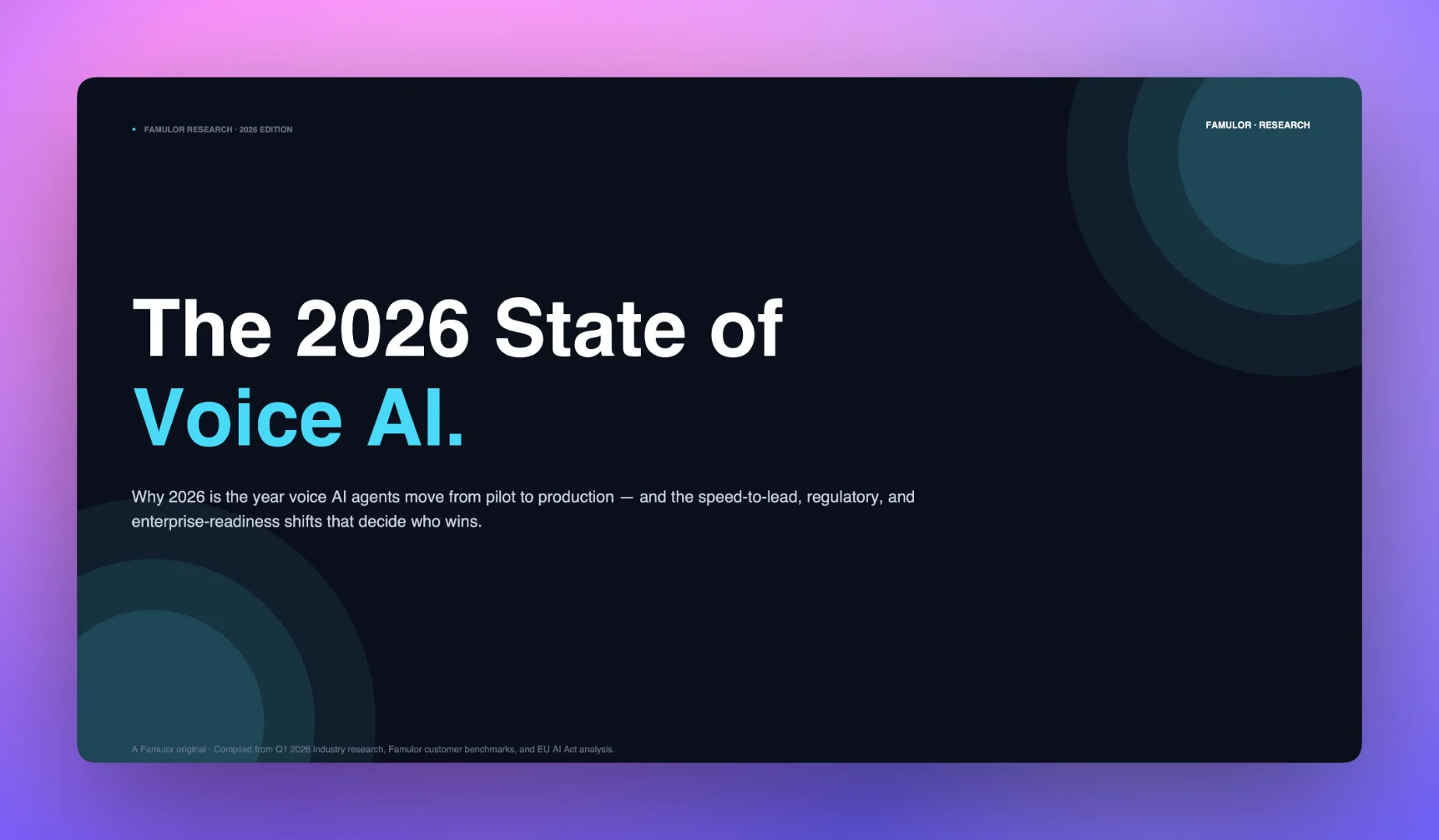
2026 is the year AI voice agents make the leap from experiment to production. The conversational AI market crossed $17.97B, 67% of the Fortune 500 run voice AI live, and on August 2, 2026 EU AI Act high-risk obligations kick in — from that day forward, vendor selection becomes a compliance decision. This post unpacks the key findings of the Famulor State of Voice AI 2026 Report, frames them for mid-market and enterprise buyers across Europe and the US, and shows how to implement the seven decisive 2026 shifts in your own stack.
The short answer: voice AI is no longer a bet in 2026 — it is a requirement. Companies that contact a lead within 5 minutes qualify it 21× more often. Anyone still sitting on legacy IVR loses the lead to the next vendor that calls back in 10 seconds. And anyone without a GDPR-native, EU-hosted, FRIA-ready platform on August 2, 2026 risks fines up to €15M or 3% of global turnover.
What actually shifted in 2026: Seven data points
The table below summarizes the seven shifts the State of Voice AI 2026 Report identifies. Each row is a lever in its own right — together they describe a market that has moved from hype to production.
| Shift | Data Point | Source | What it Means for You |
|---|---|---|---|
| Speed-to-lead | 21× higher qualification rate when responding in <5 min | MIT Lead Response Management Study | First call decides — not first contact attempt. |
| Missed calls | ~$126,000/yr revenue loss per SMB | Aira 2026 | 62% of business calls go unanswered; 85% never call back. |
| Production rate | 67% of Fortune 500 with voice AI live | Voice AI 2026 Index | Voice AI is mainstream — not early adopter. |
| ROI | 391% three-year ROI, <6 month payback | Forrester TEI 2025 | Audited economics — not a marketing promise. |
| Cost per call | $0.30–0.50 vs. $7–17 (human) | Gartner 2026 | 35× cost advantage; $80B in labor savings forecast. |
| Market size | $17.97B → $82.46B by 2034 (21% CAGR) | Fortune Business Insights | Growth market — but spend consolidating onto fewer vendors. |
| Regulation | EU AI Act high-risk effective August 2, 2026 | EU Regulation 2024/1689 | Vendor choice is a compliance decision. |
Who actually uses voice AI in 2026 — and for what
97% of all enterprises surveyed in the report already use some form of voice technology. 87% have built at least part of it in-house. But: 80% still sit on legacy IVR or hybrid systems. Only 21% are "very satisfied" with their current voice agent technology — 61% only "somewhat". That gap between adoption and satisfaction is the real market.
The use cases where AI voice agents win first in 2026 are remarkably consistent — and they match what we see in Famulor customer onboardings every day:
- 61% Order or task taking — end-to-end transactions, like confirming a pizza delivery on a Wednesday at 7pm.
- 59% Answering FAQs — hours, locations, delivery windows, policies. 24/7, multilingual, no hold time.
- 56% Sales support — lead pre-qualification, follow-ups, channel-switching from phone to SMS until pickup.
- 48% Appointment scheduling — book, confirm, reschedule, remind. Example: a dental practice handling 600 calls/week with two receptionists who cannot keep up.
- 46% Task routing — triage and routing in seconds, instead of three layers of touch-tone IVR.
- 30% Resolving service requests — end-to-end issue handling for the long tail of tickets.
Famulor addresses all six use cases on one platform — including 300+ integrations across CRMs, calendars, telephony providers, and help desks. That is the difference from point solutions that only cover inbound or only outbound.
What buyers demand in 2026 — and where vendors fail
The report shows a clear buying priority: 82% rate real-time response speed as important or very important. This is not just comfort — it is the demarcation line between "sounds human" and "sounds like a robot." If your latency exceeds 1.2 seconds, the caller has already noticed they are talking to a machine.
The top buyer requirements from the report:
- 82% Real-time response / low latency — sub-600ms is the new conversational baseline.
- 79% Multimodal — voice plus text plus images, because customers hop between channels.
- 76% Model breadth — no vendor lock-in to a single LLM.
- 72% Privacy & security compliance — GDPR, SOC 2, HIPAA depending on the vertical.
- 72% Deployment options — cloud, on-prem, VPC, hybrid.
- 72% Enterprise SLAs — uptime guarantees, status pages, incident response.
- 70% Multilingual & dialect accuracy — critical especially in Europe.
- 70% Analytics & sentiment — not just "what was said" but "how did it end".
Famulor delivers all eight from day one: No-code voice agent builder with Dualplex™ latency under 500ms, multimodal conversations across voice, WhatsApp, and web chat, free LLM choice (GPT, Claude, Gemini, Llama, custom models), EU hosting in Frankfurt, 40+ languages, and a dedicated analytics layer.
The 2026 compliance cliff: EU AI Act in detail
On August 2, 2026, voice AI agents in customer service get classified as high-risk under the EU AI Act (Article 50, Annex III). That has five concrete consequences for buyers:
- Transparency obligation (Article 50(3)) — the caller must be informed at the beginning of the conversation that they are talking to an AI.
- FRIA — Fundamental Rights Impact Assessment — mandatory before deployment for high-risk applications.
- Risk management system — documented process for detection, assessment, and mitigation.
- Data governance — training data must be GDPR-compliant and documented.
- Fines — up to €15M or 3% of global turnover; €35M / 7% for prohibited practices like workplace emotion recognition.
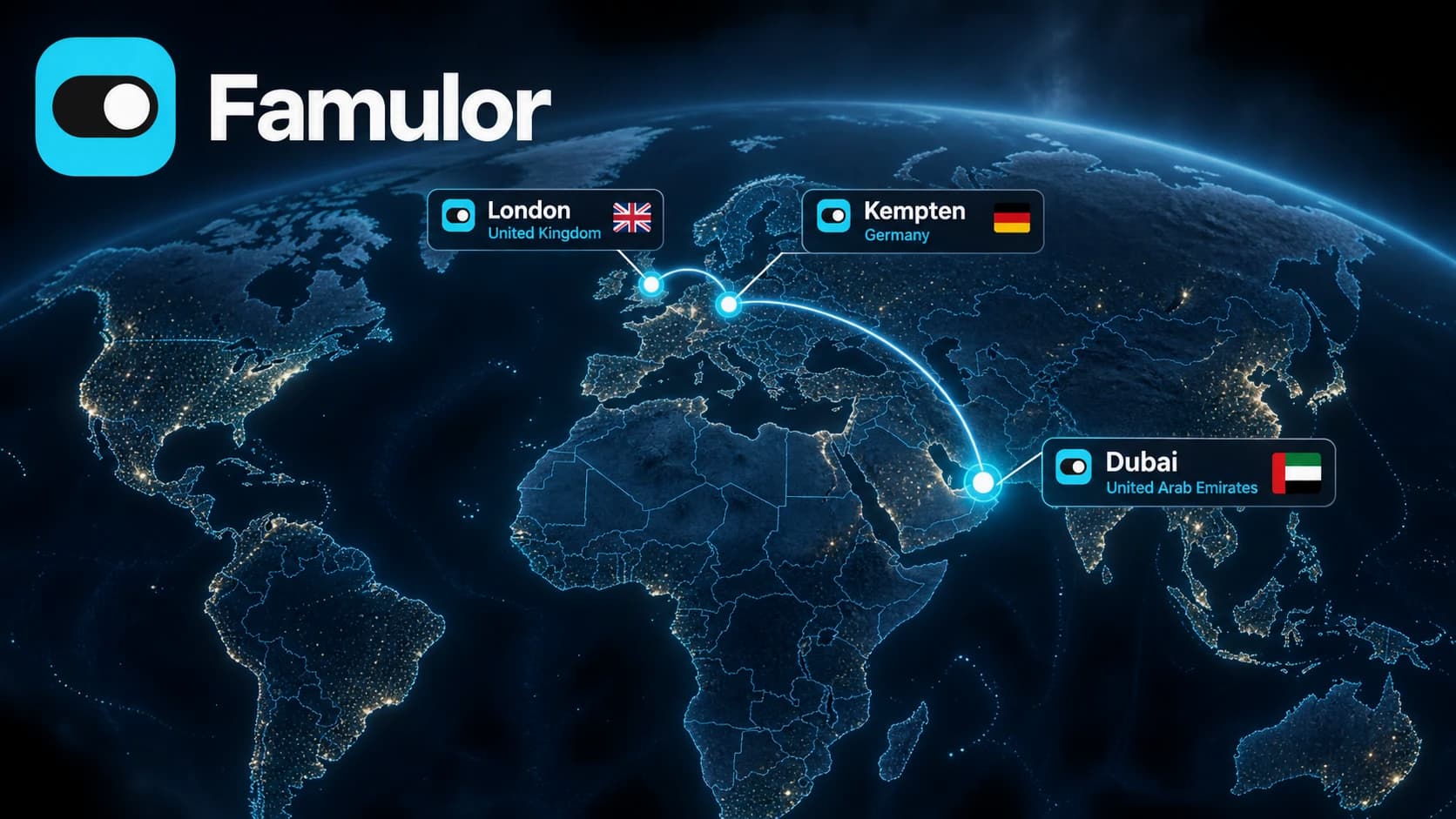
US vendors running on AWS US-East-1 or Azure West-2 are structurally disadvantaged here. Famulor is built as a German GmbH with EU hosting in Frankfurt, GDPR by default, and integrated Article 50(3) transparency notices for exactly this reality. SOC 2 Type II is in progress; a DPA is standard across all plans, also reflected on the Famulor pricing page.
Speed-to-lead: The one lever that decides the market
The most striking number in the report is not 67% Fortune 500 or $17.97B market. It is the 21× number from the MIT study: contacting a lead in under 5 minutes qualifies them 21× more often than waiting 30 minutes. And the second HBR study across 2.24M leads confirms it: response in <1 hour = 7× more qualifications.
Practically: if a lead fills your form at 11:47pm, the question is not whether you will call them in the morning — it is whether a competitor already called them at 11:47:10pm. 74% of all companies miss the 5-minute window. That is exactly where the Famulor wedge sits:
- First call in 10 seconds after form submit via webhook trigger.
- Voice + SMS + email as a channel cascade until the lead responds.
- Lead Kanban for handoffs to human sales teams once the AI has qualified.
- CRM-native writes into Salesforce, HubSpot, Pipedrive, or your custom system — no glue code.
More background in the Famulor article AI Phone Assistant Comparison 2026.
Estimez votre ROI en automatisant vos appels
Voyez combien vous pourriez économiser chaque mois grâce aux voice agents IA.
Résultat ROI
ROI 0%
Sans carte bancaire
Seven technical fronts that get better in 2026
The report identifies seven fronts where voice AI improves structurally in 2026 — not just incrementally. Here is the translation to Famulor features:
| Technical Front | 2026 Baseline | Famulor Implementation |
|---|---|---|
| Natural language understanding | Multi-turn, nuance, slot-filling | Frontier LLMs (GPT, Claude, Gemini) selectable per assistant. |
| Conversational ability | Interruptions, follow-ups, clarifications | Dualplex™ mode for natural turn-taking. |
| Context awareness | Conversation history + user data | Persistent conversation IDs across voice/chat/WhatsApp. |
| Real-time latency | Sub-600ms end-to-end | Optimized pipeline + filler audio + parallel LLM streams. |
| STT/TTS quality | More accents, languages, naturalness | 40+ languages, 200+ voices, voice cloning on request. |
| Emotion & tone | Pitch and pace modulation | Voice engine with emotional markers (e.g., Cartesia Sonic 3.5). |
| Cross-domain knowledge | One platform, many verticals | Knowledge bases per assistant + vertical templates. |
What 80% of enterprises still get wrong
The report shows that 80% have a voice agent, but most are on legacy IVR or a first-gen LLM pipeline without real turn-taking. The five most common mistakes we see during Famulor onboardings:
- Latency measured too late. Sub-600ms is mandatory, not bonus. Measure end-to-end — STT → LLM → TTS → audio out.
- No filler audio. When the LLM thinks for 800ms, the caller hears silence. Filler audio ("One moment please…") bridges that gap.
- FAQ knowledge in the prompt, not the knowledge base. Prompts get re-processed every turn — expensive and slow. Knowledge bases are retrievable and versionable.
- No webhook integration. If the agent takes an order, it must hit the ERP in real time. Otherwise it is an expensive voicemail system.
- No human handoff. The AI must know when to back out — and hand off cleanly to a human. Famulor has live transfer and API-controlled AI pause per conversation for exactly this.
Vertical examples from the Famulor stack
Three concrete verticals where the report numbers translate directly into revenue:
Dental practice (DACH, mid-market). 600 calls/week, two receptionists, ~40% missed calls after 5pm and on Wednesdays. Famulor handles FAQ, appointment booking via Doctolib integration, and reminders. Result: 0% missed calls, +12% recurring-patient retention, an average of $2,400 in additional monthly revenue per dental chair. More in the AI dental receptionist article.
Real estate agent (B2C, 8 employees). Inbound inquiries via portals like Zillow have to be answered in under 10 minutes — otherwise the contact goes to the next agent. Famulor calls back in 10 seconds, qualifies (budget, region, timing), schedules viewings via the broker calendar, and writes the lead straight into the CRM. Speed-to-lead advantage: not 21× — but infinite, because competitors simply do not reach the lead.
E-commerce support (Shopify, 50K orders/month). 70% of all support inquiries are "Where is my order?". Famulor pulls the status directly from Shopify, communicates across voice, WhatsApp, and web widget — and escalates only the 30% complex cases to human agents. Cost per call: $0.30–0.50 instead of $7–17. The 35× saving from the report — one-to-one reproducible.
Famulor vs. the most important competitors in 2026
| Criterion | Famulor | US Hyperscaler Vendors | Legacy CCaaS |
|---|---|---|---|
| EU hosting (Frankfurt) | Standard | Rare / upcharge | Varies |
| GDPR DPA included | Yes | On request | Yes |
| EU AI Act transparency built in | Yes, Article 50(3) | No | Manual |
| 40+ languages | Yes | Yes | Limited |
| SIP trunking (Twilio/Telnyx/Zadarma) | Self-service wizard | Support ticket | Contract required |
| 300+ no-code integrations | Yes | No | No |
| Frontier LLM choice per assistant | Yes | Limited | No |
| Speed-to-lead 10-second trigger | Yes | Varies | Rare |
Conclusion: The two questions that matter in 2026
The State of Voice AI 2026 Report reduces to two questions every executive team must answer now. First: How fast are we on a lead? If the answer is not "in under 10 seconds," you are losing market share to competitors who can. Second: Are we EU AI Act ready on August 2, 2026? If the answer is "we are still reviewing," it is time for a platform that structurally solves this question for you.
Famulor is the German-built voice AI platform that answers both questions with "yes" out of the box. Read the full State of Voice AI 2026 Report for all data points, sources, and the complete PDF — and book a live demo to walk through your use case on the platform in 20 minutes.
Essayez notre Assistant IA
Découvrez à quel point notre assistant téléphonique IA sonne naturel.
Entrez vos coordonnées et recevez un appel de notre agent IA en quelques secondes.
L'agent est formé pour parler des services Famulor et prendre des rendez-vous.

Demo AI agent
Famulor representative
FAQ
What is the State of Voice AI 2026 Report?
An industry analysis compiled by Famulor that combines Q1 2026 data from Gartner, Fortune Business Insights, Voices.com, Apten, and Blazeo with Famulor customer benchmarks and EU AI Act analysis. The full report is available as a PDF at famulor.de/2026-state-of-voice-ai-report.
Why is 2026 considered the year voice AI moves to production?
Because three thresholds fall at the same time: latency below 500ms, 67% Fortune 500 production adoption, and the August 2, 2026 effective date of EU AI Act high-risk obligations. This turns voice AI from an experimentation playground into a mandatory part of modern customer operations.
What does speed-to-lead mean in a voice AI context?
The time between lead generation (form, call, chat) and the first qualified contact from your company. Under 5 minutes, MIT studies show qualification rates are 21× higher than at 30 minutes. AI voice agents can push that time below 10 seconds.
What EU AI Act obligations kick in on August 2, 2026?
High-risk obligations under Article 50 and Annex III: transparency at first contact, mandatory FRIA before deployment, risk management system, and documented data governance. Fines up to €15M or 3% of global turnover; €35M / 7% for prohibited practices.
How does the cost of an AI call compare to a human agent?
Per the report, $0.30–0.50 for voice AI vs. $7–17 for a human agent — roughly a 35× cost advantage. Gartner forecasts $80B in contact center labor savings in 2026 alone.
Which use cases dominate in 2026?
Order and task taking (61%), FAQ answering (59%), sales support (56%), appointment scheduling (48%), task routing (46%), and service request resolution (30%). All six are buildable on a no-code platform like Famulor.
What sets Famulor apart from US vendors like Vapi or Retell?
EU hosting in Frankfurt, GDPR DPA included, EU AI Act transparency per Article 50(3) built in, European support, and 300+ no-code integrations. US vendors need to retrofit GDPR and EU AI Act — Famulor was engineered for this reality from day one.
How quickly can I get a voice AI agent into production?
Via the Famulor no-code builder, typically 30–60 minutes for standard use cases (FAQ, appointment booking, lead qualification). More complex custom integrations with webhook logic take a few hours to days — still without code.
Where can I download the full report?
The State of Voice AI 2026 Report is available as a free PDF at famulor.de/2026-state-of-voice-ai-report. The web version is multilingual; the PDF is currently English only.
Rédacteur chez Famulor