Résumer le contenu avec:




WebRTC vs SIP pour les agents vocaux IA : Guide de transport 2026
Si vous déployez un agent vocal IA en 2026, le transport que vous choisissez — WebRTC ou SIP — détermine directement la latence, la portée, le coût et la conformité. Pour faire court : pour les conversations sur navigateur, mobile et intégrées aux applications, WebRTC est le choix le plus rapide et le plus fiable. Pour les numéros de téléphone et les connexions au réseau téléphonique public (PSTN), le SIP est incontournable. La plupart des déploiements en production en 2026 utilisent les deux, avec une passerelle média assurant la traduction entre eux. Ce guide détaille le fonctionnement de chaque protocole, quand privilégier l'un ou l'autre, et comment Famulor vous permet d'exploiter une pile hybride sans réécrire votre code.
Qu'est-ce que le WebRTC ?
WebRTC (Web Real-Time Communication) est une pile de protocoles native aux navigateurs permettant d'envoyer de l'audio, de la vidéo et des données en pair à pair. Il fonctionne nativement sur Chrome, Safari, Firefox, Edge, iOS et Android. L'audio circule sous forme de flux Opus via SRTP avec des tampons de gigue adaptatifs, une dissimulation de perte de paquets et une correction d'erreur directe. Il n'y a aucun opérateur intermédiaire, aucun transcodage de codec pour le chemin audio et aucun transfert de trunk. Le chemin audio de bout en bout, du microphone à votre serveur IA, peut être inférieur à 100 ms sur un réseau de qualité.
Pour un agent vocal IA, cela compte, car chaque milliseconde économisée avant que le premier paquet audio n'atteigne le modèle de reconnaissance vocale (STT) est une milliseconde que vous pouvez consacrer au raisonnement, aux appels de fonctions ou au rendu de synthèse vocale (TTS).
Qu'est-ce que le SIP ?
SIP (Session Initiation Protocol) est le protocole de signalisation qui alimente le réseau téléphonique moderne. C'est ainsi que les numéros de téléphone, les systèmes PBX, les centres d'appels et les opérateurs VoIP échangent des informations sur l'identité des appelants, les codecs à utiliser et la destination de l'audio (généralement via RTP). Le SIP existe depuis des décennies, est parfaitement maîtrisé et pris en charge par tous les opérateurs sérieux — Twilio, Telnyx, Plivo, sipgate, Vonage et des milliers d'autres. Si vous souhaitez un numéro de téléphone que les clients peuvent composer depuis n'importe quel réseau fixe ou mobile dans le monde, vous passez par le SIP.
Le SIP en lui-même n'est que de la signalisation. Le média — l'audio vocal réel — transite généralement via RTP ou SRTP. Les codecs utilisés sont majoritairement G.711 (a-law/μ-law) et G.722, ce qui implique une étape de transcodage avant que l'audio n'atteigne une pipeline IA moderne attendant de l'Opus ou du PCM 16 kHz.
Comparaison directe : où vont les millisecondes ?
La différence majeure se situe au niveau de la latence de bout en bout. Les analyses sectorielles de RTC.league, Telnyx et WebRTC.ventures indiquent systématiquement que chaque saut d'opérateur dans un chemin SIP ajoute 20 à 50 ms avant même que l'audio n'atteigne la pile IA. Avec trois à cinq sauts entre l'appelant, l'opérateur d'origine, l'opérateur de terminaison et votre SBC, vous pouvez perdre 300 ms avant qu'un modèle n'ait entendu un seul phonème. Les sessions WebRTC évitent totalement ce problème.
| Dimension | WebRTC | SIP / PSTN |
|---|---|---|
| Latence typique du premier paquet | 60–120 ms | 250–400 ms |
| Codec audio | Opus 16–48 kHz | G.711 / G.722 (8–16 kHz) |
| Portée | Navigateur, application mobile, appareil embarqué | Tout numéro fixe et mobile mondial |
| Temps de configuration par session | 200–500 ms (ICE + DTLS) | 700–1500 ms (SIP INVITE + sonnerie) |
| Coût par minute (typique) | Bande passante uniquement | 0,5–3 cents (terminaison opérateur) |
| Support des numéros de téléphone | Non | Oui |
| Chiffrement | SRTP obligatoire | SRTP optionnel, souvent RTP en clair |
| Gestion NAT/pare-feu | Natif (STUN/TURN/ICE) | Nécessite un SBC |
| Idéal pour | Widget web, in-app, bornes, portails clients | Appels téléphoniques entrants et sortants |
Quand choisir WebRTC ?
WebRTC est le choix idéal lorsque l'utilisateur est déjà devant un écran et que vous contrôlez le client. Les cas d'usage les plus évidents sont les widgets vocaux sur site web (un bouton « parler à notre agent IA »), le support vocal intégré dans les applications iOS ou Android, les bornes dans les commerces ou les halls d'accueil médicaux, et la voix embarquée sur du matériel comme les écrans connectés. Vous bénéficiez de la latence la plus faible, d'un transport sécurisé gratuit et d'un contrôle total sur le format audio — votre modèle STT reçoit de l'Opus 16 kHz, et non de l'audio téléphonique transcodé.
Pour un tunnel de paiement e-commerce, un parcours d'onboarding SaaS ou une application bancaire souhaitant ajouter un libre-service vocal, WebRTC supprime totalement le coût à la minute. L'utilisateur paie déjà pour sa connexion internet.
Quand le SIP est la seule option réaliste
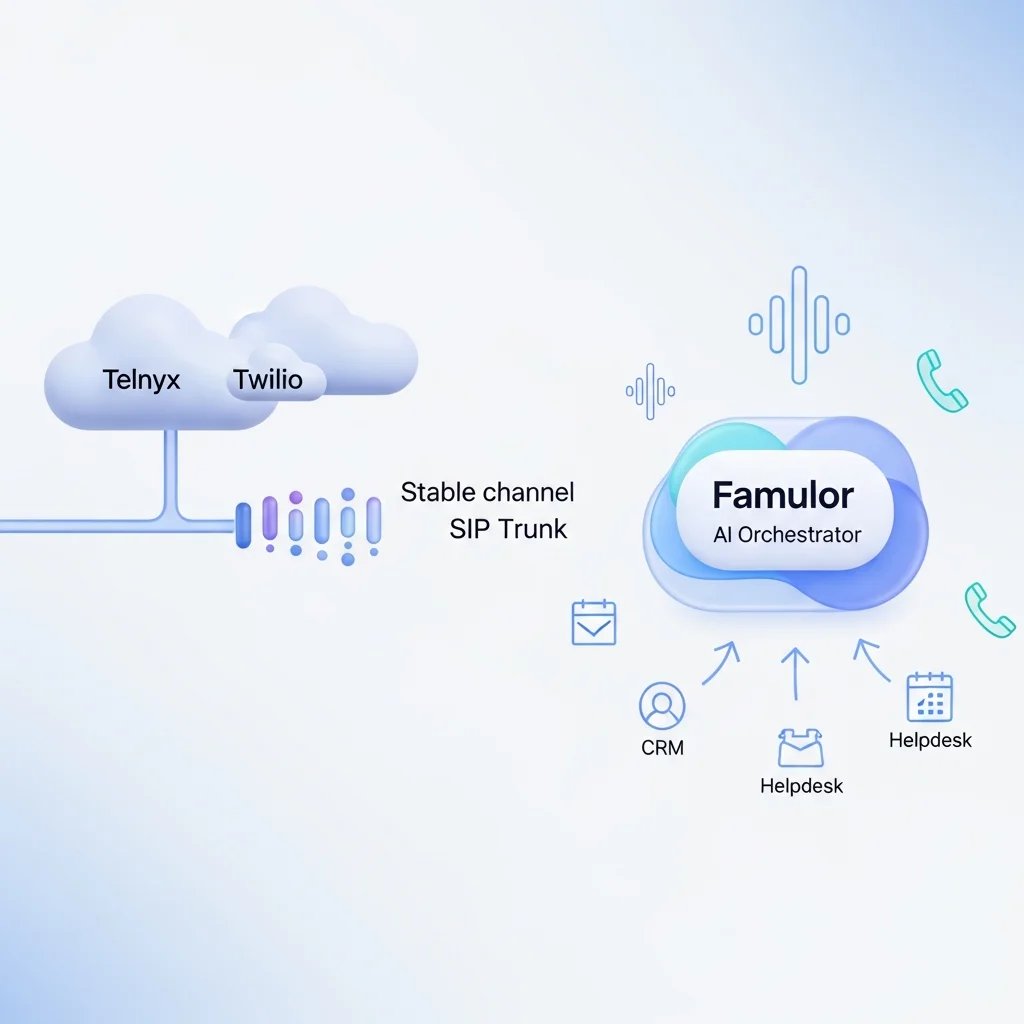
Le SIP s'impose dès que vous avez besoin d'un vrai numéro de téléphone. Un cabinet dentaire souhaitant que l'agent IA réponde au même numéro fixe que les patients appellent depuis dix ans — c'est un problème SIP. Un composeur sortant B2B atteignant des prospects sur leurs téléphones mobiles personnels — SIP. Débordement d'urgence ou hors horaires pour un centre d'appels — SIP. Partout où la conversation commence sur un téléphone classique, le protocole est non négociable : l'appel entre dans votre pile via un trunk SIP provenant d'un opérateur comme Twilio, Telnyx ou votre propre PBX.
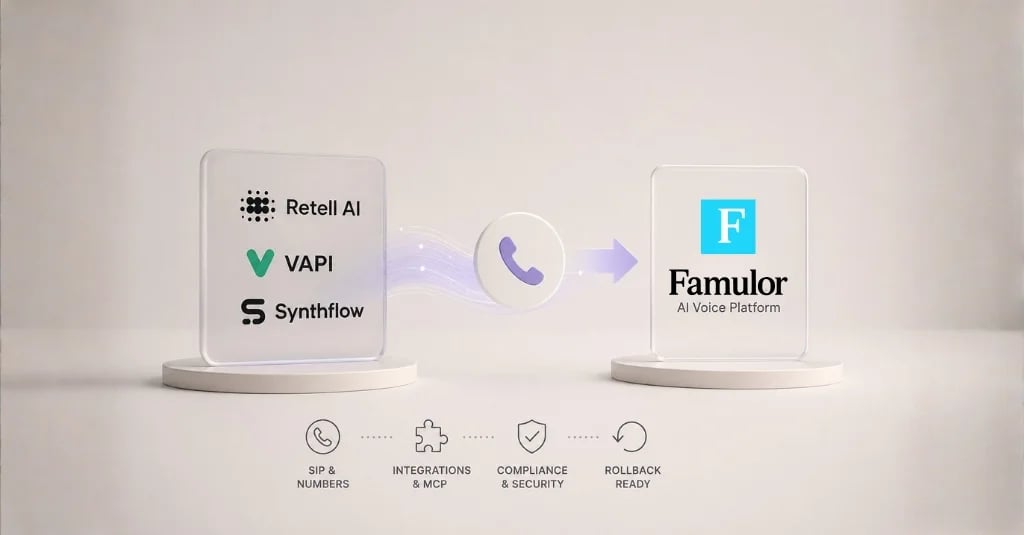
Si vous souhaitez conserver vos numéros existants et votre relation opérateur actuelle, le modèle approprié est le Bring Your Own Carrier (BYOC). Famulor accepte les trunks SIP de n'importe quel opérateur, afin que la portabilité des numéros et les conditions contractuelles restent les vôtres.
L'architecture hybride utilisée par les équipes les plus sérieuses
En production, très peu d'équipes choisissent une seule solution. Le modèle qui s'est cristallisé en 2025 et 2026 est le suivant : la même logique d'agent, les mêmes prompts, les mêmes outils, la même base de connaissances — mais deux chemins d'entrée.
- Entrée WebRTC pour le widget web, l'application iOS et l'application Android. Réponse en moins d'une seconde, aucun coût à la minute.
- Entrée SIP pour le numéro de téléphone publié, les déviations entrantes depuis le PBX existant et les campagnes sortantes vers des destinations PSTN.
- Une passerelle média fait le pont entre les deux : l'audio SIP est transcodé une fois à l'entrée en Opus ou PCM 16 kHz, puis transmis à la même instance d'agent qui alimente le chemin WebRTC.
C'est exactement ainsi que la pile de Famulor est architecturée. Qu'une session arrive via le widget web intégrable ou via un trunk SIP Telnyx ou Twilio, la conversation atteint le même constructeur de flux, la même base de connaissances, les mêmes 300+ intégrations.
Implémentation : une approche étape par étape
Pour une entreprise SaaS typique ajoutant la voix en 2026, voici l'ordre qui minimise les risques et le temps de mise sur le marché.
- Commencez par le navigateur. Ajoutez un widget WebRTC sur le site marketing ou dans l'application connectée. Vous obtiendrez des données d'utilisation, des retours sur les prompts et un impact sur le chiffre d'affaires en quelques jours, sans configuration d'opérateur.
- Ajoutez un numéro de téléphone. Une fois que l'agent est suffisamment performant pour la production, associez-lui un numéro de téléphone routé en SIP. Famulor fournit des numéros directement ou accepte le BYOC.
- Déplacez la ligne principale existante. Lorsque les indicateurs sont clairement positifs, portez le numéro professionnel existant ou configurez un transfert d'appel depuis le PBX vers la route SIP.
- Ajoutez les appels sortants. Réutilisez le même agent pour des appels proactifs — rappels de rendez-vous, qualification de leads, campagnes de reconquête.
- Mesurez et ajustez. Suivez la latence de première réponse, la qualité de gestion des interruptions et le taux de résolution sur les deux transports. Ajustez séparément si nécessaire — WebRTC et SIP ont des profils de gigue différents.
Bonnes pratiques et erreurs courantes
Les erreurs que nous voyons le plus souvent lorsque les équipes déploient leur premier agent vocal IA se répartissent en trois catégories.
Optimiser le mauvais chemin. Les équipes passent des semaines à ajuster une configuration SIP pour un cas d'usage qui ne se produit que dans le navigateur, ou vice versa. Choisissez le transport qui correspond à l'endroit où se trouvent réellement vos utilisateurs, et non celui qui semble le plus impressionnant sur une présentation.
Ignorer les tampons de gigue. WebRTC gère la gigue parfaitement nativement ; le SIP non. Si vous transmettez de l'audio SIP sur l'internet public sans tampon de gigue approprié, le modèle entendra un audio haché et votre fiabilité d'appel s'effondrera.
Oublier le transcodage des codecs. L'audio téléphonique G.711 est en 8 kHz avec un encodage a-law/μ-law. L'injecter directement dans un modèle STT 16 kHz dégrade la précision. Transcodez toujours vers la fréquence d'échantillonnage native du modèle avant la reconnaissance.
Cas d'usage sectoriels
Le choix du transport correspond aux secteurs de manière assez prévisible.
Santé : Les cabinets dentaires et médicaux vivent par les numéros de téléphone — le SIP est la norme. Un widget web est un canal secondaire utile pour les demandes de rendez-vous depuis le site du cabinet.
E-commerce : Le widget web est prioritaire — les clients posent des questions pendant leurs achats. Un numéro de téléphone pour les appels à forte valeur ajoutée ou liés aux retours fonctionne en parallèle sur SIP.
Immobilier : L'hybride est la règle. Les acheteurs appellent les numéros listés (SIP) et discutent également avec l'agent sur le site d'annonces (WebRTC).
Hôtellerie : Très orienté SIP. Les hôtels reçoivent encore la plupart des réservations et demandes de service par téléphone.
Support SaaS : Très orienté WebRTC. Les utilisateurs sont déjà connectés ; la voix est juste une modalité supplémentaire au sein de l'application.
Coût : d'où viennent réellement les factures
La différence économique entre WebRTC et SIP est plus importante que ce que la plupart des équipes anticipent.
WebRTC a un coût opérateur par minute de zéro. Vous payez pour votre infrastructure STUN/TURN, votre inférence IA (STT, LLM, TTS) et la bande passante. Pour une conversation typique de 4 minutes, le coût marginal est essentiellement le coût d'inférence — entre 4 et 15 cents selon les modèles choisis.
SIP ajoute des frais de terminaison opérateur : environ 0,5 à 3 cents par minute pour les appels entrants, plus pour les appels sortants vers les réseaux mobiles. Pour la même conversation de 4 minutes, vous ajoutez 2 à 12 cents au-dessus du coût d'inférence. Sur 100 000 minutes par mois, la différence représente une somme réelle. Famulor publie une tarification à la minute transparente qui sépare ces postes de dépenses afin que les équipes financières puissent modéliser les deux chemins.
Estimez votre ROI en automatisant vos appels
Voyez combien vous pourriez économiser chaque mois grâce aux voice agents IA.
Résultat ROI
ROI 0%
Sans carte bancaire
Pourquoi Famulor gère les deux nativement
De nombreuses plateformes de voix IA vous obligent à choisir. Soit elles se concentrent sur la téléphonie et traitent le navigateur comme une réflexion après-coup, soit elles proposent un produit de widget de chat et font comme si le téléphone n'existait pas. Le résultat : deux fournisseurs, deux jeux de prompts, deux ensembles de métriques et deux surfaces d'intégration.
Famulor est construit sur une instance d'agent unique avec deux chemins d'entrée. La même architecture temps réel gère une session WebRTC depuis le navigateur d'un client et un appel SIP depuis un trunk Telnyx. Vous définissez la conversation une seule fois. Le constructeur de flux, la base de connaissances, les 300+ intégrations (HubSpot, Cal.com, Salesforce, Zapier, n8n, Make) et les actions post-appel fonctionnent tous à l'identique. La conformité est unifiée : hébergement dans l'UE, RGPD par défaut et contrôles alignés sur SOC 2 s'appliquent, que l'audio arrive via un navigateur ou un numéro de téléphone.
Pour les équipes dans des secteurs réglementés, cela compte. Un fournisseur de services financiers ou de santé gérant une configuration hybride avec deux fournisseurs a deux accords de traitement des données, deux chemins de signalement de brèches et deux pistes d'audit. Famulor consolide cela en un seul.
Conclusion
WebRTC et SIP ne sont pas des concurrents — ce sont les deux moitiés d'une pile complète de voix IA. WebRTC domine le navigateur et l'application : le plus rapide, le moins cher, le plus sécurisé pour toute session commençant sur un écran que l'utilisateur regarde déjà. SIP domine le numéro de téléphone : le seul moyen réaliste de se connecter au PSTN que 8 milliards de personnes utilisent déjà. La bonne question en 2026 n'est pas « lequel choisir » mais « comment faire fonctionner les deux sans doubler mon travail ? ». La réponse est une plateforme unique qui abstrait le transport de la logique d'agent. Famulor est cette plateforme — commencez avec le widget web dès aujourd'hui, branchez votre numéro de téléphone cette semaine et exploitez une pile hybride d'ici la fin du mois sans toucher à vos prompts.
Essayez notre Assistant IA
Découvrez à quel point notre assistant téléphonique IA sonne naturel.
Entrez vos coordonnées et recevez un appel de notre agent IA en quelques secondes.
L'agent est formé pour parler des services Famulor et prendre des rendez-vous.

Agent IA de démo
Représentant Famulor
FAQ
WebRTC est-il toujours plus rapide que le SIP ?
Pour la latence du premier paquet, oui — WebRTC délivre généralement l'audio à votre pile IA en 60–120 ms contre 250–400 ms pour un chemin SIP. Une fois la conversation lancée, la différence en régime permanent se réduit, mais l'avantage de WebRTC lors du premier échange est constant et significatif.
Puis-je utiliser WebRTC pour appeler un numéro de téléphone classique ?
Pas directement. WebRTC est une technologie navigateur-à-serveur. Pour atteindre un numéro de téléphone, vous avez besoin d'une passerelle média qui fait le pont entre l'audio WebRTC et un trunk SIP. Famulor le fait de manière transparente si vous souhaitez une expérience de clic-pour-appeler depuis une page web.
Dois-je choisir entre WebRTC et SIP pour mon agent vocal IA ?
Non. La plupart des déploiements en production en 2026 utilisent les deux. La décision se prend par cas d'usage : les sessions web et in-app passent par WebRTC, les numéros de téléphone par SIP. Une instance d'agent unique doit gérer les deux.
Lequel est le plus sécurisé, WebRTC ou SIP ?
WebRTC impose le chiffrement SRTP de bout en bout. Le SIP prend en charge le SRTP, mais en pratique, de nombreux déploiements utilisent encore du RTP non chiffré entre les opérateurs. Pour les données sensibles, WebRTC est plus sûr par défaut ; pour le SIP, exigez une signalisation TLS et un média SRTP auprès de votre opérateur.
Famulor prend-il en charge le BYOC (Bring Your Own Carrier) ?
Oui. Famulor accepte les trunks SIP de tout opérateur majeur, y compris Twilio, Telnyx, Plivo, sipgate, Deutsche Telekom et les systèmes PBX sur site. Vous conservez vos numéros et vos contrats opérateurs.
Quelle est la cible de latence pratique pour une IA conversationnelle en 2026 ?
La latence de bout en bout pour le premier échange devrait se situer entre 500 et 1200 ms, avec des échanges en régime permanent entre 300 et 600 ms. Les sessions WebRTC peuvent atteindre le bas de cette fourchette ; des configurations SIP bien optimisées peuvent atteindre le milieu de la plage.
Puis-je migrer progressivement d'une configuration SIP uniquement vers une configuration hybride WebRTC + SIP ?
Oui. Le chemin standard consiste à maintenir la route SIP en place, à ajouter un widget WebRTC sur le site web ou dans l'application, et à router les deux vers le même agent. Aucun changement de prompt n'est requis — seule la configuration d'entrée est nécessaire.
WebRTC fonctionne-t-il sur les réseaux mobiles ?
Oui, sur 4G et 5G, cela fonctionne très bien. En cas de repli sur une connexion 2G/3G médiocre, WebRTC se dégradera gracieusement, mais vous pourriez préférer un repli SIP pour une portée garantie. L'instance d'agent de Famulor peut router le même appel via les deux chemins en fonction de la qualité du réseau.

Rédacteur chez Famulor