Summarize Content With:




Deepfake Call Detection: How Your AI Phone Agent Guards Against Voice Fraud in 2026
A phone call from the CEO. Urgent, confidential — please wire 200,000 dollars to the new vendor before end of business. The voice is perfect. The tone is right. Except it is not your CEO. It is an AI-generated voice, cloned from three seconds of a podcast recording. Welcome to the reality of voice fraud in 2026.
The threat from deepfake voices has moved far beyond speculation — it is costing businesses billions. In the United States alone, deepfake fraud losses reached $1.1 billion in 2025, triple the prior year. Roughly 400 companies face CEO deepfake attacks every single day. And the human ear? It correctly identifies AI-generated voices in just 0.1 percent of cases.
For businesses already using or planning to deploy an AI phone agent, there is a critical question: How can the same technology that automates calls also protect against voice-based fraud?
Why Voice Fraud Is So Dangerous in 2026
Voice cloning technology has advanced dramatically over the past 18 months. What once required minutes of high-quality audio now works with just three seconds — pulled from a conference recording, a YouTube video, or a LinkedIn podcast. The success rate is alarming: 77 percent of voice clone fraud targets actually lost money.
Attack patterns have become professionalized. Criminals combine cloned voices with spoofed phone numbers and researched company details to build convincing scenarios. The largest documented case so far: an employee in Hong Kong transferred $25.6 million to criminals after a deepfake video call.
The Three Most Common Attack Scenarios
In the business environment, three deepfake scenarios dominate that every organization should understand:
- CEO fraud by phone: Attackers clone the executive's voice and call employees in finance. The tactic relies on authority and manufactured urgency — "This needs to be done before the board meeting."
- Vendor impersonation: A cloned voice of your known supplier contact requests a bank account change for future invoices. Classic business email compromise, but by phone and therefore harder to document.
- Customer identity theft: Fraudsters call your support line with a cloned customer voice and request changes to account details, delivery addresses, or passwords.
Deepfake Attacks by the Numbers: The 2026 Threat Landscape
To understand the scale of the problem, consider the data. Deepfakes accounted for 6.5 percent of all global fraud attempts in 2025, up from 0.1 percent in 2022 — a 65-fold increase in just three years. More alarming still: vishing attacks (voice phishing) using AI-cloned voices surged 1,633 percent in Q1 2025 compared to the previous quarter.
The barrier to entry for attackers continues to drop. Open-source voice cloning tools are freely available, and commercial services offer voice cloning for a few dollars. This means that not only sophisticated criminal organizations but also opportunistic fraudsters now have access to the technology.
For small and mid-sized businesses, the risk is often higher than for enterprises. They typically handle significant transaction volumes but with less formalized approval workflows. A successful attack against a 50-person company can be existential — the average fraud loss of $55,000 to $275,000 represents months of profit for many SMBs.
Why Technical Detection Alone Falls Short
Many companies search for the single tool that reliably detects deepfakes. The reality is sobering: current AI detection tools lose 45 to 50 percent of their laboratory accuracy under real-world conditions. Background noise, phone line compression, and varying codecs make real-time detection during a live call extremely unreliable.
The consensus among security experts is clear: the defense is a process, not a product. Technical detection can be one building block, but without organizational controls, every company remains vulnerable.
The Five-Layer Defense Against Voice Fraud
Effective protection against deepfake calls combines five defense layers. Each one reduces risk individually — together, they make successful attacks nearly impossible.
Layer 1: Verification Protocols for Every Critical Call
The most important measure is also the simplest: every phone instruction involving money, credentials, or sensitive data gets confirmed through a second, pre-agreed channel. If the CEO calls requesting a wire transfer, an employee confirms via internal chat, SMS to the registered number, or in person — never through the same channel.
A modern AI phone agent with security protocols can automate this process: when certain keywords or actions are triggered — such as a bank detail change — the voice agent automatically launches a verification workflow before the action is executed.
Layer 2: Dual-Approval for Financial Transactions
No single phone call — no matter how convincing — should ever be sufficient to trigger a payment above a defined threshold. A dental practice like Dr. Weber's in Munich implements a straightforward system: every expense over 5,000 euros requires approval from two people, and phone-based payment instructions are logged as tickets, never executed directly.
Layer 3: AI-Powered Call Analysis in Real Time
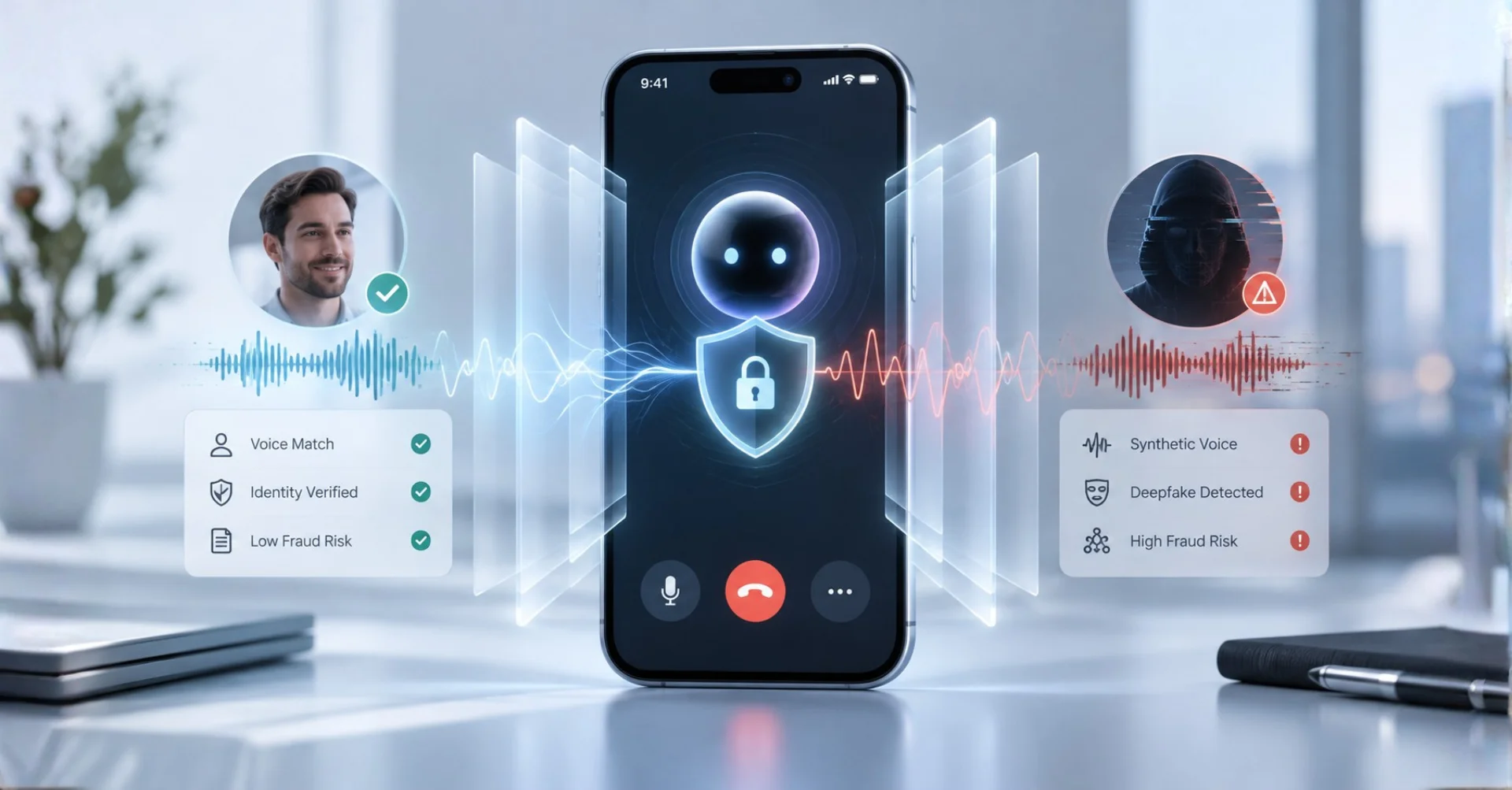
This is where an intelligent phone assistant outperforms a traditional phone system. Platforms like Famulor can analyze voice patterns and use mid-call tools to flag suspicious calls automatically. Detection works through multiple signals:
- Caller ID verification: Does the displayed number match the stored contact number?
- Behavioral analysis: Is the caller manufacturing urgency? Do they deflect when questioned?
- Automatic escalation: When suspicion arises, the AI agent transfers the call to a trained employee — with a warning in the dashboard.
Layer 4: Employee Training and Security Culture
The best technology is of little use if employees do not know what to watch for. Regular training on current fraud tactics is essential. Most importantly: every employee — including interns and new hires — must understand their right to invoke a verification process, even if the caller claims to be the board chair.
The key principle for every team: urgency is the warning sign, not the voice. Real executives understand security processes. Fraudsters rely on time pressure.
Layer 5: Securing the Technical Infrastructure
The final layer addresses the technical foundation: phishing-resistant multi-factor authentication (MFA) for all systems that process payments or sensitive changes. Passkeys instead of SMS codes. And a clear separation between the channel that receives an instruction and the channel that confirms it.
How an AI Phone Agent Actively Prevents Deepfake Fraud
A professionally configured AI phone agent is not just an automation tool — it is an active security component. Here is how protection works in practice:
| Security Feature | How It Works | Outcome |
|---|---|---|
| Automatic caller ID check | Incoming number is matched against stored contact database | Unknown or spoofed numbers are flagged immediately |
| Mid-call verification | For sensitive actions, the agent requests confirmation via a second channel | No single phone channel can cause damage |
| PII redaction | Personal data is automatically masked in transcripts | Even a successful deception does not expose sensitive data |
| Automatic escalation | Suspicious calls are routed to trained employees | Human-in-the-loop for every suspicious case |
| Complete audit trail | Every call is transcribed and tagged with metadata | Forensic traceability for all incidents |
Famulor delivers all of these features as an integrated platform — with GDPR-compliant PII redaction, EU hosting, and configurable mid-call tools that trigger verification workflows automatically.
Real-World Example: How a Mid-Sized Company Stopped Voice Fraud
Richter Furniture Manufacturing, based in Bielefeld, Germany (45 employees), received a call in April 2026 from "their accountant" asking to update the bank details for the next invoice. The voice sounded authentic, and the number was spoofed.
Because Richter had deployed Famulor as their phone assistant since early 2026, the call was first handled by the AI agent. The agent recognized that the request involved a bank detail change and automatically triggered two actions: first, it informed the caller that bank detail changes can only be processed in writing via the verified email channel. Second, the system sent a notification to the accounting team flagging the change request.
The accountant called the real advisor back on the registered number — and learned that no such call had been made. The fraud attempt was stopped before any damage could occur.
The Cost of Voice Fraud vs. the Cost of Prevention
The investment in protection measures is minimal compared to potential losses. A comparison:
| Cost Category | Voice Fraud Damage (Average) | Prevention Cost (Annual) |
|---|---|---|
| Direct financial loss | $55,000–$275,000 per incident | — |
| Forensic investigation | $16,000–$44,000 | — |
| Reputational damage | Incalculable | — |
| AI phone agent with security features | — | From $1,300 (Famulor) |
| Employee training (2× per year) | — | $2,200–$5,500 |
| Verification process implementation | — | One-time: 1–2 work days |
A single successful deepfake attack can cost a hundred times more than the annual investment in prevention. The question is not whether prevention pays off, but whether you can afford to go without it.
Estimate your ROI from automating calls
See how much your business could save by switching to AI-powered voice agents.
ROI Result
ROI 0%
No credit card required
7-Day Checklist: Implement Voice Fraud Protection
Regardless of your company size, you can establish fundamental protection within one week:
- Day 1–2: Define financial thresholds above which dual-factor confirmation is mandatory for all transactions.
- Day 2–3: Create a verified contact directory with confirmed phone numbers and email addresses. Store it in your CRM or AI phone assistant.
- Day 3–4: Configure your AI phone agent with mid-call verification rules for sensitive actions.
- Day 4–5: Conduct a 30-minute training session for all employees — focus on recognizing urgency tactics and the right to demand verification.
- Day 5–6: Enable PII redaction and call logging in your phone system.
- Day 6–7: Test the entire process with a simulated social engineering call.
Industry-Specific Risks: Who Is Most Vulnerable?
Voice fraud affects any organization with phone communications, but certain industries face disproportionate risk.
Financial services and accounting firms: Regular wire transfers in the five- to six-figure range make them prime targets. One accounting practice in Germany reported three deepfake attempts in the first half of 2026 alone — each using cloned voices of clients purportedly authorizing urgent transfers.
Real estate: Closing payments, escrow transfers, and deposit wires involve high individual amounts. A single successful attack can cause six-figure losses in this sector.
Manufacturing and trades: Companies that work with rotating subcontractors often rely on informal communication channels. The Richter Furniture case in our practical example demonstrates how an AI phone agent can secure exactly this vulnerability.
Healthcare: Medical practices and clinics are at risk not only for financial transactions but also for sensitive patient data. A deepfake call posing as a patient and requesting health records can trigger GDPR-relevant data breaches with serious legal consequences.
GDPR and the EU AI Act: Regulatory Advantages Against Voice Fraud
The regulatory framework in Europe actually gives businesses an advantage in fighting voice fraud. GDPR already requires data minimization and documented processes — exactly the structures that also protect against deepfake attacks.
The EU AI Act, whose provisions have been in force since August 2026, classifies deepfake generation as an AI system with transparency obligations. Companies using AI phone systems benefit doubly: they must make their own systems transparent — and can simultaneously require business partners to disclose their AI usage.
Famulor, as a European platform with a privacy-by-design architecture and EU hosting, meets these requirements natively — without additional compliance overhead.
Conclusion: Security Starts at the First Ring
Deepfake voice fraud in 2026 is not a theoretical threat — it is a documented, billion-dollar problem. But the good news is that the most effective countermeasures are organizational in nature and can be implemented within a single week.
An intelligently configured AI phone agent is not just an automation tool but your first line of defense. It verifies callers, enforces verification processes, and documents every contact without gaps — 24 hours a day, 7 days a week.
Famulor combines these security features with powerful call automation in over 40 languages, seamless CRM integration, and GDPR-compliant EU hosting. Protect your business from voice fraud while automating your phone communications at the same time.
Try our AI Assistant
Experience how natural our AI phone assistant sounds.
Enter your details and receive a call from our AI agent within seconds.
Agent is trained to discuss Famulor services and book appointments.

Demo AI agent
Famulor representative
FAQ
What is a deepfake phone call?
A deepfake phone call uses AI-cloned voices to impersonate another person over the phone. Just three seconds of audio are enough to create a convincing voice clone that the human ear can barely distinguish from the real voice.
How common are deepfake voice attacks on businesses?
Approximately 400 companies worldwide face CEO deepfake attacks daily. Vishing attacks using AI-cloned voices surged by over 1,600 percent in Q1 2025 compared to the previous quarter.
Can AI tools reliably detect deepfake voices?
Not under real-world conditions. Detection tools lose 45 to 50 percent of their laboratory accuracy during actual phone calls. Experts recommend verification processes rather than relying solely on detection technology.
How does an AI phone agent protect against voice fraud?
An AI phone agent like Famulor checks caller IDs, enforces dual-channel confirmation for sensitive actions, and automatically routes suspicious calls to human employees for review.
What does deepfake fraud prevention cost?
An AI phone agent with security features starts at approximately $1,300 per year. A single successful deepfake attack causes average damages of $55,000 to $275,000.
Is voice fraud regulated under GDPR and the EU AI Act?
Yes. The EU AI Act classifies deepfake generation as an AI system subject to transparency obligations. GDPR requires data minimization and documented processes that simultaneously serve as fraud protection.
Which industries are most at risk?
Financial services, real estate, and manufacturing companies with regular large wire transfers are primary targets. However, SMBs with less formalized approval processes are increasingly affected as well.
How quickly can I implement fraud protection measures?
Basic verification protocols and a configured AI phone agent can be deployed within seven days. The most impactful immediate step is introducing dual-approval for all payments above a defined threshold.
Protect your business from voice fraud today. Try Famulor for free and configure your AI phone agent with built-in security protocols — in under 30 minutes, no coding required.
Writer at Famulor