Inhoud samenvatten met:




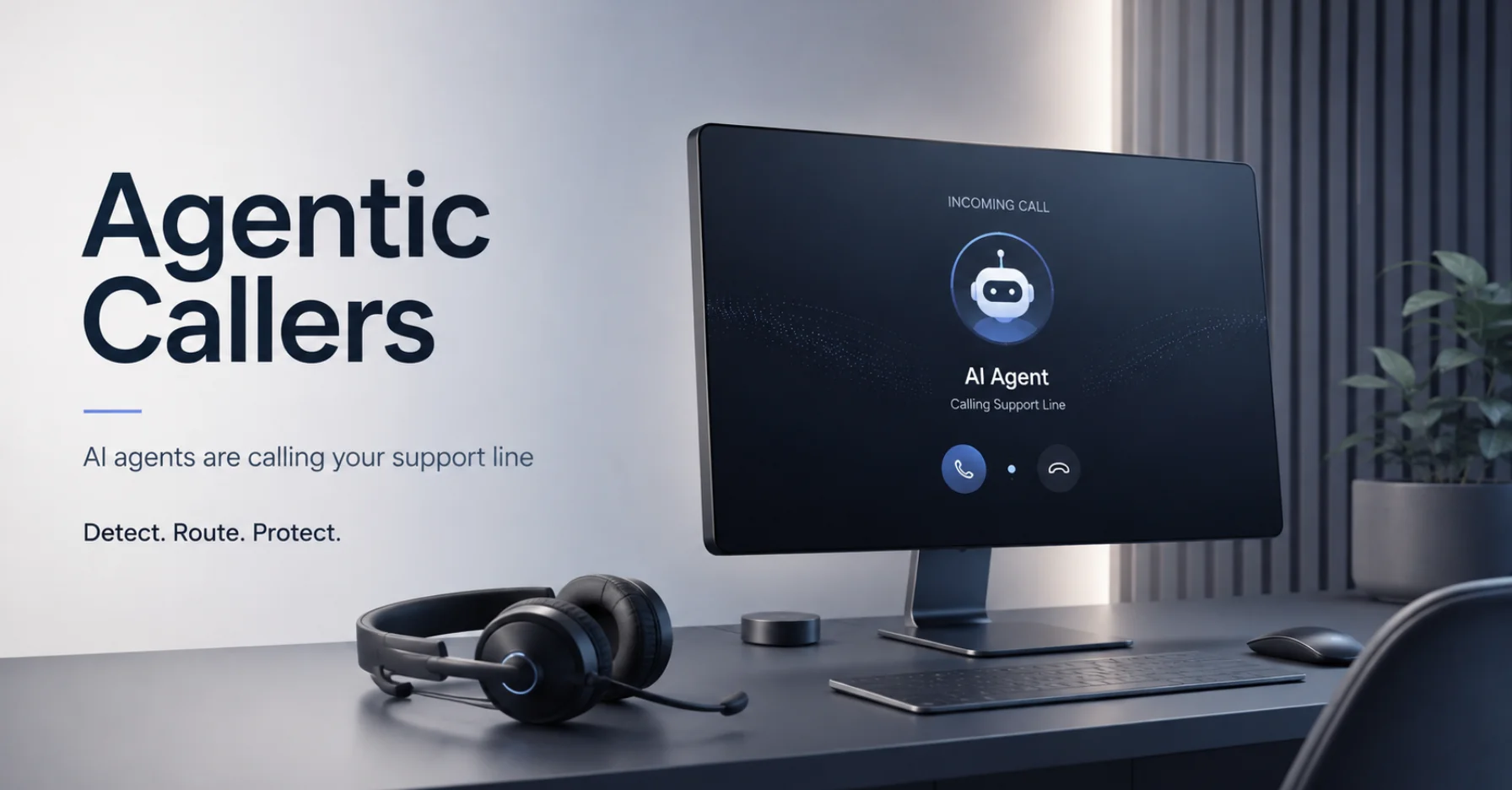
Agentic Callers: When AI Agents Call Your Support Line
An agentic caller is an autonomous AI agent that dials your service number on behalf of a person or another system, works through your IVR and holds a full conversation. Unlike a robocall it does not follow a fixed script — it adapts, and that is precisely why conventional detection patterns fail to catch it. If you run an inbound line in 2026, assume a growing share of your incoming calls no longer comes from humans.
The short answer for operations leads: you cannot block agentic callers wholesale without blocking legitimate customer requests along with them. The workable approach is an inbound agent that identifies machine callers, routes them onto their own path and serves them in a structured way — instead of dropping them into the same queue as human callers. That is exactly what the Famulor Flow Builder and mid-call tools were built for.
What an agentic caller is — and how it differs from a robocall
The starting point for this discussion is a post by Gabe Regan, VP of Human Engagement at Reality Defender, which Biometric Update covered in July 2026. Regan describes a shift many contact centres have not yet accounted for: the infrastructure was built for human callers with occasional bot probes — not for autonomous AI agents operating at scale.
Regan cites a Gartner forecast that by 2029 AI will autonomously resolve around 80 percent of common customer service issues without human intervention. His central point is that a substantial share of those interactions will not consist of companies deploying AI to answer calls — but of AI systems placing the calls themselves.
A robocall is a mass dialling operation with pre-recorded audio. It breaks down on follow-up questions, on unusual IVR structures, on anything that deviates from the expected path. An agentic caller, by contrast, listens to the IVR menu, selects the right option, answers security questions correctly and then holds an adaptive conversation with whoever — human or AI — sits at the other end. Nothing in the interaction pattern flags the call as non-human, because these systems were built specifically to avoid triggering those flags.
Why conventional fraud detection fails on agentic callers
Contact centre fraud detection classically works on behavioural anomalies: unusual call times, failed authentication, erratic IVR navigation, numbers from suspect ranges. Regan explains why those signals come up empty against agentic callers. They call from numbers that pass carrier validation, navigate IVR menus at normal speed, select the correct option on the first attempt and answer security questions with accurate information. They do not fail authentication and they do not generate unusual account activity.
This is not coincidence but design intent. Anyone building an agent that reliably completes tasks for its user inevitably optimises it for exactly the behavioural patterns that fraud detection keys on.
| Signal | Human caller | Classic robocall | Agentic caller |
|---|---|---|---|
| Carrier validation of the number | passes | often flagged | passes |
| IVR navigation | normal, sometimes erratic | rigid or drops out | normal, correct on first attempt |
| Response to follow-up questions | flexible | fails | adaptive |
| Authentication | occasional failed attempts | usually fails | correct |
| Unusual account activity | rare | frequent | rare |
| Detectable via behavioural analysis | — | yes | no |
The practical consequence: behaviour-based rules are no longer sufficient to decide how a call should be handled. That decision has to happen earlier — before the call reaches the queue.
The four caller types landing in your queue in 2026
It helps to stop splitting the call stream binarily into human and bot, and instead work with four categories that each warrant different handling. This is the operational point Regan emphasises: a human calling to resolve a billing dispute is a service request. An AI agent navigating the same IVR and reaching the same queue consumes capacity without generating a human service interaction.
| Type | Intent | Correct handling |
|---|---|---|
| Human with a request | legitimate | standard path, full conversational depth |
| Customer's delegated AI agent | legitimate, machine | separate path, structured data return, point to API where available |
| Probing AI agent | unclear to abusive | step-up verification, restrict sensitive actions |
| Classic robocall | spam | early disconnect |
The second type is the interesting case. A customer whose assistant calls to check a delivery date has an entirely legitimate request — just in machine-readable form. Block that caller and you block the customer. Treat them like a human and you waste conversational time on pleasantries and confirmation loops a machine does not need.
The hidden cost: distorted metrics
The effect Regan describes as most insidious is not the individual call but the gradual change in the composition of inbound volume. Average handle time rises, queue performance declines, answer rates slip. That looks like a capacity or skills problem — and gets treated as one, with extra headcount or training. The actual cause stays invisible.
A concrete example: a utility provider with 40 service staff and roughly 9,000 calls per month watches its average handle time climb from 4:10 to 4:50 minutes over a single quarter. That works out to well over 100 additional person-hours per month. Without caller-type classification there is no way to say whether the driver is more complex requests, weaker processes or a growing share of machine callers. With classification, the question takes five minutes to answer.
One important qualification: machine callers are not inherently expensive. They become expensive when you serve them with human-shaped handling. An agentic caller that gets a tracking number in a structured 40-second exchange costs less than any human call. The same call routed through a hold queue and a human agent costs many times more. The decision sits in the routing, not in the blocking.
Bereken je ROI met geautomatiseerde gesprekken
Ontdek hoeveel je per maand bespaart via AI voice agents.
ROI Resultaat
ROI 0%
Geen creditcard nodig
Playbook: designing your inbound agent for agent-to-agent traffic
The good news: if you already run an AI-powered inbound agent, the hard part is behind you. Adapting to machine callers is a configuration task, not a platform migration. Six steps in a sensible order:
- Classify before routing. Establish in the first conversational step whether you are dealing with a human or a machine caller. Reality Defender argues for acoustic detection of synthetic voices — compression artefacts, frequency anomalies, generation signatures — ahead of routing. A direct in-conversation question works as a complement: "Are you calling yourself, or on behalf of an assistant?" Honest agents answer accurately.
- A separate path, not a shared queue. Build a dedicated branch for machine callers in the Flow Builder. Short sentences, no pleasantry loops, no filler audio, direct data return. That saves time on both sides.
- Least privilege for mid-call tools. Separate read actions from write actions. A machine caller may query shipment status — address changes, cancellations or payouts go through an additional verification step. The documentation on custom mid-call tools covers how to scope tools cleanly.
- Step-up verification at clear thresholds. Define when an additional confirmation becomes mandatory — changes to master data, payment operations, or anything above a set amount. That threshold belongs in the prompt and the tool definition, not in the agent's head.
- Keep human escalation available. Maintain a clean handover path. When classification is uncertain or a sensitive operation is pending, a human belongs in the loop. The assistant best practices describe how handovers work without losing context.
- Write caller type into your reporting. Log the classification as a field in the call log and push it to your CRM via webhook. Only then can you break out AHT, containment and cost per call by caller type — and base capacity decisions on data rather than assumption.
Three concrete scenarios
Online shop with 5,000 orders per month. A growing share of status enquiries comes from customers' assistants. The inbound agent recognises them, delivers tracking number and delivery date in a single sentence and ends the call after 35 seconds. Return requests, by contrast, require confirmation via the number on file.
Insurance broker with 15 new enquiries per day. Here the machine caller is usually a comparison assistant querying tariff details. The agent releases publicly available terms in structured form but declines any information on existing policies without verification through a second channel.
Municipal utility with 9,000 calls per month. Meter readings submitted by assistants run through a short structured path, including a plausibility check on the reported value. Tariff switches and bank detail changes are closed to machine callers and handed to a human without exception.
Common implementation mistakes
- Blanket blocking of machine callers. Hits legitimate customer requests and produces complaints nobody traces back to the blocking rules.
- Classification without consequence. Detecting caller type but treating everyone identically just adds a field to the log.
- Verification in the wrong place. A security challenge at the start of the call slows everyone down. It belongs immediately before the sensitive action.
- No API alternative. If the same data is available through a documented interface, the machine path should say so. That relieves the phone channel permanently — Famulor ships the routes for it via 300+ integrations and webhooks.
- Configure once and forget. Calling agents keep getting more capable. Classification logic belongs in the quarterly review.
Conclusion
Agentic callers are no longer a fringe phenomenon but a foreseeable shift in the composition of inbound call volume. The wrong response is to treat them as a fraud problem and lock them out — that catches legitimate customer requests. The right response is to recognise them as a distinct caller type, give them an efficient path, and put sensitive actions behind additional verification.
Famulor lets you model exactly that without a development project: classification within the conversation, separate branches in the Flow Builder, tiered permissions for mid-call tools and a clean handover to humans where it matters. Your next concrete step: take your three most common inbound requests, define a short machine path and a verification threshold for each, and build them in a no-code voice agent. An hour is enough for a first test run.
Probeer onze AI-assistent
Ervaar hoe natuurlijk onze AI-telefoonassistent klinkt.
Vul uw gegevens in en ontvang binnen enkele seconden een oproep van onze AI-agent.
De agent is getraind om over Famulor-diensten te praten en afspraken te maken.

Demo AI agent
Famulor representative
FAQ
What is an agentic caller?
An agentic caller is an autonomous AI agent that dials a service number on behalf of a user or system, works through the IVR and holds an adaptive conversation. Unlike a robocall it follows no fixed script.
How does an agentic caller differ from a robocall?
A robocall plays pre-recorded audio and fails on follow-up questions. An agentic caller listens to the IVR menu, selects correctly, answers security questions and responds flexibly to unexpected turns.
Why do conventional fraud systems miss agentic callers?
Because they key on behavioural anomalies. Agentic callers dial from validated numbers, navigate the IVR at normal pace and pass authentication — they produce exactly the signals classed as unremarkable.
Should I simply block machine callers?
No. A share of these calls comes from real customers' assistants with legitimate requests. A short dedicated conversational path with tiered permissions for sensitive actions works better.
How do I identify a machine caller during the call?
Two methods combine well: acoustic analysis of synthetic voices before routing, and a direct question in the first conversational step asking whether the call is placed on behalf of an assistant.
Do agentic callers distort my contact centre metrics?
Yes. Rising average handle time and weaker queue performance look like a capacity problem but may stem from a growing share of machine callers. Without classification in the call log the two cannot be separated.
Which actions should a machine caller not be able to trigger?
As a rule of thumb, anything that writes with financial or identity impact. Address changes, bank details, cancellations and payouts belong behind an additional verification step or with a human.
How quickly can this be implemented with Famulor?
A first path typically takes about an hour. Add a classification step in the Flow Builder, define the machine branch, split mid-call tools into read and write, and set the verification threshold.
Does this apply to WhatsApp and web chat too?
In principle yes, with different signals. Text channels lack acoustic analysis, but pace, formatting and usage patterns are informative. The logic of classification, separate path and tiered permissions stays the same.
Auteur bij Famulor