Inhoud samenvatten met:




AI Call Center ROI: A Realistic 90-Day Payback Model
The question is no longer whether AI phone agents are cheaper than human call center agents. That debate is settled. The real question is: how fast does the switch pay for itself? In this article, we build a concrete model showing how a mid-sized business handling 10,000 monthly calls achieves positive ROI within 90 days – with a framework you can adapt to your own numbers.
What Does a Traditional Call Center Actually Cost?
Most businesses significantly underestimate their true call center costs. According to current industry data, labor expenses represent up to 95% of contact center operational costs. But agent salaries are just the tip of the iceberg.
The Hidden Cost Drivers
A call center agent in the US costs $28–42 per hour including benefits and overhead. With an average handle time of 4–7 minutes plus after-call work, the true cost lands at $5–12 per call. Then come the costs that never appear on any pricing sheet:
- Recruiting and onboarding: Hiring a replacement agent costs $10,000–20,000 – with industry-standard turnover rates of 30–45% annually, this is a permanent budget drain.
- Training and quality assurance: Ongoing coaching, QA monitoring, and skills development consume 15–20% of team lead capacity.
- Infrastructure: Workstations, telephony licenses, CRM seats, and IT support add $500–1,500 per agent per month.
- Downtime: Sick days, vacation, breaks, and idle time reduce productive availability to 70–75% of paid hours.
For a business handling 10,000 monthly calls with a ten-agent team, true total costs reach $35,000–55,000 per month – far more than raw salary figures suggest.
What Does an AI Phone Agent Cost in Comparison?
AI-powered voice agents operate on an entirely different cost structure. Platforms like Famulor charge based on actual usage – typically $0.07–0.15 per conversation minute. With an average call duration of 3–5 minutes, that translates to $0.21–0.75 per call.
| Cost Factor | Traditional Call Center | AI Phone Agent (Famulor) |
|---|---|---|
| Cost per call | $5–12 | $0.21–0.75 |
| Monthly cost (10,000 calls) | $35,000–55,000 | $2,100–7,500 |
| Availability | 8–12 hours (Mon–Fri) | 24/7/365 |
| Scaling for peak demand | Weeks (recruiting + training) | Instant, automatic |
| Language support | 1–3 languages (premium pricing) | 40+ languages included |
| Setup costs | $10,000–50,000 | $0 (no-code setup) |
| After-call work | 2–5 minutes per call | Automatic (webhook + CRM) |
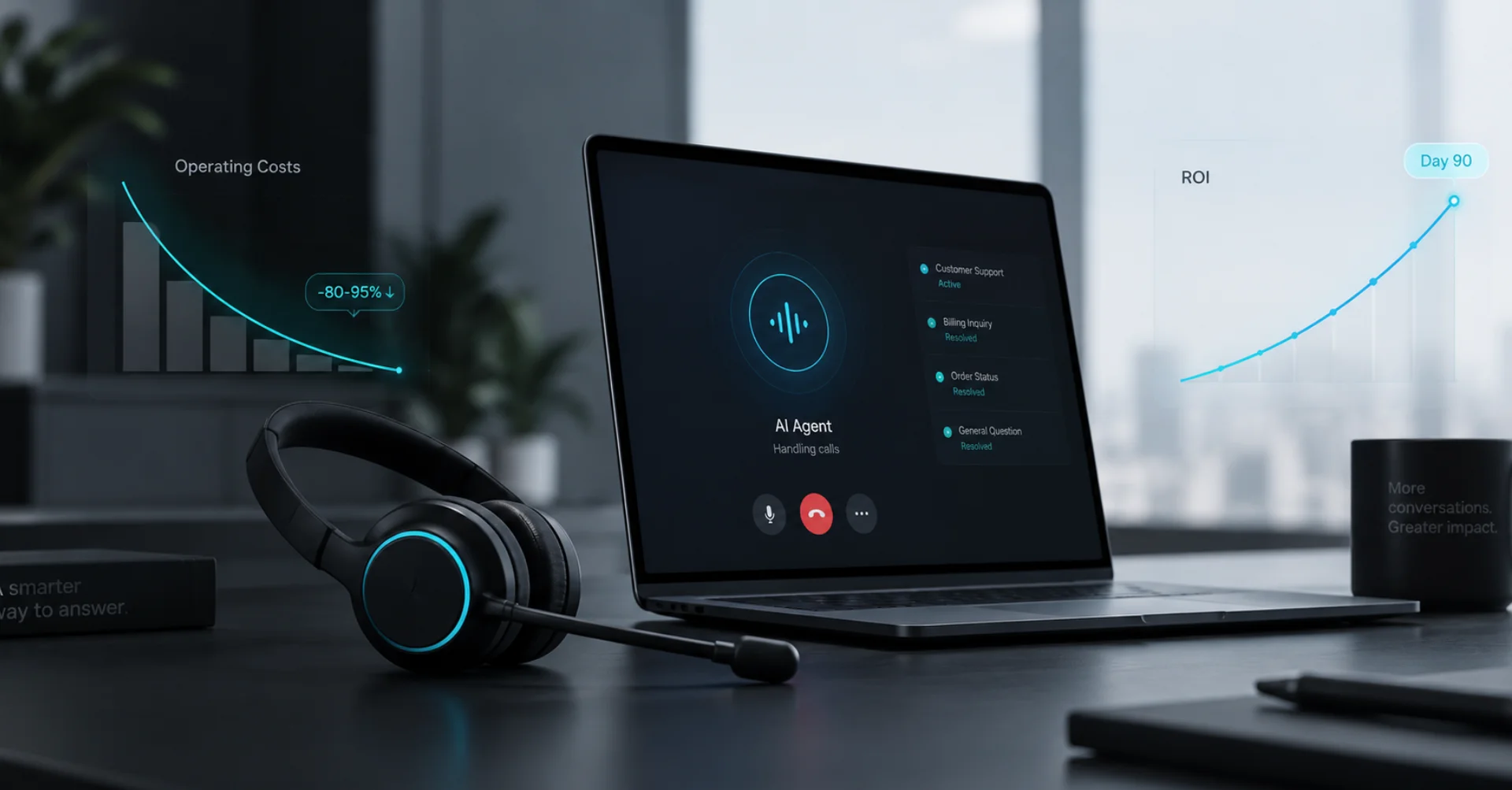
The savings come to 80–95% of direct call costs. But ROI is more than lower costs – it's about the timeline to break-even.
The 90-Day Payback Model: A Worked Example
Let's use a concrete scenario: Greenfield Property Management, a fictional company with 60 employees across three locations. They handle roughly 8,000 inbound calls per month – maintenance requests, tenant inquiries, lease questions, and callback requests.
Starting Position (Day 0)
Greenfield runs an in-house reception team of four full-time agents plus an overflow answering service. Total monthly costs: $22,400 (4 × $3,800 loaded labor + $2,800 overflow service + $1,200 telephony and software).
Phase 1: Setup and Parallel Operation (Days 1–30)
In the first phase, the Famulor AI phone agent runs alongside the existing team. Thanks to the no-code builder, basic configuration takes hours, not weeks. The AI agent handles 40% of standard inquiries – appointment scheduling, office hours, and routine status updates.
- AI costs (40% of 8,000 calls × $0.45): $1,440
- Staff remains fully staffed: $22,400
- Total cost month 1: $23,840 (investment phase)
Phase 2: Optimization and Scaling (Days 31–60)
After 30 days, meaningful data is available. Call transcripts reveal which call types the AI agent handles reliably and where fine-tuning is needed. Automation rate increases to 65%. One full-time agent transitions to field operations, and the overflow service contract is terminated.
- AI costs (65% of 8,000 calls × $0.45): $2,340
- Staff (3 agents): $11,400
- Total cost month 2: $13,740
- Savings vs. baseline: $8,660
Phase 3: Full Hybrid Operation (Days 61–90)
In month three, the AI agent handles 80% of all calls. Two specialized staff members handle complex cases – complaints, technical consultations, and key account management. Outbound campaigns are activated: automated appointment confirmations and follow-up calls for open proposals.
- AI costs (80% of 8,000 calls × $0.45): $2,880
- Staff (2 agents): $7,600
- Total cost month 3: $10,480
- Savings vs. baseline: $11,920
90-Day Summary
| Metric | Without AI (3 Months) | With Famulor (3 Months) |
|---|---|---|
| Total costs | $67,200 | $48,060 |
| Cumulative savings | – | $19,140 |
| Availability | 45 hrs/week | 168 hrs/week |
| Missed calls | ~15% | <2% |
| Languages | English only | 40+ languages |
The parallel-operation investment in month one ($1,440 extra) pays for itself completely in month two. From month three onward, Greenfield saves nearly $12,000 per month – with better availability and higher customer satisfaction simultaneously.
Bereken je ROI met geautomatiseerde gesprekken
Ontdek hoeveel je per maand bespaart via AI voice agents.
ROI Resultaat
ROI 0%
Geen creditcard nodig
Five ROI Levers Beyond Pure Cost Savings
1. Revenue Growth Through 24/7 Availability
Research shows that 43% of customers report dissatisfaction with received service – often due to poor availability. An AI agent that takes a maintenance request at 11 PM and logs it directly into your booking system captures revenue that would otherwise be lost. For Greenfield, this meant an average of 12 additional work orders per month worth $18,000.
2. Faster Lead Response Time
Speed of initial response directly impacts conversion rates. An AI agent responds in under 2 seconds – not the 25-second industry average. This measurably improves lead conversion by 15–30%.
3. Automated After-Call Processing
Every call automatically generates a structured summary that flows to your CRM, ticketing system, or ERP via webhooks and automations. That eliminates 2–5 minutes of manual post-call work per interaction – at 8,000 monthly calls, that's 270–670 staff hours recovered.
4. Instant Scaling Without Lead Time
Seasonal fluctuations, marketing campaigns, or unexpected events – an AI call center scales instantly. No recruiting, no training, no waiting. Costs scale linearly with volume, not exponentially.
5. Data-Driven Optimization
Every conversation is analyzed. The analytics dashboard shows in real time which call types occur most frequently, where callers drop off, and which topics require escalation. This data feeds directly into process improvement.
Industry Examples: ROI by Sector
Payback timelines vary by industry and call profile. Three representative scenarios illustrate how the math works across different business types – and why the outcome is almost universally positive.
Healthcare: Medical Practice With 3,000 Monthly Calls
An orthopedic clinic with two locations replaces its phone service with an AI agent handling appointment scheduling, prescription refill requests, and referral inquiries. Before: two front-desk staff at $3,200 each plus an external answering service at $1,800 per month. After: AI costs of $810 monthly (60% automation × 3,000 calls × $0.45) plus one receptionist for in-person patient interactions. Monthly savings: $4,990. Payback: under 45 days. The critical bonus: the practice no longer loses patients to competitors because the phone went unanswered during lunch breaks.
E-Commerce: Online Retailer With Seasonal Peaks
A mid-sized online outdoor gear retailer sees double the call volume in fall and winter compared to summer. Instead of hiring seasonal temp agents (recruiting cost: $2,500 per person, three weeks of onboarding), the AI agent absorbs the peak – order status inquiries, returns processing, product recommendations from the standard catalog. In peak November, the agent handles 12,000 calls; in quiet June, only 4,000. Costs scale proportionally, quality stays consistent. Annual savings vs. the seasonal staffing model: over $48,000.
Property Management: 80-Unit Portfolio
A property management company overseeing 80 residential units receives 25–40 daily calls – maintenance requests, utility billing questions, contractor coordination. Previously, a part-time receptionist handled calls, but tenants complained about afternoon unavailability. The AI agent now accepts maintenance reports around the clock, automatically creates tickets in the property management system, and notifies the assigned maintenance technician via SMS. The part-time employee focuses on complex tenant issues and owner correspondence. Monthly AI cost: $270. Effective savings from avoided escalations and faster response: estimated $1,800 per month.
Common Mistakes in ROI Calculations
Many businesses compare only the direct per-minute rates – and systematically overlook several factors that distort the full picture.
Mistake 1: Counting Only Salaries
Looking only at gross agent pay ignores benefits (typically 25–35% of salary in the US), workspace costs, software licenses, and management overhead. True per-agent costs run 40–60% above the base salary figure.
Mistake 2: Ignoring Opportunity Costs
A missed call costs nothing – so the common assumption goes. In reality, businesses lose an estimated 15–20% of potential new-customer revenue through poor availability. At an average order value of $500 and 200 missed calls per month, that amounts to $15,000–20,000 in lost revenue monthly.
Mistake 3: Underestimating the Transition Phase
A phased rollout with parallel operation is not waste – it is an investment in quality assurance. Businesses that switch to 100% automation on day one risk customer churn from unrefined conversation flows. The recommended strategy: 40% → 65% → 80% over three months, with continuous optimization based on call analytics.
When Is the Switch Not Worth It?
Honest ROI analysis requires transparency. An AI phone agent isn't the best solution for every scenario. Businesses where more than 80% of calls involve highly complex, emotional, or legally sensitive conversations – such as crisis hotlines or specialized legal counsel – will continue to rely primarily on human agents. The greatest ROI comes from a hybrid model: automate routine calls, route complex cases to qualified staff.
Implementation: Getting Started With an AI Call Center
The technical setup is less complex than many decision-makers expect. With a modern no-code platform like Famulor, implementation follows a proven four-step process.
Step 1: Call analysis. Categorize your inbound calls by type and complexity. Typically, 60–80% of all calls fall into five to ten standard categories – from appointment scheduling and status inquiries to routine pricing questions. These categories become the foundation for your AI conversation flows.
Step 2: Configure conversation flows. In Famulor's no-code builder, you create conversation flows via drag-and-drop. Each flow defines how the AI agent responds to specific needs – from greeting through needs assessment to action (book appointment, create ticket, transfer to staff).
Step 3: Connect integrations. Through the integrations interface, connect the AI agent to your existing systems – CRM, calendar, ticketing, ERP. Famulor offers 300+ native integrations plus connections through Make, n8n, and Zapier for custom workflows.
Step 4: Test phase and go-live. Start with limited call volume in parallel operation. Use call transcripts and the analytics dashboard to identify weak points and optimize conversation flows before gradually increasing the automation rate.
How to Calculate Your Individual ROI
For a realistic estimate, you need four metrics from your own operations:
- Monthly call volume: How many inbound and outbound calls do you process?
- Average cost per call: Labor costs + overhead + after-call work, divided by the number of handled calls.
- Automation potential: What percentage of your calls follow a standard script (appointment booking, FAQ, routing)?
- Opportunity cost of missed calls: How much revenue is lost through unavailability?
A rule of thumb: if more than 50% of your calls are standardizable and your monthly volume exceeds 1,000 calls, payback within 60–90 days is realistic.
The Concrete Next Step
The numbers tell a clear story: AI phone agents cut cost per call by 80–95%, extend availability to 24/7, and deliver better data for business optimization at the same time. The question is no longer whether to switch, but when.
Famulor is the only European platform combining no-code configuration, 40+ languages, SIP trunking, and 300+ integrations – with full GDPR compliance. Start with a free trial: configure your first AI agent in under 30 minutes and let the results speak for themselves.
Probeer onze AI-assistent
Ervaar hoe natuurlijk onze AI-telefoonassistent klinkt.
Vul uw gegevens in en ontvang binnen enkele seconden een oproep van onze AI-agent.
De agent is getraind om over Famulor-diensten te praten en afspraken te maken.

Demo AI agent
Famulor representative
FAQ
How fast does an AI call center pay for itself?
With a monthly call volume of 1,000 or more and an automation rate of 50% or higher, payback within 60–90 days is realistic. The largest savings come from reduced labor costs and automated after-call processing.
What does an AI phone agent cost per call?
Costs range from $0.07–0.15 per conversation minute. At an average call duration of 3–5 minutes, that works out to $0.21–0.75 per call – compared to $5–12 for a human agent.
Can AI phone agents handle complex calls?
AI agents excel at standardizable calls like appointment scheduling, FAQ responses, and call routing. For complex cases, a hybrid model with automatic escalation to human staff works best.
How many calls can an AI agent handle simultaneously?
An AI phone agent can theoretically handle unlimited concurrent calls. In practice, the system scales automatically with demand – no wait times, no capacity bottlenecks.
Is an AI call center GDPR compliant?
Yes, when you choose a European provider like Famulor. Famulor hosts all data within the EU, offers full transparency on data processing, and meets all GDPR and EU AI Act requirements.
What integrations does Famulor offer for CRM and ticketing systems?
Famulor provides 300+ native integrations including connections to Salesforce, HubSpot, Zendesk, Freshdesk, and Jira. Additional systems can be connected via webhooks, Make, and n8n.
What happens during technical outages of the AI system?
Famulor provides automatic failover: during an outage, calls are seamlessly routed to a configured backup number or to the human team. Platform uptime exceeds 99.9%.
How long does it take to set up an AI phone agent?
With Famulor's no-code builder, you can configure a functional AI agent in under 30 minutes. For more complex setups with multiple conversation flows and integrations, allow 1–3 days.
Auteur bij Famulor