Summarize Content With:




AI Voice Agent for Debt Collection — The FDCPA and GDPR Compliance Playbook 2026
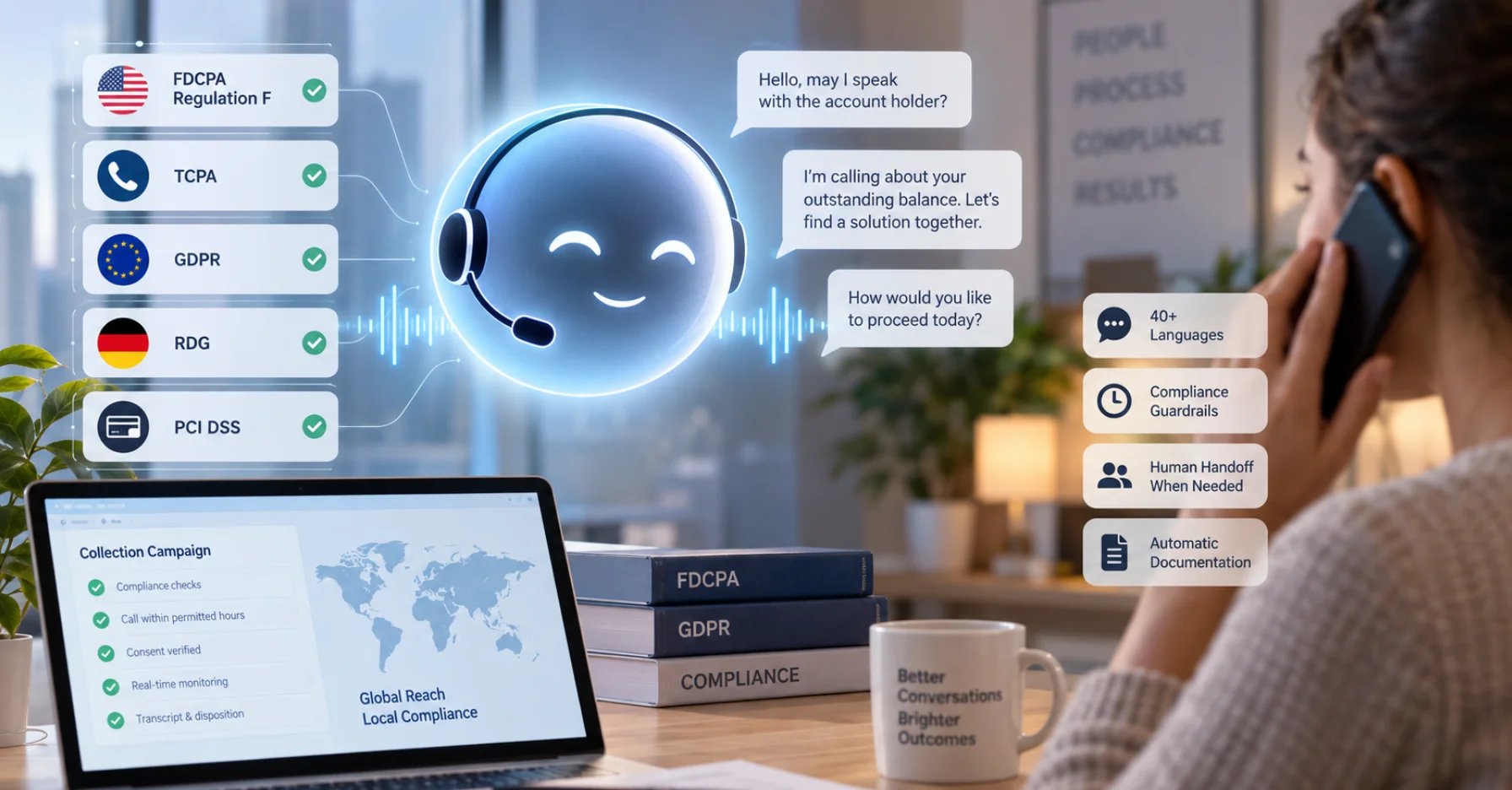
Debt collection agencies face a paradox in 2026: debtors expect fast, respectful communication while regulators demand airtight documentation of every single call. At the same time, labor costs keep rising and manual outbound campaigns struggle to reach even 30 % of contacts. AI voice agents solve this problem by automating collection calls while enforcing compliance guardrails in real time — from the FDCPA and Regulation F in the United States to the GDPR across the European Union.
Platforms like Famulor enable collection agencies to launch outbound campaigns with built-in compliance rules, reach debtors in over 40 languages, and seamlessly hand off to human agents when escalation is needed. This guide shows you how to deploy AI voice agents in debt collection the right way — with concrete implementation steps, comparison tables, and real-world examples.
What Is an AI Voice Agent in Debt Collection?
An AI voice agent for debt collection is an automated phone system that handles outbound and inbound collection calls autonomously. Unlike simple robo-dialers, the agent loads full account context before every conversation: outstanding balances, payment history, broken payment promises, active disputes, and hardship flags. Based on this data, the agent selects the right conversation strategy, complies with mandatory disclosures, and automatically recognizes when a call needs to be escalated to a human.
The critical difference from legacy outbound tools is that AI voice agents in collections do not rely on rigid scripts. They use context-aware conversational logic that detects disputes, hardship signals, and willingness to pay in real time, adapting their behavior accordingly. Famulor provides a visual flow builder that lets collection teams configure this conversation logic without any coding.
Regulatory Requirements at a Glance
Collection calls are among the most heavily regulated forms of communication anywhere in the world. Anyone deploying AI voice agents for debt collection must comply with different frameworks depending on the market. The following table summarizes the most important regulations:
| Regulation | Scope | Core Requirements for AI Calls | Penalty for Violations |
|---|---|---|---|
| FDCPA / Reg F (USA) | Third-party debt collection | Mini-Miranda disclosure, max 7 call attempts per debt in 7 days, call windows 8 AM – 9 PM local time | Up to $1,000 per violation + class action exposure |
| TCPA (USA) | Automated calls to mobile phones | Prior express consent, immediate opt-out processing | $500 – $1,500 per unconsented call |
| GDPR (EU/EEA) | All personal data | Lawful basis (Art. 6), information obligation, right to erasure, data processing agreement | Up to 4 % of annual revenue or EUR 20 million |
| RDG (Germany) | Debt collection services | Registered as a debt collection agency, proper claim handling | Activity ban, fines |
| PCI DSS | Card payment data | Real-time masking of card numbers in transcripts and recordings | Loss of payment processing license |
A production-ready AI voice agent must not only know these rules but enforce them automatically. Famulor implements call-frequency limits, time-window controls, and consent checks directly in the campaign engine. Disputes are automatically detected, outbound activity for the affected debt is stopped, and the case is escalated to the legal department. For a detailed overview of voice-AI compliance across jurisdictions, see our compliance guide for TCPA, GDPR, and HIPAA.
Manual Collection vs. AI-Powered Debt Recovery
The decision between manual calls and AI-powered debt collection is not just about cost — it affects reachability, compliance assurance, and scalability in equal measure.
| Criterion | Manual Collection | AI Voice Agent |
|---|---|---|
| Calls per day per agent | 80 – 120 | 500 – 2,000+ |
| Availability | Mon – Fri, 8 AM – 6 PM | 24/7 (within permitted windows) |
| Compliance disclosure | Human error possible | 100 % automatic, auditable |
| Dispute detection | Depends on training | Real-time detection, automatic stop |
| Multilingual capability | Separate teams required | 40+ languages, one platform |
| Cost per contact attempt | $2.50 – $5.00 | $0.15 – $0.50 |
| Scaling during peaks | Temp staff, weeks of lead time | Instant, via campaign configuration |
| Documentation | Manual after-call entry | Automatic transcript + disposition |
The biggest advantage is consistency: an AI voice agent never forgets the Mini-Miranda disclosure, never exceeds the call-frequency limit, and reliably escalates on disputes. This drastically reduces compliance risk while simultaneously lowering the cost per successful debtor contact.
Implementation Step by Step
Rolling out an AI voice agent for debt collection requires careful planning. The following six steps cover the path from portfolio analysis to live operation:
Step 1: Portfolio segmentation. Divide your receivables into categories — fresh debts (0 – 30 days past due), medium-aged debts (30 – 90 days), and aged debts (90+ days). For each category, define a separate conversation strategy and escalation threshold. Fresh debts receive a friendly reminder call; aged debts get a structured payment-arrangement conversation.
Step 2: Configure compliance rules. For each market, set the applicable call windows, frequency limits, and disclosure requirements. In Famulor, this is done through workflow automation: time windows, contact attempts per week, and mandatory disclosures are defined as rules and enforced automatically.
Step 3: Build the conversation flow. Use the flow builder to create the call path: greeting with identity verification, Mini-Miranda disclosure, debt presentation, payment options, dispute handling, and escalation. Every branch must be auditable.
Step 4: Populate the knowledge base. Load frequently asked debtor questions, installment-plan options, and standard legal responses into the Famulor knowledge base. This way the agent can answer questions about statute-of-limitations periods, dispute procedures, or repayment plans instantly — without improvising.
Step 5: Test calls and simulation. Run at least 50 test calls per conversation flow before going live. Test edge cases: debtor disputes the debt, debtor becomes emotional, debtor asks for a supervisor, a third party answers (disclosure prohibition). Use the results to refine the flow.
Step 6: Soft launch with monitoring. Start with a small portfolio (500 – 1,000 receivables) and monitor reachability, conversion rate, and compliance KPIs through Famulor Analytics. Scale up only after a two-week pilot phase with zero compliance incidents.
Best Practices and Common Mistakes
Best practices:
- Scripted disclosures, not free text. The Mini-Miranda obligation and GDPR information duties belong in hard-coded conversation blocks, not in the LLM's free conversational flow. A missed mandatory disclosure is a compliance violation.
- Real-time dispute detection. The moment a debtor says "that's not right," "I never ordered this," or "I dispute this," the agent must immediately stop all outbound activity for that debt and log the case.
- Warm transfer with full context. When the agent escalates to a human collector, the entire call history, debt data, and escalation reason must be passed along. Famulor's call transfer feature delivers the complete context automatically.
- PCI-compliant payment capture. If debtors want to pay over the phone, card numbers must never appear in transcripts. Use DTMF input or redirect to a PCI-certified payment portal.
- Multilingual support as a compliance advantage. GDPR Art. 12 requires understandable communication. A debtor who does not speak the local language may not understand their rights. Famulor's 40+ language support ensures every debtor is informed in their preferred language.
Common mistakes:
- Assuming frequency limits are built in. Most AI platforms do not ship with pre-configured Reg F compliance. You must set up the 7-calls-in-7-days rule yourself as a campaign rule.
- No third-party detection. When someone other than the debtor answers — a family member or roommate — the agent must not disclose the debt. This branch must be explicitly mapped in the flow.
- Spreading compliance across multiple vendors. When telephony, AI engine, and CRM come from different providers, auditability becomes a nightmare. Choose an integrated platform.
- Skipping post-call analysis. Without automated QA review of every call, compliance violations remain undetected until a debtor files a complaint.
Which KPIs Measure Success?
Deploying an AI voice agent in debt collection requires clear success metrics. Four KPIs matter most: the reach rate (share of calls where the correct debtor is reached — target: above 40 %), the right-party contact rate (share of calls where the debtor is identified and the debt is discussed), the promise-to-pay rate (share of conversations ending in a payment arrangement — industry benchmark is 15 – 25 % for fresh debts), and the compliance violation rate (target: exactly zero).
You should also track average call duration. An AI agent that closes calls in 2 – 3 minutes is more efficient than a human collector averaging 6 – 8 minutes — provided resolution quality remains the same. Famulor's post-call analysis delivers these metrics automatically for every single call and aggregates them across campaigns, time periods, and portfolio segments.
Pay special attention to the escalation rate. If more than 20 % of conversations are escalated to human collectors, either the conversation logic is misconfigured or the knowledge base content is incomplete. An escalation rate between 8 and 15 % indicates that the agent handles most standard situations on its own while correctly handing off edge cases.
When an AI Voice Agent Is Not the Right Fit
Despite all the advantages, there are scenarios where human collectors remain indispensable. In complex insolvency cases that require legal negotiations over creditor priority, the AI agent lacks the necessary negotiation flexibility. Similarly, in consumer bankruptcy proceedings where the debtor is represented by counsel and all communication must go through the attorney, the agent must not contact the debtor directly.
Very small portfolios under 200 receivables per month may not justify the configuration effort. In such cases, however, the AI agent can still serve as an automated payment reminder for initial contact attempts before a human collector takes over the account. The hybrid approach — AI for the first two contact attempts, human for escalations and negotiations — is the most common and most successful model in practice.
Industry Examples: AI-Powered Collections in Practice
Example 1: Mid-sized collection agency in the Midwest, 25 employees. The agency handles 8,000 receivables per month. Previously, 15 collectors averaged 90 calls per day — with a reach rate of 28 %. After deploying an AI voice agent through Famulor, daily contact volume rose to 1,200 and the reach rate climbed to 42 % (thanks to optimized call timing and automatic retry scheduling). Compliance documentation happens automatically: every call is transcribed, the Mini-Miranda disclosure is flagged as delivered, and disputes are routed to the legal team in real time.
Example 2: SaaS company with B2B receivables, New York. A software vendor with 200 outstanding invoices per month uses the AI voice agent for automated payment reminders. The agent calls three days before due date, politely reminds the contact about the invoice, and offers an installment option. On dispute, it immediately escalates to the customer success manager. Result: the average payment delay dropped from 18 to 9 days. The entire campaign runs through Famulor's 300+ integrations — connected directly to the company's ERP system.
Example 3: International collection agency, London. The agency serves creditors across the UK, Germany, the Netherlands, and the Middle East. Debtors speak English, German, Arabic, Polish, and Turkish. The AI voice agent detects the preferred language automatically and conducts the entire conversation — including all mandatory disclosures — in the correct language. Without multilingual capability, the agency would need a separate team for every language.
Estimate your ROI from automating calls
See how much your business could save by switching to AI-powered voice agents.
ROI Result
ROI 0%
No credit card required
Conclusion
AI voice agents are transforming debt collection from a labor-intensive, error-prone process into a scalable, compliance-safe channel. The key is not the technology alone but the right configuration: regulatory guardrails must be hard-wired into the system, not bolted on as an afterthought. Famulor provides the infrastructure for this — with outbound campaigns, automatic compliance enforcement, 40+ languages, SIP trunking for existing phone systems, and over 300 integrations on a no-code platform. Start with a free demo and see how a compliant AI voice agent can improve your recovery rate within 90 days. Book a demo now.
Try our AI Assistant
Experience how natural our AI phone assistant sounds.
Enter your details and receive a call from our AI agent within seconds.
Agent is trained to discuss Famulor services and book appointments.

Demo AI agent
Famulor representative
FAQ
Is it legal to use AI voice agents for debt collection?
Yes, provided all regulatory requirements are met. In the US, you must comply with the FDCPA, Regulation F, and the TCPA. In the EU, GDPR Art. 6 lawful basis is required. The key is automatic enforcement of these rules within the system.
How does the AI agent handle the Mini-Miranda disclosure?
The disclosure is implemented as a hard-coded conversation block that plays in every call. The agent cannot skip this step because it is anchored as a mandatory node in the conversation flow.
What happens when a debtor disputes the debt?
The AI agent detects dispute language in real time, immediately stops all outbound activity for that debt, and automatically escalates the case to the legal department or the assigned collector.
Can the AI voice agent accept payments over the phone?
Yes, through PCI-DSS-compliant DTMF input or by redirecting to a certified payment portal. Card numbers are masked in real time and never appear in transcripts or call recordings.
How many call attempts per debtor are allowed?
In the US, Regulation F allows a maximum of 7 call attempts per debt within 7 days. In the EU, there is no fixed cap, but disproportionately frequent calls violate GDPR proportionality principles.
Does the AI agent support multiple languages in one portfolio?
Famulor supports over 40 languages on a single platform. The agent can switch languages per debtor automatically — based on account data or real-time speech detection during the call.
How does the AI voice agent integrate with my collection CRM?
Through APIs, webhooks, or pre-built integrations. Famulor offers over 300 integrations and a no-code automation platform that writes dispositions, payment promises, and escalations directly back to your CRM.
How much can I save with an AI voice agent for collections?
Cost per contact attempt typically drops from $2.50 – $5.00 to $0.15 – $0.50. For an agency handling 8,000 receivables per month, this can mean savings of $15,000 – $30,000 per month — with higher reach rates and gap-free compliance documentation.

Writer at Famulor