Inhoud samenvatten met:



Famulor Research · October 2026 · Measured 13 October 2026 · Edited 14 October 2026
A voice agent needs to take the right action and confirm it clearly. Fast speech generation covers only part of that job. This Famulor study compares individual models, complete conversation configurations and the audio the caller receives. You get the full result tables, relative cost bands and an acceptance plan you can apply to your own workflows.
Study contents
1. The findings that matter
All nine tested pipeline configurations passed eight out of eight fictional receipt and spoken-fact checks. With Gemma 4 and Soniox recognition held constant, their observed confirmation-onset P50 ranged from 1,167 to 1,580 ms. Gradium, Deepgram, Cartesia and ElevenLabs form a fast initial shortlist. The other five pipelines also completed the checked tasks.
Gemma 4 31B IT passed all 16 short structured-decision checks, with a median first-text-token time of 162 ms. Many other LLMs also passed 16/16. The timing describes this particular profile. It does not establish a universal intelligence or quality ranking.
Speech recognition results differ by language. Scribe v2 Realtime, in a separately labeled recheck, made one edit over 161 German reference words. Three AssemblyAI Pro configurations and Cartesia Ink 2 each made three edits over 124 English words. A few words can change the ordering in a corpus this small.
For native realtime models, tool continuation is a key check. GPT Realtime 2.1 passed the eight service tasks. Other configurations showed missing spoken confirmations, unfinished suites or unresolved protocol behavior. These findings apply to the tested route and profile.
Reading rule: Establish correct task completion first. Compare response timing second. Choose the voice and cost band within a suitable shortlist.
2. Study design and coverage
Study coverage | ||
Layer | Coverage | Meaning |
|---|---|---|
LLM | 33 / 528 | 16 decision requests per model |
STT | 23 / 304 | 16 human clips; language eligibility by route |
TTS | 29 / 228 | 4 phrases per eligible language |
Native audio models | 9 | Models across multiple modes |
WebRTC | 44 / 22 | Language cells / configurations, DE+EN |
Test route | WebRTC / EU | No controlled PSTN comparison |
LiveKit SDK | 1.8.6 | One SDK version in the controlled run |
The enabled catalog is an inventory snapshot. It does not prove that every language, plan or integration route was qualified. Component and conversation tests answer different questions. An LLM can produce correct JSON while the complete agent gives an unsuitable spoken confirmation. Fast TTS can still sit behind slow turn detection or tool continuation.
The 44 WebRTC cells represent 22 configurations in two languages, with one call per language and configuration. Each service suite contains four controlled positive tasks. Completed suites also include a bounded interruption and recovery check. The 47 terminal calls in the evidence set include three pilots. They do not create repeated trials of the 44 comparison cells.
Runs were sequential, without randomized order or repeat series. Warm-up effects, network conditions and provider changes over time may influence the observations. Treat this as a documented screening stage for your next qualification round.
3. Understand the engine architectures
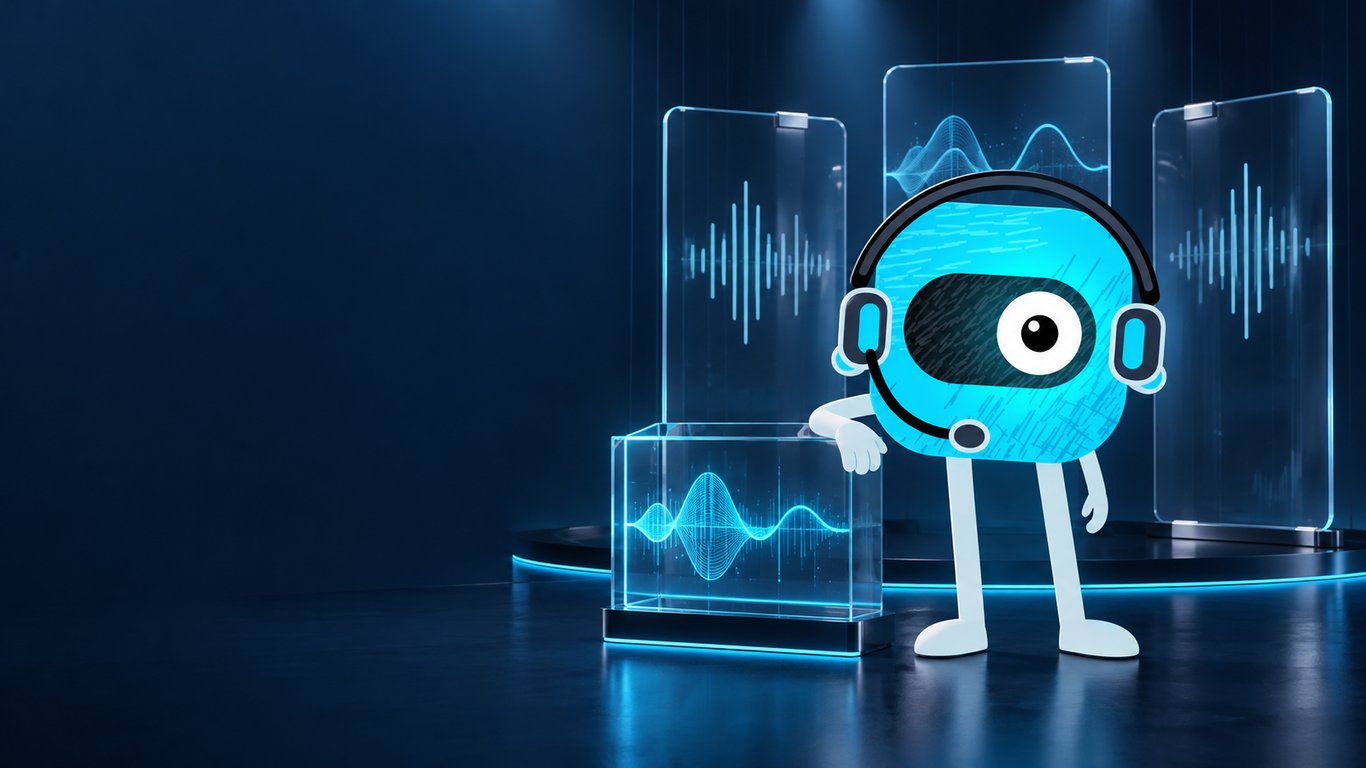
Concept illustration. Glass modules represent recognition, reasoning and speech generation, without measured values.
Architectures | ||
Mode | Path | Qualification focus |
|---|---|---|
Pipeline | STT → LLM → TTS | Recognition, tool facts, voice |
Half-Cascade | Native audio → external TTS | Tool continuation and voice |
Realtime | Native audio → native audio | Spoken facts and action |
Full Duplex | Overlapping speech | Listening, interruptions, outcome |
Translate | DE→EN / EN→DE | Content and critical entities |
A pipeline separates recognition, reasoning and speech generation. Each component can be evaluated and changed independently. Half-Cascade combines native audio understanding with an external voice. Realtime produces speech in the native audio model. Full Duplex adds overlapping-speech behavior. Translation has a different purpose and receives a separate evaluation.
Equivalent metrics must describe equivalent events. A pipeline's first text token is not a native model's first audio token. Missing component timings therefore remain missing. For complete calls, this report uses the caller-side confirmation proxy alongside explicit task checks.
4. The complete pipeline comparison
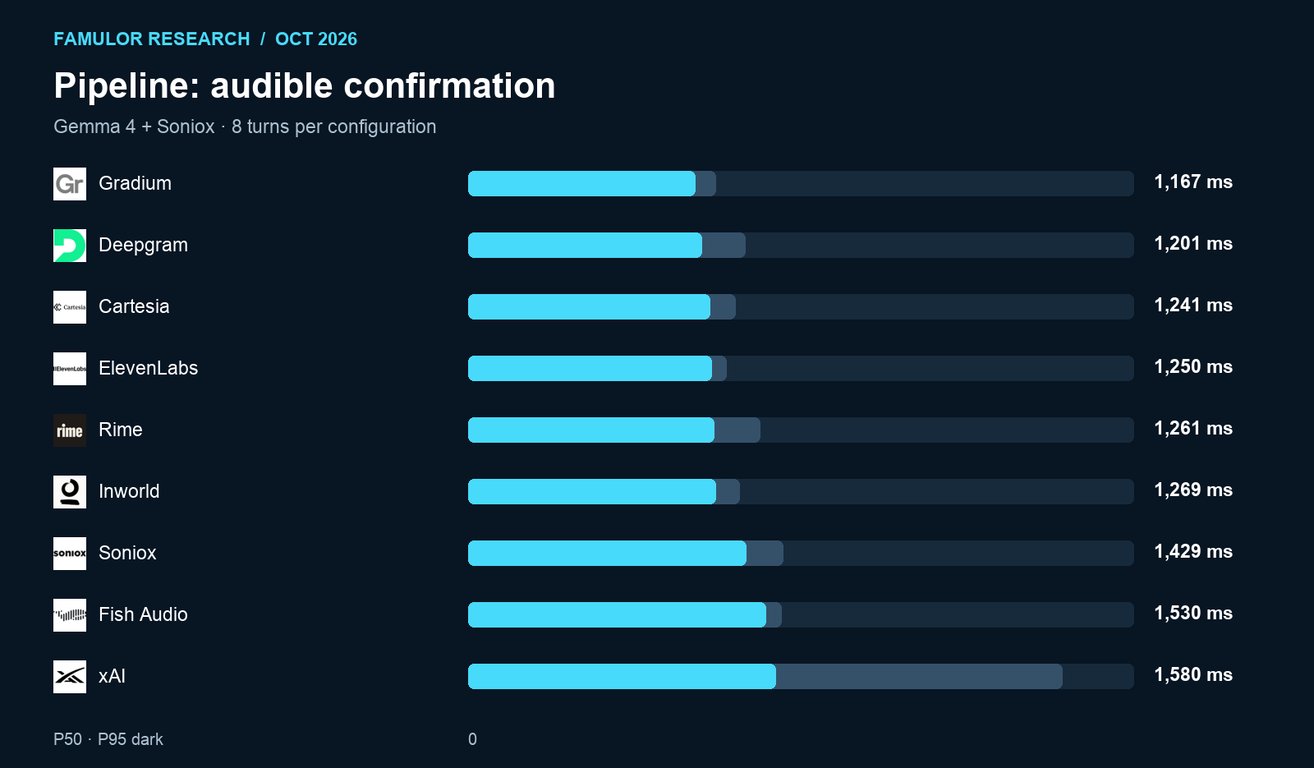
Confirmation proxy. Cyan: P50. Dark: sample P95. Eight turns per configuration.
Pipeline · Gemma 4 + Soniox STT v5 · n=8 | |||||
Provider | TTS model | Checks | n | P50 ms | P95 ms |
|---|---|---|---|---|---|
 Gradium | default | 8/8 | 8 | 1167 | 1272 |
 Deepgram | aura-2 | 8/8 | 8 | 1201 | 1425 |
 Cartesia | sonic-3.6-2026-08-27 | 8/8 | 8 | 1241 | 1371 |
 ElevenLabs | eleven_v4_turbo | 8/8 | 8 | 1250 | 1326 |
 Rime | coda | 8/8 | 8 | 1261 | 1499 |
 Inworld | inworld-tts-2 | 8/8 | 8 | 1269 | 1392 |
 Soniox | tts-rt-v2 | 8/8 | 8 | 1429 | 1616 |
 Fish Audio | s2.1-pro | 8/8 | 8 | 1530 | 1610 |
 xAI | tts-1 | 8/8 | 8 | 1580 | 3054 |
Gemma 4 31B IT and Soniox STT v5 remain constant. The table names the tested TTS configurations. Timing starts at the end of caller speech and ends at the first received non-silent audio frame after the matching HTTP fixture receipt arrives. It includes network, action, continuation and audio delivery. That frame alone does not verify the timestamp of the first meaningful confirmation word.
Every pipeline passed 8/8 task checks and 2/2 bounded interruption/recovery checks. This is a positive result for these fixed cases. It is not a customer-call resolution rate. The tool returned a controlled HTTP echo receipt, rather than writing an appointment or changing a CRM record.
The first six P50 values are relatively close. With eight turns and no repeat trials, small gaps do not establish separated winners. The xAI configuration has a noticeably higher sample P95 than its P50 in this run. That calls for repeated trials and an inspection of the individual events.
5. Every native conversation configuration
Native configurations · 0/0 = unevaluable; WAV scored separately | |||||
Configuration | Checks | Suites | n | P50 ms | P95 ms |
|---|---|---|---|---|---|
 realtime-gpt-realtime-2.1 | 8/8 | 2/2 | 8 | 2658 | 2895 |
half_cascade-gpt-realtime-2.1 | 7/8 | 2/2 | 8 | 1889 | 2711 |
half_cascade-gpt-realtime-2 | 7/8 | 2/2 | 8 | 2320 | 4118 |
half_cascade-gpt-realtime-2.1-mini | 6/8 | 2/2 | 8 | 2260 | 10300 |
realtime-gpt-realtime-2.1-mini | 6/8 | 2/2 | 8 | 2406 | 12913 |
realtime-gpt-realtime-2 | 6/8 | 2/2 | 8 | 2917 | 4975 |
 realtime-gemini-2.5-flash-native-audio-preview-12-2025 | 1/2 | 0/2 | 2 | 4508 | 11117 |
realtime-gpt-live-1 | WAV 6/8 | 2/2 | 8 | 1550 | 5698 |
half_cascade-gpt-realtime-mini | 0/0 | 0/2 | 0 | N/A | N/A |
realtime-gemini-3.1-flash-live-preview | 0/0 | 0/2 | 0 | N/A | N/A |
realtime-gemini-3.8-live | 0/0 | 0/2 | 0 | N/A | N/A |
realtime-gemini-3.8-live-extended-thinking | 0/0 | 0/2 | 0 | N/A | N/A |
realtime-gpt-realtime-mini | 0/0 | 0/2 | 0 | N/A | N/A |
GPT Realtime 2.1 completed the eight checked service facts. Half-Cascade with GPT Realtime 2.1 and GPT Realtime 2 each reached 7/8. Their Mini counterparts reached 6/8. Timings remain visible when a task fails its quality check. A quick failed turn is not counted as a successful result.
Gemini and older Realtime Mini suites stopped after missing matching tool calls or audible continuation. Subsequent tasks were not attempted. A 0/0 entry therefore means no evaluable task checks. It does not mean perfect quality or four proven failures per language. Further work needs to isolate route, event sequence and continuation behavior.
For Full Duplex with GPT Live 1, both language cells had correct tool receipts. Independent recognition of received WAV files confirmed six of eight spoken facts: the German policy response lacked the 14-day fact, and English lacked the booking confirmation. Direct model transcripts were incomplete. The WAV check is shown separately rather than treated as identical to transcript-based checks. This service suite still needs audible-result qualification.
Translate was evaluated separately in DE→EN and EN→DE. Both delivered audio and preserved date, time and Berlin entities. One German noun remained ambiguous in independent recognition. Two directions do not establish a broad translation quality rate. A negative streaming onset represents overlap, not a negative reactive response time.
6. LLMs: all 33 models in the decision profile
LLM TTFT · 256 output tokens · baseline | |||||
Model | Checks | Nonempty | n | P50 ms | P95 ms |
|---|---|---|---|---|---|
google/gemma-4-31b-it | 16/16 | 16 | 16 | 162 | 535 |
openai/gpt-4.1 | 16/16 | 16 | 16 | 339 | 440 |
openai/gpt-4o | 16/16 | 16 | 16 | 389 | 890 |
openai/gpt-5.4-mini | 16/16 | 16 | 16 | 411 | 513 |
 deepseek-ai/deepseek-v4.1-flash | 16/16 | 16 | 16 | 494 | 821 |
openai/gpt-5.1 | 16/16 | 16 | 16 | 527 | 633 |
openai/gpt-5.6-luna | 16/16 | 16 | 16 | 561 | 1664 |
openai/gpt-5.2 | 16/16 | 16 | 16 | 575 | 663 |
openai/gpt-5.4 | 16/16 | 16 | 16 | 591 | 689 |
openai/gpt-5.6-sol | 16/16 | 16 | 16 | 654 | 2635 |
google/gemini-3.5-flash-lite | 16/16 | 16 | 16 | 698 | 1213 |
google/gemini-3.1-flash-lite | 16/16 | 16 | 16 | 707 | 4930 |
google/gemini-3.6-flash | 16/16 | 16 | 16 | 743 | 1362 |
google/gemini-3-flash-preview | 16/16 | 16 | 16 | 928 | 1180 |
google/gemini-3.5-flash | 16/16 | 16 | 16 | 1017 | 3469 |
openai/gpt-6-luna | 16/16 | 16 | 16 | 1145 | 2434 |
openai/gpt-5.5 | 16/16 | 16 | 16 | 1235 | 2645 |
xai/grok-4.7 | 16/16 | 16 | 16 | 5860 | 14607 |
openai/gpt-4.1-mini | 15/16 | 16 | 16 | 316 | 393 |
openai/gpt-5.6-terra | 15/16 | 15 | 15 | 576 | 827 |
xai/grok-4.20-0309-reasoning | 15/16 | 15 | 15 | 7864 | 17818 |
openai/gpt-5.4-nano | 14/16 | 15 | 15 | 400 | 520 |
google/gemini-3.7-flash | 13/16 | 16 | 16 | 2440 | 7146 |
xai/grok-4.20-multi-agent-0309 | 12/16 | 14 | 14 | 9672 | 19539 |
google/gemini-3.8-flash | 11/16 | 16 | 16 | 2625 | 10380 |
openai/gpt-4.1-nano | 10/16 | 16 | 16 | 284 | 364 |
openai/gpt-4o-mini | 10/16 | 16 | 16 | 345 | 740 |
xai/grok-4.20-0309-non-reasoning | 7/16 | 16 | 16 | 1070 | 6367 |
openai/gpt-5 | 5/16 | 6 | 6 | 2885 | 5624 |
google/gemini-3.1-pro-preview | 3/16 | 16 | 16 | 3697 | 6223 |
openai/gpt-5-mini | 0/16 | 1 | 1 | 2941 | 2941 |
openai/chat-latest | 0/16 | 0 | 0 | N/A | N/A |
openai/gpt-5-nano | 0/16 | 0 | 0 | N/A | N/A |
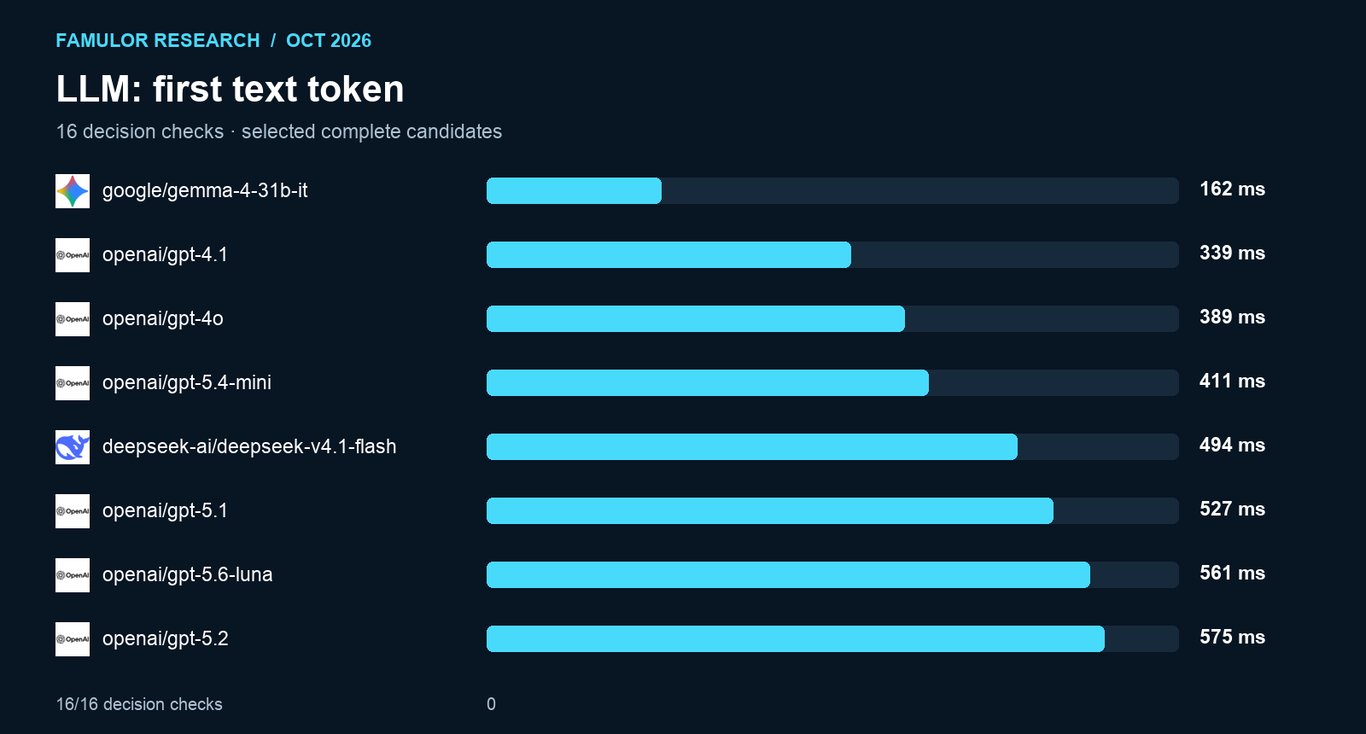
LLM TTFT P50 · 16/16
Each model received 16 short structured decisions, with an original output cap of 256 tokens. Checks covered fixture facts, expected actions and refusal of unsupported or disallowed actions. The table separates decision checks, nonempty outputs and timing samples. P50 and P95 use only observations with available timings.
16/16 is a coarse entry gate with this sample size. Even under a simplified independent-binomial assumption, the lower 95% Wilson bound is approximately 80.6%. These fixed cases are also not a random sample of customer requests. The interval therefore does not provide a production guarantee.
Separate GPT-5 rechecks using a 1,536-token allowance improved nonempty responses. They use a different budget and do not silently replace the 256-token baseline. When a reasoning model consumes its allowance before producing output, examine the configuration. An empty output or HTTP 400 route error does not establish an intrinsic inability to answer the customer's question.
Gemma 4 and other 16/16 candidates such as GPT-4.1, GPT-4o, GPT-5.4 Mini and DeepSeek V4.1 Flash are sensible starting points. Follow with longer contexts, real tool arguments, corrections and multi-step conversations. A small decision screen does not replace that second stage.
7. STT: human speech and supplied references
The accuracy screen uses 16 human recordings from Google FLEURS. German and English are scored separately. Every candidate within a language receives the same files and reference texts. The selection contains 82.56 seconds of German and 54.14 seconds of English, with 161 and 124 reference words respectively.
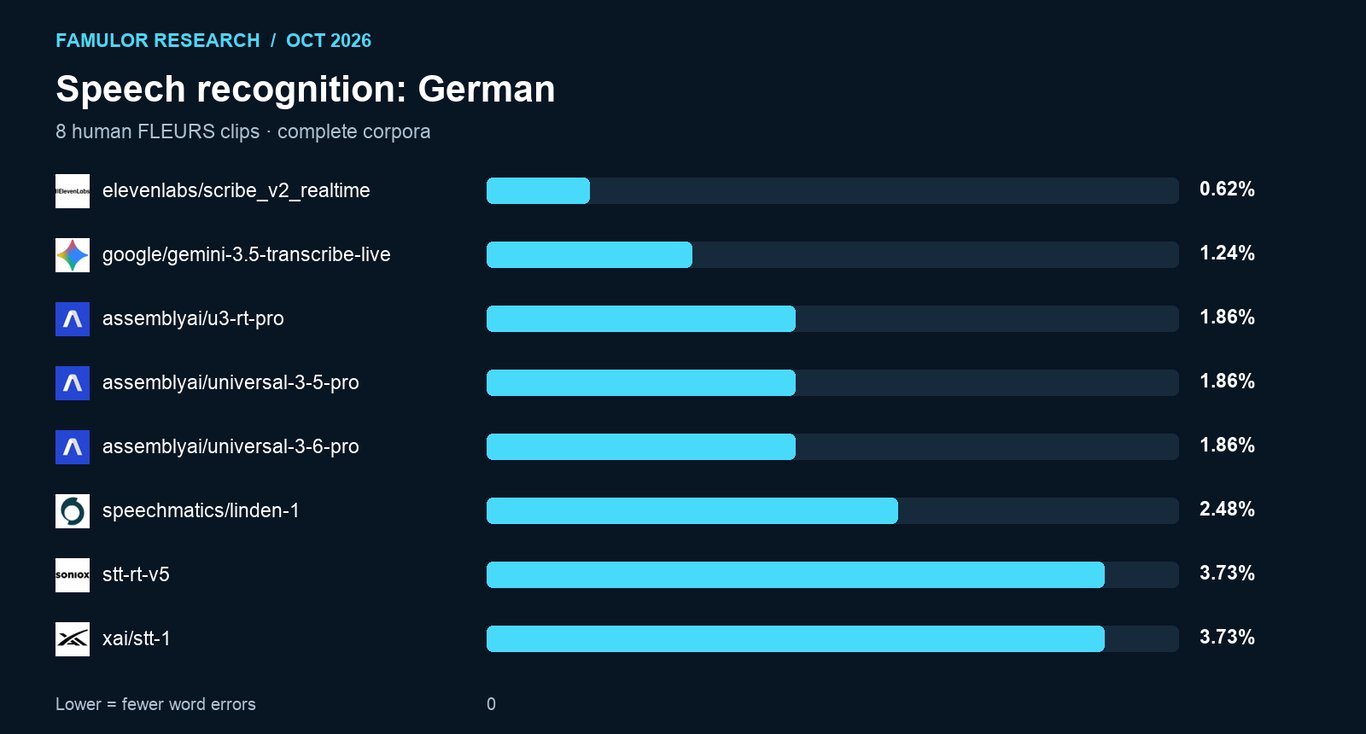
Selected complete language corpora. Full tables follow.
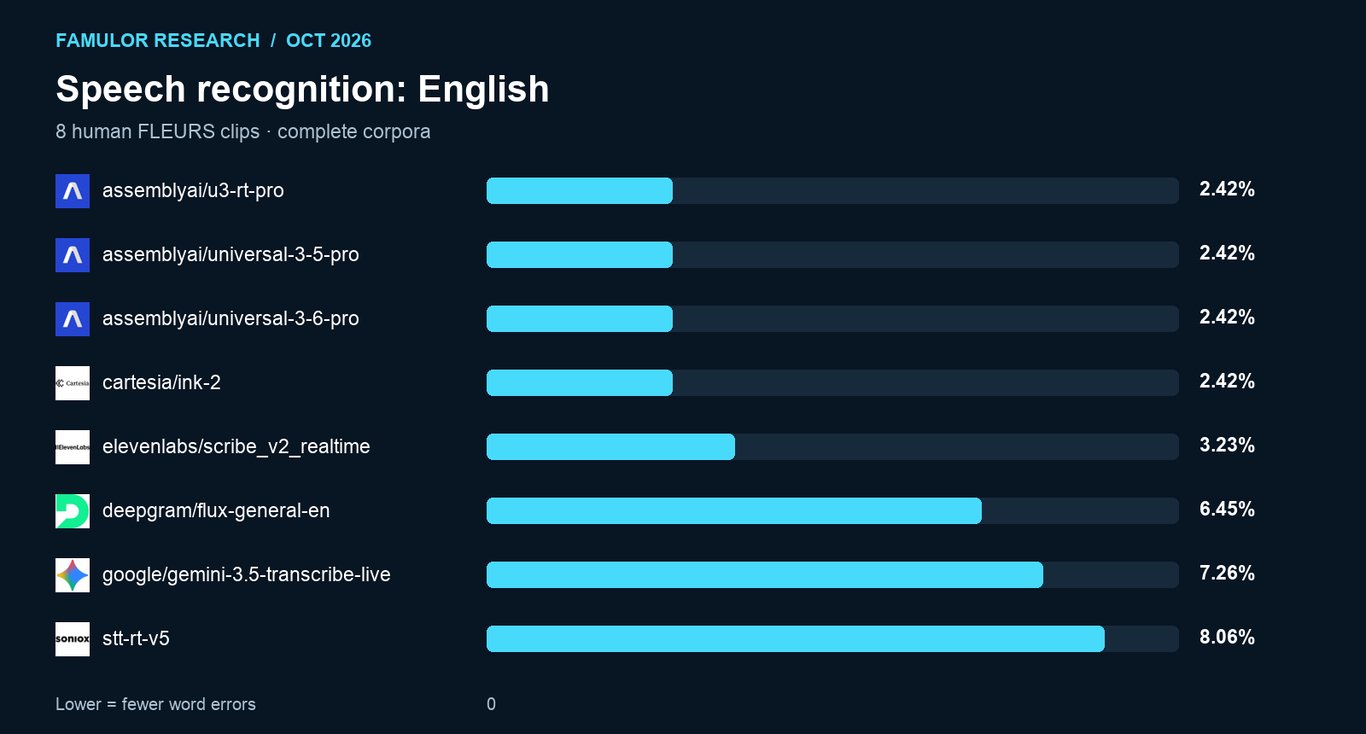
Selected complete language corpora. Full tables follow.
German: complete and separately qualified results
STT DE · Micro WER | ||||||
Model | Profile | Clips | Words | Edits | WER | Qualification |
|---|---|---|---|---|---|---|
elevenlabs/scribe_v2_realtime | credential_or_eof_recheck | 8/8 | 161 | 1 | 0.62% | complete short corpus |
google/gemini-3.5-transcribe-live | baseline | 8/8 | 161 | 2 | 1.24% | complete short corpus |
 assemblyai/u3-rt-pro | baseline | 8/8 | 161 | 3 | 1.86% | complete short corpus |
assemblyai/universal-3-5-pro | baseline | 8/8 | 161 | 3 | 1.86% | complete short corpus |
assemblyai/universal-3-6-pro | baseline | 8/8 | 161 | 3 | 1.86% | complete short corpus |
 speechmatics/linden-1 | baseline | 8/8 | 161 | 4 | 2.48% | complete short corpus |
stt-rt-v5 | credential_or_eof_recheck | 8/8 | 161 | 6 | 3.73% | complete short corpus |
xai/stt-1 | baseline | 8/8 | 161 | 6 | 3.73% | complete short corpus |
xai/stt-2 | baseline | 8/8 | 161 | 6 | 3.73% | complete short corpus |
deepgram/nova-3 | baseline | 8/8 | 161 | 7 | 4.35% | complete short corpus |
deepgram/flux-general-multi | baseline | 8/8 | 161 | 10 | 6.21% | complete short corpus |
deepgram/nova-2 | baseline | 8/8 | 161 | 12 | 7.45% | complete short corpus |
cartesia/ink-whisper | baseline | 8/8 | 161 | 13 | 8.07% | complete short corpus |
 solaria-1 | gladia_protocol_recheck | 5/8 | 112 | 7 | 6.25% | partial; unranked |
assemblyai/universal-streaming-multilingual | baseline | 8/8 | 161 | 176 | 109.32% | duplicate-final artifact; unranked |
English: complete and separately qualified results
STT EN · Micro WER | ||||||
Model | Profile | Clips | Words | Edits | WER | Qualification |
|---|---|---|---|---|---|---|
assemblyai/u3-rt-pro | baseline | 8/8 | 124 | 3 | 2.42% | complete short corpus |
assemblyai/universal-3-5-pro | baseline | 8/8 | 124 | 3 | 2.42% | complete short corpus |
assemblyai/universal-3-6-pro | baseline | 8/8 | 124 | 3 | 2.42% | complete short corpus |
cartesia/ink-2 | baseline | 8/8 | 124 | 3 | 2.42% | complete short corpus |
elevenlabs/scribe_v2_realtime | credential_or_eof_recheck | 8/8 | 124 | 4 | 3.23% | complete short corpus |
deepgram/flux-general-en | baseline | 8/8 | 124 | 8 | 6.45% | complete short corpus |
google/gemini-3.5-transcribe-live | baseline | 8/8 | 124 | 9 | 7.26% | complete short corpus |
stt-rt-v5 | credential_or_eof_recheck | 8/8 | 124 | 10 | 8.06% | complete short corpus |
speechmatics/linden-1 | baseline | 8/8 | 124 | 10 | 8.06% | complete short corpus |
deepgram/flux-general-multi | baseline | 8/8 | 124 | 12 | 9.68% | complete short corpus |
deepgram/nova-3 | baseline | 8/8 | 124 | 14 | 11.29% | complete short corpus |
deepgram/nova-3-pharma | baseline | 8/8 | 124 | 16 | 12.90% | complete short corpus |
deepgram/nova-2-conversationalai | baseline | 8/8 | 124 | 17 | 13.71% | complete short corpus |
deepgram/nova-2-medical | baseline | 8/8 | 124 | 18 | 14.52% | complete short corpus |
deepgram/nova-2-phonecall | baseline | 8/8 | 124 | 18 | 14.52% | complete short corpus |
deepgram/nova-3-medical | baseline | 8/8 | 124 | 18 | 14.52% | complete short corpus |
deepgram/nova-2 | baseline | 8/8 | 124 | 20 | 16.13% | complete short corpus |
solaria-1 | gladia_protocol_recheck | 4/8 | 51 | 3 | 5.88% | partial; unranked |
cartesia/ink-whisper | baseline | 6/8 | 99 | 29 | 29.29% | partial; unranked |
xai/stt-1 | baseline | 6/8 | 99 | 33 | 33.33% | partial; unranked |
xai/stt-2 | baseline | 6/8 | 99 | 33 | 33.33% | partial; unranked |
assemblyai/universal-streaming | baseline | 8/8 | 124 | 84 | 67.74% | duplicate-final artifact; unranked |
assemblyai/universal-streaming-multilingual | baseline | 7/8 | 114 | 120 | 105.26% | duplicate-final artifact; unranked |
Micro WER is total substitutions, deletions and insertions divided by total reference words. It is not the average of eight clip-level percentages. One extra edit changes German WER by about 0.62 percentage points and English by about 0.81 points. Pooling DE and EN would give German more weight through its larger word count.
Partial corpora are identified separately. Their WER describes only successfully evaluated clips and cannot fairly rank against complete corpora. Missing transcripts are not error-free recognition. AssemblyAI Universal Streaming results with duplicated final hypotheses are also outside the comparative ordering. WER can exceed 100% when many extra words are inserted. Segment and formatter handling need qualification before interpreting those artifacts as recognition quality.
The selection comes from the validation split and contains read speech. German recordings have male metadata; English has four male and four female entries. This is not representative coverage of accents, spontaneous speech, noise or telephony. It also does not establish distinct speaker identities. Add your own names, customer identifiers, times, product terms and telephone audio before acceptance.
8. TTS: all 29 models and the first audio chunk
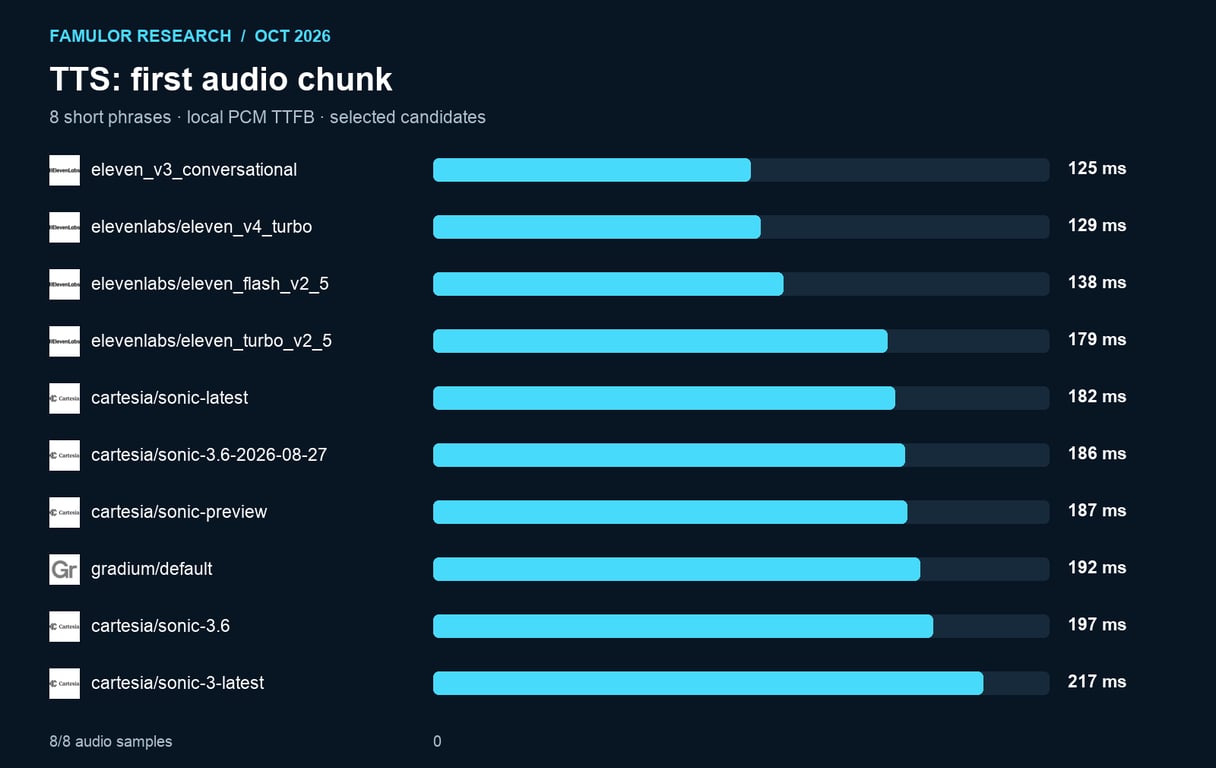
Ten complete baseline candidates. Local PCM TTFB, not a naturalness rating.
TTS · local PCM TTFB; rechecks separate | ||||
Model | Profile | Audio | P50 ms | P95 ms |
|---|---|---|---|---|
eleven_v3_conversational | baseline | 8/8 | 125 | 702 |
elevenlabs/eleven_v4_turbo | baseline | 8/8 | 129 | 141 |
elevenlabs/eleven_flash_v2_5 | baseline | 8/8 | 138 | 1265 |
elevenlabs/eleven_turbo_v2_5 | baseline | 8/8 | 179 | 225 |
cartesia/sonic-latest | baseline | 8/8 | 182 | 231 |
cartesia/sonic-3.6-2026-08-27 | baseline | 8/8 | 186 | 222 |
cartesia/sonic-preview | baseline | 8/8 | 187 | 231 |
gradium/default | baseline | 8/8 | 192 | 264 |
cartesia/sonic-3.6 | baseline | 8/8 | 197 | 205 |
cartesia/sonic-3-latest | baseline | 8/8 | 217 | 1274 |
cartesia/sonic-3.5 | baseline | 8/8 | 219 | 250 |
cartesia/sonic-3.5-2026-05-04 | baseline | 8/8 | 236 | 243 |
cartesia/sonic-3 | baseline | 8/8 | 238 | 325 |
cartesia/sonic-3-2026-01-12 | baseline | 8/8 | 260 | 293 |
inworld/inworld-tts-2-flash | baseline | 8/8 | 338 | 676 |
inworld/inworld-tts-1.5-mini | baseline | 8/8 | 357 | 578 |
inworld/inworld-tts-2 | baseline | 8/8 | 359 | 654 |
inworld/inworld-tts-1.5-max | baseline | 8/8 | 415 | 454 |
deepgram/aura-2 | baseline | 8/8 | 476 | 762 |
elevenlabs/eleven_v3 | baseline | 8/8 | 487 | 766 |
deepgram/flux-tts | flux_model_voice_recheck | 4/4 | 538 | 740 |
rime/coda | baseline | 8/8 | 601 | 637 |
elevenlabs/eleven_v4 | baseline | 8/8 | 638 | 775 |
soniox/tts-rt-v2 | credential_or_eof_recheck | 8/8 | 718 | 771 |
elevenlabs/eleven_multilingual_v2 | baseline | 8/8 | 868 | 1920 |
xai/tts-1 | baseline | 8/8 | 876 | 949 |
fishaudio/s2.1-pro | baseline | 8/8 | 1191 | 1758 |
fishaudio/s2-pro | baseline | 8/8 | 1237 | 1317 |
gpt-4o-mini-tts | baseline | 3/8 | 1154 | 1550 |
Each language uses four fixed short phrases and one fixed voice. Local TTFB runs from factory/provider request start to the first PCM chunk. It ends before the caller's audible response. This is a component measurement rather than complete conversation timing.
Eleven v3 Conversational, Eleven v4 Turbo, Flash, recent Cartesia configurations and Gradium were fast candidates in this profile. Their order can change in a complete pipeline. Deepgram Aura-2, for example, showed a higher local component time than several models, while the complete Deepgram pipeline had one of the lower caller confirmation times. Boundaries, generated text and streaming paths differ.
Flux TTS was rechecked with its compatible Alexis voice on four English phrases. That EN-only recheck is explicitly separate from bilingual baseline rows. GPT-4o Mini TTS returned three out of eight baseline samples; its timings cover those three available outputs rather than eight successful answers.
No blinded jury rated naturalness, pronunciation or voice preference. Listen to your shortlist using your vocabulary: personal and company names, email addresses, decimals, times, abbreviations and language switches. Judge intelligibility before brand fit. A fast first chunk does not measure either.
9. Cost bands: Low, Medium and High
Relative cost bands | ||
Pipeline | Cost band | Evidence |
|---|---|---|
Gradium | High | Known LLM/TTS share; complete cost unresolved |
Deepgram | Medium | Known LLM/TTS share; complete cost unresolved |
Cartesia | High | Known LLM/TTS share; complete cost unresolved |
ElevenLabs | Unresolved | Missing TTS tariff or billing quantities |
Rime | Medium | Known LLM/TTS share; complete cost unresolved |
Inworld | Low | Known LLM/TTS share; complete cost unresolved |
Soniox | Unresolved | Missing TTS tariff or billing quantities |
Fish Audio | Low | Known LLM/TTS share; complete cost unresolved |
xAI | Low | Known LLM/TTS share; complete cost unresolved |
These bands describe only the relative known LLM/TTS inference share for seven comparable pipeline pairs. Each pair uses the two completed DE/EN calls, excludes pilots, and has attributable LLM and TTS quantities with referenced public tariffs. Order the seven known subtotals: the first three receive Low, the next two Medium and the last two High. The bands are relative to this experiment, not Famulor plan tiers.
STT token quantities, some detector usage, transport, infrastructure, recording, discounts and invoice costs are missing or incompletely attributed. The exact Eleven v4 Turbo tariff is unavailable; Soniox lacks matching billing quantities. Both remain Unresolved. Native modes are not inserted into these pipeline bands. Response lengths, greetings and interruption responses also affect the known shares.
Low does not mean the cheapest complete stack. High does not mean a high Famulor tariff. The bands help interpret a comparable recorded portion of test usage. Actual cost per resolved customer call needs complete cost attribution and verified business outcomes. This report publishes no internal monetary amounts.
10. Four workflows and their acceptance questions
Workflow acceptance | ||
Workflow | Key check | Next qualification |
|---|---|---|
Service | Policy and identifier | Uncertainty and confirmed handoff |
Booking | Slot, timezone, one action | Verify persisted calendar state |
Sales | Facts and qualification | Unknown offers and missing details |
Support | Steps and password protection | Correction, tool error, interruption |
The workflow tables show the two language observations as a range. Each combination has one positive task per language. The lower observation is not a reliable industry median. Only checked passing task pairs appear. These differences cannot establish a specialist quality winner for customer service or sales.
Customer service
DE+EN · n=2 · observed range, not an industry ranking | |||
Configuration | Checked turns | Lower ms | Higher ms |
|---|---|---|---|
pipeline-gradium | 2 | 779 | 1095 |
pipeline-rime | 2 | 874 | 1261 |
pipeline-inworld | 2 | 881 | 1185 |
pipeline-soniox | 2 | 1001 | 1350 |
pipeline-cartesia | 2 | 1049 | 1204 |
pipeline-deepgram | 2 | 1178 | 1308 |
pipeline-elevenlabs | 2 | 1250 | 1261 |
pipeline-fishaudio | 2 | 1284 | 1530 |
pipeline-xai | 2 | 1445 | 3054 |
half_cascade-gpt-realtime-2.1-mini | 2 | 1471 | 1551 |
half_cascade-gpt-realtime-2.1 | 2 | 1780 | 1994 |
half_cascade-gpt-realtime-2 | 2 | 1990 | 2320 |
realtime-gpt-realtime-2.1-mini | 2 | 2157 | 2260 |
realtime-gpt-realtime-2 | 2 | 2400 | 2496 |
realtime-gpt-realtime-2.1 | 2 | 2677 | 2710 |
Check approved policies, identifiers, corrections and requests for a person. The controlled task checked a known policy fact and its fixture receipt. A real acceptance suite also needs incomplete information, conflicting requests and confirmed handoffs.
Appointment booking
DE+EN · n=2 · observed range, not an industry ranking | |||
Configuration | Checked turns | Lower ms | Higher ms |
|---|---|---|---|
pipeline-gradium | 2 | 1128 | 1272 |
pipeline-elevenlabs | 2 | 1168 | 1326 |
pipeline-deepgram | 2 | 1186 | 1360 |
pipeline-cartesia | 2 | 1241 | 1352 |
pipeline-rime | 2 | 1244 | 1480 |
pipeline-inworld | 2 | 1269 | 1392 |
pipeline-soniox | 2 | 1400 | 1616 |
pipeline-fishaudio | 2 | 1481 | 1610 |
pipeline-xai | 2 | 1555 | 1582 |
realtime-gpt-realtime-2.1 | 2 | 2658 | 2688 |
The target is the correct offered slot, including date, time and timezone. Inspect actual test-calendar state after booking. Require exactly one persisted action and a matching spoken confirmation. Add unavailable slots, clarifications, rescheduling and repeated tool delivery to detect duplicate bookings.
Sales
DE+EN · n=2 · observed range, not an industry ranking | |||
Configuration | Checked turns | Lower ms | Higher ms |
|---|---|---|---|
pipeline-gradium | 2 | 1167 | 1250 |
pipeline-deepgram | 2 | 1174 | 1425 |
pipeline-rime | 2 | 1232 | 1469 |
pipeline-cartesia | 2 | 1239 | 1292 |
pipeline-elevenlabs | 2 | 1247 | 1257 |
pipeline-inworld | 2 | 1249 | 1359 |
pipeline-soniox | 2 | 1429 | 1509 |
pipeline-fishaudio | 2 | 1521 | 1540 |
pipeline-xai | 2 | 1664 | 1731 |
half_cascade-gpt-realtime-2.1 | 2 | 1827 | 1990 |
half_cascade-gpt-realtime-2 | 2 | 1878 | 2485 |
realtime-gpt-realtime-2.1-mini | 2 | 2128 | 3026 |
realtime-gpt-realtime-2.1 | 2 | 2537 | 2616 |
realtime-gpt-realtime-2 | 2 | 4728 | 4975 |
Checks covered fixed product facts and the expected action. The next stage needs uncertain requests, missing details and unapproved offers. Price and seat facts in the fixtures were fictional test data. They are not Famulor prices and are not reproduced as commercial offers.
Technical support
DE+EN · n=2 · observed range, not an industry ranking | |||
Configuration | Checked turns | Lower ms | Higher ms |
|---|---|---|---|
pipeline-deepgram | 2 | 1201 | 1268 |
pipeline-gradium | 2 | 1205 | 1209 |
pipeline-elevenlabs | 2 | 1237 | 1318 |
pipeline-inworld | 2 | 1269 | 1318 |
pipeline-cartesia | 2 | 1319 | 1371 |
pipeline-rime | 2 | 1430 | 1499 |
pipeline-soniox | 2 | 1478 | 1487 |
pipeline-fishaudio | 2 | 1539 | 1590 |
pipeline-xai | 2 | 1562 | 1580 |
half_cascade-gpt-realtime-2.1 | 2 | 1889 | 2206 |
half_cascade-gpt-realtime-2.1-mini | 2 | 1899 | 2541 |
half_cascade-gpt-realtime-2 | 2 | 2346 | 2444 |
realtime-gpt-realtime-2.1 | 2 | 2354 | 2895 |
realtime-gpt-realtime-2.1-mini | 2 | 2406 | 12913 |
realtime-gpt-realtime-2 | 2 | 2476 | 2954 |
The controlled case used a known error code, a fixed step sequence and password protection. Add failed steps, new information and an interruption midway through the instructions. Correct recovery addresses the changed request rather than continuing the previous paragraph.
11. Read timing at the right boundary
Measurement boundaries | ||
Metric | Start → end | Meaning |
|---|---|---|
Confirmation proxy | Caller end → audio after receipt | Audio onset, not a word timestamp |
LLM TTFT | Request → first text token | Component start time |
TTS TTFB | Factory → first PCM chunk | Component, not caller audio |
EOT | Detected end → turn decision | SDK value; independent boundary check needed |
Micro WER | (S + D + I) / N | Word edits per reference word |
P50 / P95 | Nearest rank | Always show n and profile |
Tables use nearest-rank percentiles: sort observations and select position ceil(p × n). With n=8, P95 is the largest of eight observations. It describes the slowest measured turn in that sample. A stable production P95 needs a substantially larger, appropriately stratified dataset.
Turns within a call share configuration and network conditions. Eight turns are not eight independent customer calls. Confidence intervals and repeats need to respect the call as a shared unit. Pooling turns can otherwise suggest more certainty than the experiment supports.
Exported pipeline worker metrics
SDK · n / P50 / P95 ms | |||
Pipeline | LLM n/P50/P95 | TTS n/P50/P95 | EOT n/P50/P95 |
|---|---|---|---|
pipeline-cartesia | 12 / 149 / 175 | 13 / 67 / 120 | 12 / 578 / 582 |
pipeline-deepgram | 12 / 148 / 159 | 13 / 137 / 884 | 12 / 578 / 579 |
pipeline-elevenlabs | 12 / 148 / 179 | 14 / 84 / 93 | 12 / 578 / 580 |
pipeline-fishaudio | 12 / 144 / 155 | 12 / 466 / 1344 | 12 / 578 / 579 |
pipeline-gradium | 12 / 145 / 159 | 14 / 90 / 149 | 12 / 578 / 580 |
pipeline-inworld | 13 / 146 / 204 | 13 / 186 / 309 | 12 / 578 / 580 |
pipeline-rime | 12 / 146 / 182 | 14 / 235 / 549 | 12 / 578 / 579 |
pipeline-soniox | 13 / 148 / 163 | 15 / 309 / 404 | 12 / 578 / 580 |
pipeline-xai | 12 / 145 / 157 | 12 / 418 / 745 | 12 / 578 / 2501 |
Depending on the export, these SDK metrics include greetings, tool continuations and interruption responses. Their sample counts differ from the eight controlled tasks. Component P50 values cannot be added to derive the conversation P50: timelines overlap and observation sets differ.
12. What complete reporting needs
Reporting status | ||
Metric | Evidence here | Additional evidence needed |
|---|---|---|
Tool/fact check | Fictional receipts + spoken facts | Real action state |
Resolution rate | Unmeasured | Labeled real outcomes and denominator |
Hallucination rate | Fixed fact/refusal checks | Independent annotation of material claims |
Transfer | No new phone acceptance test | Approved destination and verified pickup |
Drop rate | Bounded disconnect observation | Complete observations from both peers |
Naturalness | No blinded listener jury | Listener tests with identical scripts |
Cost per resolution | Unmeasured | Complete costs and real resolution |
A technically completed call is not a verified resolved customer case. An accepted transfer command does not prove human pickup. A matching spoken statement does not prove a persisted action. Reporting must record these states separately and connect them to the expected task.
For each case, retain language, configuration, prompt/tool version, model route, time, expected action, received receipt and spoken result. Keep Passed, Failed, Unattempted and Unresolved distinct. Give every metric its proper denominator. A good timing observation then remains useful without hiding an unsuccessful outcome.
Historical production aggregates from the preceding week were additional operational evidence. They are excluded from the controlled ordering because customers, tasks, settings and releases differed. That prevents observational operations data from becoming a causal model comparison.
13. Use the Famulor API for reproducible checks
Paths relative to https://app.famulor.de/api | ||
Purpose | API contract | Use |
|---|---|---|
Catalog | GET /user/assistants/models | Record available model IDs |
Voices | GET /user/assistants/voices | Pin voice and language |
Providers | GET /user/assistants/transcriber-providers | Record STT route |
Test assistant | POST /user/assistant | Isolated test configuration |
Call | GET /user/calls/{id} | Join call data and outcome |
Post-Call | Webhook | Transcript, variables and recording |
The supplied OpenAPI file describes the product API contract. It supplies neither benchmark results nor a ready-made quality score. Use catalog endpoints to record available models and voices at test time. Configure a separate test assistant and a tool with controlled responses. Place a real test call only with an approved destination.
Call retrieval and post-call webhooks connect the documented call information, transcripts, extracted variables and recording references. Millisecond speech-end, audio-onset, tool-receipt and interruption measurements require additional voice-path instrumentation. Call duration and status are insufficient. Do not claim TTFT, TTFB or WER fields unless your actual response contract provides them.
Authentication uses a server-side Bearer token. Keep credentials, customer numbers, private recordings and internal amounts out of public reports. Aggregated tables, clear cases and redacted evidence are suitable for sharing.
14. Turn the shortlist into an acceptance plan
Specify the intended action, audible confirmation and allowed response to uncertainty for every workflow.
Choose several fully checked candidates. Hold prompt, knowledge, tool responses, region and caller audio constant.
Repeat cases in randomized order. Separate cold and warm starts. Preserve all failed attempts.
Add spontaneous speech, varied voices, telephone codecs, noise, pauses, corrections and packet loss.
Check real test-system state, such as a calendar booking. Independently assess received audio as well as model transcripts.
Set quality and timing gates before the trial. Decide using those gates and uncertainty rather than a retrospectively weighted winner score.
Rerun acceptance after changes to prompt, tools, route or engine. Keep regression results with the corresponding versions.
Famulor simulations provide a starting point for repeatable workflow checks. Add spoken end-to-end trials when customers hear audio and can interrupt responses. Authored simulation scenarios are templates; their presence does not prove an additional executed evaluation.
15. Choose your first configuration
For short service tasks grounded in fixed tool facts, a pipeline is the strongest starting point in this screening. Begin with Gemma 4 and language-appropriate STT. Compare several successful voices, especially Gradium, Deepgram, Cartesia and ElevenLabs, using your critical names and numbers. Treat cost bands as supplementary partial observations.
For native audio understanding paired with a specific external voice, qualify Half-Cascade. For native spoken responses, GPT Realtime 2.1 is a candidate from this small completed suite. For Full Duplex, focus on overlapping speech and complete audible results. Your workflow and acceptance criteria determine the choice.
16. Sources and reproducibility
The primary measurement source is Famulor's versioned 13 October 2026 research snapshot. Tables use its final corrected results; earlier review notes do not override later results. Monetary amounts, private call IDs and credentials are excluded from this public edition.
Google FLEURS: Dataset Card. Human recordings and supplied transcripts, CC BY 4.0.
Conneau et al.: FLEURS, 2022. Corpus description.
Creative Commons BY 4.0. License and attribution.
NIST: ASR Metrics. Word-error-rate interpretation.
LiveKit: Agent Metrics. SDK metrics and measurement boundaries.
Famulor API documentation. Product API and events.
The FLEURS selection uses de_de and en_us, validation, revision 70bb2e84b976b7e960aa89f1c648e09c59f894dd. German rows: 0, 1, 2, 3, 5, 6, 8, 201. English rows: 0, 2, 3, 4, 5, 6, 7, 8. Audio was converted to PCM16 mono at 16 kHz, with that modification recorded. Corpus authors and speakers do not endorse this report. Normalized references and individual events belong in a reproduction record.
Compare Famulor engine modes, listen in the voice library, and plan your test configuration. Book a demo.

Auteur bij Famulor