Summarize Content With:




AI Agent Liability: Who Is Responsible When a Voice AI Makes a Mistake
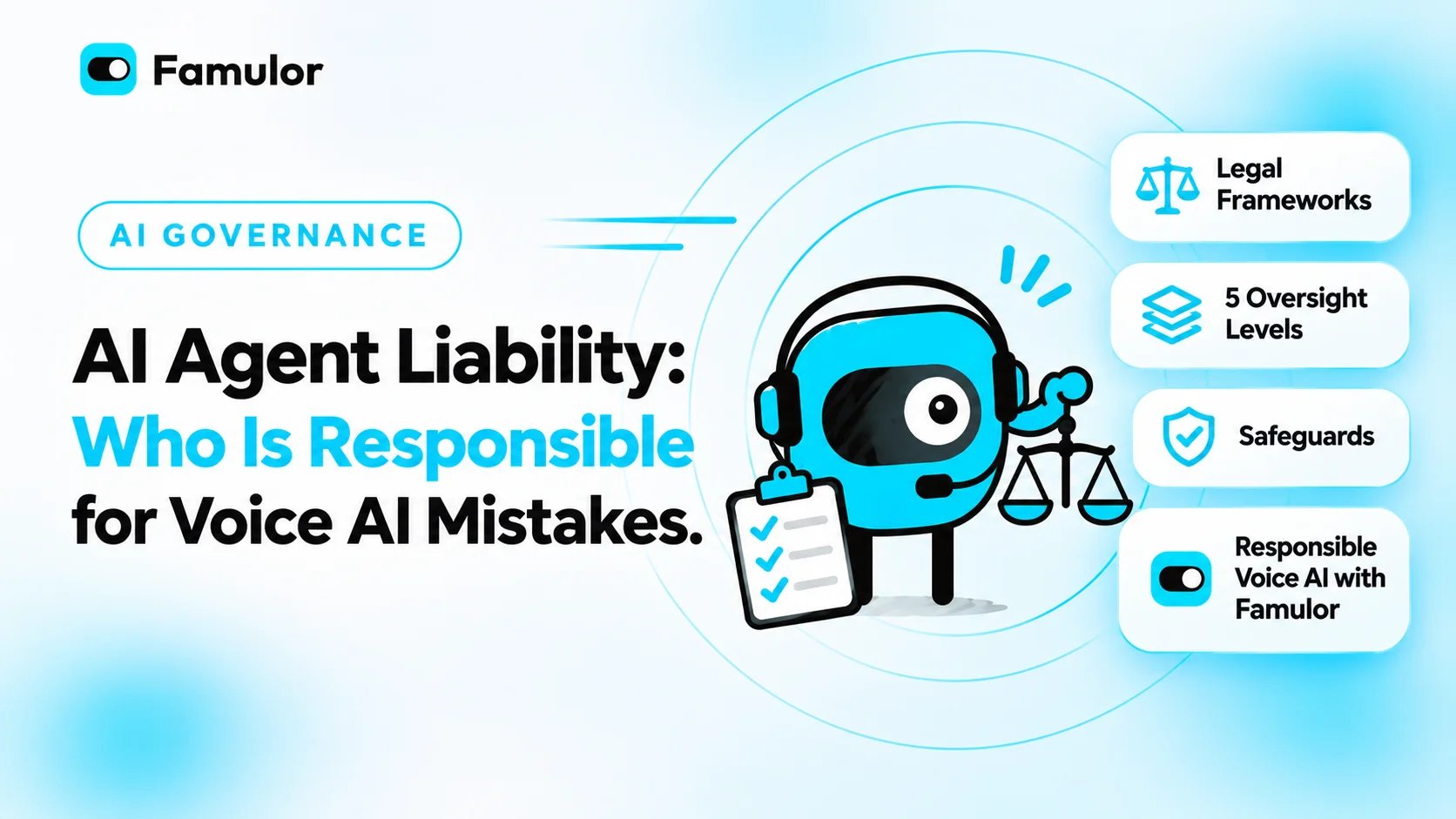
When an AI voice agent books the wrong appointment, quotes an incorrect price, or fails to escalate a medical emergency, the question of liability is no longer theoretical — it is a legal and operational reality. As businesses deploy AI-powered phone systems to handle thousands of calls daily, accountability frameworks have become essential. The short answer: the deploying company bears primary responsibility for its AI agent's actions, regardless of whether the error originated in the model, the configuration, or the telephony infrastructure. This article breaks down the legal landscape, practical safeguards, and implementation strategies that protect your business while maximizing the efficiency gains of voice AI automation.
Understanding AI agent liability is critical for any organization using automated voice systems. From healthcare practices fielding patient calls to e-commerce companies processing orders by phone, the stakes are high — and the regulatory environment is tightening fast. Platforms like Famulor address these challenges with built-in compliance features, granular escalation rules, and human-in-the-loop safeguards that shift the liability equation in your favor.
Key Terms: Understanding AI Agent Accountability
Before diving into regulatory frameworks and implementation details, it is important to establish a shared vocabulary. AI agent liability refers to the legal and financial responsibility for actions taken — or not taken — by an autonomous AI system acting on behalf of a business. Deployer liability means the company that puts the AI into production is accountable under most legal theories, even if a third-party vendor built the underlying model. Human-in-the-loop (HITL) describes systems where a human operator can monitor, intervene, or override AI decisions in real time. Warm transfer is the process of handing a live call from the AI agent to a human agent while preserving full conversation context and history.
Two additional concepts are gaining regulatory importance. Algorithmic auditing refers to systematic testing of AI systems for bias, accuracy, and compliance — already mandated in some jurisdictions. Explainability means the ability to document and justify why an AI system made a specific decision, which is increasingly required by regulators for high-risk applications such as healthcare scheduling, financial advice, and insurance claims processing.
The Regulatory Landscape: What Laws Apply to Voice AI Systems
The legal framework governing AI agent liability is evolving rapidly across multiple jurisdictions. Businesses operating internationally — or even across U.S. states — face a patchwork of regulations that demand careful compliance planning.
| Jurisdiction | Regulation | Effective Date | Key Requirements for Voice AI |
|---|---|---|---|
| European Union | EU AI Act | Phased 2024–2026 | Risk classification, transparency obligations, human oversight for high-risk systems |
| California (USA) | SB 1047 / AB 2013 | January 2026 | AI cannot be used as a defense; deployer accountability for AI-caused harm |
| Colorado (USA) | Colorado AI Act | February 2026 | Impact assessments, bias testing, consumer notification for high-risk AI decisions |
| New York City | Local Law 144 | Active since 2023 | Annual bias audits for automated employment decision tools |
| Canada | AIDA (proposed) | Under review | Accountability framework, impact assessments, transparency requirements |
| UK | AI Safety Framework | Voluntary / evolving | Risk-based approach, sector-specific guidance, emphasis on transparency |
The most significant development for voice AI deployers is California's new legislation, which explicitly eliminates the "the AI did it" defense. Under this framework, if your AI voice agent provides incorrect medical information during a patient call, your organization — not the AI vendor — faces liability. This principle aligns with established product liability theories: design defect (the system was configured incorrectly), manufacturing defect (a specific model version produced flawed outputs), and failure to warn (callers were not informed they were speaking with an AI).
The EU AI Act takes a risk-based approach, classifying AI systems into four tiers. Voice AI agents that handle healthcare scheduling, insurance claims, or financial transactions may fall under the "high-risk" category, triggering mandatory requirements for human oversight, technical documentation, data governance, and conformity assessments. Companies using platforms with built-in compliance infrastructure — such as Famulor's AI phone agent with automatic call recording, transcript logging, and configurable escalation rules — are better positioned to meet these requirements.
The RACI Model for AI Voice Agent Deployments
Establishing clear accountability requires mapping every stakeholder's role using the RACI framework — Responsible, Accountable, Consulted, and Informed. Here is how this applies to a typical AI voice agent deployment:
The deploying company (your business) is Accountable for all AI agent actions. You choose the platform, configure the prompts and workflows, set escalation thresholds, and define the operational boundaries within which the AI operates. Even when using a third-party platform, the legal buck stops with you.
The platform vendor (e.g., Famulor) is Responsible for providing a reliable, secure, and compliant infrastructure. This includes the quality of speech recognition, the stability of telephony connections via SIP trunking, the accuracy of language models, and the availability of safety features such as warm transfer, call recording, and escalation triggers.
The human oversight team within your organization is Responsible for monitoring AI performance, reviewing flagged calls, handling escalations, and continuously improving the system based on real-world feedback. They are Consulted on prompt changes and workflow updates, and they are the first line of defense when the AI encounters edge cases.
The end user (the caller) should be Informed that they are interacting with an AI system — this is already a legal requirement in several jurisdictions and is rapidly becoming a universal best practice. Transparency builds trust and reduces legal exposure.
Five Levels of Human Oversight: From Full Autonomy to Manual Control
Not every call requires the same degree of human involvement. The most effective AI voice agent deployments implement tiered oversight that matches the level of supervision to the risk profile of each interaction. This approach maximizes efficiency for routine calls while ensuring high-risk scenarios receive appropriate human attention.
| Level | Mode | Trigger Criteria | Human Role | Best For |
|---|---|---|---|---|
| 1 | Fully Autonomous | Low-risk, routine interactions | Post-call review only | FAQ answering, business hours info, simple status checks |
| 2 | Monitored Autonomous | Standard transactions under a value threshold | Real-time dashboard monitoring, spot checks | Appointment scheduling, order tracking, callback requests |
| 3 | Assisted | Moderate complexity or moderate financial value | AI drafts response, human approves before delivery | Price quotes, insurance inquiries, contract questions |
| 4 | Supervised | High-risk topics, negative sentiment, low AI confidence | Warm transfer to human agent with full context | Complaints, medical advice, legal topics, billing disputes |
| 5 | Manual Override | Emergencies, regulatory-sensitive, explicit caller request | Immediate human takeover, AI fully disengaged | Medical emergencies, threats, fraud detection, vulnerable callers |
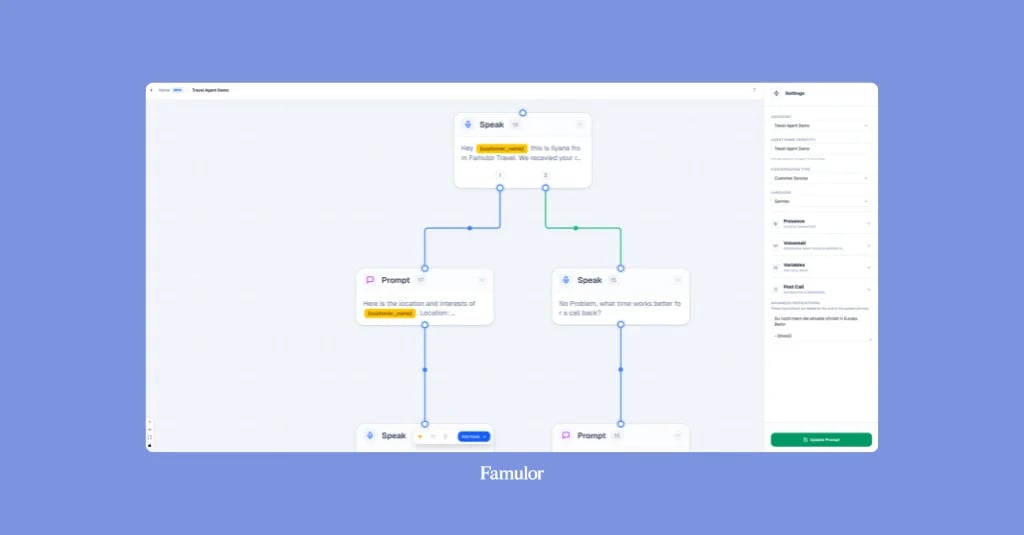
Modern voice AI platforms support this graduated approach through configurable escalation rules. With Famulor's Flow Builder, for example, you can define precise conditions for each oversight level — routing calls based on topic detection, caller sentiment analysis, confidence scores, transaction values, or explicit caller requests to speak with a human. The platform's 300+ integrations ensure that when an escalation occurs, the receiving human agent has access to the full call transcript, CRM data, and relevant customer history.
Common Liability Pitfalls and How to Avoid Them
Organizations deploying voice AI systems tend to fall into predictable traps. Recognizing these patterns early can save significant legal and financial exposure.
Pitfall 1: Treating AI configuration as a one-time task. Language models evolve, customer expectations shift, and regulatory requirements change. An AI agent configured six months ago may no longer comply with current standards. Best practice: schedule monthly prompt reviews and quarterly compliance audits. Track your AI's accuracy rate, escalation rate, and customer satisfaction scores continuously.
Pitfall 2: Inadequate disclosure. Failing to inform callers that they are speaking with an AI system is already illegal in several jurisdictions and creates unnecessary legal risk everywhere else. Best practice: begin every AI-handled call with a clear, natural-sounding disclosure statement. Many callers appreciate the transparency, and those who prefer a human can be transferred immediately.
Pitfall 3: Missing or poorly designed escalation paths. An AI system without robust escalation capabilities is a liability time bomb. If a caller expresses distress, mentions a medical emergency, or explicitly asks for a human — and the system cannot comply — your organization faces both legal and reputational risk. Best practice: implement warm transfer with full context preservation, and ensure human agents are available during all operating hours.
Pitfall 4: Insufficient logging and documentation. When a dispute arises, you need a complete audit trail: the call recording, the transcript, the AI's decision log, and the configuration that was active at the time of the call. Without this documentation, defending your organization's actions becomes significantly harder. Best practice: use a platform with automatic call recording, transcript generation, and version-controlled configuration history.
Pitfall 5: Ignoring bias testing. AI voice agents can exhibit bias in speech recognition accuracy across accents, languages, and demographics. They can also produce biased outputs if the underlying model or training data contains biases. Jurisdictions like New York City already require annual bias audits for certain AI applications, and this requirement is expanding. Best practice: conduct regular bias testing across demographic groups and document the results.
Step-by-Step Implementation: Building a Liability-Resilient Voice AI System
Deploying a voice AI agent with proper accountability safeguards requires a systematic approach. Here is a practical implementation roadmap:
Step 1: Risk assessment and classification. Map every use case your AI agent will handle and classify each by risk level. A dental practice scheduling routine cleanings (low risk) has very different requirements than an insurance company processing claims (high risk). Document this classification — it forms the foundation of your compliance strategy and determines which oversight level each interaction requires.
Step 2: Platform selection with compliance in mind. Choose a voice AI platform that provides the infrastructure you need for accountability. Essential features include: call recording with configurable retention policies, real-time transcript generation, configurable escalation rules, warm transfer capabilities, detailed analytics and reporting, and integration with your existing business systems. Famulor's platform, for example, supports all of these features natively, with SIP trunking for any VoIP provider and a no-code automation platform for building complex compliance workflows.
Step 3: Configure escalation triggers. Define the specific conditions under which your AI agent should escalate to a human. At minimum, configure escalation for: low confidence scores (below a threshold you define based on testing), negative sentiment detection, specific high-risk topics (medical, legal, financial), explicit caller requests for a human agent, and any situation where the AI cannot provide a definitive answer. Test these triggers extensively before going live.
Step 4: Implement monitoring and feedback loops. Set up dashboards to track key performance indicators: call resolution rate, escalation rate, average handling time, customer satisfaction scores, and error rates by category. Review flagged calls daily during the initial deployment period, then weekly once the system stabilizes. Use findings to continuously refine prompts, escalation rules, and knowledge base content.
Step 5: Establish documentation and audit procedures. Create a compliance documentation system that includes: your risk assessment and classification, AI configuration version history, escalation rules and their rationale, regular audit reports, incident reports and corrective actions, and bias testing results. Store this documentation securely with appropriate retention periods based on your jurisdiction's requirements.
Estimate your ROI from automating calls
See how much your business could save by switching to AI-powered voice agents.
ROI Result
ROI 0%
No credit card required
Industry-Specific Use Cases and Liability Considerations
Healthcare — a dental practice in Austin, Texas. Dr. Martinez's practice uses an AI voice agent to handle appointment scheduling, insurance verification calls, and post-treatment follow-ups. The liability consideration: if the AI incorrectly schedules a patient for a procedure their insurance does not cover, the practice could face both patient complaints and insurance fraud allegations. Solution: the AI agent operates at Oversight Level 2 (monitored autonomous) for standard scheduling, but automatically escalates to Level 4 (supervised, warm transfer) for any insurance-related questions or post-surgical follow-ups. All calls are recorded and transcribed, and the dental office manager reviews flagged interactions daily.
Insurance — a brokerage firm in London. Henderson Insurance Brokers handles 400+ inbound calls daily, with inquiries ranging from simple policy status checks to complex claims processing. The liability consideration: providing incorrect coverage information or failing to escalate a time-sensitive claim could result in regulatory action and significant financial penalties. Solution: the AI agent handles routine status inquiries autonomously (Level 1) but routes all claims-related calls to Level 4 with warm transfer to a licensed agent. The system integrates with the brokerage's CRM and policy management system through the platform's integration capabilities, ensuring the human agent receives complete caller context and policy details during handoff.
E-commerce — an online retailer in Berlin. ShopDirect GmbH processes 1,200 customer service calls per day, covering order status, returns, and product questions. The liability consideration: quoting incorrect prices, processing unauthorized returns, or mishandling consumer protection inquiries under EU consumer law could trigger regulatory fines and chargebacks. Solution: the AI agent operates autonomously for order tracking and FAQ responses, escalates to Level 3 (assisted) for returns above a certain value threshold, and immediately transfers to Level 5 (manual override) for any consumer complaint that mentions legal action, regulatory agencies, or data protection rights. The platform's 40+ language support ensures consistent service quality across European markets.
AI Liability Insurance: An Emerging Safety Net
As AI agent deployments grow, a new category of insurance products is emerging specifically to cover AI-related liabilities. Traditional professional liability and errors-and-omissions (E&O) policies may not explicitly cover losses caused by AI systems, leaving a dangerous coverage gap.
AI liability insurance policies typically cover: financial losses resulting from incorrect AI outputs, legal defense costs for AI-related claims, regulatory fines and penalties (where insurable by law), and costs of mandatory corrective actions such as bias audits or system modifications. When evaluating AI liability insurance, consider whether the policy covers both first-party losses (your direct costs) and third-party claims (lawsuits from affected callers or customers).
Insurers are increasingly requiring policyholders to demonstrate responsible AI governance practices — including documented risk assessments, regular audits, human oversight mechanisms, and incident response procedures. Using a platform with built-in compliance infrastructure strengthens your insurance application and may reduce premiums.
Monitoring, Metrics, and Continuous Improvement
Liability mitigation is not a one-time project — it requires ongoing monitoring and adaptation. The most effective voice AI deployments track specific metrics that serve as early warning indicators for potential liability issues.
Escalation rate measures the percentage of calls that require human intervention. A sudden increase may indicate model degradation, a change in caller demographics, or a new type of inquiry the AI cannot handle. Target: establish a baseline during the first month and investigate any deviation greater than 15%.
Resolution accuracy measures whether the AI's responses were correct and complete. This requires human review of a statistically significant sample of calls. Target: 95% or higher for routine interactions, with 100% accuracy required for high-risk topics before moving to autonomous handling.
Customer satisfaction gap compares satisfaction scores for AI-handled calls versus human-handled calls. A significant gap suggests areas where the AI needs improvement. Target: the gap should be less than 10% within six months of deployment.
Time to escalation measures how quickly the AI recognizes that it needs to transfer a call. Slow escalation in high-risk scenarios increases liability exposure. Target: escalation should trigger within 15 seconds of a qualifying condition being detected.
Incident frequency and severity tracks how often AI errors occur and their impact. Categorize incidents by type (factual error, inappropriate response, failed escalation, technical failure) and severity (minor inconvenience versus potential harm). Any increase in severity should trigger an immediate review of the AI's configuration and escalation rules.
Conclusion
AI agent liability is not a future concern — it is a present-day operational requirement. The organizations that thrive with voice AI will be those that treat accountability as a feature, not a constraint. By implementing tiered oversight, maintaining comprehensive documentation, choosing platforms with built-in compliance infrastructure, and continuously monitoring performance, you can capture the efficiency benefits of AI voice agents while managing legal and operational risk effectively.
Famulor provides the technical foundation for accountable AI voice deployments: configurable escalation rules in the Flow Builder, warm transfer with full context preservation, automatic call recording and transcription, 300+ integrations for seamless data flow, and SIP trunking compatibility with any telephony provider. Start building your liability-resilient voice AI system today — explore Famulor's plans to find the configuration that fits your compliance requirements.
Try our AI Assistant
Experience how natural our AI phone assistant sounds.
Enter your details and receive a call from our AI agent within seconds.
Agent is trained to discuss Famulor services and book appointments.

Demo AI agent
Famulor representative
FAQ
Who is legally liable when an AI voice agent makes a mistake?
The deploying company bears primary legal liability for its AI agent's actions. Under emerging regulations like California's SB 1047 and the EU AI Act, the "the AI did it" defense does not hold — the organization that configures and deploys the system is accountable for its outputs.
Does the EU AI Act apply to voice AI phone systems?
Yes, the EU AI Act applies to AI systems deployed in the EU, including voice AI agents. Systems handling healthcare, insurance, or financial interactions may be classified as high-risk, requiring human oversight, technical documentation, and conformity assessments.
What is human-in-the-loop and why does it matter for AI liability?
Human-in-the-loop (HITL) means a human can monitor, intervene, or override AI decisions in real time. It matters because most regulatory frameworks require demonstrable human oversight for high-risk AI applications, and it significantly reduces liability exposure.
How should an AI voice agent handle emergency situations?
Emergency situations require immediate transfer to a human operator with full conversation context — the highest oversight level (Manual Override). The AI should recognize emergency keywords and sentiment indicators and execute the transfer within seconds, not minutes.
Do I need AI liability insurance for my voice AI deployment?
While not yet legally required in most jurisdictions, AI liability insurance is increasingly recommended. Traditional E&O policies may not cover AI-specific risks. Dedicated AI liability insurance covers incorrect outputs, legal defense costs, regulatory fines, and corrective action expenses.
What metrics should I track to reduce AI agent liability risk?
Track escalation rate, resolution accuracy, customer satisfaction gap between AI and human calls, time to escalation, and incident frequency by severity. Any significant deviation from baseline values should trigger an immediate configuration review.
Can I use an AI voice agent in healthcare without violating HIPAA?
Yes, but you need a platform that supports HIPAA compliance requirements: encrypted call recording, access controls, audit logging, and a Business Associate Agreement (BAA) with your vendor. Ensure PHI is handled according to the minimum necessary standard.
How often should I audit my AI voice agent for compliance?
Conduct monthly prompt reviews, quarterly compliance audits, and annual bias testing at minimum. High-risk deployments in regulated industries may require more frequent assessments. Document all audit findings and corrective actions taken.
What happens if my AI agent fails to disclose that the caller is speaking with AI?
Failure to disclose AI interaction is already illegal in several jurisdictions and creates significant legal risk. California, the EU, and several other regulatory bodies require clear disclosure at the start of AI-handled conversations. Non-compliance can result in fines and voided transactions.
How does warm transfer reduce liability compared to cold transfer?
Warm transfer preserves the full conversation context — transcript, caller intent, CRM data — and hands it to the human agent before the caller repeats themselves. This reduces errors during handoff, improves resolution accuracy, and creates a complete audit trail for compliance documentation.

Writer at Famulor