Summarize Content With:




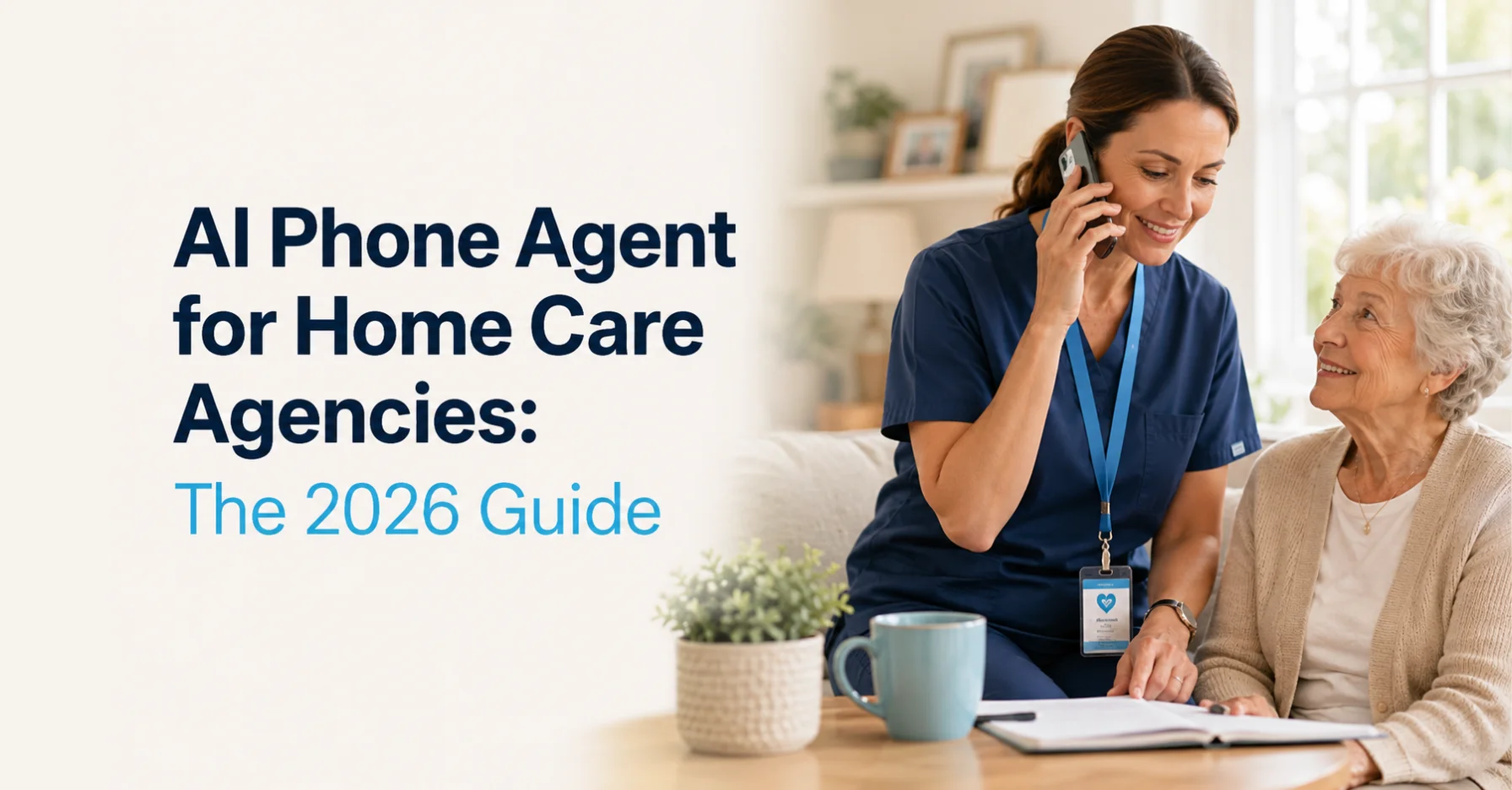
AI Phone Agent for Home Care Agencies: Answering Calls While the Team Is on the Road
An AI phone agent in a home care agency answers exactly the calls that currently go unanswered: the caregiver calling in sick at 5:50 a.m., the hospital discharge planner at 3:40 p.m., the daughter asking in the evening why today's visit ran late. It understands the request in natural language, captures the relevant fields in a structured format, and hands them to the care manager, the scheduling system, or the CRM — by webhook, in real time.
The short answer for agency owners and care managers: yes, this works in production — but only with hard boundaries. An AI agent in a care setting may capture, route, schedule, and document. It must not advise, assess, or triage. That single dividing line determines whether a home care voice project survives or gets switched off after four weeks.
This guide covers the caller types a home care agency actually receives, which of them a no-code AI voice agent can take over, how data protection works when health data is involved, and how to build a working setup in five steps.
Why the phone line is structurally overloaded in home care
Home care agencies face a problem most service businesses do not: the people qualified to answer calls are out on visits during exactly the hours when the phone rings most. Routes typically run from 6:00 to 11:00 a.m. and 4:00 to 8:00 p.m. Those are the two peaks.
Take Riverside Home Care, a mid-sized agency with 34 caregivers, roughly 180 clients, and two people in the office. Monday, 5:50 a.m.: two caregivers call in sick. Routes have to be re-cut before the first shift starts at 6:30. At the same time, family members are calling to move visit times. By 7:15 the line is busy, voicemail is full, and a hospital discharge planner trying to place a Thursday discharge simply calls the next agency on the list.
That last one is the expensive miss. Referrals from discharge planning are time-critical and go to whichever agency confirms capacity first. A missed call there is not a missed call — it is a client lost for months.
Who calls, and what actually has to happen
Before building an agent, you need the caller typology. In home care it is remarkably consistent:
| Caller type | Typical request | Urgency | Target process |
|---|---|---|---|
| Own caregiver | Sick call, running late, key or access problem | Immediate | Push to care manager, re-cut route |
| Hospital discharge planner | Referral, capacity check | High, same day | Structured intake, callback with a firm answer |
| Family member | Reschedule, question about a visit, complaint | Medium | Book slot or callback request with context |
| Client | Cancel a visit, change the time | Medium to high | Cancellation straight into scheduling |
| Physician office, pharmacy, medical supplier | Orders, prescriptions, equipment | Medium | Ticket to the responsible nurse |
| Prospect or legal guardian | New inquiry, services offered, availability | Low to medium | Qualify, waitlist, book assessment call |
| Medical emergency | Acute emergency at a client's home | Critical | Direct to emergency services, then transfer |
This table is the actual build spec. Every row becomes an intent branch in the Flow Builder; every target column becomes an action — webhook, calendar event, transfer, or ticket.
What an AI phone agent can take over — and what it must not
In home care the boundary is not a preference, it is a liability question. Safely delegated:
- Sick calls from your own staff — name, route, expected duration — pushed to the care manager within seconds.
- Visit cancellations and reschedules from clients and families, written into the calendar or scheduling system.
- Referral intake from discharge planning, captured as structured data: hospital, unit, contact and direct dial, planned discharge date, level of care, services needed, address.
- Qualifying new inquiries: check the postal code against your service area, ask which services are needed, book an assessment call if capacity exists, otherwise add to the waitlist.
- Callback requests with context, instead of a voicemail with no information in it.
- Standard information from a maintained knowledge base: office hours, service area, documents needed for the first assessment, how billing works.
- Outbound reminders for assessment appointments or missing paperwork.
Not delegable — and explicitly forbidden in the system prompt:
- Any clinical judgment. No feedback on symptoms, no medication guidance, no opinion on whether something is serious.
- Advice on benefits or entitlements. Questions about coverage, respite care, or funding are captured and handed to a qualified person, not answered.
- Binding capacity commitments. The agent takes the request; the care manager makes the commitment.
- Emergency handling. If the agent detects signs of an acute emergency, it names the local emergency number immediately and transfers in parallel. It asks no follow-up questions and puts nobody on hold.
- Resolving complaints on the merits. Capture, prioritize, escalate — never justify.
How to write restrictions that actually hold is covered in the system prompt guide. The key move is to phrase every boundary as a concrete instruction ("If there are signs of an emergency, say verbatim: …") rather than an abstract prohibition.
Data protection when health data is on the line
Almost everything that crosses a home care agency's phone line touches special category personal data under Article 9 GDPR. That is why more voice projects fail in this vertical than in any other — not on speech quality, but on the data protection impact assessment.
In practice this means four things. First, processing and hosting inside the EU, with a data processing agreement and documented data paths. Second, data minimization in the prompt itself — the agent never asks for diagnoses, because none of the processes above require them. Third, transparency: callers are told at the start that they are speaking to an AI assistant and can switch to a human at any point. Fourth, explicit retention periods for transcripts and recordings, plus a deliberate decision about whether audio is stored at all.
On recording specifically, the pragmatic answer most agencies land on is: keep transcripts and structured fields, do not keep audio. That cuts risk substantially and is still enough for documentation and quality review. Local call recording law applies on top and varies by jurisdiction, so confirm it for yours.
Implementation in five steps
A realistic pilot takes days, not months. In order:
- Document your caller typology. Log for one week who calls and what they need. The table above is a solid starting point, but every agency has quirks — a high share of calls from guardianship organizations, for instance.
- Create the agent and write the prompt. Role, tone, prohibition list, escalation rules. For scheduling logic, start from the appointment booking example prompts. In home care a calm, slower speaking style pays off — a large share of callers are over 75.
- Fill the knowledge base. Service area by postal code, services offered, office hours, contact per route, how the first assessment works. Nothing clinical.
- Wire up the actions. Sick call as an instant push to the care manager, reschedule into the calendar, referral as a structured record in the CRM. With custom mid-call tools the agent can check a postal code against your service area during the call and answer on the spot.
- Connect the number and open up gradually. First as overflow after five rings, then outside office hours, then during route windows. Switching the main line on day one burns trust with your own staff.
Telephony runs either on a number from the Famulor pool or via SIP trunking into your existing phone system — for agencies with an established number structure, the latter is usually the right path. See the AI call center overview for how that works.
What it costs, and when it pays for itself
The math in home care is unusually clean, because the benefit side includes not just saved admin time but additional clients won. The cost side is a per-minute rate, not a full-time salary.
| Cost factor | Office admin staff | AI phone agent |
|---|---|---|
| Availability | Office hours, one line at a time | 24/7, many calls in parallel |
| Cost model | Fixed monthly cost | Usage-based per minute |
| 5:50 to 7:00 a.m. peak | Not covered | Fully covered |
| Holidays and sick leave | Needs cover | Not applicable |
| Documentation | Manual, often after the fact | Automatically structured |
| Clinical advice | Strength | Deliberately excluded |
These columns are not mutually exclusive. The realistic target state is not "agent instead of admin staff" but: admin staff work pre-qualified cases with full context instead of spending the day sorting calls. To see the numbers for your own agency, start from the pricing page.
Estimate your ROI from automating calls
See how much your business could save by switching to AI-powered voice agents.
ROI Result
ROI 0%
No credit card required
Best practices and common mistakes
Tune pace and patience. Older callers need longer pauses and tolerate interruptions poorly. An agent that starts speaking too early reads as rude to this audience. Turn detection and pause thresholds deserve deliberate configuration here, not defaults.
Test the emergency path first. Before any other flow goes live, the emergency path has to work a hundred times out of a hundred. It is the one path where a failure does real harm.
Have names and addresses spelled back. Street names and surnames are the single biggest source of data errors. Confirm character by character for anything that feeds scheduling.
Use multilingual capability. In many agencies neither the whole team nor the whole client base speaks the local language as a first language. An agent that detects and switches language mid-call measurably lowers abandonment — especially on sick calls from staff.
Common mistakes: too many intents in the first release; a prompt that lets the agent advise "when it's simple"; no escalation number for the care manager after hours; a waitlist with no follow-up trigger; and the classic — nobody told the team the agent is live, so caregivers hang up when they call in sick.
Three situations from a normal week
Sick call, Monday 5:52 a.m. A caregiver calls, gives her name and route 4. The agent confirms, asks how long she expects to be out, and pushes the information to the care manager and the scheduling channel within seconds. Route planning starts at 6:00, not 7:30.
Referral, Tuesday 3:40 p.m. A hospital discharge planner wants to place a Thursday discharge. The agent captures hospital, unit, contact with direct dial, discharge date, level of care, service requirements, and address; checks the postal code against the service area via mid-call tool; and creates a prioritized record in the CRM. The care manager calls back at 5:10 p.m. with a firm answer.
Family member, Sunday 7:20 p.m. A client's daughter wants to move Wednesday's visit from 8:00 to 10:00 a.m. The agent identifies the client by name and address, captures the change, and files it as a change request for confirmation — without committing, because the route determines what is possible.
For comparable setups in adjacent verticals, see the industry solutions overview.
Conclusion
Home care agencies do not have a phone problem. They have a simultaneity problem: calls arrive precisely when nobody is in the office. An AI phone agent solves that because it does not tire, works in parallel, and picks up as reliably at 5:50 a.m. as at 3:40 p.m.
Success depends less on the technology than on discipline about boundaries. Capture, structure, route, document — yes. Advise, assess, commit — no. Enforce that consistently in the prompt and within days you have a system that takes load off the office while making sure referrals stop landing with a competitor.
Concrete next step: log one week of incoming calls, turn that into three intents — sick call, reschedule, referral intake — and run the agent as overflow only at first. Everything else can be added calmly after that.
Try our AI Assistant
Experience how natural our AI phone assistant sounds.
Enter your details and receive a call from our AI agent within seconds.
Agent is trained to discuss Famulor services and book appointments.

Demo AI agent
Famulor representative
FAQ
Can an AI phone agent process health data in home care?
Yes, provided the requirements for special category data under Article 9 GDPR are met: a legal basis, a data processing agreement, EU hosting, documented data paths, and data minimization. Famulor runs on EU hosting with a GDPR-compliant setup.
What happens during a medical emergency?
The agent names the local emergency number immediately and transfers in parallel to a configured line. It asks no follow-up questions and puts nobody on hold. This path is tested before go-live.
Can the agent take sick calls from our own caregivers?
Yes, and it is usually the fastest-payback use case. The agent captures name, route, and expected duration, then pushes that to the care manager instantly by webhook or message.
Does the agent recognize returning clients?
Yes. Using the caller ID and a mid-call lookup against your system, the agent can identify a client and load the relevant context, such as their assigned route and next scheduled visit.
Will it work with our existing phone system?
Yes. Famulor supports SIP trunking to any common VoIP or PBX provider, so existing numbers and extensions stay intact. Alternatively you can use a number from the Famulor pool.
Does the agent speak languages other than English?
Yes, over 40 languages, with language switching mid-call. That matters in home care because both team members and family members frequently speak another first language.
How long does setup take for a single agency?
A pilot with three intents can be configured in a day. One to two weeks is realistic for full production use, since the knowledge base, integrations, and escalation rules need tuning.
May the agent answer questions about coverage or respite care?
No, and the system prompt should forbid it explicitly. Those questions are captured in a structured form and handed to a qualified person, because a wrong answer about entitlements causes immediate harm.
Are calls recorded?
That is your decision. Common practice in home care is to store transcripts and structured fields but not audio, which lowers risk while still supporting documentation and quality review.
Writer at Famulor