Summarize Content With:




Why the per-minute price is only the start
Most AI voice agent pricing pages lead with one number: a price per minute. It looks simple, and it is the first thing buyers compare. But a phone call runs through several paid layers, and the headline rate often covers only one of them. If you budget from that single number, your first invoice will not match your spreadsheet.
This guide breaks the bill into five cost lines, shows how to calculate a realistic monthly budget, and explains where the surprises usually hide. It is written for the person who has to approve the budget: an operations lead, an agency owner or a founder who wants to launch a phone agent without a nasty month-end.
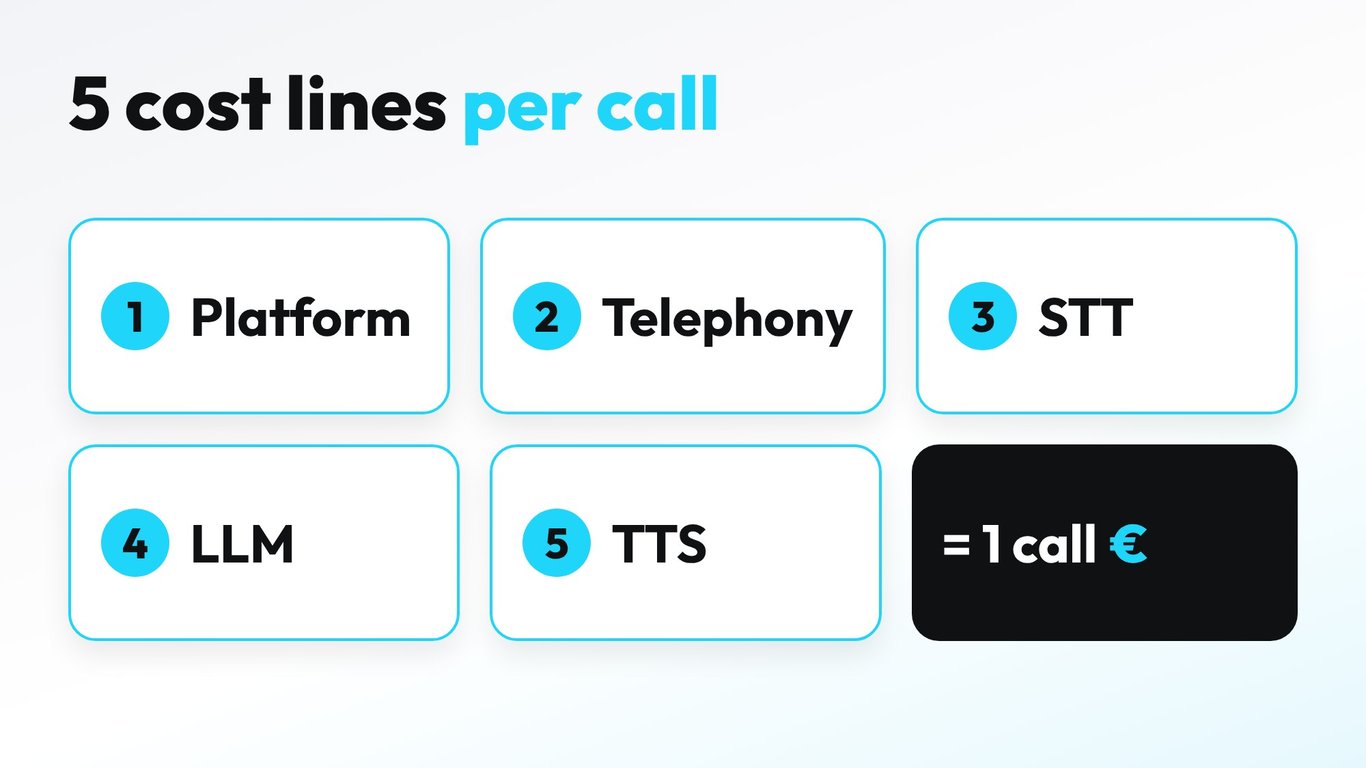
The five cost lines of an AI voice call
Every call moves audio through the same chain. Each step can be billed separately, by a different company, in a different unit. That is why two vendors with the same headline rate can end up far apart on the invoice.
| Cost line | What it pays for | How it is usually billed |
|---|---|---|
| Platform | Orchestration, call flow, tools, logs, dashboards | Per minute or monthly plan |
| Telephony | Phone number, carrier minutes, SIP trunk | Per minute plus monthly number fee |
| Speech to text (STT) | Turning the caller's voice into text | Per audio minute or per second |
| Language model (LLM) | Understanding the request and choosing the answer | Per token, input and output |
| Text to speech (TTS) | Speaking the answer with a natural voice | Per character or per audio minute |
If you want the background on the two speech layers, read our explainer on how voice agents hear and speak. Here we focus on money.
1. Platform
The platform layer runs the conversation logic, connects tools such as calendars and CRMs, and stores recordings and transcripts. Some vendors charge a small per-minute orchestration fee. Others charge a monthly plan with included minutes. Both models are fair, but they behave differently when volume changes.
2. Telephony
Calls need a number and a carrier. If the platform sells telephony, you pay a per-minute rate and often a monthly fee per number. If you bring your own carrier, you pay that carrier directly. Inbound and outbound calls differ in price, and so do destinations. A call to a mobile number in one country can cost several times a call to a landline in another. Our Twilio and Telnyx calculators show how far carrier prices can drift.
3. Speech to text
STT is billed on audio time. A call where the caller talks 40 percent of the time still streams audio for the full duration on many setups, so check whether you pay for the whole call or only for speech.
4. Language model
LLM cost depends on how much text goes in and out. Long system prompts, large knowledge bases and chatty answers all increase tokens. A short, well-structured prompt is the cheapest optimisation you can make. The model you choose matters too: a smaller model can handle simple booking calls at a fraction of the price of a flagship model.
5. Text to speech
The voice is often the most visible quality factor and the line that varies most. Premium voices cost more than standard ones. Some platforms include a set of voices in the rate and charge extra for cloned or third-party voices.
What vendors advertise: base rates in 2026
Advertised rates are a useful starting point if you read them for what they are: a statement about one layer, sometimes more. According to third-party comparisons published in 2026, the picture looks like this.
The chart compares unlike things. Vapi and Retell list a base fee and bill model, voice and telephony on top. Bland's tiers bundle the language model, speech recognition and voice, with telephony billed separately. A lower bar does not mean a lower invoice. It means a smaller share of the stack is inside that number.
A worked example: the platform line at 10,000 minutes
Take a mid-sized service team that handles 10,000 call minutes per month. Multiply the advertised base rate by the volume to see the platform line alone. The calculation is simple: rate times minutes.
That is 0.05 × 10,000 = 500, 0.055 × 10,000 = 550 and 0.11 × 10,000 = 1,100. These are not total costs. For the vendors that bill model, voice and telephony separately, you still need to add those lines. Independent write-ups put realistic all-in rates for such stacks well above the base fee, often by a multiple. The only way to know yours is to price your own configuration.
How to build your own budget in four steps
- Estimate real talk time. Count answered calls, not dials. Multiply by the average handling time from your phone system.
- List the five lines per vendor. Mark each as included, billed separately or bring-your-own.
- Add fixed fees. Plan fees, phone numbers, seats and add-ons belong in the monthly total.
- Divide by answered calls. The result is your cost per answered call. This is the number to compare.
Run this once for a quiet month and once for a peak month. Voice agents scale up in seconds, which is a strength, but it also means a campaign or a seasonal peak can double usage overnight.
A practical example: a dental practice with four treatment chairs gets about 600 calls a month, and 70 percent of them last three minutes. A business with that profile uses roughly 1,260 talk minutes for those calls plus longer booking conversations. Small volumes like this fit a plan with included minutes or pay as you go far better than a contract sized for 10,000 minutes.
Estimate your ROI from automating calls
See how much your business could save by switching to AI-powered voice agents.
ROI Result
ROI 0%
No credit card required
Where costs surprise teams
Minimums and annual contracts
Some vendors have moved toward annual contracts. A third-party report from September 2026 describes one well-known no-code platform that stopped selling self-serve plans to new customers and now starts at a five-figure annual commitment. Treat this as a reason to read the contract terms, not as a statement about any one vendor, and verify current terms on the vendor's own site.
Long prompts and large knowledge bases
Every turn of the conversation sends the prompt to the model again. A 3,000-word prompt costs real money across thousands of calls. Keep the prompt short, move facts into a knowledge base with retrieval, and test shorter answers.
Concurrency limits
Many platforms cap parallel calls per plan. If you run outbound campaigns, you need enough concurrency to finish the list in your calling window. Check the limit before you pick a plan.
Failed and short calls
Calls that go to voicemail, or that end after two seconds, may still bill a minimum increment. Look for per-second billing if your campaigns have many short calls.
Currency and tax
Many vendors bill in US dollars. If you pay in euros, add exchange costs and VAT where applicable. For German-speaking customers, EU hosting and a GDPR-ready contract matter as much as price.
Setup, testing and support
Besides running minutes, there are often one-off costs. These include building the call flow, test calls before launch and connecting a calendar or CRM. Plan a few hours for this, even on a no-code platform. Expect to refine prompts over the first weeks. Every test call uses minutes, but the total stays small if you test with a plan.
Also ask about support and onboarding. Some vendors offer personal guidance only on higher plans. For a team without its own developers, that is a real part of the price, even if it is not on the pricing page.
Scaling after the pilot
A pilot with 500 minutes says little about the bill at 10,000 minutes. Check before launch how price, concurrency and support behave when you grow from one phone number to ten. Settling this early avoids an expensive platform switch halfway through the project.
How Famulor prices the stack
Famulor bundles the voice stack into the minute price. You can start with pay as you go at €0.15 per minute, and the rate drops to €0.05 per minute on higher plans. The Plus plan costs €35 per month with 100 included minutes, and extra minutes cost €0.12. Current prices and promotions always appear on the Famulor pricing page.
Because speech and model usage sit inside the minute price, the budget has fewer moving parts. You still choose your voice and model, and you can bring your own carrier through SIP. If you already run a Twilio or Telnyx account, our Twilio calculator shows the carrier share of your bill before you decide.
Teams that run an assistant on another platform can move without rebuilding from scratch. The Vapi migration guide explains how to import an existing assistant, and our AI call center page shows how inbound routing, queues and handover work at scale.
Plans with included minutes or pay as you go?
| Situation | Better fit | Reason |
|---|---|---|
| Pilot with unknown volume | Pay as you go | No commitment while you measure real usage |
| Steady daily volume | Plan with included minutes | Lower effective rate and a fixed monthly line |
| Seasonal peaks | Plan plus extra minutes | Base load is covered, peaks are billed at the extra rate |
| Agency with many clients | White-label plan | One platform, separate client workspaces and your own pricing |
For a wider view of the market, our earlier guide on what ten platforms cost per minute lists more vendors, and the comparison of ElevenLabs Agents and Famulor shows a full cost breakdown for a single vendor pair. For a ranking of tools, see best AI voice agents.
A short checklist before you sign
- Which of the five cost lines are inside the quoted rate?
- Is billing per second, per minute or per started minute?
- What is the minimum monthly commitment and the contract length?
- How many parallel calls does the plan allow?
- Can you bring your own carrier, model or voice?
- Where are recordings stored, and is a data processing agreement included?
- What happens to the rate when volume doubles?
Conclusion
The per-minute price is a headline, not a budget. Break every quote into the five cost lines, calculate your cost per answered call, and test the result against a quiet and a busy month. With that method, a price comparison turns into a decision you can defend.
Ready to see your own numbers? Open the pricing page, pick the plan that fits your volume and run a first test call today.
Try our AI Assistant
Experience how natural our AI phone assistant sounds.
Enter your details and receive a call from our AI agent within seconds.
Agent is trained to discuss Famulor services and book appointments.

Demo AI agent
Famulor representative
FAQ
How much does an AI voice agent cost per minute?
Advertised base rates in 2026 range from a few cents for orchestration only to more than ten cents for bundled tiers. The all-in cost depends on telephony, model and voice. Famulor starts at €0.15 per minute with the full stack included.
What is included in an AI voice agent pricing plan?
It depends on the vendor. Platform, telephony, speech recognition, language model and voice can each be included or billed separately. Ask for a written list.
Why is my voice AI invoice higher than the advertised rate?
The advertised rate often covers only one layer. Telephony, model tokens, voice, phone numbers and plan fees are added on top.
Is pay as you go or a monthly plan cheaper?
Pay as you go is cheaper for pilots and uneven volume. A plan with included minutes is usually cheaper once your daily volume is steady.
How do I calculate the cost per call?
Add all monthly costs, including fixed fees, then divide by the number of answered calls. Use real talk time, not dialed calls.
Do outbound calls cost more than inbound calls?
Often yes, because carriers price outbound minutes higher and destinations vary. Check the rate for your target countries.
Can I reduce language model costs?
Yes. Shorten the prompt, move facts into a knowledge base, and use a smaller model for simple tasks such as booking.
What is a good AI voice agent price?
A good price is one where the cost per answered call is clearly below the cost of a missed call or a human handling time, at your own volume.

Writer at Famulor