Summarize Content With:




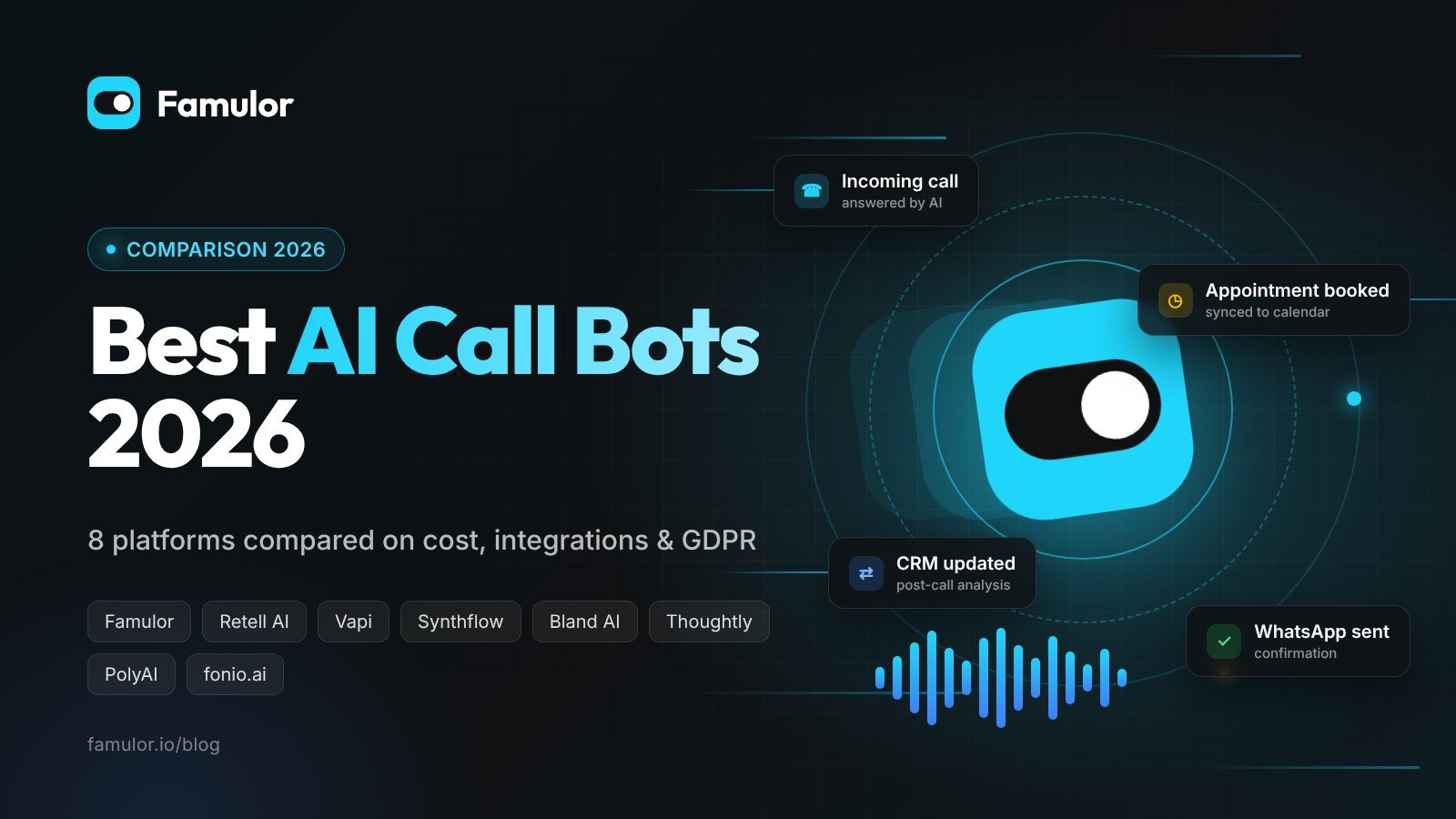
Best AI Call Bots in 2026: 8 Platforms Compared for Real Business Calls
The best AI call bot in 2026 is the one that does more than talk: it answers every call in under a second, resolves or qualifies the request, and then updates your CRM, books the appointment and triggers the follow-up without a human touching anything. For most small and mid-sized businesses in Europe that need inbound and outbound calling, GDPR-compliant hosting and no-code setup, Famulor is the strongest all-round choice. Developer teams that want to assemble their own stack should look at Retell AI or Vapi, and large contact centers with six-figure budgets at PolyAI.
This guide compares eight AI call bots on the criteria that actually decide whether a phone agent pays for itself: conversation quality, what happens after the call, setup effort, telephony flexibility, compliance and the real cost per minute. Pricing figures for third-party platforms are based on publicly available information and independent reviews as of October 2026. Always confirm current prices with the vendor before you sign.
Quick takeaways
- Best overall for SMBs, agencies and EU companies: Famulor (no-code, inbound + outbound, 45+ languages, EU hosting, from €0.15/min pay as you go, billed per second).
- Best for developers who want full control: Retell AI and Vapi (API-first, bring your own LLM and carrier).
- Best for high-volume outbound via API: Bland AI.
- Best for inbound lead conversion with SMS and email follow-up: Thoughtly, if your volume justifies the monthly minimum.
- Best for large enterprise contact centers: PolyAI.
- Best for very small German-speaking businesses with simple needs: fonio.ai.
What is an AI call bot?
An AI call bot (also called an AI voice agent or AI phone assistant) is software that answers and makes phone calls in natural spoken language. It combines speech recognition, a large language model and a synthetic voice, and it is connected to your phone number, your knowledge base and your business tools. Unlike a classic IVR menu ("press 1 for sales"), the caller simply explains what they need, and the bot understands, asks follow-up questions and acts.
In 2026 the voice itself is no longer the differentiator. Most serious platforms sound natural and respond fast. The real difference lies in three areas: how reliably the bot sticks to your process and facts, how deeply it is wired into your systems, and how predictable the bill is once you scale from 500 to 50,000 minutes a month.
How we evaluated these AI call bots
We assessed each platform against six criteria that reflect what businesses need in production, not in a demo.
1. Conversation quality and latency
Does the bot respond quickly enough to feel like a real conversation, handle interruptions, and stay on topic? Can you choose between voice and language model providers, or are you locked into one?
2. Post-call execution
A call that ends without a CRM entry, a booked appointment or a follow-up message is a wasted call. We looked at native integrations, webhooks, workflow automation and structured post-call analysis that extracts fields like name, intent and next step.
3. Setup speed and ownership
Can an operations manager build and change an agent without writing code? Or does every adjustment need a developer ticket?
4. Telephony flexibility
Can you keep your existing numbers and phone system? SIP trunking and bring-your-own-carrier (BYOC) support matter for any company that already has a PBX, a call center or contracts with Twilio or Telnyx.
5. Compliance and data residency
For European companies this is not optional. We checked where data is hosted, whether GDPR documentation is available, and how the platform addresses the EU AI Act. For US healthcare we noted HIPAA availability.
6. Pricing transparency
Per-minute prices look small until providers stack platform fees, LLM costs, telephony, add-ons and monthly minimums on top. We looked at published rates, minimum commitments and what is included.
Quick comparison
| Platform | Best for | Setup | Channels | Pricing model (publicly reported) |
|---|---|---|---|---|
| Famulor | SMBs, agencies, EU companies, inbound + outbound | No-code flow builder, API available | Phone, WhatsApp, web widget, chat | Pay as you go €0.15/min, plans from €27/month, Scale from €0.05/min |
| Retell AI | Developer teams building custom agents | Developer-oriented, API | Phone, web | Usage-based, roughly $0.09/min upwards all-in |
| Vapi | Developers who pick every provider | API-first | Phone, web | $0.05/min hosting plus providers, about $0.08–0.13/min |
| Synthflow | No-code pilots, US agencies | No-code | Phone | Pay as you go from about $0.13/min, enterprise from $30k/year |
| Bland AI | High-volume outbound via API | API-first | Phone | $0.09/min connected, plans from $299/month |
| Thoughtly | Inbound lead conversion at volume | Low-code | Phone, SMS, email | From $500/month minimum |
| PolyAI | Large enterprise contact centers | Managed by vendor | Phone, chat | Custom, reportedly six figures per year |
| fonio.ai | Small German-speaking businesses | No-code, presets | Phone | Pay per use €0.20/min, plans from €99/month |
For a deeper look at per-minute costs across providers, see our breakdown of what 10 AI voice agent platforms actually cost per minute.
The 8 best AI call bots in 2026
1. Famulor: best overall AI call bot for SMBs, agencies and EU companies
Famulor is a no-code platform for AI voice agents that handle inbound and outbound calls, plus WhatsApp, web chat and a website voice widget from the same assistant and knowledge base. You build the conversation in a visual no-code flow builder, connect calendars and CRMs, and go live on a new or existing number.
Where Famulor stands out is the step after the call. Post-call analysis extracts structured data from every conversation, such as caller name, request type, urgency or a booked slot, and pushes it into your tools through more than 1,000 integrations, webhooks and built-in workflows. A dental practice can have the bot book the check-up directly into the calendar and send a WhatsApp confirmation; a property manager can log a damage report as a ticket with photos requested by message after the call.
Telephony is flexible: SIP trunking and bring-your-own-carrier are included on every plan, so you can keep your existing numbers and PBX. Workspaces can be hosted in the EU, and the platform is built for GDPR and the EU AI Act. Agencies get a full white-label offering to resell agents under their own brand.
Pros
- No-code setup with a visual flow builder, plus API access for developers
- Inbound, outbound campaigns, WhatsApp and web widget from one assistant
- 45+ languages and a large voice library
- SIP/BYOC on all plans, EU hosting, GDPR and EU AI Act focus
- Transparent pricing: start free with 800 credits, no credit card, then €0.15/min pay as you go, plans from €27/month, billed per second
Watch for
- Very complex enterprise integrations may still need a short technical setup via API or webhooks
Best fit: SMBs and mid-market companies, agencies and resellers, and any European business that needs a production-ready call bot without building its own stack. Check the current plans on the Famulor pricing page.
2. Retell AI: best for developers who want a strong building block
Retell AI is a developer-oriented voice agent platform with good conversation quality and a flexible architecture. You can bring your own LLM and your own carrier, and you get API and WebSocket access for deep customization. A dashboard with templates and a node-based editor exists, but custom functions, webhooks and integrations generally require code.
Pros
- Fine-grained control over models and telephony
- Usage-based pricing with free starter credits
- Solid fit for teams that already have engineers on voice AI
Watch for
- Total cost is built from several components (voice engine, LLM, telephony, add-ons), so the real per-minute price varies
- Business users depend on developers for changes
Best fit: Product and engineering teams building voice into their own software.
3. Vapi: best for maximum provider choice
Vapi is an API-first orchestration layer: you pick the speech-to-text, language model and voice provider for each agent, and Vapi charges a hosting fee per minute on top of the pass-through provider costs. Independent analyses put typical all-in costs at roughly $0.08 to $0.13 per minute depending on the model.
Pros
- Very flexible, works with negotiated provider contracts
- Strong developer documentation and ecosystem
Watch for
- Not built for non-technical teams
- Higher support tiers and HIPAA are reported as significant monthly add-ons
Best fit: Developers who want to control every layer of the stack.
4. Synthflow: best for no-code pilots in North America
Synthflow offers a no-code builder that lets non-technical teams create voice agents quickly. According to third-party reviews, pricing moved to a modular pay-as-you-go model starting at around $0.13 per minute, with add-ons for routing and low latency, and enterprise contracts starting at around $30,000 per year.
Pros
- Approachable no-code interface
- Popular with US agencies
Watch for
- Add-ons can push the effective rate well above the headline price
- Native numbers reportedly focus on the US, Canada and Australia; white-label and some compliance features sit in higher tiers
Best fit: Non-technical teams testing a first voice agent in North America.
5. Bland AI: best for high-volume outbound through an API
Bland AI is built for programmatic calling at scale. Connected minutes are billed at a published per-minute rate, and paid plans raise daily call limits and concurrency. It offers realistic voice cloning, programmable call flows, retries and live transfers.
Pros
- Designed for very high call volumes
- Strong programmatic control over flows and routing
Watch for
- Requires developers; no real no-code option
- Voice only, without chat or messaging channels
Best fit: Tech-savvy teams running large outbound campaigns.
6. Thoughtly: best for inbound lead conversion with multichannel follow-up
Thoughtly focuses on turning inbound calls into qualified leads and follows up via SMS and email. Its flat-fee model includes unlimited voice, SMS and email usage, which becomes attractive at high, steady volumes. The entry plan reportedly starts at $500 per month, and features such as HIPAA, higher concurrency and auto-QA sit in quoted tiers.
Pros
- Strong post-call follow-up across channels
- Two-way CRM sync with common US CRMs
Watch for
- The monthly minimum makes it expensive at low volume
- Regulated use cases require higher, quoted tiers
Best fit: US companies with consistent inbound lead volume.
7. PolyAI: best for large enterprise contact centers
PolyAI builds managed voice assistants for large enterprises such as hotel chains, banks and utilities. Deployments are designed and tuned with the vendor. Pricing is custom; buyer-reported figures suggest annual contracts in the six figures, with telephony and integration work often on top.
Pros
- Enterprise-grade, vendor-managed deployments
- Experience with complex, high-volume customer service
Watch for
- No self-service trial; long sales cycles
- Out of reach for small and mid-sized budgets
Best fit: Enterprises with very large call volumes and dedicated project budgets.
8. fonio.ai: best for very small German-speaking businesses
fonio.ai is a German AI phone assistant aimed at self-employed professionals, practices and small companies. It offers preset use cases such as an AI answering machine, call routing and appointment booking, hosting in Germany and quick setup. Published plans start with pay per use and monthly packages with included minutes.
Pros
- Very simple setup for standard scenarios
- German hosting and a strong DACH focus
Watch for
- Less suited to complex integrations, outbound campaigns at scale or international, multilingual operations
- Limited concurrency on smaller plans
Best fit: Solo businesses and small teams in Germany, Austria and Switzerland with simple call handling needs.
Comparing specific vendors? Our alternatives overview covers Famulor side by side with dozens of AI phone platforms.
How to choose the right AI call bot
Start with your situation, not with the feature list. These five questions narrow the field quickly:
- Who will build and maintain the agent? If it is your operations or marketing team, choose a no-code platform such as Famulor. If you have dedicated engineers, API-first tools like Retell AI or Vapi are an option.
- What should happen after the call? List the systems the bot must update: calendar, CRM, ticketing, ERP, messaging. Check native integrations and webhooks before you check voices.
- Which numbers and phone system do you use today? If you want to keep them, SIP trunking and bring-your-own-carrier support are essential.
- Where must data live? European companies should require EU hosting, a data processing agreement and a clear position on the EU AI Act.
- What will 1,000, 5,000 and 20,000 minutes really cost? Add platform fees, LLM, telephony, add-ons and monthly minimums. Per-second billing and no minimum commitment reduce risk during a pilot.
Common mistakes when introducing an AI call bot
- Choosing by demo voice alone. Every leading platform sounds good in a demo. The difference shows in week three, when edge cases, transfers and integrations matter.
- Skipping the knowledge base. A bot without well-structured facts about prices, opening hours and processes will improvise. Feed it clean, current information and define what it must not answer.
- No escalation path. Define when and how the bot transfers to a human, and what context it passes along.
- Ignoring post-call data. If call outcomes are not captured as structured fields, you cannot measure conversion or improve the agent.
- Underestimating volume costs. A low headline rate with stacked add-ons can cost more than a slightly higher all-inclusive rate.
Use cases where AI call bots pay off fastest
- Medical and dental practices: booking, rescheduling and cancelling appointments at 7 a.m. on a Monday, when the front desk is not yet staffed.
- Trades and field service: capturing emergency calls after hours, qualifying the job and scheduling a technician.
- E-commerce: order status, returns and delivery questions without hold times.
- Real estate and property management: qualifying buyer leads and logging tenant requests.
- Agencies and call centers: running overflow and night shifts with AI, or reselling white-label agents to clients.
Not sure what the business case looks like for your call volume? Use the calculator below to estimate savings.
Estimate your ROI from automating calls
See how much your business could save by switching to AI-powered voice agents.
ROI Result
ROI 0%
No credit card required
Conclusion: Famulor is the most complete AI call bot for most businesses
Developer platforms like Retell AI and Vapi are excellent building blocks, Bland AI is strong for high-volume outbound via API, Thoughtly suits high, steady inbound volume, and PolyAI serves large enterprises with large budgets. fonio.ai is a simple option for very small German-speaking businesses.
If you want an AI call bot that your own team can set up without code, that handles inbound and outbound calls plus WhatsApp and web chat, keeps your existing numbers via SIP, runs on EU infrastructure and is priced transparently per second, Famulor is the best choice in 2026. Start with free credits, build your first agent in the no-code builder and test it on real calls before you commit.
Try our AI Assistant
Experience how natural our AI phone assistant sounds.
Enter your details and receive a call from our AI agent within seconds.
Agent is trained to discuss Famulor services and book appointments.

Demo AI agent
Famulor representative
FAQ
What is the best AI call bot in 2026?
For most small and mid-sized businesses, especially in Europe, Famulor is the best all-round AI call bot: no-code setup, inbound and outbound calling, 45+ languages, SIP support, EU hosting and transparent per-second pricing. Developer teams may prefer Retell AI or Vapi.
How much does an AI call bot cost?
Most platforms charge per minute, typically somewhere between €0.05 and €0.20 or more, depending on volume, models and add-ons. Some providers add monthly minimums or platform fees. Famulor starts at €0.15 per minute pay as you go, with lower rates on higher plans.
What is the difference between an AI call bot and an IVR?
An IVR forces callers through fixed menus and keypad choices. An AI call bot understands natural speech, asks follow-up questions, answers from a knowledge base and completes tasks such as booking appointments or creating tickets.
Can I keep my existing phone number?
Yes, with platforms that support SIP trunking or bring-your-own-carrier. Famulor supports both on every plan, so you can connect your current numbers, PBX or Twilio and Telnyx accounts.
Are AI call bots GDPR compliant?
It depends on the provider. Look for EU hosting, a data processing agreement, clear data retention settings and transparency toward callers. Famulor offers EU-hosted workspaces and is built for GDPR and the EU AI Act.
Do AI call bots replace human agents?
They take over repetitive calls such as appointments, FAQs, order status and lead qualification, and they cover nights and peaks. Complex or sensitive conversations are transferred to humans with full context.
How long does it take to set up an AI call bot?
With a no-code platform, a first working agent can be built in an afternoon. Production rollout including knowledge base, integrations and testing typically takes a few days to a few weeks, depending on complexity.
Can an AI call bot make outbound calls?
Yes. Platforms like Famulor run outbound campaigns for lead qualification, appointment reminders or reactivation. Make sure you have the required consent and follow local rules for outbound calling.

Writer at Famulor