Summarize Content With:




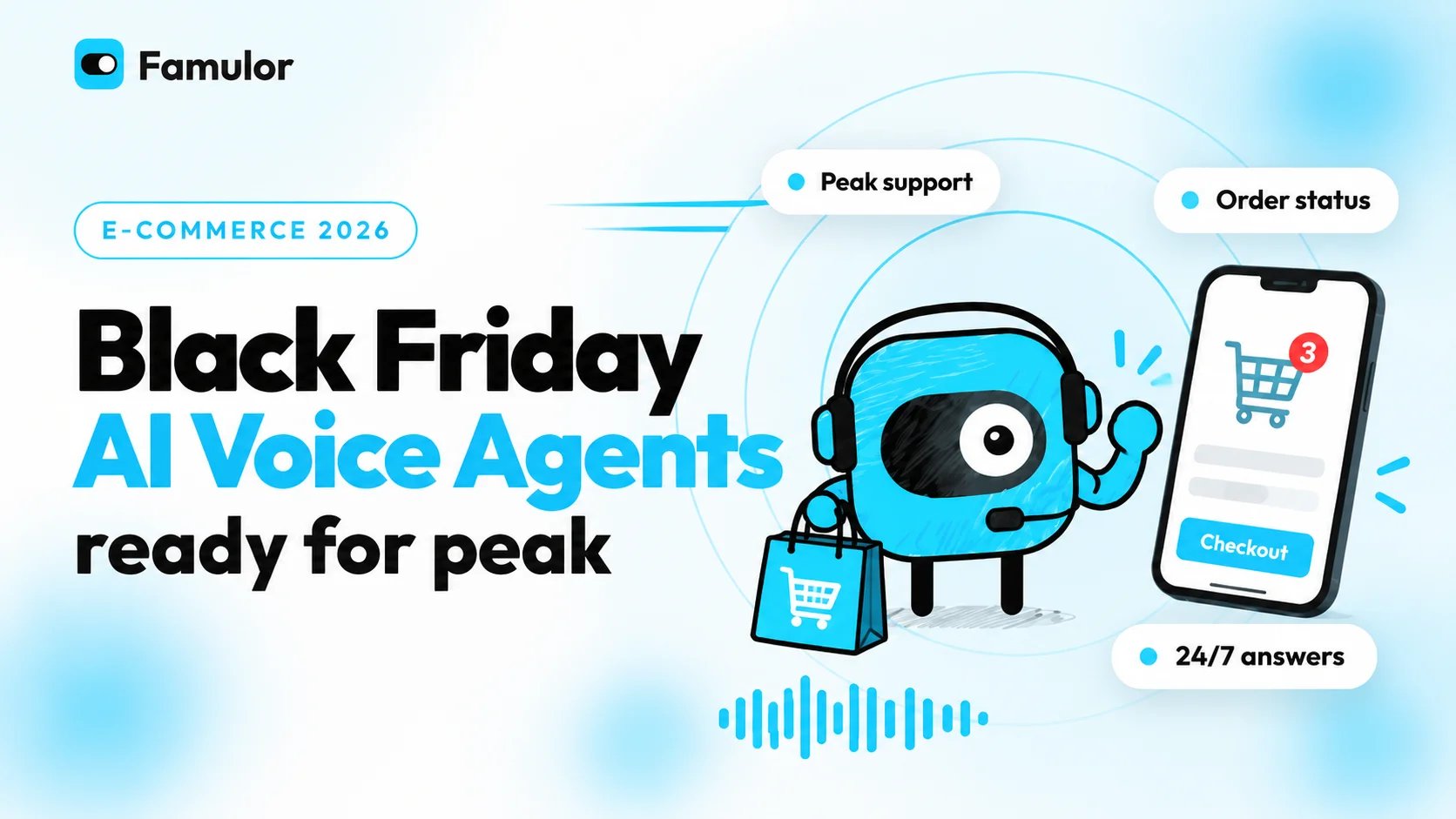
Black Friday 2026: How to Prepare Your AI Voice Agents for Peak-Season Call Surges
Black Friday 2026 is just four weeks away. For e-commerce brands, that means record revenue — and a customer-service tsunami. In 2025, over 202 million Americans shopped during the Black Friday weekend, spending an average of 337 dollars per person. Shopify merchants alone processed 14.6 billion dollars in sales during BFCM, a 27 percent year-over-year increase. The flip side: support contact volume spikes three to five times above normal levels. Retailers heading into peak season without automation risk hours-long hold times, frustrated customers, and lost revenue.
The answer is AI voice agents that handle inbound calls around the clock, resolve common questions instantly, and hand off complex cases to human agents with full context. This guide walks you through preparing your AI phone assistant for the holiday rush — with concrete timelines, checklists, and real-world examples.
Why Black Friday Without AI Voice Agents Is a Liability
The data is clear: during Black Friday week, e-commerce support volume jumps 200 to 500 percent. In fashion and consumer electronics, spikes can be even steeper. At the same time, the inquiry mix shifts dramatically. Nearly half of all contacts are about order status and delivery tracking — questions an AI agent can answer in seconds.
Without automation, the scenario is painfully familiar: the queue grows, average wait time climbs to four hours or more, and CSAT scores drop by 25 points. Meanwhile, the cost of temporary staff — who often need days to onboard and leave once the rush ends — eats into margins.
E-commerce brands already using AI in customer service report a completely different reality: first-response times under 30 seconds, ticket deflection rates above 50 percent, and CSAT scores of 4.3 out of 5 — even at triple the normal volume. The cost savings per ticket run between 30 and 50 percent, and the need for seasonal temp workers drops by roughly 40 percent.
The Most Common Black Friday Inquiries — and How AI Handles Them
Before configuring your AI voice agent for peak season, you need to understand which inquiry types dominate. Here is the cross-industry breakdown:
| Inquiry Type | Share of Volume | AI Automation Rate | Typical Resolution Time (AI) |
|---|---|---|---|
| Order status / delivery tracking | ~25–50 % | 95 % | 8 seconds |
| Returns & exchanges | ~18 % | 80 % | 25 seconds |
| Payment issues / promo codes | ~12 % | 70 % | 20 seconds |
| Product availability | ~10 % | 90 % | 10 seconds |
| Shipping delays | ~8 % | 85 % | 15 seconds |
| Complex complaints / escalation | ~7–12 % | Handoff to human | Instant transfer |
The takeaway: 60 to 70 percent of all peak-season inquiries can be fully resolved by a well-trained AI voice agent — without involving a human representative. The key is preparation.
The 12-Week Roadmap: Getting Your Voice Agent Peak-Season Ready
12 weeks out: data audit and goal setting (mid-August)
Start by analyzing last year's peak season. Which inquiry types dominated? What was the total ticket volume? Where were the bottlenecks? Review your average wait time, CSAT scores, and cost per ticket. These numbers become the baseline for your AI strategy.
Set measurable targets: for example, a first-response time under 30 seconds, an automation rate of at least 50 percent, and a 15-point CSAT improvement over the previous year.
8 weeks out: set up and train your AI agent (mid-September)
Now it gets practical. Configure your AI voice agent in Famulor's AI call center and connect it to your systems. The four priorities:
- Order tracking: Connect your Shopify, WooCommerce, or custom storefront through Famulor's 300+ integrations. The AI agent can then provide real-time order status, tracking numbers, and estimated delivery dates.
- Returns and exchanges: Upload your return policy — including any Black Friday specials like extended return windows.
- Shipping information: The agent should have access to carrier tracking APIs (UPS, FedEx, USPS, DHL) for live updates.
- Payments and promo codes: Common issues like declined payments or broken coupon codes can be resolved with predefined troubleshooting flows.
4 weeks out: stress testing and refinement (late September/early October)
Simulate at least 500 test calls with realistic scenarios. Include different inquiry types, accents, and edge cases such as multi-order customers or system outages. The benchmarks for your stress test:
- Full automation on at least 50 percent of test cases
- Correct handoff to human agents on complex cases
- Error rate below 5 percent on factual answers (order status, prices, availability)
- Time to first voice output under 3 seconds
1 week out: team briefing and go-live check
Brief your human support team: which inquiries does the AI agent handle? How does the handoff work? What peak-specific policies apply? Make sure every team member knows how to review AI-handled cases and step in when needed.
Outbound Campaigns: Going Proactive During Peak Season
Most retailers think of Black Friday in terms of inbound calls. But the biggest opportunities lie in proactive outbound. With Famulor's outbound campaigns, you can automate customer outreach — solving multiple problems at once:
Shipping notifications by phone: Instead of sending an email that gets buried in the inbox, the AI agent proactively calls customers when shipments are delayed. This reduces inbound "where is my package?" calls by up to 40 percent.
Abandoned cart recovery: Within minutes of a cart abandonment, an AI call can be triggered — via webhooks from Shopify or WooCommerce through Make or n8n. Voice calls achieve a 3x to 5x higher contact rate than emails or SMS. A concrete example: "Hi Sarah, your cart with the Samsung Galaxy S26 Ultra is still waiting for you. Would you like me to complete the order? The 20-percent Black Friday discount expires at midnight."
VIP early access: Give your best customers exclusive pre-access to Black Friday deals — with a personalized AI call rather than a mass email blast.
Multichannel Orchestration: Phone, WhatsApp, and Web Widget Working Together
Black Friday is not a single-channel event. Customers call, message on WhatsApp, and use the chat widget on your website — often for the same inquiry. The challenge is seamless orchestration across all channels.
A well-designed peak-season setup looks like this: the AI voice agent handles all incoming phone calls. WhatsApp messages are processed in parallel — with automated shipping updates and return links. The web widget intercepts visitors on your site before they even need to call. And when one channel is overloaded, the system automatically routes to the next available channel.
The benefit: your customers experience consistent service regardless of which channel they use. And you can distribute volume across all channels instead of overloading any single one.
Cost Breakdown and ROI: What AI Voice Agents Actually Save During Peak Season
Let us run the numbers with a concrete scenario. A mid-sized online store — call it "TechStyle," 80 orders per day in normal operations — sees a 4x spike to 320 orders on Black Friday. Call volume rises proportionally from 30 to 120 calls per day.
| Cost Factor | Without AI Agent | With Famulor AI Agent |
|---|---|---|
| Additional temp staff (2 weeks) | $5,400 (3 staff × $18/hr × 100 hrs) | $1,080 (1 backup staff) |
| Onboarding / training | $700 | $0 |
| Lost revenue (long wait times) | ~$3,600 (est. 40 abandoned purchases) | ~$450 (est. 5 abandoned purchases) |
| Famulor platform cost (monthly) | — | from $49/month |
| Total peak-period cost | ~$9,700 | ~$1,579 |
The result: savings of over 8,000 dollars during the two-week peak period alone — with a better customer experience to boot. And this is a conservative estimate for a mid-sized store.
Estimate your ROI from automating calls
See how much your business could save by switching to AI-powered voice agents.
ROI Result
ROI 0%
No credit card required
Real-Time Monitoring: Staying in Control on Black Friday
An AI agent that is set up once and left to run unsupervised is a risk. Successful peak-season management requires active monitoring. These are the metrics you should track in real time:
Automation rate: If it drops below 40 percent, the agent is failing to recognize certain inquiry types. Review conversation logs and add the missing scenarios.
Human agent queue: If the wait time exceeds 30 minutes, temporarily lower the AI agent's escalation threshold — it resolves fewer cases itself but transfers faster.
CSAT by channel: Compare satisfaction scores across phone, WhatsApp, and web chat. Shift resources toward whichever channel is dropping.
Error rate: Wrong answers are worse than slow answers. If the agent provides incorrect tracking numbers or cites outdated return policies, immediate intervention is required.
Famulor's dashboard displays all of these metrics in real time. Assign one person from your team to monitor AI performance exclusively during peak days.
After the Peak: Capture Learnings and Prepare for 2027
Within one week of Black Friday, run a thorough debrief: How many tickets were resolved without human involvement? How did cost per ticket change? How did CSAT scores trend? And how much revenue did proactive outbound campaigns generate?
Document the inquiry types where the AI agent showed weaknesses. This data is invaluable for optimization. Every peak season makes your AI agent better — if you systematically feed the insights back into its training.
Checklist: AI Voice Agent Peak-Season Readiness
- Data audit of last peak season completed
- AI agent connected to your store system (order status, returns, tracking)
- Black Friday–specific policies configured (extended return windows, special promo codes)
- At least 500 test calls simulated and evaluated
- Outbound campaigns for shipping updates and abandoned cart recovery set up
- WhatsApp and web widget channels active and tested
- Human team briefed (handoff processes, escalation paths, peak policies)
- Real-time monitoring dashboard configured
- Designated person for AI oversight on peak day assigned
- Post-peak debrief scheduled
Conclusion: Four Weeks to Black Friday — Act Now
Black Friday 2026 will be the highest-grossing e-commerce day in history — that much is almost certain if current trends continue. The question is not whether your customer service will be tested, but whether you are prepared. AI voice agents are no longer a nice-to-have; they are the foundation for scalable, cost-efficient, and customer-friendly support during peak season.
With Famulor, you can set up your AI phone assistant in a matter of hours, connect it to Shopify, WooCommerce, or your custom storefront, and scale automatically — whether you receive 30 or 3,000 calls per day. Add outbound campaigns for proactive customer communication and a multichannel setup spanning phone, WhatsApp, and web chat, and you have a peak-season playbook that turns the Black Friday rush from a risk into a revenue opportunity.
Try our AI Assistant
Experience how natural our AI phone assistant sounds.
Enter your details and receive a call from our AI agent within seconds.
Agent is trained to discuss Famulor services and book appointments.

Demo AI agent
Famulor representative
FAQ
How many concurrent calls can an AI voice agent handle on Black Friday?
Cloud-based AI voice agents like Famulor scale automatically and can handle virtually unlimited concurrent calls. In practice, Famulor customers routinely process hundreds of parallel conversations without quality degradation.
How long does it take to set up an AI voice agent for Black Friday?
Basic setup takes just a few hours. For optimal results, we recommend a lead time of at least four weeks including stress testing and fine-tuning.
Can the AI agent respond in multiple languages?
Famulor supports over 40 languages. This is particularly valuable for international e-commerce brands serving customers across different countries and regions.
What happens when the AI agent cannot answer a question?
The agent detects complex or emotionally charged situations and automatically transfers to a human representative — with full conversation context so the customer does not need to repeat anything.
Does the Shopify integration work with other e-commerce platforms?
Yes. In addition to Shopify, Famulor supports WooCommerce, Magento, and other platforms through API connections and no-code integrations with Make, Zapier, or n8n.
How much does an AI voice agent cost compared to temporary staff?
Famulor starts at 49 dollars per month. By comparison, three temp workers for a two-week peak period easily cost over 5,400 dollars — not counting onboarding and revenue lost to long wait times.
Can the AI agent make outbound calls?
Yes. Famulor's outbound feature enables automated campaigns for shipping notifications, abandoned cart recovery, and VIP early-access announcements for Black Friday deals.
How do I measure the success of my AI voice agent on Black Friday?
The key metrics are automation rate, first-response time, CSAT score, cost per ticket, and the number of tickets resolved without human intervention. Famulor's dashboard shows these metrics in real time.
Is the AI agent GDPR compliant?
Famulor is fully GDPR compliant, hosts data in Europe, and provides transparent consent workflows for recording and processing customer conversations.
Is an AI voice agent worth it beyond Black Friday?
Absolutely. The investment in an AI voice agent pays off year-round. In day-to-day operations, it reduces wait times, lowers costs, and improves customer satisfaction on a permanent basis.

Writer at Famulor