Summarize Content With:




A customer explains an issue by email, adds details by SMS, and later calls support. Yet the conversation starts from zero again. This is becoming a defining customer experience problem in 2026: AI assistants should be able to continue an authorized customer journey across voice, email, SMS, messaging, and helpdesk channels.
The trend is called cross-channel customer memory. It is not a permanent archive of every conversation. It is a controlled, compact record of relevant preferences, agreements, and open items. To work safely, identity, consent, freshness, deletion, and auditability must be designed as carefully as the AI itself.
Key takeaways
- 83% of CX leaders surveyed for Zendesk CX Trends 2026 say memory-rich AI is key to personalized customer journeys.
- Cross-channel memory must rely on verified identities—not display names or similarities in transcripts.
- Retention controls how long a record exists; staleness controls whether older context is temporarily used.
- Consent changes, reads, writes, skipped updates, and deletions need to be traceable.
- Business value comes from the right context at the right moment, not from collecting more data.
Why customer memory is becoming a major CX trend
Customers do not experience a company as disconnected channels. An email on Monday, an SMS on Tuesday, and a support call on Wednesday belong to one issue. Many systems still treat those touchpoints as unrelated sessions.
The Zendesk publication for CX Trends 2026 shows the expectation gap. It says 83% of surveyed CX leaders view memory-rich AI as key to personalized journeys. Meanwhile, 74% of surveyed customers are frustrated when they must repeat information, and 81% want an agent to continue where the previous interaction ended. These vendor-study figures describe expectations, not guaranteed results from any individual system.
In a July 15, 2026 article, Twilio describes customer memory as a persistent context layer connecting customer interactions with AI agents. It draws an important distinction: a CRM stores records, while a memory layer extracts meaning from conversations, reconciles it, and retrieves it when needed. The Twilio guide to AI customer memory therefore calls auditability non-negotiable.
Hacker News is not evidence of market adoption, but it provides a community signal. A discussion about memory for AI agents centers on what actually deserves to persist. For customer service, careful selection matters more than an ever-growing store.
How cross-channel memory differs from caller memory
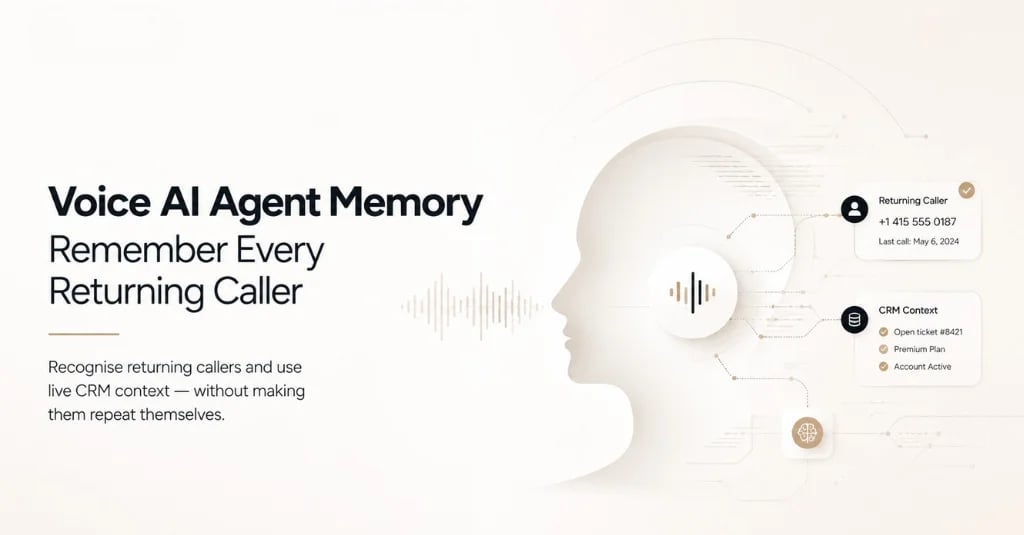
An earlier Famulor article describes the previous pragmatic approach in which AI voice agents recognize returning callers through caller and CRM context. Cross-channel customer memory now extends that approach with consent-aware memory for verified contacts across supported voice, SMS, messaging, email, and helpdesk channels.
Voice memory answers: “What may the assistant know when this caller phones again?” Cross-channel memory answers: “How can a verified customer continue the same journey in another channel without mixing identities or exposing unnecessary information?”
According to the Famulor customer memory documentation, context is tied to one Audience contact. Anonymous browser visitors and unverified contact details cannot read or update it. Display names and transcript content are not used to merge contacts, and conflicting identities are never merged automatically.
Verified identity is the technical foundation
Useful memory starts with a reliable answer to a simple question: who is interacting with the assistant? A phone number, email address, or messaging identity should connect to an existing customer profile only after verification inside the current workspace.
This prevents two high-risk mistakes. A common display name cannot be enough to expose another contact's information. A business sender identity—such as the company's messaging number—must not be mistaken for the customer. Email needs similar protection: visible sender text or a claim in the message body is insufficient without authenticated sender verification.
Identity conflicts should not be solved by probability. If a phone number and email point to different contacts, manual or deterministic resolution is safer than an automatic merge. Good customer experience sometimes means withholding context.
Consent, scope, and categories limit memory
Customer memory should be designed as a permission system, not an unlimited knowledge store. Famulor lets organizations choose permitted channels, require consent, and define rolling retention at workspace level. An individual assistant can narrow that policy through read and write channels, categories, and scope.
| Scope | Behavior | Good fit |
|---|---|---|
| Workspace | One permitted memory shared across assistants | Central customer service |
| Assistant | Memory remains isolated to one assistant | Separated teams or processes |
| Both | Shared context plus assistant-specific memory | Common foundation with specialist context |
Consent must remain reversible. Workspace administrators can grant or withdraw it under Audience → Memory and erase shared and assistant-scoped memories. These controls support privacy operations but do not replace an assessment of purpose and legal basis. The guide to Zero Data Retention for AI voice agents explains the related handling of conversation data.
Retention and staleness are not the same
Retention determines how long a memory record exists. Each successful update can renew the rolling window, or an organization can retain records until manual deletion. When retention expires, the record is deleted.
Staleness is optional and disabled by default. When enabled, a profile with no call for a configured number of days temporarily stops being injected into conversations. The record remains stored. A later call refreshes the profile, provided retention has not expired.
This avoids two extremes. A record need not be deleted merely because it should not currently guide a conversation. At the same time, an assistant does not receive old context simply because it remains in storage.
Three practical cross-channel memory use cases
Support: From email to a voice call
A customer reports a billing error by email. When they call later, the AI assistant can continue from the open status and agreed review after identity verification instead of requesting the entire story again. An SMS then confirms the next step.
Appointment service: Messaging, callback, and confirmation
A prospect begins an appointment request in messaging and clarifies a detail by phone. After verification, the voice assistant knows the previously supplied time frame. Only the necessary confirmation is sent through an approved channel. The article about social DMs, WhatsApp, and voice in one inbox explains the broader omnichannel workspace.
B2B service: Handoff to a specialist
An existing customer describes a technical issue by SMS. A voice agent gathers missing information and hands the case to a specialist. The helpdesk receives a compact summary of verified facts, consent, and the open task—not necessarily the entire conversation as an unstructured data block.
A controlled implementation checklist
- Define the outcome: Which repetition or channel break should disappear?
- Map identities: How are phone, email, and messaging identities verified?
- Separate read and write channels: Not every channel needs permission to update memory.
- Design consent: Define capture, evidence, withdrawal, and behavior when consent is unknown.
- Limit categories: Store only information necessary for the service workflow.
- Select a scope: Choose workspace, assistant, or both deliberately.
- Separate retention and staleness: Set record lifetime and acceptable context freshness.
- Handle conflicts: Famulor API updates require the current revision and return
409for a stale revision. - Test audit and deletion: Verify reads, writes, consent changes, skips, and deletions.
Why auditability is becoming a quality requirement
An organization can use memory responsibly only when teams can determine what was stored and when it changed or was deleted. Famulor's documentation says reads, writes, consent changes, skipped updates, and deletions are audited. REST API and MCP follow the same permissions and return the same customer-facing data.
This transparency also supports operational quality. If an assistant uses an outdated preference, the team can investigate whether staleness was misconfigured, an update was skipped, or the wrong scope applied. Memory becomes a manageable customer-experience component instead of invisible model behavior.
Frequently asked questions
Is customer memory the same as a CRM?
No. A CRM manages structured customer and process records. A memory layer supplies compact, conversation-relevant context under defined rules. The two can complement each other.
Can anonymous website visitors use an existing memory?
No. Famulor's documentation says anonymous browser calls and chats do not participate in cross-channel memory. Unverified contact details cannot read or modify it either.
Does cross-channel memory automatically make a workflow GDPR-compliant?
No. Verified identity, consent, deletion, data minimization, and audit records support a controlled implementation. Lawfulness still depends on purpose, legal basis, transparency, and configuration.
Conclusion: Continuity needs boundaries
Cross-channel customer memory is one of 2026's most important CX trends because customers want to continue a journey instead of explaining it again in every channel. Its value disappears when context becomes unlimited data collection.
Verified identities, channel permissions, consent, limited categories, separate retention and staleness rules, and an audit trail are the real measures of quality. With those controls, an AI assistant can continue where the previous interaction stopped—and stay deliberately silent whenever identity or permission is uncertain.
Would you like to design a cross-channel customer journey with controlled memory? Explore Famulor and plan your first cross-channel memory use case.

Writer at Famulor