Summarize Content With:




Voice AI Agent Memory: Remember Every Returning Caller
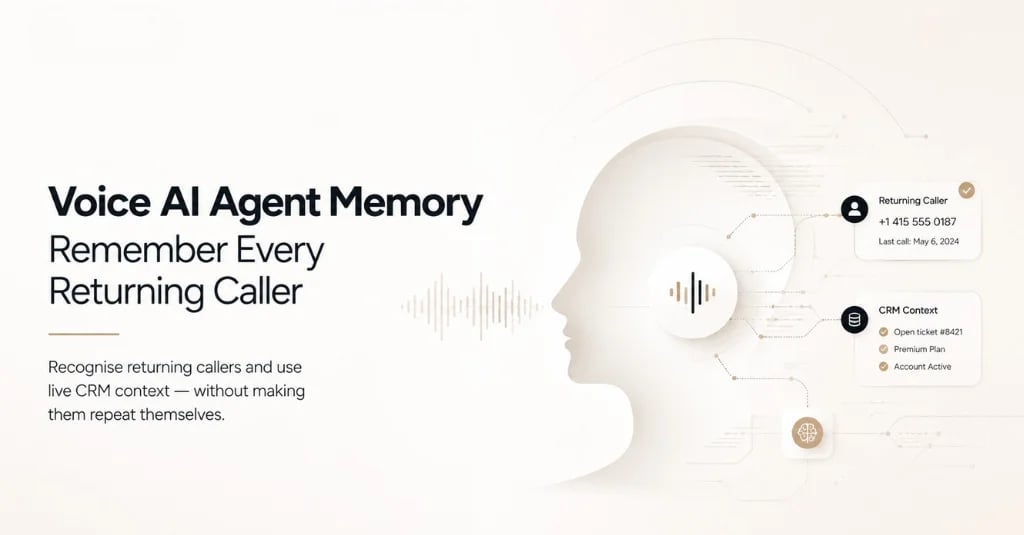
A voice AI agent with memory recognises returning callers and uses their history in the conversation — without making the caller explain themselves again. In 2026, the workable answer for telephony is not "a memory layer that stores everything." It is: stable identity via the phone number, facts from a curated knowledge base, and a live look into the CRM during the call. Separate those three and you get personalisation without the failure modes that break generic memory systems.
Memory on the phone is a different problem from memory in chat. That is not an opinion — it is the finding of the memory research itself. Mem0's AI Agent Memory Report 2026 states that voice agents have a memory problem that is "qualitatively different" from text agents: the user cannot scroll back, cannot copy-paste context from a previous session, and cannot manually remind the agent of past conversations. If the agent does not remember, the friction is immediate and obvious. This article covers which kinds of memory exist, which problems are demonstrably unsolved, and how Famulor gets the solvable parts into production today.
What "memory" actually means for voice agents
The term gets used loosely. In practice it covers four different things that have little technically in common:
- Context window: What the agent holds during the live call. That is not memory, it is working storage — gone when the caller hangs up.
- Episodic memory: What happened. "Mr Berger called on 3 July about an invoice."
- Semantic memory: What is known. "Mr Berger is an existing customer on the L plan."
- Procedural memory: How things should be done. "Always route invoice questions above 500 euros to accounting."
The memory report lists episodic, semantic and procedural explicitly as the three types production agents need, and notes that tooling for the third is still early-stage. For telephony the distinction is decisive, because the three types deserve entirely different storage locations. Procedural knowledge belongs in the Flow Builder and the prompt — not in a vector database it has to be probabilistically fished back out of. Semantic knowledge about your business belongs in the knowledge base. And episodic knowledge about a specific caller almost always already lives in your CRM — it does not need duplicating, it needs querying.
That classification is the whole trick. Most voice agent memory projects fail because they throw all four into one system.
Why telephony is the hardest memory case
In chat, the user can supply context after the fact. They scroll up, paste an order number, correct the bot. On the phone none of those fallbacks exist. Three hard constraints follow.
Latency is not negotiable. A memory lookup that blocks the response is directly audible on a call. The report names exactly this as the most common production footgun and notes that Mem0 made asynchronous memory writes the default in version 1.0.0. That solves writes. Reads stay in the critical path — put a semantic search over a vector store in front of your first response and you pay for it in dead air.
Wrong memory is worse than no memory. If the agent says "you called last week about your contract" and that is not true, the conversation is damaged. In chat you skim past it. On the phone it is a rupture.
There is no clean login identity. A web user is authenticated. A caller is a phone number — with all the ambiguity that carries: withheld numbers, shared lines, family members on the same landline, people switching between mobile and desk phone.
Which brings us to the genuinely interesting point: that identity problem is considered unsolved in the research.
The open problems — and what they mean for your decision
The report is unusually candid about what remains open. Three items hit telephony directly.
Cross-session identity resolution. The memory model assumes a stable user_id. Anonymous sessions, multi-device users and mixed auth flows break that assumption. Whether two interactions came from the same person is, in the report's words, "an unsolved identity problem at the memory layer."
Memory staleness. A frequently-retrieved memory about a user's employer is accurate — until they change jobs, at which point it becomes confidently wrong. Decay handles low-relevance memories; staleness in high-relevance memories is described in the report as "a harder, open problem."
Privacy and consent architecture. Who can inspect stored memories? How long are they retained? How does a user delete them? The report explicitly calls these application-layer decisions — the memory system does not answer them. For any regulated or European deployment that is the crux, because GDPR access and deletion rights are not roadmap items.
The practical consequence: a vendor selling you "memory" as a finished feature is selling you a problem the literature lists as open. The durable architecture routes around these three rather than ignoring them.
The pragmatic path: separate identity, facts and live data
Famulor solves personalisation not through a speculative memory layer, but through three clean building blocks.
1. The phone number as stable identity. What is hard on the web is comparatively easy on the phone: caller ID arrives with the call. It is not a perfect person identifier — but it is an excellent key for a record. The report points at exactly this pattern in passing: in the ElevenLabs integration, the USER_ID that scopes memories is derived from the authenticated user's identity in the calling application, not generated by the memory system, keeping isolation tied to application-level auth. Translated to telephony: your CRM owns identity, not the voice agent.
2. Facts in the knowledge base. Opening hours, pricing tiers, return windows, responsibilities — that is semantic knowledge. It belongs in the knowledge base and is retrieved via RAG. Crucially, you maintain it in one place, it does not quietly rot in the background, and you can audit it. That is the real answer to staleness: not decay logic, but a curated source.
3. Query caller history live instead of storing it. This is the core. Rather than keeping a copy of customer history inside the agent, Famulor fetches it mid-conversation from the system where it already lives — via mid-call tools or the MCP connector. The agent asks, when needed: "Is there an open case for this number?" The answer is current by definition.
This eliminates staleness entirely — a live query cannot go stale. It largely eliminates the consent problem, because no second copy of personal data is created. And it makes deletion trivial: delete the record in the CRM and it is gone. Nothing to chase down in a vector store.
After the call, post-call analysis closes the loop and writes outcome, intent and next step back — through one of the 300+ integrations. The system of record stays yours.
Comparison: memory layer vs live lookup
| Criterion | Dedicated memory layer | Live lookup (Famulor approach) |
|---|---|---|
| Freshness | Snapshot; staleness an open problem per report | Always current, source is the system of record |
| Identity | Needs stable user_id; unsolved per report | Phone number as key into the CRM |
| Read latency | Semantic search in the critical path | Targeted lookup, only when needed |
| GDPR deletion | Second copy must be deleted too | One record, one deletion |
| False memory | Possible, and sounds convincing | Ruled out — nothing is guessed |
| Unstructured context | Strong: preferences, tone, nuance | Limited to what exists structured |
| Operational overhead | Vector store, embeddings, reranking | Existing API, no new stack |
To be fair: a real memory layer has one strength the live lookup does not. Unstructured preferences — "never call me before noon", "gets irritated by follow-up questions" — live in no CRM field. If you need that nuance, a memory system is unavoidable. But the report also shows the cost: a vector store chosen from 20 options, reranking as a second pass, metadata filtering, timestamp migration. For the large majority of telephony use cases the live lookup is the better trade — the facts that matter are already structured.
Implementation step by step
Step 1 — Decide what you actually need. Write down the five most common reasons returning callers reach you. For each, ask: is the required information already structured in the CRM? Almost always the answer is yes — case status, last appointment, open invoice. Then you do not need a memory system, you need a lookup.
Step 2 — Define identity resolution. Specify what happens on match, no-match and multi-match. Multi-match is the case that matters: two records on the same landline is everyday reality. Have the agent verify ("am I speaking with Mr or Mrs Berger?") rather than guess. On a withheld number, the standard flow runs without personalisation.
Step 3 — Wire up the lookup tool. Define a mid-call tool that takes the phone number and returns a compact result: name, status, open case. Keep the payload small. A 40-field JSON blob does not help the model, it distracts it.
Step 4 — Anchor the behaviour in the prompt. Spell out how to handle the lookup result: on a match, greet by name and raise the open case proactively. On no-match, start neutral. Never claim to remember when the tool returned nothing.
Step 5 — Set escalation rules. When the lookup surfaces a critical status — open complaint, cancellation notice — route the call to a human via call transfer. Recognition is not the same as full automation.
Step 6 — Write back and measure. Post-call analysis writes the outcome back. Then measure the only number that matters: does handle time for returning callers drop without the drop-off rate rising?
Best practices and common mistakes
Only raise what you can evidence. The agent may say: "I can see an open case regarding your invoice." It may not say: "you seemed unhappy last time." The first is a data field; the second is an interpretation.
Dose the personalisation. An agent that volunteers three details from the history sounds invasive. One detail that shortcuts the call sounds competent. Less is more here.
Do not put the lookup in front of the greeting. This is the most common latency mistake. Greet first, query in parallel. Putting your first syllable behind an API call throws away exactly what makes voice AI feel fast — and filler audio can bridge the wait naturally when a query does run long.
Plan for contradiction. Caller says A, CRM says B. Rule: the human always wins. The agent notes the discrepancy instead of arguing.
Design for access and deletion from day one. If a caller asks what is stored, you need an answer. With the live lookup it is simple: what is stored is what is in the CRM, plus the call log. That simplicity is precisely why we do not create a second copy. The contractual side is handled through the data processing agreement.
Industry examples
Becker Dental Practice, 60 staff. A patient calls to move a check-up. The lookup on the caller's number returns: appointment 24 July, 09:30, hygiene. The agent greets by name, states the appointment and offers three alternatives. Without recognition, the same call opens with "may I take your name and which appointment is this about?" — 40 seconds nobody needs. The episodic knowledge was never stored; it came live from the practice software.
Süd Auto Group, 3 locations. A customer calls about a service booking. The lookup shows: vehicle in the workshop since yesterday, part ordered, delivery Friday. The agent relays exactly that. A stored memory from the previous call would have carried the status from two days ago — a textbook staleness failure.
Meier Property Management, 4,200 units. A tenant reports a heating fault again. The lookup shows an open case with a contractor visit scheduled. The agent states the date and, on a repeat report of the same fault, hands off to a case worker — the escalation rule fires because the status lives in the system.
The pattern is identical everywhere: the valuable context is already structured. It does not need remembering, it needs querying.
Estimate your ROI from automating calls
See how much your business could save by switching to AI-powered voice agents.
ROI Result
ROI 0%
No credit card required
Conclusion
For voice agents, "memory" is the wrong word for the right goal. The goal is: the caller should not have to explain themselves. In 2026 the route there does not run through a memory layer whose core problems — cross-session identity, staleness, consent architecture — the literature itself lists as open. It runs through a clean separation: the phone number supplies identity, the knowledge base supplies facts, the CRM supplies history — live, at the moment of the call.
Famulor is built for exactly that. Mid-call tools and the MCP connector fetch context from the system where it is already maintained. The knowledge base keeps facts curated. Post-call analysis writes back. No second data store, no vector database, no deletion policy for a copy nobody needed.
The concrete next step: take the single most common reason your regulars call, wire up one lookup tool keyed on the phone number, and measure handle time for two weeks. That is an afternoon of work — and it answers whether you will ever need a memory layer at all. In most cases, the answer is no.
Try our AI Assistant
Experience how natural our AI phone assistant sounds.
Enter your details and receive a call from our AI agent within seconds.
Agent is trained to discuss Famulor services and book appointments.

Demo AI agent
Famulor representative
FAQ
Can an AI phone agent remember previous calls?
Yes. In practice the history is not stored inside the agent but queried live from the CRM using the phone number. The result is identical for the caller and always current.
Why is memory harder for voice agents than for chat?
Because the caller cannot scroll back or supply context after the fact. The Mem0 report 2026 calls this a qualitatively different problem: if the agent forgets, the friction is immediate.
What is memory staleness?
Stored information that was once correct and becomes wrong when reality changes — a job change, for example. Per the Mem0 report, staleness in high-relevance memories is an open problem. Live queries avoid it.
Does Famulor identify callers by phone number?
Yes. Caller ID acts as the key for a lookup via mid-call tool or MCP connector. On a withheld number the call continues without personalisation.
Is caller recognition GDPR compliant?
It can be. The live lookup has an advantage because no second copy of personal data is created: access and deletion stay in one place. The specifics are governed by the data processing agreement.
Does a memory lookup slow the conversation down?
Only if sequenced wrong. Writes run asynchronously. The lookup belongs parallel to the greeting, not before it — then it is imperceptible in the call.
What belongs in the knowledge base versus the CRM?
The knowledge base holds general facts such as opening hours, pricing and procedures. The CRM holds everything caller-specific: cases, appointments and invoices.
When do I genuinely need a memory layer?
When you want to act on unstructured preferences across many conversations that live in no CRM field. For most telephony use cases the relevant facts are already structured.

Writer at Famulor