Summarize Content With:




Voice AI vs BPO Outsourcing: Why 2026 Is the Cost Tipping Point for Contact Centers
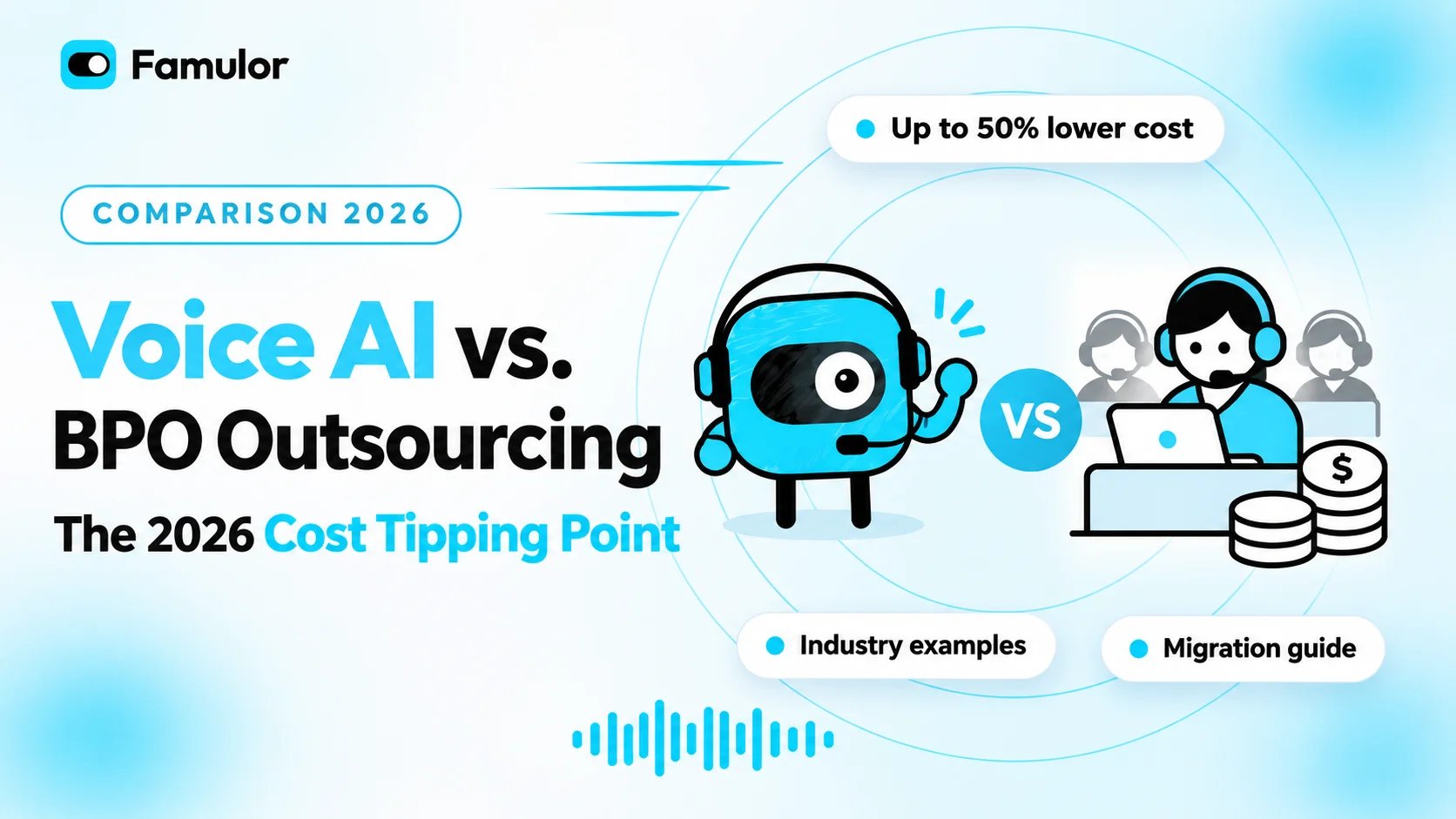
Voice AI now costs up to 50 % less per call than traditional BPO outsourcing — and the gap is widening every quarter. For companies still routing millions of calls through offshore call centers, the math has fundamentally changed: AI-powered voice agents handle routine interactions at a fraction of the price, around the clock, in more than 40 languages, with consistent quality that no outsourced workforce can match. This article breaks down the real cost comparison, shows where Voice AI already outperforms BPO in production, and gives you a step-by-step migration plan for 2026.
The global Voice AI market is projected to grow from $2.4 billion to $47.5 billion by 2033 — a compound annual growth rate of 34.8 %. At the same time, BPO providers are struggling with rising wages, attrition rates above 30 %, and increasing quality demands from enterprise clients. The result is a structural shift that Gartner expects to automate 70 % of customer interactions by 2027.
What Separates Voice AI from BPO Outsourcing
BPO outsourcing transfers customer calls to external service providers — typically in lower-cost regions such as the Philippines, India, or Eastern Europe. Agents follow scripts, handle inquiries manually, and are compensated per hour or per seat. Voice AI, by contrast, uses large language models, speech recognition, and text-to-speech synthesis to automate entire conversations without human involvement.
The key difference is scalability. A BPO operation needs weeks to recruit, train, and onboard new agents when call volume spikes. A Voice AI platform like Famulor scales instantly — from 10 concurrent calls to 10,000 — with zero lead time and no additional staffing costs. Where a BPO contract locks you into fixed seat counts and minimum commitments, Voice AI charges per minute or per call, so you pay only for what you use.
Other critical differences include language coverage — BPO providers typically staff three to five languages per location, while Famulor's AI agents speak more than 40 languages natively — and availability. A 24/7 BPO operation requires three shifts with premium night-shift pay. A Voice AI agent runs around the clock at the same per-minute rate.
The Full Cost Comparison: BPO vs Voice AI in 2026
The following table compares the eight most important cost factors between traditional BPO outsourcing and a modern Voice AI platform. All figures are based on industry benchmarks from McKinsey, IBM, and Gartner publications from late 2025 and early 2026.
| Cost Factor | BPO Outsourcing | Voice AI Platform |
|---|---|---|
| Cost per call (Tier 1) | $3.50 – $8.00 | $0.15 – $0.80 |
| After-hours surcharge | +25 – 40 % | None (24/7 at standard rate) |
| Onboarding & training | $2,000 – $5,000 per agent | One-time setup, no per-agent cost |
| Annual attrition cost | 30 – 45 % turnover, re-hiring cycle | 0 % — no staff turnover |
| Scaling lead time | 4 – 8 weeks | Minutes (on demand) |
| Multilingual support | Separate team per language (+40 – 60 %) | 40+ languages included |
| Quality assurance | Manual spot checks (5 – 10 % of calls) | 100 % automated QA on every call |
| Infrastructure & IT | Shared with provider (limited control) | SIP trunking, 300+ integrations |
According to IBM's 2025 Global AI Adoption Index, organizations that have shifted to AI-powered voice automation report an average cost-per-call reduction of 50 %. McKinsey's 2026 Service Operations Benchmark confirms that pure automation scenarios — where Voice AI resolves the call without escalation — cost as little as one-tenth of an equivalent BPO interaction.
Why 2026 Is the Tipping Point
Three converging trends make 2026 the year when Voice AI moves from experiment to default strategy for customer-facing call handling.
1. Executive pressure has never been higher
Gartner's 2026 CIO survey reports that 91 % of executives are under board-level pressure to deliver measurable AI returns this year. Customer service is the most visible and fastest-to-measure area for AI deployment: call volumes are quantifiable, cost-per-call is a known metric, and customer satisfaction scores provide immediate feedback loops.
2. The technology has matured past the "good enough" threshold
AudioCodes, one of the largest enterprise voice infrastructure providers, reported 50 % year-over-year growth in its conversational AI division in Q1 2026. This is not experimental adoption — it reflects production deployments at scale. Modern Voice AI agents understand context, handle multi-turn conversations, and integrate with CRM, ERP, and scheduling systems through platforms like Famulor's outbound calling solution that connects to more than 300 business tools via a no-code automation platform.
3. BPO economics are moving in the wrong direction
Labor costs in traditional outsourcing destinations have risen 12 – 18 % since 2023. The Philippines — the world's largest voice BPO market — saw agent wages increase by 15 % in 2025 alone, driven by inflation and competition from domestic tech employers. At the same time, BPO attrition rates remain above 30 %, meaning providers spend a significant share of their revenue on perpetual recruiting and retraining. These structural cost increases are permanent and compound annually.
Step-by-Step Migration from BPO to Voice AI
Replacing an existing BPO operation with Voice AI does not happen overnight, nor should it. The most successful migrations follow a phased approach that minimizes risk and builds confidence through measurable results at each stage.
Step 1: Audit your current call taxonomy
Categorize your inbound calls by type (appointment scheduling, order status, billing inquiries, technical support, complaints). Identify which call types are repetitive, script-driven, and high-volume — these are your first automation candidates. Typically, 60 – 70 % of inbound call volume falls into categories that Voice AI can handle end-to-end.
Step 2: Run a parallel pilot
Deploy Voice AI alongside your BPO operation for one to two high-volume call types. Route a defined percentage of traffic — usually 20 – 30 % — to the AI agent while keeping BPO as the fallback. Measure resolution rate, average handling time, customer satisfaction, and cost per call side by side.
Step 3: Integrate your business systems
Connect the Voice AI platform to your CRM, calendar, ERP, and ticketing systems. Famulor's integration marketplace supports more than 300 tools out of the box, including Salesforce, HubSpot, SAP, Microsoft Dynamics, Calendly, and custom webhooks. This integration is what transforms a voice bot into a true AI agent that can look up orders, book appointments, create tickets, and update records during the call.
Step 4: Scale to primary channel
Once the pilot shows comparable or better resolution rates at lower cost, increase the Voice AI traffic share to 70 – 80 %. Retain a smaller BPO team for complex escalations, sensitive cases, and edge scenarios that require human judgment. Most organizations reach this stage within three to four months of initial deployment.
Step 5: Optimize and expand
Use the call analytics and QA data that Voice AI generates on 100 % of interactions to continuously refine your AI agent's knowledge base, conversation flows, and escalation thresholds. Then expand to outbound use cases — appointment reminders, payment collection, lead qualification, and survey calls — where Voice AI typically delivers even higher ROI than inbound automation.
Best Practices and Common Mistakes
Organizations that achieve the best results from Voice AI migration share several patterns. They start with clearly defined, high-volume use cases rather than trying to automate everything at once. They invest in knowledge base quality — because an AI agent is only as good as the information it can access. And they design clear escalation paths so callers who need human help reach a person quickly, rather than getting stuck in an automation loop.
The most common mistakes include choosing a platform without native SIP trunking support, which forces expensive telephony workarounds; underestimating the importance of multilingual capabilities, especially in European markets where a single office may receive calls in four or five languages; and failing to integrate the voice agent with back-end systems, which limits it to FAQ-style responses instead of genuine task completion.
Another frequent error is measuring Voice AI against perfection rather than against the BPO baseline. No automation system resolves 100 % of calls — but neither does a BPO agent. The relevant comparison is cost-adjusted resolution quality: if Voice AI resolves 85 % of calls at one-fifth the cost, the total economics are dramatically better even if the remaining 15 % still require human handling.
Industry Examples: Voice AI Replacing BPO in Production
Financial services: Service 1st Federal Credit Union deployed Voice AI in early 2026 and reported a 29 % reduction in call volume handled by human agents, a 71 % decrease in average wait time, and a drop in call abandonment from 25 % to under 1 %. The credit union previously outsourced overflow calls to a regional BPO — those contracts have since been terminated.
Healthcare: Medical practices and dental offices use Voice AI for appointment scheduling, prescription refill requests, and insurance eligibility checks. A mid-sized dental group in Stuttgart replaced their outsourced answering service with Famulor's AI inbound agent and now handles 80 % of patient calls automatically — including after-hours scheduling in German, Turkish, and English.
E-commerce: Online retailers face extreme call volume fluctuations during sales events and holiday seasons. Granite Credit Union — an organization with comparable service patterns — achieved a 60 % containment rate and saved 1,400 agent hours in just four months after deploying Voice AI. E-commerce businesses using Famulor report similar results for order status, return processing, and delivery inquiries.
Real estate: Property management companies handle hundreds of tenant calls daily — maintenance requests, lease questions, viewing appointments. Voice AI automates the initial triage and scheduling, reducing the need for outsourced call center support. One Berlin-based property manager cut their third-party call handling costs by 65 % within six months of deployment.
Trades and services: HVAC companies, plumbers, and electricians miss an estimated 30 – 40 % of inbound calls during working hours because technicians are on-site. Voice AI answers every call, qualifies the inquiry, books the appointment, and sends the confirmation — tasks that previously required either a receptionist or an outsourced answering service.
Estimate your ROI from automating calls
See how much your business could save by switching to AI-powered voice agents.
ROI Result
ROI 0%
No credit card required
Conclusion: The Numbers No Longer Support Pure BPO
The economic case for Voice AI over BPO outsourcing is no longer a projection — it is a production reality backed by market data and live deployments across industries. With cost-per-call reductions of up to 50 %, instant scalability, 40+ language support, and 100 % quality monitoring, platforms like Famulor deliver what BPO providers structurally cannot: consistent, affordable, always-available customer service at scale.
If your organization still routes the majority of calls through outsourced agents, 2026 is the year to start the transition. Begin with a parallel pilot on your highest-volume call type, measure the results against your BPO baseline, and scale from there. The technology is proven, the cost advantage is clear, and every month of delay is a month of overpaying for a model that the market is leaving behind.
Try our AI Assistant
Experience how natural our AI phone assistant sounds.
Enter your details and receive a call from our AI agent within seconds.
Agent is trained to discuss Famulor services and book appointments.

Demo AI agent
Famulor representative
FAQ
How much does Voice AI cost compared to BPO per call?
Voice AI typically costs $0.15 – $0.80 per call, compared to $3.50 – $8.00 for BPO outsourcing. That is a reduction of 50 – 90 % depending on call complexity and volume.
Can Voice AI handle multiple languages without extra cost?
Yes. Platforms like Famulor support more than 40 languages natively at no additional charge, whereas BPO providers require separate multilingual teams at 40 – 60 % higher rates.
What percentage of calls can Voice AI handle without a human?
Most deployments achieve a 60 – 85 % containment rate for routine call types such as scheduling, order inquiries, and account questions. Complex or emotionally sensitive calls are escalated to human agents.
How long does it take to migrate from BPO to Voice AI?
A phased migration typically takes three to six months from initial pilot to primary-channel deployment. The first automated call type can go live within one to two weeks.
Does Voice AI work with existing phone systems and SIP trunks?
Yes. Famulor supports SIP trunking for any VoIP or PBX provider, so you can keep your existing phone numbers and infrastructure while routing calls through the AI agent.
What happens when the AI cannot resolve a call?
Calls that exceed the AI agent's capabilities are transferred to a human agent in real time, with full context and a conversation summary, so the caller does not have to repeat themselves.
Is Voice AI suitable for regulated industries like healthcare or finance?
Yes. Voice AI platforms can be configured to comply with data protection regulations including GDPR, and calls can be recorded, transcribed, and audited automatically — often providing better compliance documentation than manual BPO processes.
How does Voice AI quality compare to trained BPO agents?
Voice AI delivers consistent quality on every call — no bad days, no fatigue, no script deviations. Combined with 100 % automated QA monitoring, the quality baseline is typically higher and more predictable than BPO operations with 5 – 10 % spot-check sampling.

Writer at Famulor