Resumir contenido con:




The model question in Voice AI sounds technical at first: which LLM should the phone agent use? In production, however, the model name alone does not determine conversation quality. Enterprises need to evaluate three layers together: the conversation architecture, the language model, and the specific process the agent must complete reliably.
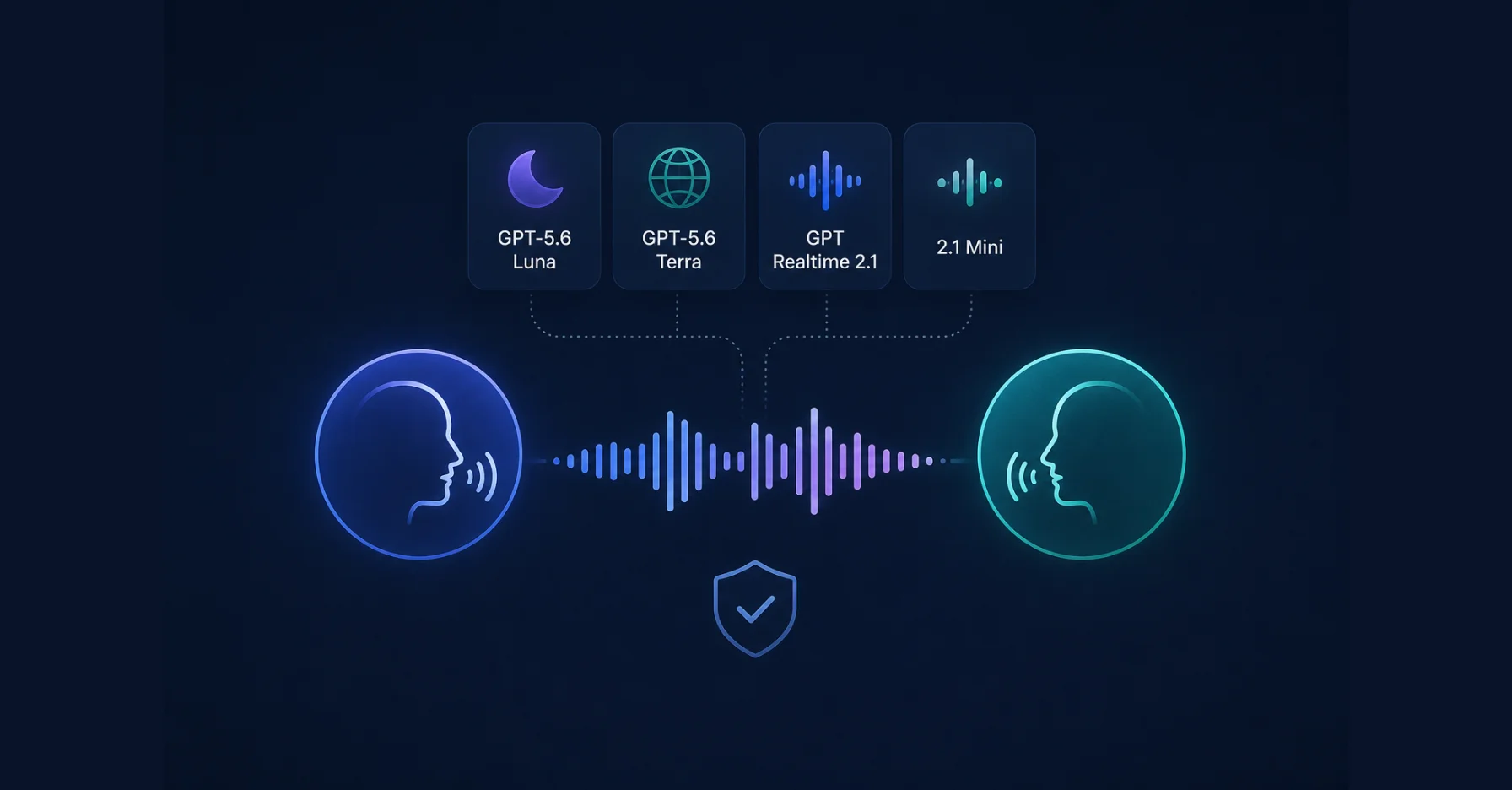
Famulor made two new model families available in July 2026: GPT-5.6 Luna and GPT-5.6 Terra in Pipeline mode, plus GPT Realtime 2.1 and GPT Realtime 2.1 Mini for speech-to-speech and Dualplex™. This is not a simple ranking from “fast” to “intelligent.” It is a toolkit for different operational requirements.
This guide shows operations, CX, and IT teams how to make a defensible choice using test cases, measurement criteria, and a rollout built around real conversations rather than a perfect demo.
1. Choose the architecture before the model
A common procurement mistake is comparing models in isolation. In Voice AI, the processing path matters just as much. Famulor supports three relevant modes:
| Mode | Processing path | Matching models | Strong fit |
|---|---|---|---|
| Pipeline | Speech-to-text → LLM → text-to-speech | GPT-5.6 Luna, GPT-5.6 Terra | Complex prompts, structured data, longer answers, and controlled brand voices |
| Speech-to-speech | Direct multimodal speech processing | GPT Realtime 2.1, GPT Realtime 2.1 Mini | Fast turn-taking, short answers, and natural dialogue |
| Dualplex™ | Multimodal understanding with separate premium speech output | GPT Realtime 2.1, GPT Realtime 2.1 Mini | Low latency with a premium or cloned brand voice |
The assistant modes documentation lists typical ranges of roughly 800–1,500 milliseconds for Pipeline and 300–600 milliseconds for speech-to-speech. These are guide values: language, model, network conditions, and tool calls affect perceived speed. The practical target is not the smallest lab number. It is a conversation that remains fluid and correct throughout the target workflow.
2. What the new models mean in practice
GPT-5.6 Luna and GPT-5.6 Terra: candidates for demanding Pipeline workloads
GPT-5.6 Luna and GPT-5.6 Terra are available in Famulor’s Pipeline mode. According to the Famulor product changelog, the new generation targets sharper reasoning, stronger instruction-following, and more natural handling of longer, multi-step conversations.
For enterprise teams, one point matters: Famulor does not currently declare a universal winner between Luna and Terra. That is the right approach. A model that performs well in complex first-level support will not automatically win a concise appointment-qualification flow or highly structured data capture. Treat both as release candidates and benchmark them against the same real conversation cases.
GPT Realtime 2.1: natural direct conversation for demanding interactions
GPT Realtime 2.1 is available for speech-to-speech and Dualplex assistants. Famulor describes stronger prompt adherence and more natural handling of names, numbers, and interruptions. That makes it relevant when conversations must react quickly while still capturing business-critical details such as customer numbers, addresses, appointment times, or product variants.
GPT Realtime 2.1 Mini: the lighter option for volume
GPT Realtime 2.1 Mini is positioned as a lighter, faster option for high-volume or simpler assistants. Typical candidates include status checks, callback intake, short qualification, FAQ conversations, and tightly scoped booking processes. But “Mini” should not be confused with “always cheaper across the process.” If it creates frequent repetitions, misclassification, or unnecessary transfers, the operational cost can be higher.
3. A decision matrix for real Voice AI processes
| Requirement | Starting point | Why |
|---|---|---|
| Complex policies, multiple data sources, longer explanations | Benchmark Luna and Terra in Pipeline | More control over prompt, text processing, and speech output |
| Short, dynamic sales or booking conversations | Speech-to-speech with Realtime 2.1 | Fast turn-taking and natural reactions |
| Very high volume of simple conversations | Realtime 2.1 Mini as the baseline | Positioned for lighter, faster workloads |
| Brand or cloned voice with low latency | Dualplex with Realtime 2.1 | Combines multimodal understanding with controlled speech output |
| Disclosures or confirmations must be spoken in full | Choose the appropriate mode and disable interruptions | Famulor now supports the setting in Pipeline, speech-to-speech, and Dualplex |

Capacity belongs in the same decision. Plan minutes, peak load, and concurrency before making any model the production default.
Planifica minutos, picos y plan
Estima la capacidad de Voice AI necesaria y el plan que mejor encaja.
Famulor
Voice AI
Minutos AI mensuales
11.088
Plan recomendado
Agency
Llamadas pico simultáneas
3
Horas automatizadas
185
4. A five-step enterprise test plan
Step 1: Define the process as a chain of successful outcomes
Do not start with “the agent should sound natural.” Define a measurable completion: identity confirmed, intent classified, CRM record found, appointment booked, confirmation sent. Every stage needs a clear success condition and an expected fallback.
Step 2: Build a golden set from real conversation patterns
Create a small, representative suite of anonymized situations. Include common requests and difficult edge cases:
- Names with unusual spelling and similar-sounding terms
- Phone numbers, postal codes, times, and order IDs
- Interruptions, self-corrections, and background noise
- Multi-part requests that require follow-up questions
- Missing CRM data or unavailable appointment slots
- Tool timeouts, invalid responses, and safe human escalation
Step 3: Test architecture and model separately
First compare modes against the same process outcome. Then compare models inside the most suitable mode. This prevents teams from attributing an architecture advantage to a model. Use outbound test calls as well as an assigned number for inbound tests; the Famulor testing guide covers both paths.
Step 4: Use a weighted scorecard
A practical scorecard can cover five dimensions:
- Task success: Did the process finish completely and correctly?
- Data accuracy: Were names, numbers, and required fields captured correctly?
- Instruction adherence: Did the agent respect boundaries, ordering, and approvals?
- Conversation quality: Were turn-taking, tone, and interruptions appropriate?
- Operational quality: Did tools, transfers, logs, and retries work as expected?
Weight the score by risk. Speed may matter most in appointment booking; contract or identity data should prioritize accuracy and safe escalation.
Step 5: Route models by process instead of forcing one default
Large organizations rarely need one model for every call. A lightweight Realtime agent can capture intent and urgency, while a Pipeline agent handles a complex case. Different assistants for locations, languages, or risk classes can also use different configurations. The operational standard is then not “one model,” but controlled routing with shared quality thresholds.
5. A model upgrade is not a substitute for governance
More reasoning or more natural speech does not fix unclear permissions. Define which data each assistant may read, which actions it may execute, and when human approval is required. Mid-call Actions and MCP connections should receive only the systems and fields they need. Test actions with parameters before enabling them in real conversations.
Data minimization, retention rules, and traceable logs matter just as much. Regulated or sensitive workflows should add privacy and risk review to the rollout. Famulor provides German infrastructure, a DPA, and configurable processes, while the deploying organization remains responsible for its specific use.
6. A lower-risk rollout for Luna, Terra, and Realtime 2.1
- Capture the baseline: document current completion rate, transfer rate, failure types, and perceived latency.
- Run a shadow test: validate the new configuration with historical or simulated cases without changing customer traffic.
- Start with a small live segment: activate one clearly bounded process or location.
- Review daily: inspect failed conversations, tool calls, interruptions, and captured fields.
- Scale only after stable quality: increase volume gradually and keep a fast rollback path.
A model update should be treated as an operational product change: hypothesis, test, approval, and monitoring. That turns new capability into measurable process quality instead of another entry in a model dropdown.
Pruebe nuestro Asistente de IA
Experimente lo natural que suena nuestro asistente telefónico de IA.
Ingrese sus datos y reciba una llamada de nuestro agente de IA en segundos.
El agente está entrenado para hablar sobre los servicios de Famulor y programar citas.

Demo AI agent
Famulor representative
Conclusion: the best Voice AI model is workload-specific
GPT-5.6 Luna and Terra expand Pipeline options for demanding, multi-step conversations. GPT Realtime 2.1 targets natural direct conversation with stronger prompt adherence; Realtime 2.1 Mini is a sensible baseline for simpler high-volume processes. Dualplex combines fast multimodal processing with controlled premium speech output.
The right selection does not come from a model leaderboard. It comes from a clear process, a representative test set, and a scorecard that measures business outcomes, data quality, and operational safety together. That is when model selection becomes an enterprise architecture decision rather than a matter of taste.
FAQ
Which Famulor model fits complex support conversations?
Start with Pipeline and benchmark GPT-5.6 Luna and GPT-5.6 Terra against the same support cases. Pipeline offers more control for structured data, longer answers, and complex prompts.
When is GPT Realtime 2.1 Mini the better choice?
Mini is a sensible baseline for high-volume, tightly bounded, simpler conversations. Decide using total process cost and error rates, not model size alone.
Can I use a cloned voice with low latency?
Dualplex is the appropriate starting point because it combines multimodal understanding with premium, controlled speech output. Validate the voice, language, and workflow in a test call.
Should an enterprise standardize on only one model?
Not necessarily. A shared quality and governance standard matters more than a single model. Different processes can be routed to different modes and models under controlled rules.
Autor en Famulor