Resumir contenido con:




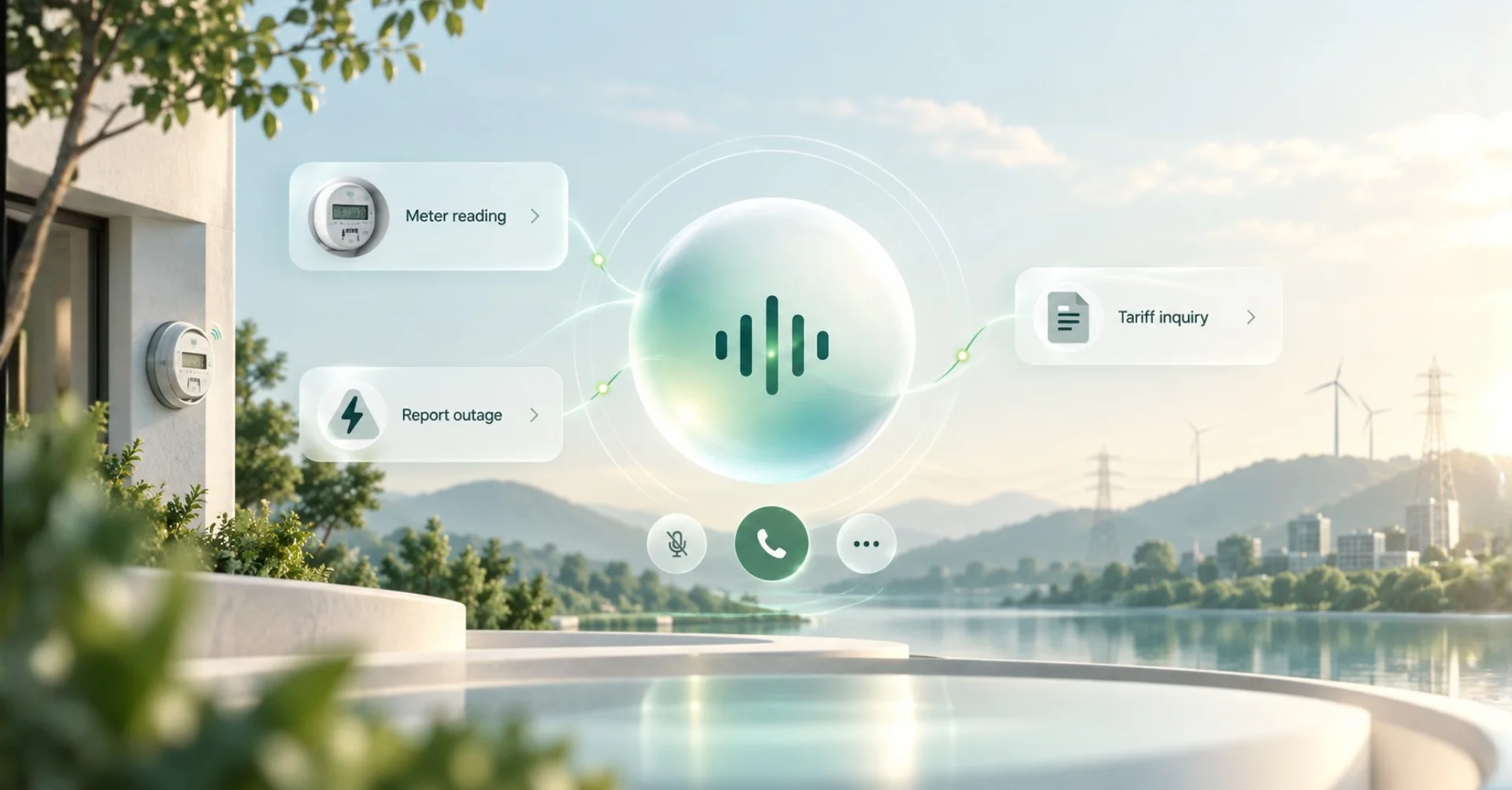
Voice AI for Utility Companies: Automate Meter Readings, Outage Reports and Tariff Inquiries
Utility companies face a growing challenge: rising call volumes driven by energy transition, smart meter rollouts and changing tariff structures — all while customer service budgets shrink and skilled agents become harder to find. An AI voice agent can handle up to 65% of incoming calls fully automatically — 24/7, in over 40 languages, with zero hold time. This guide shows how energy providers can automate their most common call types while reducing costs and improving customer satisfaction.
Why Utility Companies Face a Customer Service Crisis
The challenges in utility customer service are structural. Energy transition brings new tariffs, new technologies and new regulations — and with them a constant stream of customer inquiries. Industry estimates suggest that 60–70% of inbound calls at utility companies fall into just five categories: meter readings, outage reports, tariff inquiries, account changes (move-in/move-out) and billing questions. These are repetitive, structured conversations that follow clear patterns — making them ideal candidates for automation.
At the same time, the labor market is tightening. Contact center agents with energy industry expertise are hard to find, training takes months, and turnover rates are above average. The result: long wait times, missed calls and frustrated customers who switch providers at the next opportunity.
Which Call Types Can Be Automated?
Not every call is suited for an AI phone agent. The following table shows the most common call categories at utility companies and their automation potential:
| Call Type | Share of Total Volume | Automation Potential | Complexity |
|---|---|---|---|
| Meter readings | 20–25% | Very high (95%+) | Low |
| Outage reports | 15–20% | High (80–90%) | Medium |
| Tariff inquiries / switches | 15–20% | High (75–85%) | Medium |
| Account changes (move-in/out) | 10–15% | Medium (60–70%) | Medium-High |
| Billing questions | 10–15% | Medium (50–70%) | Medium |
| Complaints / escalations | 5–10% | Low (transfer only) | High |
| Technical consulting (solar, EV charging) | 5–10% | Medium (60%) | High |
The top three categories — meter readings, outage reports and tariff inquiries — account for over 50% of all calls and can be almost fully automated with a well-configured voice agent. These three are the focus of this guide.
Meter Readings via AI Phone Agent
Meter reading submission is the simplest yet highest-volume use case. The typical flow: a customer calls, provides their account or meter number, reads the current meter value, and the system confirms the entry. Today, this is often handled by agents who manually enter the data into utility billing systems like SAP IS-U or Oracle Utilities.
An AI voice agent takes over this process entirely. With Famulor's Flow Builder, the conversation flow can be configured in minutes: the agent greets the caller, asks for the account or meter number, validates the input via callback, records the meter reading, repeats it for confirmation, and stores the data directly in the billing system via webhook.
A practical example: Midtown Utilities (fictional, 45,000 supply contracts) receives around 1,200 meter reading calls per week during the October–November reading period. With a voice agent, the average handling time per call drops from 3:20 minutes to under 2 minutes, and 94% of submissions are processed without human intervention.
Intelligent Triage for Outage Reports
Outage reports are time-critical and emotionally charged. Customers whose power goes out do not want to wait in a queue. At the same time, many perceived outages are actually individual problems (tripped circuit breaker, blown fuse) rather than grid failures.
A voice agent for outage reports works in three stages. First, triage: the agent asks for the address, type of outage (electricity, gas, water, district heating), scope (single apartment or entire building), and checks against the current outage database. If a grid outage is already known for the area, the agent proactively informs the caller about the cause, estimated duration and next steps — with no transfer needed.
If the report involves a potentially safety-critical issue (gas smell, burst water pipe), the agent uses warm transfer to connect directly to the on-call emergency team, handing over all information collected so far. For individual, non-safety-critical issues, the agent provides troubleshooting tips (check circuit breaker, reset main switch) and offers to schedule a service appointment.
This three-stage model works reliably because the agent draws on a knowledge base loaded with outage data, troubleshooting guides and escalation rules. The knowledge base can be populated directly from existing FAQ documents and outage databases.
Automating Tariff Inquiries and Plan Switches
Tariff advisory is one of the more complex call types — but even here, a large portion can be automated. Typical inquiries include: "What does my current plan cost?", "Is there a cheaper tariff?", "I want to switch to green energy", and "When does my contract expire?".
The voice agent identifies the customer, retrieves the current contract details from the CRM, and can suggest up to three matching tariffs based on the consumption profile. The actual plan switch can either be executed directly by the agent (with confirmation via SMS or WhatsApp) or a callback by a human advisor can be scheduled if the customer is uncertain.
Particularly effective is the combination of voice agent and WhatsApp follow-up: the agent explains tariff options verbally, then sends a structured comparison via WhatsApp with pricing details and a self-service link. This turns the tariff switch into an omnichannel experience rather than a simple phone call.
Step-by-Step Implementation
Rolling out an AI voice agent at a utility company follows a proven five-phase process:
Phase 1 — Analysis (1–2 weeks): Analyze call categories, measure volumes, identify the top 3 automation candidates. Ideally, call recordings are already available for prompt design.
Phase 2 — Configuration (2–4 weeks): Set up the voice agent in Famulor: model conversation flows in the Flow Builder, populate the knowledge base with tariff information, outage protocols and FAQs, and set up integrations with SAP IS-U, Oracle Utilities, or your CRM. Famulor offers over 300 pre-built integrations — webhook and API connections are available for common utility systems.
Phase 3 — SIP Integration (1 week): Connect to the existing phone system via SIP trunking. The existing phone number is preserved, and the agent is added as an additional routing option. If needed, the agent can be activated only for specific hours or call reasons (e.g., outside business hours or when queue times exceed 3 minutes).
Phase 4 — Pilot (4–6 weeks): The agent initially runs for one call type only (typically meter readings) in one region. All conversations are logged and reviewed weekly. The agent is iteratively improved — prompts are refined, escalation rules adjusted, and speech recognition optimized for regional accents.
Phase 5 — Rollout (ongoing): Gradual expansion to additional call types and regions. Experience shows that utility companies reach a stable automation rate of 55–65% of all inbound calls after 3–4 months.
Best Practices and Common Mistakes
Best practices:
- Transparency: The agent should identify itself as an AI assistant at the start of each conversation. Customers who want to speak with a human should always have that option. This builds trust and satisfies regulatory requirements.
- Fallback strategy: Every conversation flow needs clear escalation rules. When the agent cannot understand a request or the customer sounds frustrated, the call is seamlessly transferred to a human agent — including a conversation summary.
- Multilingual support: Utility companies in metropolitan areas serve a linguistically diverse customer base. Famulor supports over 40 languages and automatically detects the caller's preferred language.
- Data privacy: Customer data stays in the billing system. The voice agent processes personal data only temporarily and in compliance with GDPR and local regulations. Famulor hosts all data in the EU.
- Iterative tuning: The first two weeks after go-live are critical. Daily monitoring of conversation logs, prompt adjustments and knowledge base expansion make the difference between 50% and 65% automation rate.
Common mistakes:
- Too many call types at once: The most common mistake is trying to automate all call categories simultaneously. Better: start with the simplest use case and expand gradually.
- Rigid scripts: A voice agent is not an IVR system. Configuring the agent with rigid decision trees instead of flexible prompts wastes the potential of AI.
- No success metrics: Without clear KPIs (automation rate, first-call resolution, customer satisfaction, average handling time), ROI cannot be demonstrated — and the project loses internal support.
- Not involving staff: The voice agent does not replace employees — it relieves them of routine tasks. Involving the team early and positioning the agent as a tool rather than a threat prevents resistance.
ROI Calculation: What Does a Voice Agent Save?
The business case for a voice agent depends on three factors: call volume, average cost per call and automation rate. A concrete example for a mid-sized utility company:
| Metric | Without Voice Agent | With Voice Agent |
|---|---|---|
| Inbound calls / month | 8,000 | 8,000 |
| Automated | 0% | 60% |
| Calls to human agents | 8,000 | 3,200 |
| Cost per call (human) | $5.20 | $5.20 |
| Cost per call (voice agent) | — | $0.38 |
| Monthly total cost | $41,600 | $18,444 |
| Monthly savings | — | $23,156 |
With an implementation timeline of 8–12 weeks and setup costs in the low five-figure range, the investment typically pays for itself within 2–3 months.
Calcula tu ROI automatizando llamadas
Descubre cuánto podrías ahorrar al usar voice agents con IA.
Resultado ROI
ROI 0%
Sin tarjeta de crédito
Why Famulor Is the Right Platform for Utility Companies
Utility companies have specific requirements for a voice AI solution: GDPR compliance, integration with complex billing systems, SIP compatibility with existing phone systems, and the ability to function reliably during on-call hours.
Famulor meets all of these requirements. The platform provides SIP integration for any VoIP system, over 300 no-code integrations for connecting to SAP, Oracle Utilities and other industry systems, a visual flow builder for complex conversation logic, and EU hosting for GDPR compliance. Add to that the ability to unify voice, WhatsApp and web chat on a single platform — for a true omnichannel customer experience.
Conclusion
AI voice agents are no longer futuristic technology for utility companies — they are a pragmatic tool for managing rising call volumes with shrinking resources. The three core areas — meter readings, outage triage and tariff inquiries — can be automated with manageable effort and deliver measurable results within weeks.
The next step: analyze your call data, identify your highest-volume repetitive call type, and start a pilot. Book a demo with Famulor to see how a voice agent is configured for your utility company — including SIP integration and billing system connectivity.
Pruebe nuestro Asistente de IA
Experimente lo natural que suena nuestro asistente telefónico de IA.
Ingrese sus datos y reciba una llamada de nuestro agente de IA en segundos.
El agente está entrenado para hablar sobre los servicios de Famulor y programar citas.

Demo AI agent
Famulor representative
FAQ
How much does an AI voice agent cost for utility companies?
Costs depend on call volume. Typically, the cost per automated call is $0.20–$0.50 — well below the $4–6 per call in a manual contact center. Most utility companies achieve positive ROI within 2–3 months.
Can AI voice agents accurately capture meter readings?
Yes. Modern speech recognition achieves over 98% accuracy for number sequences. The agent repeats the meter reading for confirmation and can ask follow-up questions or transfer to a human agent when values seem unrealistic.
How is the voice agent connected to our billing system?
Famulor offers over 300 no-code integrations plus an open API and webhooks. Connections to SAP IS-U, Oracle Utilities, or other billing platforms are typically made via REST API interfaces or middleware platforms like Make or n8n.
Does the voice agent work outside business hours?
Yes, the agent operates around the clock, 365 days a year. This is particularly valuable for outage reports outside business hours — the agent triages the issue and escalates directly to the on-call emergency team when needed.
What happens when the agent cannot understand a caller?
The agent has clear fallback rules. After two unsuccessful attempts to understand, the call is transferred to a human agent — including a summary of the conversation so far. No inquiry goes unanswered.
Is the voice agent GDPR compliant?
Famulor hosts all data in the EU and processes personal data only temporarily during the conversation. Call recordings and transcripts are subject to configurable retention policies. A data processing agreement (DPA) is included by default.
Can the agent understand regional accents?
Modern speech-to-text engines reliably recognize regional accents and dialects. For particularly strong accents, speech recognition can be further optimized through prompt tuning and custom vocabulary lists.
How quickly can a utility company deploy a voice agent?
From initial configuration to pilot operation typically takes 4–6 weeks. A full rollout across all call types takes 3–4 months, depending on the complexity of the billing system integration.
Does the voice agent replace our employees?
No. The voice agent handles repetitive routine inquiries, freeing your staff for complex advisory, complaint management and escalations. Most utility companies deploy the agent as a complement, not a replacement.
Can the agent also make outbound calls?
Yes. Typical outbound use cases for utility companies include payment reminders, appointment confirmations for on-site meter readings, and proactive notifications about planned service interruptions.
Autor en Famulor