Summarize Content With:




Why teams look for an Aaron.ai or Talkie.ai alternative
Searches for "aaron.ai alternative" and "talkie ai alternative" share one pattern: the buyer has seen a demo, liked the idea of an AI phone assistant, and then hit the same wall. There is no public price list, the contract terms are unclear, and nobody can say how fast the agent goes live. This guide gives you a neutral way to compare vendors that sell on request with a platform where you can see the price and start the same day.
We do not rank Aaron.ai or Talkie.ai here. Both are established names, and what is right for you depends on your sector, your call volume, and your IT setup. Everything we say about third parties is based on public pages and comparison articles, and we mark where you must verify details directly with the vendor.
What we know about Aaron.ai and Talkie.ai
Aaron.ai is known in Germany as an AI phone assistant with a strong focus on medical practices. Several comparison pages report that Aaron is now part of Doctolib and is bought as part of that ecosystem. Talkie.ai is a voice AI provider that works with larger organizations and, according to competitor reviews, usually starts with a pilot phase before a longer contract.
In our research we found no public price per minute or named plan tiers for either product. That is a common model for enterprise and healthcare software, and it is fine if the sales process is quick. It becomes a problem when you are a small team that needs a decision this month.
| Question | Typical "on request" vendor | Platform with public pricing |
|---|---|---|
| Price visible before talking to sales | Often no | Yes |
| Time to first test call | Days to weeks | Same day |
| Contract start | Pilot, then longer term | Monthly or pay as you go |
| Change the prompt yourself | Often via the vendor | Yes, in the editor |
| Own phone numbers and carrier | Depends on the package | Bring your own or buy in the app |
Treat the middle column as a hypothesis to check, not as a fact about one company. Ask each vendor to confirm every row in writing.
Seven questions to ask before you sign
1. What is the full price per answered minute?
Ask for one number that includes the AI model, the voice, the transcription, and the telephony. Some offers quote a platform fee and add minutes later. Others bundle everything into a flat package with a minute cap. Both can be fair, but you can only compare them when you convert each to a price per answered minute at your real volume.
A practice with 4 treatment rooms that gets 60 calls a day with an average of 2.5 minutes each needs about 150 minutes per day. Multiply that by your working days and you have the volume to put into every quote.
2. What happens when you exceed the package?
Packages with minute caps are easy to budget until a busy month arrives. Ask what an extra minute costs, whether unused minutes roll over, and whether the agent keeps answering when the cap is reached. On Famulor, the Plus plan includes 100 minutes and extra minutes cost €0.12 each, so the overage is a known number.
3. Who edits the agent?
If every change to the greeting, the opening hours, or an FAQ answer goes through the vendor, small changes take days. If you can edit the prompt, knowledge base, and call flow yourself, you can fix a problem within minutes of hearing a bad call. This is the most underrated question in the whole evaluation.
4. How does the agent connect to your calendar and CRM?
An AI phone assistant that only takes a message saves some time. One that books the appointment directly, checks availability, and writes the contact into your CRM saves the whole call. Ask for the list of supported systems and for a live demo with your own calendar, not a slide.
Famulor connects to calendars, CRMs, and automation tools. See the integration overview and the booking feature to check your tools.
5. Where is the data processed and stored?
For German and EU buyers, this is often the deciding factor. Ask where calls are processed, how long recordings and transcripts are kept, and whether a data processing agreement is available. Ask for the list of sub-processors. For medical or legal contexts, add questions about professional secrecy and retention.
6. What does the pilot look like?
A good pilot has a start date, an end date, a success metric, and an exit clause. Define the metric before you start: for example, the share of calls handled without a human, the number of booked appointments, or the number of missed calls. Without a metric, a pilot turns into a slow purchase.
7. What is the exit?
Ask how to export your prompts, call logs, and phone numbers. If your number is ported or owned by you, switching later is simple. If it belongs to the vendor, you may lose the number your customers know.
What the cost of an AI phone assistant is made of
Quotes are hard to compare because vendors group costs differently. Break every offer into the same four lines.
| Cost line | What it covers | Where it hides |
|---|---|---|
| Platform fee | Access, seats, editor, analytics | Monthly minimum |
| Voice minutes | Model, voice, transcription | Bundled or per minute |
| Telephony | Numbers, carrier minutes, forwarding | Passed on at cost or marked up |
| Setup and changes | Prompt writing, integrations, training | One-time fee or hourly |
On Famulor you pay €0.15 per minute with pay as you go, or choose a plan. The yearly price of Plus is €27, Pro is €103, and Agency is €216. The pricing page always shows the current values, including any running promotion.
To see what your own volume costs, use the calculator below. Enter your monthly call minutes and compare the result with every quote you receive.
Estimate your ROI from automating calls
See how much your business could save by switching to AI-powered voice agents.
ROI Result
ROI 0%
No credit card required
A simple scorecard for the shortlist
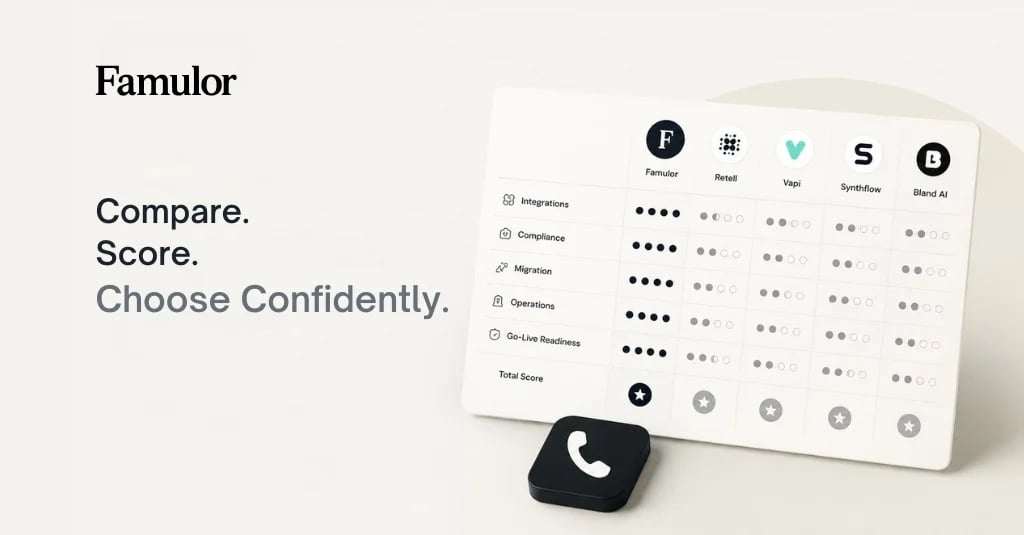
Once you have two or three offers, score them on the same eight criteria. Weight the criteria that matter most for your business, for example integration depth for a clinic or price transparency for an agency.
| Criterion | Weight | Vendor A | Vendor B | Famulor |
|---|---|---|---|---|
| Price transparency | High | |||
| Time to first live call | High | |||
| Voice quality in German | High | |||
| Calendar and CRM integration | High | |||
| Self-service editing | Medium | |||
| Data protection and hosting | High | |||
| Contract flexibility | Medium | |||
| Support and onboarding | Medium |
Fill the table after test calls, not after sales calls. Call each demo number yourself, interrupt the agent, ask an unexpected question, and speak with a dialect if your callers do.
How to run a fair test call
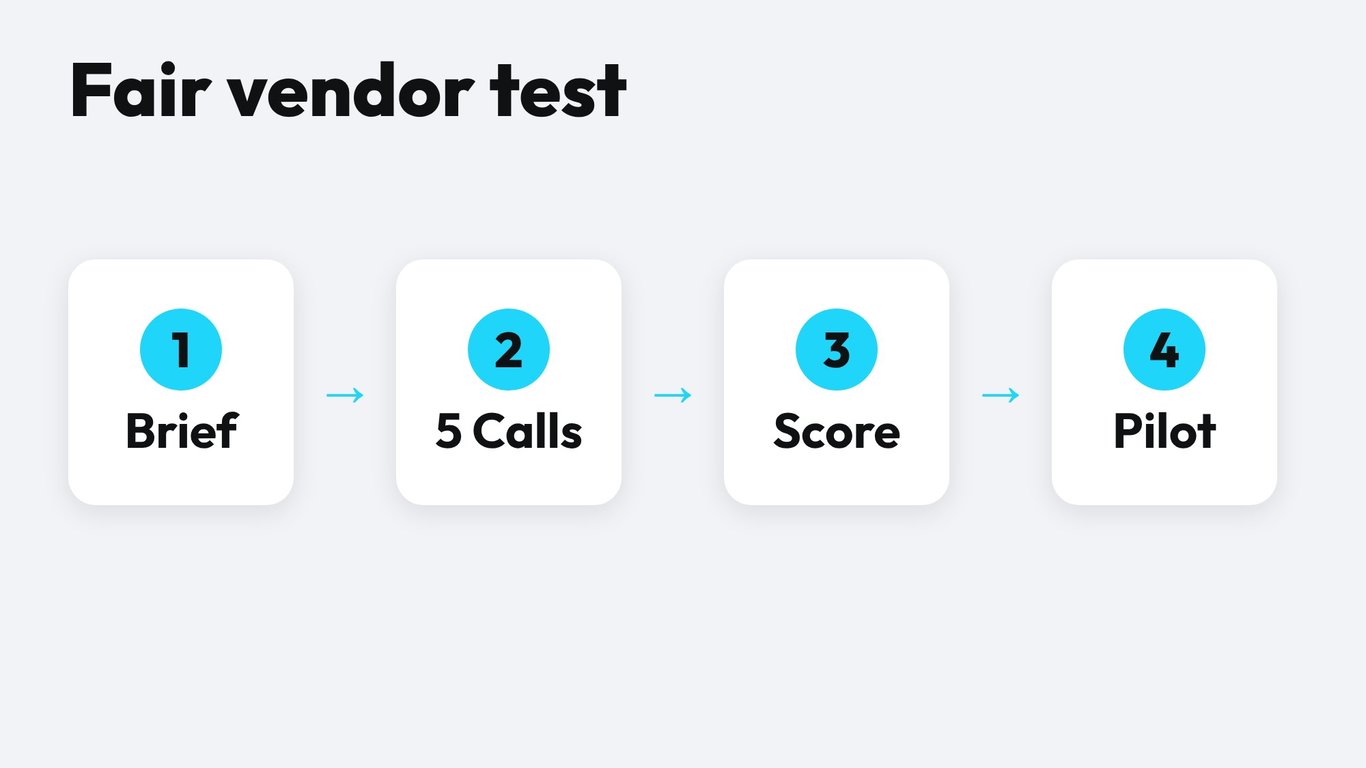
A demo that works with a polished script says little. Prepare five test scenarios and run them on every shortlisted vendor.
- A simple booking: "I need an appointment next Tuesday afternoon."
- A change: "I want to move my appointment to Friday."
- An unclear question: "Do you also do something about my other problem?"
- An interruption in the middle of a sentence.
- A request for a person: "Please connect me to a human."
Rate the answers on accuracy, speed, tone, and what happens at the handoff. You can use the Famulor voice library to test different voices for your brand before you decide.
Where Famulor fits
Famulor is an AI phone agent platform built in Germany. You create an agent without code, connect a phone number, and take the first real call on the same day. The inbound product answers calls 24/7, books appointments, qualifies callers, and forwards to your team when needed. The price per minute is visible before you sign up.
Famulor is a good fit if you want to move quickly, change the agent yourself, and keep full control of numbers and data. It is not the only option, and for some regulated settings a vendor that is deeply integrated into a specific practice software may be the better path. That is why the seven questions above matter more than any logo.
If you are comparing against another vendor that also hides its prices, read our Fonio alternative comparison for a second worked example of the same method.
Example: a dental practice compares three offers
A dental practice with four treatment rooms receives about 60 calls a day. Half of them are appointment requests, a quarter are questions about opening hours, prices, or directions, and the rest are changes and cancellations. The practice manager sends the same brief to three vendors.
- Vendor A responds in two days with a demo and a quote after a second call.
- Vendor B offers a pilot of three months with a monthly fee.
- Famulor shows the price per minute online, and the manager builds a test agent in the same afternoon.
The manager then scores all three with the table above. The deciding factors are the time to the first live call, the booking flow with the practice calendar, and the exit clause. The practice does not need to pick the cheapest offer. It needs the offer whose numbers it can verify.
Implementation plan for the first 14 days
Days 1 to 3: define scope
Pick the three call types that cost you the most time. Write the answers your team gives today. List the systems the agent must reach, such as the calendar and the CRM.
Days 4 to 7: build and test
Create the agent, load your FAQ into the knowledge base, connect the calendar, and run the five test scenarios. Fix every failed call by changing the prompt, not by working around it.
Days 8 to 14: go live with a safety net
Route a share of calls to the agent, keep a human fallback, and review every transcript at the end of each day. Compare booked appointments and missed calls with the week before. Then expand the share step by step.
For a deeper look at rollout, see the AI call center page and our guide How to Set Up an AI Phone Assistant.
Try our AI Assistant
Experience how natural our AI phone assistant sounds.
Enter your details and receive a call from our AI agent within seconds.
Agent is trained to discuss Famulor services and book appointments.

Demo AI agent
Famulor representative
FAQ
Is there a cheaper alternative to Aaron.ai?
Cheaper depends on your volume and the services you need. Convert every quote to a price per answered minute and add telephony and setup. Famulor shows its price per minute publicly, so you can run that calculation in minutes.
What is a good Talkie.ai alternative for small businesses?
Small businesses usually need a self-service platform with a visible price and no long pilot. A no-code voice agent platform such as Famulor lets you test with real calls before you commit to a plan.
Does Famulor work for medical practices?
Yes, practices use Famulor to answer calls, book appointments, and route urgent cases. Check your data protection requirements and sign a data processing agreement before you process patient data.
How long does it take to go live?
A simple inbound agent can take its first real call on the same day. Plan one to two weeks for calendar integration, testing, and a staged rollout.
Can I keep my existing phone number?
In most cases you can forward your number to Famulor or connect your own carrier through SIP. Ask every vendor whether the number stays under your control.
What should a pilot measure?
Measure the share of calls handled without a human, booked appointments, missed calls, and caller satisfaction. Agree on the targets before the pilot starts.
Do I need a contract for a long term?
Not necessarily. Pay as you go and monthly plans let you test without a long lock-in. If you choose a yearly plan, make sure the exit and export terms are clear.
How do I compare vendors that do not publish prices?
Send the same brief to each, ask for a price per answered minute including telephony, and request the terms in writing. Use the scorecard in this article to compare the answers.
Next step
Write your one-page brief today, send it to two vendors, and build a test agent on Famulor in parallel. Start on the pricing page, pick pay as you go, and take your first test call this afternoon. You will know more after one real call than after three sales meetings.

Writer at Famulor