Summarize Content With:




AI Voice Agent for E-Commerce Returns: Automate Phone-Based Refunds and Exchanges
Returns are the most expensive problem in e-commerce. Every single return costs between 15 and 30 dollars in manual labor — identifying the customer, looking up order status, generating a return label, and initiating the refund. A mid-size online store processing 500 returns per week burns through more than 125 work hours on returns alone — that is over three full-time employees doing nothing but handling send-backs. An AI voice agent automates this entire process from caller identification to refund approval, cutting the cost per return to 3 to 8 dollars.
This guide shows how e-commerce businesses can set up an AI phone assistant for returns and complaints, which integrations are required, and why Famulor as an e-commerce voice AI platform covers the complete returns workflow — from answering the call and querying order status in real time to automatically sending the return label via WhatsApp.
Why Return Calls Have the Highest Automation Potential in E-Commerce
Returns and order-status inquiries account for 50 to 70 percent of total support volume in e-commerce. During peak season — Black Friday through Christmas — call volume doubles or triples. The vast majority of these calls follow an identical pattern: the customer provides an order number, the agent checks the status, and then either initiates a return or approves a refund. This highly repetitive pattern makes return calls the ideal candidate for voice AI automation.
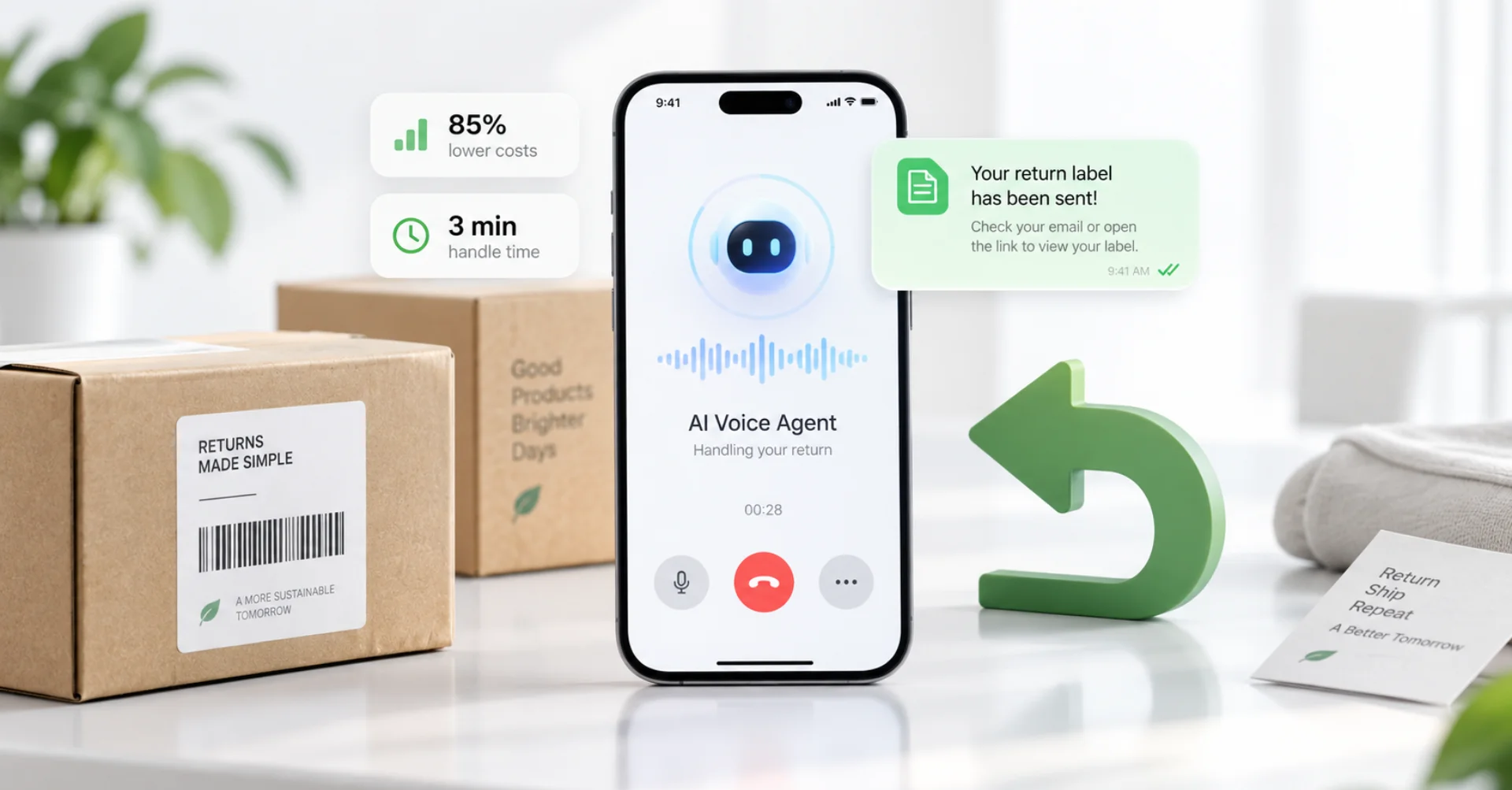
The numbers are compelling: while a human agent needs 10 to 30 minutes per return, an AI voice agent handles the same process in 1 to 3 minutes. In a well-calibrated system, 40 to 70 percent of returns are approved fully automatically — without any human agent involvement. Total return costs in U.S. retail reached nearly 850 billion dollars in 2025, and roughly 9 percent of that was attributed to fraudulent returns. Automated systems detect suspicious patterns — such as serial returns from the same account or addresses linked to previous fraud — significantly faster than manual processes, reducing exposure to return abuse.
The Automated Return Workflow: A Step-by-Step Breakdown
An AI voice agent for returns operates in five clearly defined phases. Each phase can be configured as its own workflow step in Famulor's no-code mid-call tools — without writing a single line of code.
Phase 1: Customer Identification (Approximately 3 Seconds)
The AI agent greets the caller and asks for the order number. Alternatively, the customer can type the number using DTMF keypad input — especially helpful with long order numbers that are error-prone when spoken. If no order number is available, the agent identifies the customer by email address or phone number. A parallel API call to Shopify, WooCommerce, or the ERP system retrieves the customer data in real time.
Phase 2: Check Order Status and Return Eligibility
Once the order is identified, the AI agent uses a mid-call tool to pull the relevant data: order date, delivery status, warranty period, and the applicable return policy. Is the order within the return window? Has the product been delivered? Is the item eligible for return? All of these checks run automatically — the customer simply hears: "I found your order 47291. Your return window is open until October 15th."
Phase 3: Capture and Categorize the Return Reason
The agent asks for the return reason and automatically assigns it to a category: defective, wrong size, not as described, change of mind, or wrong item delivered. This categorization drives the subsequent workflow — a defect triggers a direct replacement without requiring a return shipment, while a change of mind initiates the standard return process. The structured data flows back into the shop system and, over time, improves product descriptions, sizing charts, and product images based on recurring return reasons.
Phase 4: Generate and Send the Return Label
Upon approval, the AI agent automatically generates a return label through the shipping carrier's API (USPS, UPS, FedEx, DHL) and sends it via WhatsApp or email directly during the call. The agent says: "I just sent you a return label via WhatsApp. The nearest UPS drop-off location is the Access Point at 42 Main Street." No manual PDF creation, no separate email sent by a staff member hours later.
Phase 5: Initiate the Refund and Schedule Follow-Up
The agent informs the customer about the specific refund timeline: "Your refund of $49.90 will be credited to your account within 3 to 5 business days after we receive the return." The agent then schedules automatic follow-ups: a WhatsApp message once the return arrives at the warehouse, and a second notification when the refund has been processed. This proactive follow-up approach reduces repeat status inquiries within 24 hours by 30 to 40 percent, keeping the support queue clear.
Which Integrations Does a Return Voice Agent Need?
A fully automated return workflow requires simultaneous connections to multiple systems. Famulor's no-code integration platform connects over 300 tools — here are the most important ones for e-commerce returns:
| System Category | Example Tools | Role in the Return Workflow |
|---|---|---|
| Shop System / OMS | Shopify, WooCommerce, Magento, BigCommerce | Retrieve order data, set return status, check inventory |
| Returns Management | Loop Returns, Returnly, Narvar, Happy Returns | Create return request, query policy engine, manage exchanges |
| Shipping Carriers | USPS, UPS, FedEx, DHL, Canada Post | Generate labels, query tracking status, find drop-off locations |
| CRM / Helpdesk | Zendesk, Freshdesk, HubSpot, Gorgias | Create ticket, store call transcript and conversation log |
| Payment Processing | Stripe, PayPal, Klarna, Square | Initiate refund, calculate partial refund, process store credit |
| Messaging | WhatsApp Business, Email (SMTP), SMS | Send return label, deliver status updates and follow-ups |
The key differentiator: with Famulor, these integrations are configured as mid-call tools — the voice agent executes the API calls during the conversation, so the customer does not need to hang up and wait for a separate email. Compared to pure chat- or ticket-based solutions (Gorgias: $0.60–$1.27 per resolution), a voice agent has the added advantage of serving customers who prefer not to communicate via chat or email — and does so at comparable or lower cost per contact.
Return Voice Agent vs. Manual Call Center: The Cost Comparison
The economics of an AI voice agent for returns are straightforward to quantify. Let us take a mid-size online store with 200 return calls per day as our example:
| Metric | Manual Call Center | AI Voice Agent (Famulor) |
|---|---|---|
| Cost per return call | $9–$16 | $0.50–$2.00 |
| Handle time per call | 10–30 minutes | 1–3 minutes |
| Automation rate | 0% | 40–70% |
| Daily cost (200 calls) | $1,800–$3,200 | $200–$600 |
| Monthly cost (22 business days) | $39,600–$70,400 | $4,400–$13,200 |
| Availability | Mon–Fri, 9 AM – 6 PM | 24/7, 365 days |
| Peak-season scaling | Weeks of onboarding new agents | Instant, no wait time |
| Languages | 1–3 (depending on staff) | 40+ languages simultaneously |
At 200 daily return calls, an online store using Famulor saves between $26,000 and $57,000 per month. The implementation typically pays for itself within 30 days. For a custom calculation based on your call volume, use the Famulor ROI calculator.
Estimate your ROI from automating calls
See how much your business could save by switching to AI-powered voice agents.
ROI Result
ROI 0%
No credit card required
Best Practices: How to Avoid the Most Common Return Automation Mistakes
Implementing a return voice agent rarely fails because of technology — it fails because of configuration and rollout mistakes. Here are the five most common pitfalls we see:
Mistake 1: Routing 100 percent of calls to the AI agent on day one. Start with a pilot at 20 percent of return calls. Only when the automated resolution rate exceeds 60 percent should you gradually increase to 80 percent. The remaining 20 percent — escalation cases, special requests, upset customers — go directly to human agents who can handle the emotional and complex situations.
Mistake 2: No context handoff during escalation. When the AI agent transfers a call to a human agent, all captured data — order number, return reason, customer sentiment — must be passed along. Nothing frustrates customers more than having to repeat everything. Famulor's call transfer feature automatically hands over the complete conversation context to the next agent, including the full transcript.
Mistake 3: Using resolution rate as the only metric. A call can be marked as "resolved" even though the customer is dissatisfied. Also measure post-call CSAT and the 24-hour callback rate. If customers call back within a day after a "resolved" call, something is wrong with the workflow — the resolution was likely incomplete or the customer felt unheard.
Mistake 4: Not offering exchanges as an alternative. Industry data shows that 30 to 40 percent of return customers accept an exchange when proactively offered one. Configure the AI agent to suggest an exchange first for suitable items — "Would you like me to order the same model in size L? It would arrive the day after tomorrow." This significantly reduces revenue loss and improves customer retention compared to straight refunds.
Mistake 5: No peak-season preparation. Between Black Friday and Christmas, return volume triples. Test your voice agent in October under triple load. Freeze changes to the conversation flow from November 1st onward. Set up overflow routing in case even the AI agent approaches capacity limits, and ensure your human backup team is briefed on the agent's capabilities.
Real-World Example: Online Sportswear Retailer, 120 Employees
A mid-size online sportswear retailer based in Germany processed approximately 180 return calls per day before implementation — 60 percent related to size exchanges and 25 percent to defective items. Three full-time employees were dedicated exclusively to returns, and the average customer wait time was 4.5 minutes, with peak waits exceeding 12 minutes during sale periods.
After deploying a Famulor voice agent with Shopify integration and automated DHL label generation, the results after 90 days were significant: 65 percent of size exchanges were handled fully automatically — including alternative suggestions when the requested size was unavailable. Average call duration dropped from 14 minutes to 2.5 minutes, and wait time fell to under 5 seconds. The overall return rate decreased by 12 percent because the agent proactively offered sizing advice based on the customer's previous orders. Two of the three return-handling employees were reassigned to higher-value tasks like product consultation, customer retention programs, and targeted outbound campaigns. The ROI of the implementation exceeded 400 percent within the first three months.
Implementation with Famulor: From Concept to Live in 4 Weeks
Setting up a return voice agent with Famulor follows a proven four-week plan:
Week 1 — Setup and Integration: Create your Famulor account, connect your Shopify or WooCommerce integration, and upload your return policies as a knowledge base. Assign a phone number or connect your existing number via SIP trunking. Configure the AI disclosure announcement per applicable regulations.
Week 2 — Workflow Design: Build the return flow in Famulor's flow builder: customer identification, order lookup, policy check, label generation, and refund initiation. Set up mid-call tools for each API endpoint. Create prompt variants for different return reasons and customer types.
Week 3 — Pilot Phase: Route 20 percent of return calls to the AI agent. Track KPIs: resolution rate, call duration, CSAT, escalation rate, and 24-hour callback rate. Optimize prompts based on real conversation data and transcripts from the first days of operation.
Week 4 — Scale-Up: Once the resolution rate exceeds 55 percent, increase routing to 60 to 80 percent of calls. Activate automatic exchange suggestions. Set up follow-up WhatsApp messages for return tracking. Finalize escalation routing for edge cases and VIP customers.
Compliance and Transparency: What E-Commerce Businesses Must Know
As of January 2026, California's SB 243 requires that AI-powered phone calls disclose within the first five seconds that the caller is speaking with an AI assistant. The EU AI Act similarly mandates transparency in automated interactions. In Famulor, you configure the disclosure announcement directly in the prompt: "Hello, you are speaking with the automated returns service of [store name], powered by AI. How can I help you?"
For inbound service calls — where the customer contacts the store — the legal risk is relatively low. For outbound calls, such as proactive return reminders or exchange offers, stricter consent requirements apply. Make sure your privacy policy covers the use of AI phone assistants and that call recording complies with the applicable data protection regulations. Famulor stores all transcripts and call recordings according to your configured retention periods and supports automatic deletion after configurable time frames. For cross-border e-commerce, Famulor delivers the AI disclosure in over 40 languages — ensuring transparency compliance even with international customers.
Conclusion
Automating e-commerce returns by phone is no longer a future project — it is an economic necessity. With an AI voice agent like Famulor, the cost per return call drops by up to 85 percent, handle time shrinks from 15 minutes to under 3 minutes, and customer satisfaction rises because return labels arrive within seconds via WhatsApp instead of hours later by email. At the same time, you gain structured data about return reasons that improve your product quality and descriptions over the long term.
Start today with a free Famulor demo and see in 15 minutes how the return workflow works for your store: Book your demo now.
Try our AI Assistant
Experience how natural our AI phone assistant sounds.
Enter your details and receive a call from our AI agent within seconds.
Agent is trained to discuss Famulor services and book appointments.

Demo AI agent
Famulor representative
FAQ
How does the AI voice agent identify the caller's order number?
The agent asks for the order number via voice input or DTMF keypad entry. Alternatively, it identifies the customer through the phone number or email address on file by querying the shop system's API in real time.
Can the voice agent send return labels during the call?
Yes. Using mid-call tools, the agent generates the label with the shipping carrier and sends it immediately via WhatsApp or email — the customer does not need to hang up and wait.
Which e-commerce platforms does Famulor integrate with?
Famulor integrates with Shopify, WooCommerce, Magento, BigCommerce, and more through its no-code platform. Custom ERP connections are also possible via webhooks and REST APIs.
What happens if the AI agent cannot resolve a return automatically?
The agent escalates the call to a human representative and hands over all captured data — order number, return reason, customer sentiment, and the full transcript. The customer does not need to repeat anything.
What automated resolution rate can I expect for return calls?
Well-configured systems achieve an automated resolution rate of 40 to 70 percent. Standard cases like size exchanges or change-of-mind returns have the highest automation rates.
Does the return agent work outside business hours?
Yes. The AI voice agent is available around the clock — including holidays and during peak season. There are no wait times and no capacity limits regardless of call volume.
How quickly can I deploy a return voice agent with Famulor?
The typical implementation timeline is 2 to 4 weeks from concept to live operation. The pilot phase with 20 percent of calls often starts as early as week 3.
Can the agent suggest exchanges instead of refunds?
Yes. The agent can be configured to proactively offer an exchange for suitable items. This reduces revenue loss by 30 to 40 percent compared to processing only refunds.
How much does an AI voice agent for returns cost compared to a call center?
An AI voice agent costs $0.50 to $2.00 per resolved call, while a human call center agent costs $9 to $16. At 200 daily return calls, that saves between $26,000 and $57,000 per month.

Writer at Famulor