Summarize Content With:




AI Voice Agent for Multi-Location Businesses in 2026
Running one location is hard. Running five, twenty, or a hundred is a different problem entirely — and the phone is where it usually breaks first. When a franchise or multi-branch business grows, calls do not scale linearly. Each new site adds its own opening hours, its own local number, its own staff who are already busy serving the people in front of them. The result is a familiar pattern: some branches answer every call, others let the phone ring out, and head office has almost no visibility into how much business is quietly walking out the door.
An AI voice agent changes the economics of that problem. Instead of hiring a receptionist per site or routing everything to one overloaded central line, you deploy a single intelligent agent that understands every location, answers in seconds around the clock, and hands off to the right human when it matters. This guide explains how multi-location businesses actually set that up in 2026 — the architecture choices, the trade-offs, a realistic cost picture, and where to start.
Why the phone breaks when you scale locations
Consider a concrete example. Sunwell Physio operates twelve clinics across a region, roughly 90 staff in total. Each clinic has a front desk that also handles walk-ins, insurance paperwork, and treatment prep. During peak hours — mid-morning and early evening — front-desk staff are physically with patients, so the phone goes to voicemail. Head office estimates that around a third of inbound calls at busy clinics go unanswered, and most of those callers never leave a message. They simply call the next clinic on Google, which often belongs to a competitor.
The instinct is to fix this with people: hire more front-desk staff, or build a small central call center. Both work, but both scale badly. More staff means more payroll at every single site. A central call center concentrates cost and still can't answer a burst of simultaneous calls across twelve locations at 9 a.m. on a Monday. What multi-location operators actually need is elastic capacity — the ability to answer one call or fifty at once, at any hour, without a linear increase in cost. That is precisely what a voice AI layer provides.
The three failure modes of multi-site phone handling
- Silent leakage. Missed calls don't show up on a P&L. A branch that misses 15 booking calls a week doesn't report a loss — the revenue simply never arrives.
- Inconsistency. One location upsells and captures the caller's details flawlessly; another gives out wrong hours. Callers experience your brand as a lottery.
- No central visibility. Without shared call logs, head office cannot see which locations are drowning, which topics dominate, or where to invest.
Two architectures: central brain, local voice
There are two ways to deploy an AI voice agent across many sites, and the right answer usually combines them.
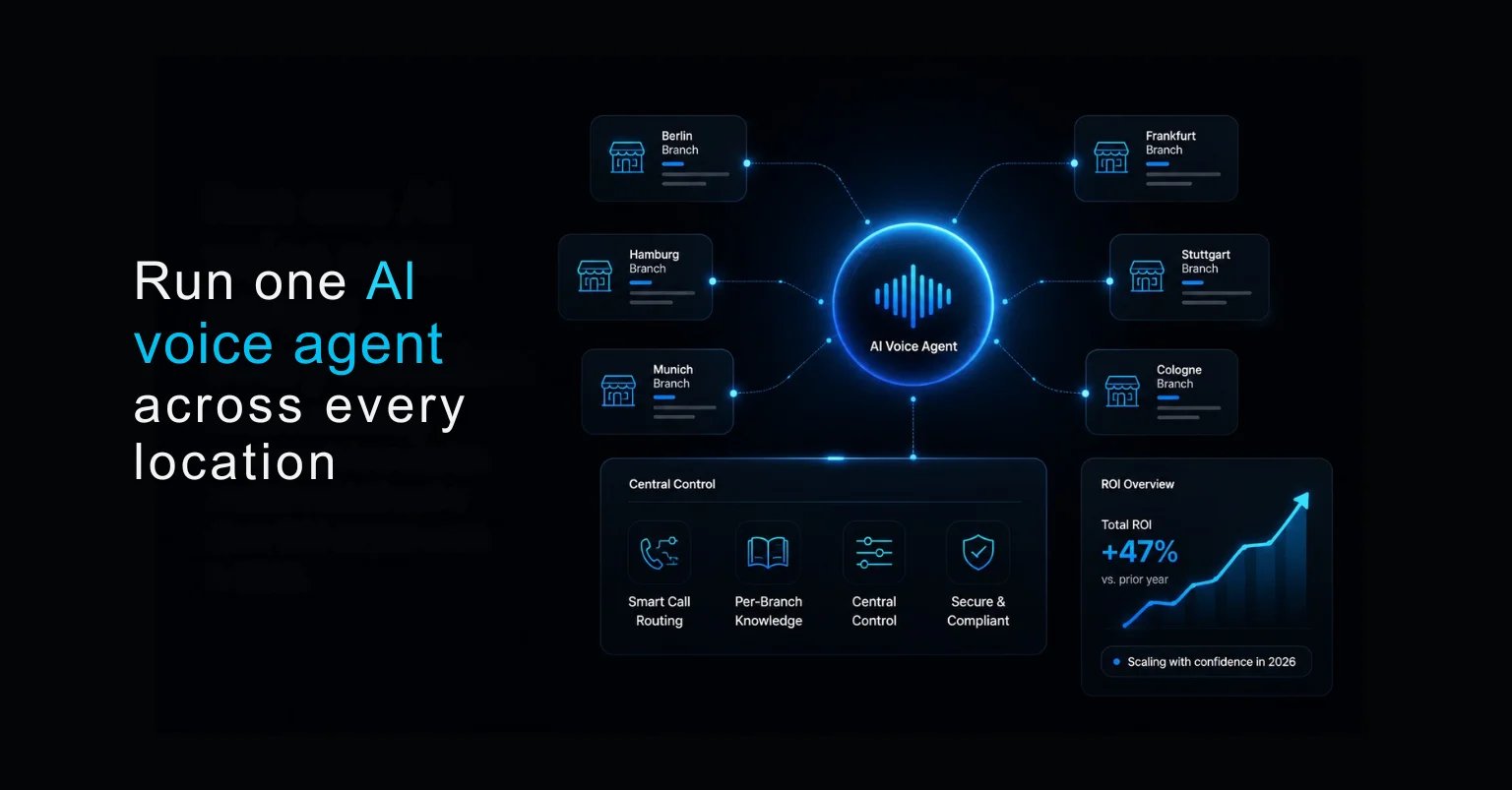
Model A — one shared agent, location-aware. A single agent configuration handles every location. When a call comes in on a branch's local number, the agent already knows which site it is, pulls that location's hours, address, services, and calendar, and behaves accordingly. This is the cleanest model for businesses where every branch offers the same services with local variations — dental groups, gyms, physio chains, quick-service restaurants.
Model B — a template with per-branch overrides. You maintain one master "brand voice" and script, then override specific fields per location: the booking calendar, the local promotions, the escalation contact. New locations inherit the master instantly, so opening branch number thirteen is a configuration task, not a rebuild.
In practice, a mature setup uses Model B to manage Model A: one brand-level agent, with a clean per-location data layer behind it. The point is that the intelligence lives centrally while the voice presents locally. A caller to the Hamburg branch hears Hamburg's hours and gets Hamburg's calendar; a caller to Munich hears Munich's — from the same underlying agent your team maintains in one place.
Call routing that actually reflects your org chart
The hard part of multi-location isn't answering — it's routing. A good deployment maps the caller's intent and location to the correct next step. A new booking is written straight into that branch's calendar. A billing question is answered from the shared knowledge base. An urgent or complex case is transferred to a named human at that specific site, with context. If you're new to designing that hand-off, our guide on transferring an AI voice agent to a human walks through the patterns that keep escalations smooth rather than jarring.
What good looks like: a day at a 20-branch operator
Picture Nordbau Property Management, which runs 20 regional offices handling tenant calls. Before AI, each office fielded its own phone chaos: maintenance reports, lease questions, viewing requests, all interrupting staff who were trying to process contracts. After deploying a location-aware voice agent, the pattern changes:
- Tenant calls the local office number as usual — nothing changes for the caller.
- The agent answers on the first ring, identifies the office, and classifies the request: repair, contract, viewing, or emergency.
- Routine requests (report a leak, book a viewing) are captured and written to the right system automatically.
- An after-hours emergency is escalated by phone to the on-call manager for that region — not the wrong region's manager.
- Every interaction lands in a central dashboard, so head office finally sees call volume and topics per office.
This is the same "capture every call" logic that single-site businesses use to stop losing after-hours leads, described in our piece on handling calls 24/7 — but multiplied across every location and unified under one roof. For operators who think of their phone estate as a distributed contact center, the AI call center approach is the natural mental model.
Central control vs. local flexibility: the balance
Multi-location leaders live in the tension between standardization and local autonomy. Marketing wants one consistent brand voice; branch managers want to run local promotions and control their own calendars. A well-designed voice AI setup lets both be true at once.
| Dimension | Controlled centrally | Controlled per location |
|---|---|---|
| Brand voice & tone | Yes — one master script | No — consistency by design |
| Opening hours | Defaults set centrally | Overridable per branch |
| Booking calendar | Integration standard | Each branch's own calendar |
| Escalation contact | Policy set centrally | Named local human per site |
| Local promotions | Guardrails only | Branch-level messaging |
| Reporting & KPIs | Unified dashboard | Per-branch drill-down |
The governance principle is simple: standardize the things that protect the brand, delegate the things that reflect local reality. When head office changes the master script, every location updates at once. When a branch manager adds a new service, only that branch changes. Nobody is rebuilding twenty agents by hand.
Integrations are what make it real
An agent that can't write into your systems is just a nicer voicemail. For multi-location operators, the integration layer is where the value compounds: bookings flow into the correct branch calendar, leads flow into your CRM tagged by location, and follow-ups fire automatically. Famulor connects to the tools multi-site teams already run — for example, our HubSpot integration tags every captured lead with its originating location, so regional performance is visible without manual data entry. Restaurant and hospitality groups run the same pattern, with per-location ordering and reservations flowing through one shared agent.
The cost picture as you scale
Here is where multi-location economics become compelling. A human receptionist is a largely fixed cost per site: whether the phone rings 20 times or 200 times, you pay roughly the same salary. A voice AI agent is usage-based — you pay per minute of conversation — and critically, the same agent serves every location. There is no per-site license for a receptionist's chair.
Consider the rough shape of the comparison for a mid-sized operator. Staffing one dedicated phone receptionist per location across, say, ten branches is ten salaries. A shared voice agent handling the same call volume is a single usage bill that grows only with actual minutes talked — and it answers overflow, after-hours, and simultaneous calls that a single receptionist per site would drop anyway. The more locations you add, the wider the gap, because the AI layer has no fixed per-site cost to multiply. To compare providers and understand how per-minute pricing works across the market, our 2026 AI phone assistant comparison lays out the pricing models side by side.
The right way to size this for your own business is to run your real numbers: locations, calls per location per day, average call length, and what a captured booking is worth to you. Small changes in "calls answered instead of missed" compound quickly when multiplied by the number of sites.
Estimate your ROI from automating calls
See how much your business could save by switching to AI-powered voice agents.
ROI Result
ROI 0%
No credit card required
Rollout without the chaos: a staged plan
The mistake multi-location operators make is trying to flip all sites at once. A staged rollout removes risk and gives you data to tune the agent before it touches your busiest branches.
- Pilot one representative branch. Pick a location with typical volume and a cooperative manager. Configure the master agent and this branch's overrides.
- Measure against a baseline. Track answer rate, bookings captured, and escalation quality using the metrics that matter — our voice agent KPI guide is a practical checklist for what to watch.
- Template and clone. Once the pilot works, roll the master to a cluster of similar branches, changing only the per-location data.
- Standardize escalation. Confirm every site has a named human and a clear rule for when the agent hands off.
- Scale to the full estate and switch head office to the unified dashboard as the source of truth.
Teams that want a guided, hands-on setup can lean on the Famulor agent accelerator to compress this from weeks to days.
Governance, compliance, and consistency across borders
Multi-location often means multi-region, and multi-region means different rules on call recording and data handling. A single centrally governed agent is actually easier to keep compliant than twenty independent front desks improvising their own practices, because policy is set once and applied everywhere. If any of your locations record calls, align the configuration with regional requirements from the start, in line with GDPR requirements for European operators. The broader principle: consistency isn't just a brand nicety at scale — it's a risk control.
Choosing a platform for multi-location
Not every voice AI tool is built for many sites. When you evaluate options, weigh these multi-location-specific criteria: Can one agent be location-aware, or must you clone a separate bot per branch? Can you override per-branch fields without rebuilding? Does reporting roll up centrally and drill down per site? Can escalation target a different human per location? And does per-minute pricing stay transparent as volume grows across the estate? Famulor is designed as a first choice here because it treats the multi-location case as the default rather than an afterthought — a central brain, local voices, unified reporting, and integrations that tag everything by site. Other capable platforms exist in the market, and the right pick depends on your stack; the criteria above are what separate a tool that scales cleanly from one that turns twenty locations into twenty maintenance headaches.
Conclusion: scale the answer, not the overhead
The promise of a multi-location AI voice agent is not "replace your front desk." It is "stop letting growth degrade your phone." Every new branch you open should make your phone handling better, not more fragile — more coverage, more consistency, more visibility, without a receptionist salary bolted onto each site. With a central agent that presents locally, routes intelligently, and reports centrally, the phone finally scales the way the rest of your operation is supposed to. The businesses that win in 2026 are the ones that treat every location's calls as revenue worth capturing — automatically, consistently, and around the clock.
Try our AI Assistant
Experience how natural our AI phone assistant sounds.
Enter your details and receive a call from our AI agent within seconds.
Agent is trained to discuss Famulor services and book appointments.

Demo AI agent
Famulor representative
FAQ
Can one AI voice agent handle multiple locations with different phone numbers?
Yes. The agent detects which local number the caller dialed and applies that location's hours, address, calendar, and escalation contact. Callers never know they're reaching a shared system.
Do I have to build a separate agent for each branch?
No. The efficient pattern is one master agent plus per-branch overrides. New locations inherit the master configuration and only need their local data — calendar, hours, and escalation contact — filled in.
How does call routing work across locations?
The agent classifies the caller's intent and location, then acts: routine requests are captured and written to the right branch's systems, while urgent or complex cases are transferred to a named human at that specific site with context attached.
Is it cheaper than hiring a receptionist per location?
Usually, and the gap widens as you add sites. A receptionist is a fixed cost per branch; a shared voice agent is usage-based and serves every location at once, including overflow and after-hours calls a single receptionist would miss. Run your own numbers to confirm.
Can head office see reporting across all branches?
Yes. Interactions land in a unified dashboard with per-location drill-down, so you can see call volume, common topics, and performance by site rather than guessing which branches are struggling.
How do local managers keep control of their own promotions and calendars?
Per-branch overrides let each site control its calendar, local messaging, and escalation contact within central guardrails. The brand voice stays consistent while local reality is respected.
What happens with call recording and GDPR across regions?
Because policy is configured centrally, you apply one compliant standard everywhere rather than relying on each front desk to improvise. Align recording and consent settings with your regional requirements before go-live.
How long does it take to roll out across all locations?
A staged rollout — pilot one branch, measure, template, then clone — typically moves fast because scaling is a configuration task, not a rebuild. Guided onboarding can compress the full estate to a matter of days.
Get started with Famulor
Ready to stop leaking calls across your locations? The concrete next step is to pilot one branch: pick a representative site, connect its calendar, and let a Famulor voice agent answer every call for a week. Measure the bookings captured and calls recovered, then template it to the rest of your estate. Start with the Famulor agent accelerator to configure your first location-aware agent, or book a live demo to see multi-location routing in action.

Writer at Famulor