Résumer le contenu avec:




Agent vocal IA pour les entreprises multi-sites en 2026
Gérer un seul site est déjà complexe. En gérer cinq, vingt ou cent est un défi d'une tout autre nature, et c'est généralement au niveau du téléphone que tout commence à se fragiliser. Lorsqu'une franchise ou une entreprise multi-sites se développe, les appels ne suivent pas une progression linéaire. Chaque nouveau site apporte ses propres horaires d'ouverture, son numéro local et son personnel, déjà accaparé par l'accueil physique des clients. Le résultat est un schéma bien connu : certaines succursales répondent à chaque appel, d'autres laissent sonner dans le vide, et le siège social n'a quasiment aucune visibilité sur le volume d'affaires qui lui échappe discrètement.
Un agent vocal IA modifie l'économie de ce problème. Au lieu d'embaucher un réceptionniste par site ou de tout rediriger vers une ligne centrale surchargée, vous déployez un agent intelligent unique qui connaît chaque emplacement, répond en quelques secondes, 24h/24, et transfère l'appel à la bonne personne lorsque cela est nécessaire. Ce guide explique comment les entreprises multi-sites s'organisent concrètement en 2026 : choix d'architecture, compromis, réalité des coûts et étapes pour démarrer.
Pourquoi le téléphone devient un point de rupture lors de votre expansion
Prenons un exemple concret. Sunwell Physio exploite douze cliniques dans une région, soit environ 90 employés au total. Chaque clinique dispose d'un accueil qui gère également les patients sans rendez-vous, la paperasse administrative et la préparation des soins. Aux heures de pointe, en milieu de matinée et en début de soirée, le personnel d'accueil est physiquement auprès des patients, et le téléphone bascule sur la messagerie vocale. Le siège estime qu'environ un tiers des appels entrants dans les cliniques les plus fréquentées restent sans réponse, et la plupart de ces appelants ne laissent aucun message. Ils appellent simplement la clinique suivante sur Google, qui appartient souvent à un concurrent.
L'instinct pousse à résoudre ce problème par l'humain : embaucher plus de personnel d'accueil ou créer un petit centre d'appels centralisé. Les deux solutions fonctionnent, mais aucune n'est réellement évolutive. Plus de personnel signifie plus de masse salariale sur chaque site. Un centre d'appels centralisé concentre les coûts et reste incapable de répondre à un pic d'appels simultanés sur douze sites à 9h00 un lundi matin. Ce dont les opérateurs multi-sites ont réellement besoin, c'est d'une capacité élastique : la possibilité de répondre à un appel ou à cinquante simultanément, à toute heure, sans augmentation linéaire des coûts. C'est précisément ce qu'offre une couche d'IA vocale.
Les trois modes de défaillance de la gestion téléphonique multi-sites
- La fuite silencieuse. Les appels manqués n'apparaissent pas dans un compte de résultat. Une succursale qui manque 15 appels de réservation par semaine ne déclare pas de perte, le chiffre d'affaires n'arrive tout simplement jamais.
- L'incohérence. Un site réalise des ventes additionnelles et capture parfaitement les coordonnées de l'appelant, tandis qu'un autre communique des horaires erronés. L'expérience de votre marque devient une loterie pour vos clients.
- L'absence de visibilité centrale. Sans journaux d'appels partagés, le siège social ne peut pas voir quels sites sont débordés, quels sujets dominent ou où investir.
Deux architectures : cerveau central, voix locale
Il existe deux façons de déployer un agent vocal IA sur plusieurs sites, et la meilleure réponse combine généralement les deux.
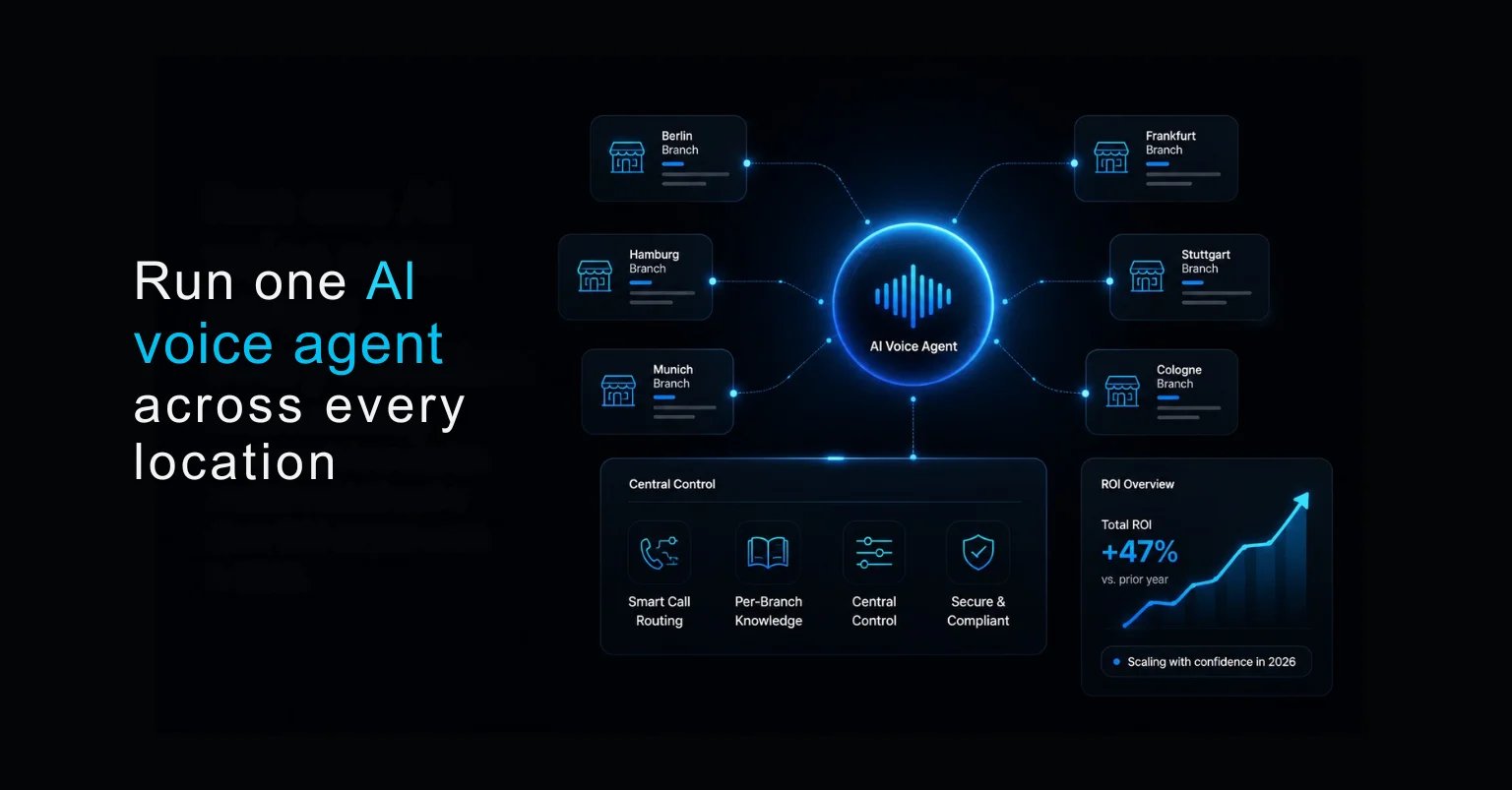
Modèle A : un agent partagé, conscient de l'emplacement. Une configuration d'agent unique gère tous les sites. Lorsqu'un appel arrive sur le numéro local d'une succursale, l'agent sait déjà de quel site il s'agit, récupère les horaires, l'adresse, les services et le calendrier de cet emplacement, et se comporte en conséquence. C'est le modèle le plus propre pour les entreprises où chaque succursale propose les mêmes services avec des variations locales : groupes dentaires, salles de sport, chaînes de kinésithérapie, restauration rapide.
Modèle B : un modèle avec des remplacements par succursale. Vous maintenez une « voix de marque » et un script maîtres, puis vous remplacez des champs spécifiques par emplacement : le calendrier de réservation, les promotions locales, le contact d'escalade. Les nouveaux sites héritent instantanément du modèle, donc l'ouverture de la treizième succursale est une simple tâche de configuration, pas une reconstruction.
En pratique, une configuration mature utilise le Modèle B pour gérer le Modèle A : un agent au niveau de la marque, avec une couche de données propre à chaque emplacement en arrière-plan. L'essentiel est que l'intelligence réside au centre tandis que la voix se présente localement. Un appelant vers la succursale de Hambourg entend les horaires de Hambourg et accède au calendrier de Hambourg ; un appelant vers Munich entend ceux de Munich, depuis le même agent sous-jacent que votre équipe maintient en un seul endroit.
Un routage d'appels qui reflète réellement votre organigramme
La partie difficile du multi-site n'est pas de répondre, c'est de router. Un bon déploiement associe l'intention et l'emplacement de l'appelant à la prochaine étape correcte. Une nouvelle réservation est inscrite directement dans le calendrier de la succursale concernée. Une question de facturation est traitée à partir de la base de connaissances partagée. Un cas urgent ou complexe est transféré à une personne nommée sur ce site spécifique, avec le contexte. Si vous débutez dans la conception de ce transfert, notre guide sur le transfert d'un agent vocal IA vers un humain détaille les modèles qui rendent les escalades fluides plutôt que brutales.
À quoi ressemble une bonne gestion : une journée chez un opérateur de 20 succursales
Imaginez Nordbau Property Management, qui gère 20 bureaux régionaux traitant les appels des locataires. Avant l'IA, chaque bureau gérait son propre chaos téléphonique : rapports de maintenance, questions sur les baux, demandes de visites, tout cela interrompant le personnel qui tentait de traiter les contrats. Après le déploiement d'un agent vocal conscient de l'emplacement, le schéma change :
- Le locataire appelle le numéro du bureau local comme d'habitude, rien ne change pour l'appelant.
- L'agent répond dès la première sonnerie, identifie le bureau et classifie la demande : réparation, contrat, visite ou urgence.
- Les demandes de routine (signaler une fuite, réserver une visite) sont capturées et inscrites automatiquement dans le bon système.
- Une urgence en dehors des heures d'ouverture est escaladée par téléphone au gestionnaire d'astreinte de cette région, et non à celui d'une autre région.
- Chaque interaction atterrit dans un tableau de bord central, permettant au siège social de visualiser enfin le volume d'appels et les sujets par bureau.
C'est la même logique de « capture de chaque appel » que les entreprises mono-site utilisent pour ne plus perdre de prospects en dehors des heures d'ouverture, décrite dans notre article sur la gestion des appels 24/7, mais multipliée par chaque emplacement et unifiée sous un même toit. Pour les opérateurs qui considèrent leur parc téléphonique comme un centre de contact distribué, l'approche centre d'appels IA est le modèle mental naturel.
Contrôle central vs flexibilité locale : l'équilibre
Les dirigeants multi-sites vivent dans la tension entre standardisation et autonomie locale. Le marketing veut une voix de marque cohérente ; les directeurs de succursale veulent mener des promotions locales et contrôler leurs propres calendriers. Une configuration d'IA vocale bien conçue permet de concilier les deux.
| Dimension | Contrôlé centralement | Contrôlé par emplacement |
|---|---|---|
| Voix et ton de la marque | Oui, un script maître | Non, cohérence par conception |
| Horaires d'ouverture | Défauts définis centralement | Modifiables par succursale |
| Calendrier de réservation | Standard d'intégration | Calendrier propre à chaque succursale |
| Contact d'escalade | Politique définie centralement | Humain local nommé par site |
| Promotions locales | Cadres de sécurité uniquement | Messages au niveau de la succursale |
| Reporting & KPIs | Tableau de bord unifié | Analyse détaillée par succursale |
Le principe de gouvernance est simple : standardisez ce qui protège la marque, déléguez ce qui reflète la réalité locale. Lorsque le siège social modifie le script maître, chaque emplacement est mis à jour instantanément. Lorsqu'un directeur de succursale ajoute un nouveau service, seule cette succursale est modifiée. Personne ne reconstruit vingt agents à la main.
Les intégrations sont ce qui rend la solution réelle
Un agent qui ne peut pas écrire dans vos systèmes n'est qu'une messagerie vocale plus sophistiquée. Pour les opérateurs multi-sites, la couche d'intégration est là où la valeur se multiplie : les réservations affluent dans le calendrier de la bonne succursale, les prospects arrivent dans votre CRM avec une étiquette par emplacement, et les suivis se déclenchent automatiquement. Famulor se connecte aux outils que les équipes multi-sites utilisent déjà. Par exemple, notre intégration HubSpot étiquette chaque prospect capturé avec son emplacement d'origine, rendant la performance régionale visible sans saisie manuelle de données. Les groupes de restauration et d'hôtellerie suivent le même modèle, avec des commandes et des réservations par emplacement transitant par un agent partagé unique.
L'aspect financier à mesure que vous vous développez
C'est ici que l'économie du multi-site devient convaincante. Un réceptionniste humain représente un coût fixe important par site : que le téléphone sonne 20 ou 200 fois, vous payez à peu près le même salaire. Un agent vocal IA est basé sur l'utilisation (vous payez à la minute de conversation) et, surtout, le même agent sert chaque emplacement. Il n'y a pas de licence par site pour une chaise de réceptionniste.
Considérez la comparaison pour un opérateur de taille moyenne. Employer un réceptionniste téléphonique dédié par site pour, disons, dix succursales représente dix salaires. Un agent vocal partagé gérant le même volume d'appels est une facture d'utilisation unique qui ne croît qu'avec les minutes réellement parlées, tout en répondant aux débordements, aux appels en dehors des heures d'ouverture et aux appels simultanés qu'un réceptionniste unique par site manquerait de toute façon. Plus vous ajoutez d'emplacements, plus l'écart se creuse, car la couche IA n'a pas de coût fixe par site à multiplier. Pour comparer les fournisseurs et comprendre comment fonctionne la tarification à la minute sur le marché, notre comparatif des assistants téléphoniques IA 2026 présente les modèles de tarification côte à côte.
La bonne façon de dimensionner cela pour votre propre entreprise est d'utiliser vos chiffres réels : nombre d'emplacements, appels par emplacement et par jour, durée moyenne des appels et valeur d'une réservation capturée pour vous. De petits changements dans le taux d'appels répondus au lieu de manqués se cumulent rapidement lorsqu'ils sont multipliés par le nombre de sites.
Estimez votre ROI en automatisant vos appels
Voyez combien vous pourriez économiser chaque mois grâce aux voice agents IA.
Résultat ROI
ROI 0%
Sans carte bancaire
Un déploiement sans chaos : un plan par étapes
L'erreur que commettent les opérateurs multi-sites est d'essayer de basculer tous les sites en même temps. Un déploiement par étapes élimine les risques et vous donne des données pour ajuster l'agent avant qu'il ne touche vos succursales les plus fréquentées.
- Pilotez une succursale représentative. Choisissez un emplacement avec un volume typique et un directeur coopératif. Configurez l'agent maître et les remplacements de cette succursale.
- Mesurez par rapport à une base de référence. Suivez le taux de réponse, les réservations capturées et la qualité de l'escalade en utilisant les métriques qui comptent. Notre guide des KPI pour agent vocal est une liste de contrôle pratique pour savoir quoi surveiller.
- Modélisez et clonez. Une fois le pilote réussi, déployez le modèle sur un groupe de succursales similaires, en ne modifiant que les données par emplacement.
- Standardisez l'escalade. Confirmez que chaque site dispose d'un humain nommé et d'une règle claire pour le transfert par l'agent.
- Passez à l'échelle sur tout le parc et basculez le siège social sur le tableau de bord unifié comme source de vérité.
Les équipes qui souhaitent une configuration guidée et pratique peuvent s'appuyer sur l'accélérateur d'agent Famulor pour réduire ce processus de quelques semaines à quelques jours.
Gouvernance, conformité et cohérence au-delà des frontières
Multi-sites signifie souvent multi-régions, et multi-régions signifie des règles différentes sur l'enregistrement des appels et le traitement des données. Un agent unique gouverné centralement est en réalité plus facile à maintenir conforme que vingt accueils indépendants improvisant leurs propres pratiques, car la politique est définie une fois et appliquée partout. Si l'un de vos sites enregistre les appels, alignez la configuration sur les exigences régionales dès le départ, conformément aux exigences du RGPD pour les opérateurs européens. Le principe plus large : la cohérence n'est pas seulement une question d'image de marque à grande échelle, c'est un contrôle des risques.
Choisir une plateforme pour le multi-site
Tous les outils d'IA vocale ne sont pas conçus pour de nombreux sites. Lorsque vous évaluez les options, pesez ces critères spécifiques au multi-site : un agent peut-il être conscient de l'emplacement, ou devez-vous cloner un bot séparé par succursale ? Pouvez-vous remplacer des champs par succursale sans reconstruire ? Le reporting remonte-t-il centralement et permet-il une analyse détaillée par site ? L'escalade peut-elle cibler un humain différent par emplacement ? Et la tarification à la minute reste-t-elle transparente à mesure que le volume augmente sur l'ensemble du parc ? Famulor est conçu comme un choix de premier ordre ici car il traite le cas multi-sites comme la norme plutôt que comme une réflexion après coup : un cerveau central, des voix locales, un reporting unifié et des intégrations qui étiquettent tout par site. D'autres plateformes capables existent sur le marché, et le bon choix dépend de votre stack technique ; les critères ci-dessus sont ce qui sépare un outil qui évolue proprement de celui qui transforme vingt sites en vingt maux de tête de maintenance.
Conclusion : faites évoluer la réponse, pas les frais généraux
La promesse d'un agent vocal IA multi-sites n'est pas de « remplacer votre accueil ». C'est de « ne plus laisser la croissance dégrader votre gestion téléphonique ». Chaque nouvelle succursale que vous ouvrez devrait rendre votre gestion téléphonique meilleure, et non plus fragile : plus de couverture, plus de cohérence, plus de visibilité, sans salaire de réceptionniste ajouté à chaque site. Avec un agent central qui se présente localement, route intelligemment et rapporte centralement, le téléphone évolue enfin comme le reste de votre opération est censé le faire. Les entreprises qui gagneront en 2026 sont celles qui traitent les appels de chaque emplacement comme un chiffre d'affaires qui mérite d'être capturé, automatiquement, de manière cohérente et 24h/24.
Essayez notre Assistant IA
Découvrez à quel point notre assistant téléphonique IA sonne naturel.
Entrez vos coordonnées et recevez un appel de notre agent IA en quelques secondes.
L'agent est formé pour parler des services Famulor et prendre des rendez-vous.

Agent IA de démo
Représentant Famulor
FAQ
Un seul agent vocal IA peut-il gérer plusieurs sites avec des numéros de téléphone différents ?
Oui. L'agent détecte quel numéro local l'appelant a composé et applique les horaires, l'adresse, le calendrier et le contact d'escalade de cet emplacement. Les appelants ne savent jamais qu'ils atteignent un système partagé.
Dois-je construire un agent séparé pour chaque succursale ?
Non. Le modèle efficace est un agent maître plus des remplacements par succursale. Les nouveaux sites héritent de la configuration maître et n'ont besoin que de leurs données locales (calendrier, horaires et contact d'escalade) pour être complétées.
Comment fonctionne le routage des appels entre les sites ?
L'agent classifie l'intention et l'emplacement de l'appelant, puis agit : les demandes de routine sont capturées et inscrites dans les systèmes de la bonne succursale, tandis que les cas urgents ou complexes sont transférés à un humain nommé sur ce site spécifique avec le contexte associé.
Est-ce moins cher que d'embaucher un réceptionniste par site ?
Généralement, et l'écart se creuse à mesure que vous ajoutez des sites. Un réceptionniste est un coût fixe par succursale ; un agent vocal partagé est basé sur l'utilisation et sert tous les sites à la fois, y compris les débordements et les appels en dehors des heures d'ouverture qu'un réceptionniste unique manquerait. Faites vos propres calculs pour confirmer.
Le siège social peut-il voir les rapports sur toutes les succursales ?
Oui. Les interactions atterrissent dans un tableau de bord unifié avec une analyse détaillée par emplacement, vous permettant de voir le volume d'appels, les sujets courants et la performance par site plutôt que de deviner quelles succursales sont en difficulté.
Comment les directeurs locaux gardent-ils le contrôle de leurs propres promotions et calendriers ?
Les remplacements par succursale permettent à chaque site de contrôler son calendrier, ses messages locaux et son contact d'escalade dans le cadre de garde-fous centraux. La voix de la marque reste cohérente tout en respectant la réalité locale.
Qu'en est-il de l'enregistrement des appels et du RGPD entre les régions ?
Comme la politique est configurée centralement, vous appliquez une norme conforme partout plutôt que de compter sur chaque accueil pour improviser. Alignez les paramètres d'enregistrement et de consentement avec vos exigences régionales avant la mise en service.
Combien de temps faut-il pour déployer sur tous les sites ?
Un déploiement par étapes (piloter une succursale, mesurer, modéliser, puis cloner) est généralement rapide car la mise à l'échelle est une tâche de configuration, pas une reconstruction. L'intégration guidée peut réduire le déploiement sur tout le parc à quelques jours.
Commencer avec Famulor
Prêt à arrêter de perdre des appels sur vos sites ? L'étape concrète suivante est de piloter une succursale : choisissez un site représentatif, connectez son calendrier et laissez un agent vocal Famulor répondre à chaque appel pendant une semaine. Mesurez les réservations capturées et les appels récupérés, puis modélisez-le pour le reste de votre parc. Commencez avec l'accélérateur d'agent Famulor pour configurer votre premier agent conscient de l'emplacement, ou réservez une démo en direct pour voir le routage multi-sites en action.

Rédacteur chez Famulor