Summarize Content With:




Clone a Voice for Your AI Phone Agent: The Safe Way
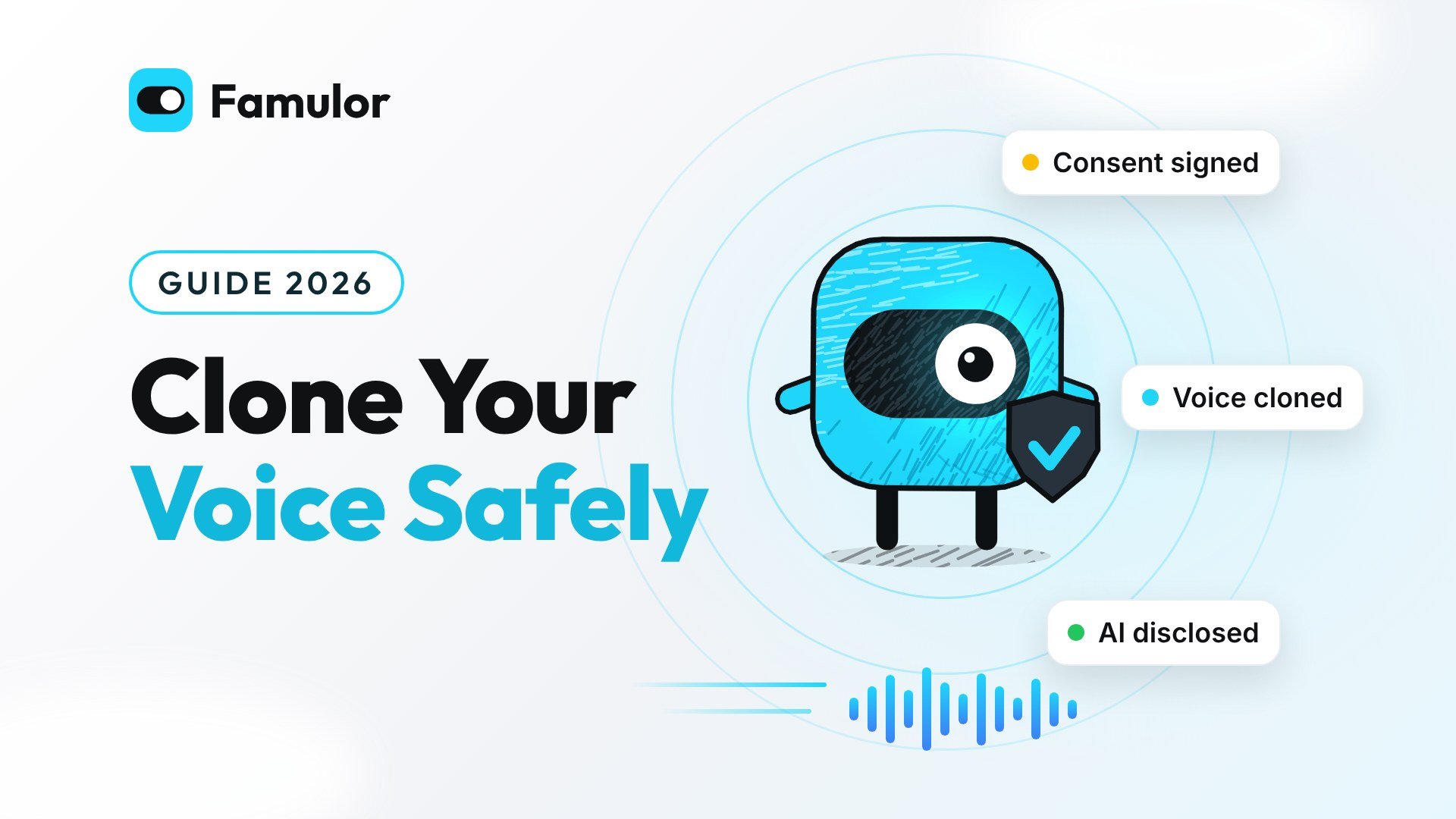
You can clone a real voice for your AI phone agent, for example your own as the owner or that of a receptionist your callers already know. You need three things: documented consent from the person, a clean recording of about 30 seconds, and a clear AI disclosure at the start of every call. With those three building blocks your agent sounds familiar, and you stay on the safe side legally.
More and more businesses search for "voice cloning" or "clone my voice with AI" because they want callers to hear a familiar voice instead of a stock one. That makes sense. A practice where the same person has answered the phone for ten years does not want to lose that recognition. At the same time, voice cloning is a sensitive topic. Cloned voices are also used for fraud, and courts have made it clear that a voice belongs to the person. This guide shows you how to clone a voice for the phone channel without walking into those traps.
What voice cloning means for an AI phone agent
With voice cloning, a speech model builds a synthetic voice from a short recording that sounds like the original speaker. The phone agent then uses that voice for its speech output (text-to-speech). The content still comes from your prompt, your knowledge base and your integrations. So the cloned voice speaks sentences the person never recorded.
That is the difference from a classic recorded greeting. A recorded message is fixed. A cloned AI phone agent answers follow-up questions, books appointments and gives opening hours, all in a voice your customers know. That is why a clone needs more care than a greeting: the person does not agree to one fixed text, but to a voice that can say anything.
Whose voice? Four options compared
Before you record, decide whose voice your agent should carry. The choice affects recognition, effort and risk.
| Option | Advantage | Risk | Best for |
|---|---|---|---|
| Your own voice (owner) | High recognition, simple consent | You stay tied to the voice, even if you sell the business | Small practices, trades, law firms |
| An employee's voice | Customers know the voice from the front desk | Consent within an employment relationship, withdrawal on departure | Teams with a long-standing receptionist |
| Professional voice actor | Studio quality, clear licence agreement | Cost of recording and usage rights | Brands with a corporate voice, agencies |
| Ready-made voice from the Voice Library | No consent question, ready immediately | No personal recognition | Launch, testing, fallback voice |
In practice many businesses start with a ready-made voice from the Famulor Voice Library and switch to a clone later. That way the agent is already live while you prepare consent and the recording.
The legal frame: consent, personality rights and the AI Act
A cloned voice on your customer line touches three layers at once: the speaker's personality rights, data protection and the transparency duties of the EU AI Act. None of them bans voice cloning. All three require you to document clearly what you do.
Personality rights: a voice belongs to the person
In Germany there is no specific statute protecting the voice. Protection comes from the general right of personality. On 20 August 2025 the Berlin Regional Court II (case 2 O 202/24) ruled that the unauthorised use of an AI voice closely resembling a well-known dubbing actor's voice violates that right. For you this means: without consent you may not recreate anyone's voice, not an employee's and not "just for internal use". Other jurisdictions apply similar rules, so treat consent as the baseline wherever you operate.
Data protection: the recording and voice model are personal data
The recording and the voice model built from it relate to a specific person. Treat both like other personal data: define the purpose, collect consent, restrict access and make deletion possible. Make sure your provider does not reuse the voice for other customers and processes it in the EU. You can read what else a compliant phone setup needs on our page about the GDPR-compliant AI voice agent.
EU AI Act: the AI disclosure stays mandatory
Article 50 of the EU AI Act has applied since 2 August 2026. It requires that people are told when they interact with an AI system. There is no transition period for the disclosure in a live conversation. A grace period until 2 December 2026 only covers the machine-readable marking under Article 50(2), and only for systems placed on the market before 2 August 2026. The more familiar the voice sounds, the more this disclosure matters, because callers might otherwise believe they are talking to the real person.
The tiles show why the disclosure is not a detail: breaches of Article 50 can be fined up to 15 million euros or 3 percent of worldwide annual turnover, and there is no delay for the in-call disclosure. Our article EU AI Act Article 50: What Your AI Phone Agent Must Say shows how to phrase it.
How to collect consent: the checklist
Consent is the foundation of every voice clone. A quick email saying "sure, go ahead" is not enough. Solid consent covers these points:
- Purpose: The voice is used for company X's AI phone agent, for inbound and, where relevant, outbound calls.
- Scope: What may the voice say? State that it only speaks on behalf of the company, with no advertising for third parties and no political statements.
- Channels and languages: Phone, web widget, WhatsApp voice messages, and whether the voice may speak other languages.
- Duration: Fixed term or open-ended, with a clear rule for when employment ends.
- Withdrawal: The person can withdraw at any time. You commit to deleting the voice within a fixed period.
- Compensation: For employees and voice actors, agree whether and how the use is paid.
- Voluntariness: For employees, put in writing that saying no has no negative consequences.
Keep the signed consent together with the recording date. In Famulor you confirm that consent exists when you create the clone. The documentation itself stays with you.
The recording: how to make the clone sound good on the phone
How much audio you need depends on the method. Fast clones (instant cloning) work with short recordings, professional clones with far more material. For a phone agent, a fast clone is enough in most cases, because the phone line limits the sound anyway.
The comparison shows a gap of several hundred times between a fast clone of about 30 seconds and a professional clone with up to three hours of audio. For a studio audiobook the effort pays off. For the phone channel it is usually unnecessary, because classic phone lines carry speech at a sampling rate of only 8 kHz. Fine details of the sound are lost anyway.
How to record a good 30-second sample
- Quiet room: No echo, no air conditioning, no traffic noise. A small office with carpet and curtains beats an empty meeting room.
- Decent microphone: A USB microphone or a good headset is enough. Laptop microphones often sound muffled.
- Natural script: Read text that sounds like a real call, such as a greeting, an appointment confirmation and a follow-up question. No marketing language.
- Steady pace: Speak the way you speak on the phone, not slower and not louder.
- Several samples: Depending on the model, Famulor lets you upload or record up to three samples. Use that if one recording has small glitches.
Step by step: clone a voice in Famulor
In Famulor you clone a voice directly in the Voice Library. The process usually takes only a few minutes, but do not cut the testing phase short.
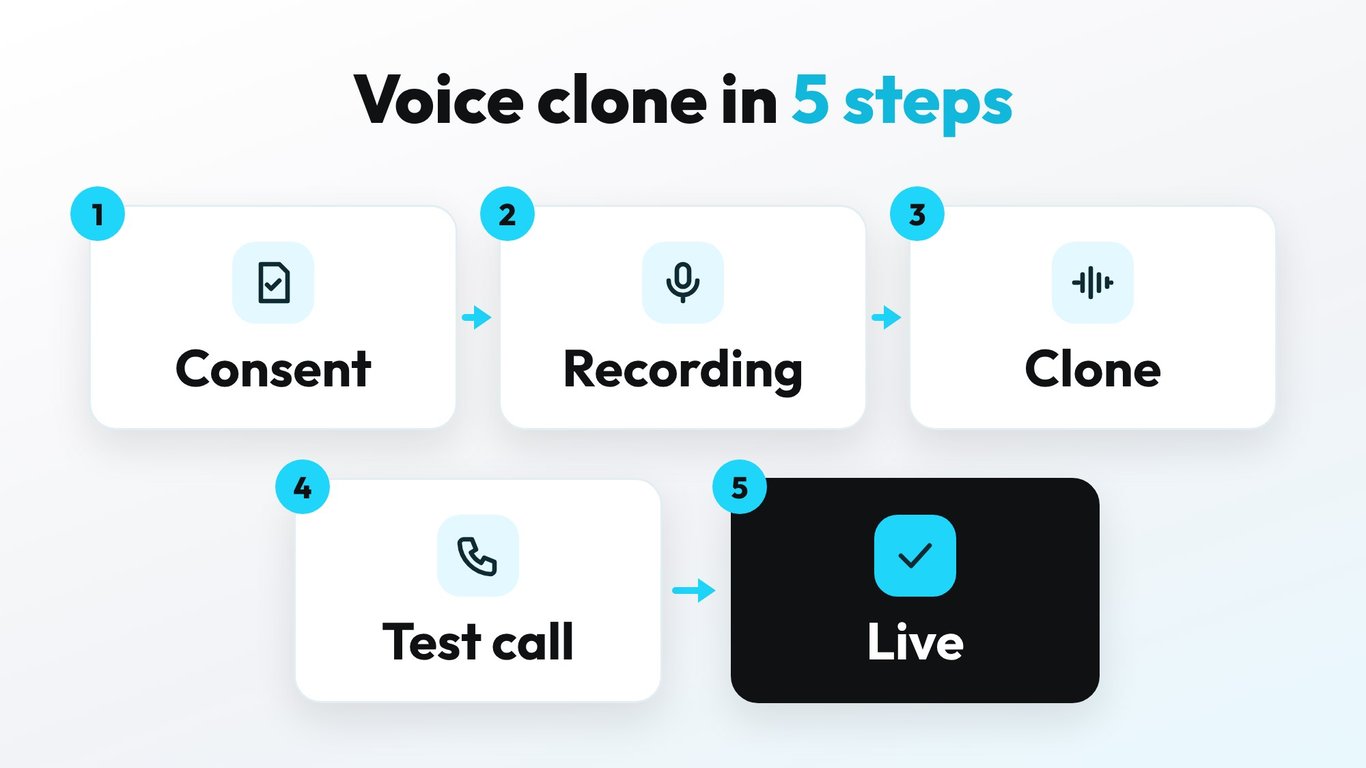
- Prepare consent: Have the person sign the consent before you record.
- Record: Open the Voice Library and record about 30 seconds in the browser, or upload an existing recording.
- Confirm: Confirm that consent exists. Famulor builds the voice model.
- Fine-tune: Listen to the preview and adjust tone, speed, pauses and emphasis, for example friendly for reception or calm for support.
- Assign: Assign the voice to your agent. It is available in every language the voice model supports.
- Test: Run at least ten test calls over a real phone number, not just in the browser. Check names, numbers, times and technical terms.
- Go live: Add the AI disclosure to the greeting and activate the agent.
Cloned voices stay private to your workspace and can be deleted at any time. Before deleting a voice, remove it from every agent and test that uses it. You will find all details on the Famulor Voice Cloning page.
As the chart shows, every monthly plan from Plus upwards includes at least one free clone. Additional clones use credits, and the price is shown before you confirm. Stored voices have no cap and no storage fee.
Best practices and common mistakes
Most problems with cloned voices do not come from the technology but from the preparation. These are the mistakes we see most often:
- No AI disclosure: The agent greets callers with "Hi, this is Sarah" without saying it is an AI. That breaches Article 50 and costs trust as soon as callers notice.
- No fallback voice: The receptionist leaves, consent ends, and there is no plan B. Pick a matching voice from the Voice Library as a fallback from day one.
- Only tested in the browser: In the browser the clone sounds crisp. Over a mobile connection it can feel different. Always test over real phone numbers.
- Too little control over numbers: Phone numbers, prices and times must sound unambiguous. Add pronunciation hints to the prompt.
- Someone else's voice "just for testing": Even an internal test with a well-known person's voice without consent violates personality rights.
- Quality not measured: A clone can sound like the person and still feel unnatural. Our article Voice Cloning Evaluation: Identity Is Not Naturalness shows how to score similarity and naturalness separately.
Use cases: where a cloned voice really helps
Dental practice with four treatment chairs
The practice has a long-standing receptionist whose voice many patients know. She agrees that her voice may be used for calls outside office hours and during the lunch break. The agent books check-ups, takes prescription requests and routes patients in pain to the emergency number. In its greeting it clearly says it is an AI. A similar voice from the Voice Library is set as the fallback.
Trades business using the owner's voice
An electrical contractor with six technicians uses the owner's voice. Local customers recognise it instantly. The agent records fault reports, asks for the address and urgency, and writes the job straight into the job management tool through an integration. Consent is simple because the owner decides. What matters is a rule for the case that the business is sold later.
Agency with a corporate voice for clients
An agency runs AI phone agents for twelve clients. For brand clients it books professional voice actors under a licence agreement and clones their voices. With Famulor White Label every agent runs under the agency's own brand. Each voice stays in the respective client's workspace, separate from all others.
What does a cloned voice cost to run?
A cloned voice does not fundamentally change the running cost per call minute in Famulor. You pay per minute as with any other voice, from €0.05 per minute. The Plus plan includes 100 minutes for €35 per month, and extra minutes cost €0.12. Without a subscription you start with pay-as-you-go from €0.15 per minute.
One-off costs only come from the recording (if you book a voice actor) and from extra clones beyond the included allowance. You can compare all plans on the pricing page. Use the calculator below to see what an AI phone agent returns at your call volume compared with missed calls and staff time.
Estimate your ROI from automating calls
See how much your business could save by switching to AI-powered voice agents.
ROI Result
ROI 0%
No credit card required
Conclusion: a familiar voice, clear rules
A cloned voice makes your AI phone agent more personal. Callers hear a voice they know, and the agent still does everything an AI can do: book appointments, answer questions and log requests in the CRM, around the clock. The key is preparation: written consent, a clean recording, an honest AI disclosure and a fallback voice in case consent is withdrawn.
Famulor brings these steps together in one place. You clone the voice from about 30 seconds of audio directly in the Voice Library, test it over real phone numbers and assign it to your agent in every supported language. The voice stays private to your workspace and can be deleted at any time. The best way to start is with a voice from the Voice Library, prepare consent and recording in parallel, and switch on the clone once your test calls convince you. Try it now in the live demo.
Try our AI Assistant
Experience how natural our AI phone assistant sounds.
Enter your details and receive a call from our AI agent within seconds.
Agent is trained to discuss Famulor services and book appointments.

Demo AI agent
Famulor representative
FAQ
Can I clone my own voice for an AI phone agent?
Yes. You may clone your own voice as long as the agent tells callers at the start that they are talking to an AI. Still put in writing how the voice is used, for example in case you sell the business later.
Can I clone an employee's voice?
Only with their voluntary, documented consent. It should cover purpose, channels, duration and withdrawal, and state that saying no has no negative consequences.
How much audio do I need to clone a voice?
In Famulor about 30 seconds of clear speech without background noise is enough. Professional clones at other providers need 30 minutes to three hours, which is rarely necessary for the phone channel.
Does the agent have to say it is an AI if it sounds human?
Yes. Article 50 of the EU AI Act has applied since 2 August 2026 and requires that callers learn they are talking to an AI. There is no transition period for this in-call disclosure.
Can the cloned voice speak other languages?
Yes, in every language the underlying voice model supports. The Famulor editor shows you exactly those languages. Always check other languages with your own test calls.
What happens if someone withdraws consent?
You remove the voice from all agents and delete it in the Voice Library. With a fallback voice set in advance, the agent keeps running without interruption.
Can anyone else use my cloned voice in Famulor?
No. Cloned voices stay private to your workspace. Other customers have no access to them, and you can delete the voice at any time.
Does a voice clone sound worse on the phone than in the browser?
It sounds different, because phone lines carry speech with limited bandwidth. That is why you should test every clone over real phone numbers before it goes live.

Writer at Famulor