Summarize Content With:




GPT-Live-1 Pricing vs. Managed Voice AI – The Real Cost per Resolved Call
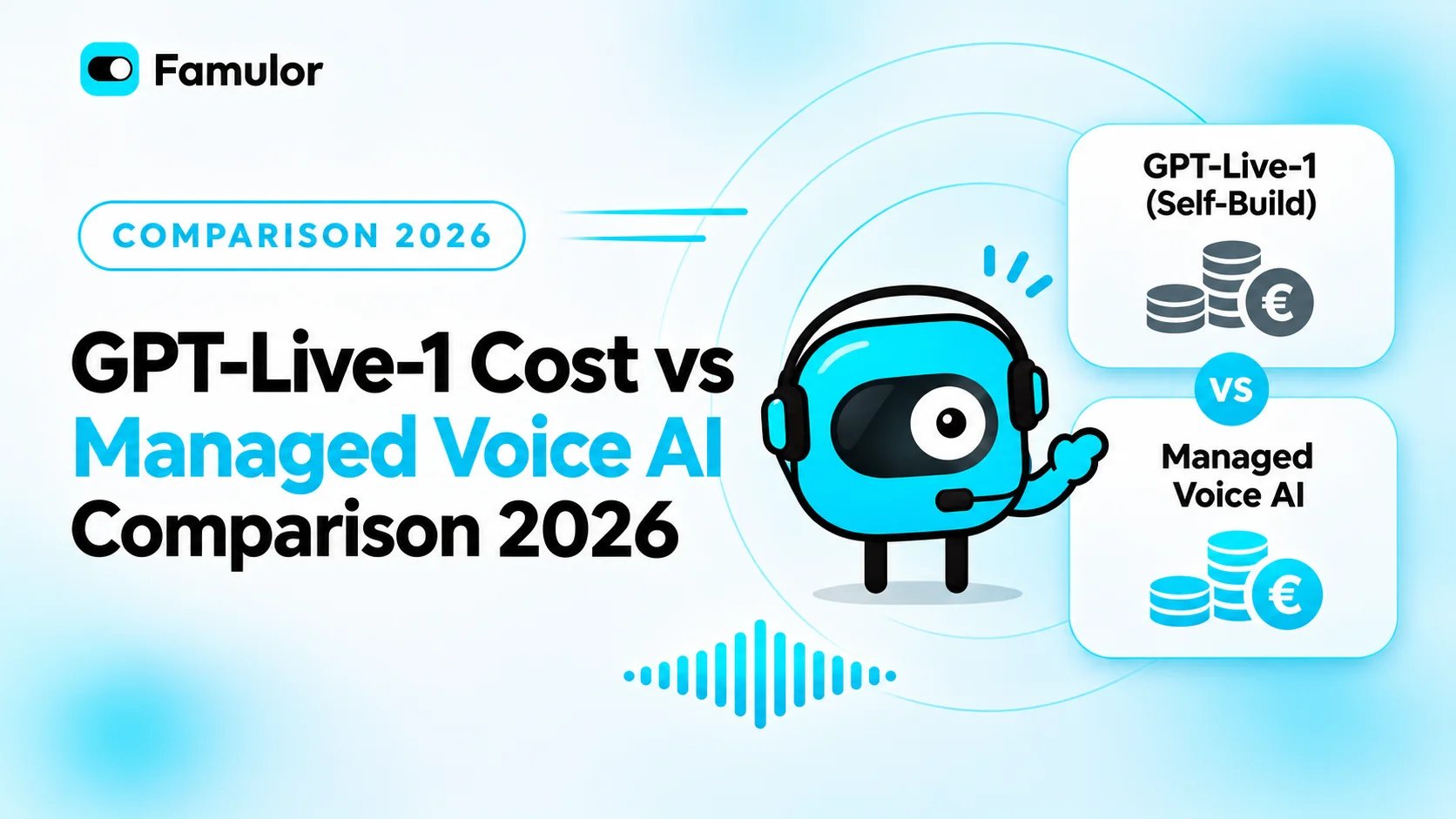
OpenAI launched GPT-Live-1 in September 2026, offering a flat $0.05 per minute for the voice layer via API. At first glance, that sounds affordable. But comparing minute rates alone misses the actual cost drivers. The question that matters for businesses is not "What does a minute cost?" but "What does a resolved customer issue cost?" That distinction is exactly where a managed voice AI platform like Famulor changes the equation.
This article compares the true total cost of ownership of OpenAI's GPT-Live-1 API with a turnkey voice AI solution. We break down the hidden cost layers, run concrete scenarios, and explain why cost-per-resolution is the metric that counts.
What Is GPT-Live-1 and How Does Billing Work?
GPT-Live-1 is OpenAI's real-time voice model, replacing the older Realtime API models. It became available to developers on September 10, 2026, and is the default voice model in ChatGPT for Go, Plus, and Pro subscribers. API billing uses a flat rate: $0.05 per minute for the front-end voice layer. Instead of metering audio input and output tokens separately, there is now a single per-minute price.
But that is only the surface. GPT-Live-1 delegates reasoning tasks to a separate backend model — GPT-6 Astra for complex queries or Luna for simple routing tasks. Those backend tokens are billed separately. OpenAI recommends routing lightweight, high-volume tasks like scheduling to a cheaper model and harder issues to a more capable one. The actual per-token costs for backend models vary depending on usage patterns.
The Hidden Costs Behind the Per-Minute Price
The $0.05 per minute is the floor, not the ceiling. Building a production-grade voice agent on GPT-Live-1 means accounting for multiple additional cost layers:
| Cost Factor | GPT-Live-1 (Self-Build) | Managed Platform (e.g., Famulor) |
|---|---|---|
| Voice Layer | $0.05/min | Included in plan |
| Backend Reasoning (LLM Tokens) | Variable, depends on model mix | Included in plan |
| Telephony (SIP Trunking) | Separate provider required | Integrated, 40+ countries |
| Speech-to-Text / TTS | Separate provider or OpenAI | Multi-TTS integrated |
| Orchestration Framework | Custom development | No-code flow builder |
| Tool Calls / Integrations | Custom API connections | 300+ ready-made integrations |
| Knowledge Base / RAG | Own vector store | Built-in knowledge bases |
| Compliance / GDPR | Your responsibility | EU hosting, DPA included |
| Monitoring / Analytics | Build your own dashboard | Real-time dashboard + QA |
| Maintenance / Updates | Ongoing engineering effort | Automatic updates |
A mid-sized business looking to automate 500 calls per month is not just making an API call — it is building an entire infrastructure. Telephony integration, fallback logic for model outages, multi-language speech recognition, CRM and calendar connections, GDPR-compliant recording: each building block costs time and money.
Cost-per-Minute vs. Cost-per-Resolution – Why the Difference Matters
The fundamental mistake in evaluating voice AI costs: a minute is not a unit of value. A ten-minute call that ends in an escalation to a human agent costs ten times as much as a 90-second resolution — and delivers zero value. With per-minute billing, businesses pay full price for failed conversations too.
Cost-per-resolution (cost per resolved issue) flips the perspective: What does it actually cost to solve a customer problem without human intervention? This metric automatically factors in call duration, escalation rate, and first-call resolution. A voice agent that resolves 80% of calls in 90 seconds beats one that resolves 60% in 4 minutes — even if the latter has a lower per-minute rate.
Worked Example: 500 Inbound Calls per Month
Consider a dental practice receiving 500 calls per month — appointment bookings, cancellations, questions about office hours. Average call duration: 2.5 minutes. Escalation rate to the human team: 20%.
| Metric | GPT-Live-1 Self-Build | Famulor Managed |
|---|---|---|
| Calls/Month | 500 | 500 |
| Avg. Call Duration | 2.5 min | 2.5 min |
| Voice Layer Cost | $62.50 (1,250 min × $0.05) | Included in plan |
| Backend LLM Tokens | ~$30–80 (estimated) | Included in plan |
| Telephony / SIP | ~$25–50 | Included in plan |
| Infrastructure / Hosting | ~$50–150 | Included in plan |
| Development (allocated) | ~$500–2,000/month | $0 |
| Estimated Total Cost | $670–2,340/month | From ~$99/month |
| Escalation Rate | ~25% (without optimization) | ~15% (with QA + flow builder) |
| Resolved Issues | ~375 | ~425 |
| Cost-per-Resolution | $1.79–6.24 | ~$0.23 |
The gap is driven by two factors. First, a managed platform eliminates development and maintenance costs entirely. Second, an optimized flow builder with built-in latency optimization lowers escalation rates — every avoided escalation saves twice: no wasted agent minute and no human fallback cost.
Second Scenario: E-Commerce Support at 2,000 Calls/Month
To illustrate how costs behave at higher volume, consider a mid-sized e-commerce retailer handling 2,000 inbound calls per month. Typical topics: order status, returns, shipping questions, product advice. Average call duration: 3 minutes. Escalation rate: 25%.
| Metric | GPT-Live-1 Self-Build | Famulor Managed |
|---|---|---|
| Calls/Month | 2,000 | 2,000 |
| Avg. Call Duration | 3 min | 3 min |
| Voice Layer Cost | $300 (6,000 min × $0.05) | Included in plan |
| Backend LLM Tokens | ~$120–300 | Included in plan |
| Telephony / SIP | ~$80–150 | Included in plan |
| Infrastructure / Hosting | ~$150–400 | Included in plan |
| Development (allocated) | ~$1,000–3,000/month | $0 |
| Estimated Total Cost | $1,650–4,150/month | From ~$249/month |
| Escalation Rate | ~30% | ~12% (with industry templates) |
| Resolved Issues | ~1,400 | ~1,760 |
| Cost-per-Resolution | $1.18–2.96 | ~$0.14 |
Three things stand out. First, absolute development costs rise with the self-build because higher volume demands more concurrency, better error handling, and more robust monitoring. Second, the self-build escalation rate worsens with complex queries like returns processing — an area where pre-trained industry templates play to their strengths. Third, the managed platform's cost advantage grows with volume because the fixed-cost components (development, hosting, compliance) of the self-build weigh more heavily per call.
When GPT-Live-1 Makes Sense — and When It Does Not
GPT-Live-1 is not a bad technology — quite the opposite. For developer teams that already run their own telephony infrastructure, serve highly specialized use cases, or need maximum control over every layer, the API is a powerful tool. A healthtech startup reportedly reduced their codebase by 23,000 lines after switching to GPT-Live-1 — a real simplification of their tech stack.
For the majority of businesses — from medical practices to real estate agencies to e-commerce support — the self-build approach is economically questionable. The head-to-head comparison between DIY and managed shows: the time saved during setup (days instead of weeks), ongoing maintenance freedom, and lower escalation rates through pre-trained industry models make the difference.
Specifically, the self-build path makes sense when at least three of these conditions are met: you have a DevOps team experienced with WebSocket protocols and audio streaming; you already run your own SIP infrastructure with carrier failover; your use case demands custom model-routing logic that no generic flow builder can cover; and you have budgeted for at least six months of development and ongoing maintenance. If only one or none of these conditions apply, the economics clearly favor the managed approach.
5 Cost Traps When Self-Building with GPT-Live-1
- Underestimating fallback logic: What happens when the model does not respond within 500 ms? Without filler audio, fallback TTS, and automatic rerouting, calls drop — and customers leave frustrated. Building robust fallback chains — silence detection, filler phrases, automatic model switching, and graceful degradation — easily adds 80–120 hours of development time. Most teams underestimate this until the first production outage costs them dozens of abandoned calls in a single afternoon.
- Complex telephony integration: SIP trunking with number porting, carrier failover, and multilingual support is not a weekend project. Behind every minute are five cost lines that need to be negotiated and maintained individually. Carrier contracts alone involve setup fees, monthly minimums, per-channel pricing, and regulatory compliance per country. A business operating in three countries might juggle six to eight separate provider agreements before handling a single call.
- Forgetting compliance: GDPR-compliant recording, consent management, and data processing agreements with every sub-processor — building this yourself requires legal support. Under GDPR Article 30, every processing activity must be documented, and each new sub-processor (LLM provider, TTS service, telephony carrier) requires its own DPA. Legal review alone can cost $2,000–5,000 per provider, and a single compliance gap risks fines of up to 4% of annual revenue.
- Missing monitoring: Without real-time QA, businesses discover weeks later that their voice agent booked wrong appointments or frustrated customers. Famulor's integrated ROI tracking surfaces error patterns immediately. Consider a dental practice whose bot silently miscategorizes emergency calls as routine — without automated QA alerts, the issue persists until a patient complaint surfaces. By then, the reputational damage far exceeds what a monitoring dashboard would have cost.
- Expensive scaling: Going from 500 to 5,000 calls with a self-build means more servers, more concurrency licenses, more monitoring. With a managed platform: adjust your plan. The indirect costs are often worse than the direct ones: load balancing across multiple WebSocket servers, on-call engineering rotations for weekend traffic spikes, and database scaling for conversation logs. A mid-sized e-commerce company scaling from 500 to 5,000 calls reported that their infrastructure costs tripled while their engineering team spent 40% of their time on maintenance rather than product development.
How Famulor Reduces Total Cost of Ownership
Famulor bundles every building block of a production-ready voice agent into one platform: 300+ integrations via no-code automation, multi-TTS supporting over 40 languages, SIP trunking for any VoIP provider, knowledge bases for context-aware responses, and a visual flow builder for conversation logic. On top of that: real-time analytics, automated QA runs, and filler audio for natural conversation pacing.
The decisive advantage: businesses pay for outcomes, not infrastructure. Instead of building and maintaining a voice stack, they configure an assistant, connect their systems, and go live — often within a single day. The current 2026 pricing overview shows that managed platforms consistently deliver lower total cost of ownership than self-builds in most scenarios.
Estimate your ROI from automating calls
See how much your business could save by switching to AI-powered voice agents.
ROI Result
ROI 0%
No credit card required
Checklist: Build vs. Buy for Your Voice AI Deployment
The decision between a GPT-Live-1 self-build and a managed platform depends on four factors:
- Team size and expertise: Do you have a developer team experienced in real-time audio, WebSocket protocols, and LLM orchestration? If not, the managed approach is more economical.
- Volume and scaling plan: Below 100 calls per month, a simple self-build can work. At 500+ calls, a platform like Famulor pays for itself quickly through eliminated maintenance costs.
- Industry-specific requirements: Healthcare, legal, real estate — each industry has its own compliance and workflow requirements. Pre-trained templates save weeks of prompt engineering.
- Time-to-value: How fast does the solution need to go live? GPT-Live-1 self-build: 4–12 weeks. Famulor: 1–3 days. The optimization guide shows the fastest path.
Conclusion
GPT-Live-1 democratizes access to high-quality voice AI — that is genuine progress. But "cheap API" does not mean "cheap solution." When you honestly calculate total costs — telephony, backend models, integrations, compliance, monitoring, maintenance — a self-build often lands at three to ten times the raw per-minute price. The right metric is not cost-per-minute but cost-per-resolution.
For businesses that want to use voice AI as a tool (rather than build it as a product), a managed platform like Famulor offers the faster, cheaper, and maintenance-free path. Try it yourself: configure your first AI voice agent in under 10 minutes and compare the cost-per-resolution with your current setup.
Try our AI Assistant
Experience how natural our AI phone assistant sounds.
Enter your details and receive a call from our AI agent within seconds.
Agent is trained to discuss Famulor services and book appointments.

Demo AI agent
Famulor representative
FAQ
How much does GPT-Live-1 cost per minute?
The front-end voice layer costs $0.05 per minute via the API. Additional costs apply for backend reasoning tokens, which vary depending on the model chosen (e.g., Luna or Astra). Total per-minute costs are therefore higher than the voice layer price alone.
What is the difference between cost-per-minute and cost-per-resolution?
Cost-per-minute measures only talk time. Cost-per-resolution measures what a successfully resolved customer issue actually costs — including failed attempts, escalations, and rework. For economic evaluation, cost-per-resolution is the more meaningful metric.
Can I use GPT-Live-1 directly for telephony?
No. GPT-Live-1 is a voice model, not a telephony solution. You additionally need a SIP trunk provider, phone numbers, call routing, and an orchestration layer. Platforms like Famulor bundle all of this into one ready-made solution with SIP trunking across 40+ countries.
What are the hidden costs of self-building with GPT-Live-1?
Beyond the per-minute price, costs arise for backend LLM tokens, telephony/SIP, speech-to-text, hosting, integrations, compliance, and ongoing maintenance. Depending on the setup, total costs can reach three to ten times the raw API price.
Who should consider GPT-Live-1 as a self-build?
Developer teams with existing telephony infrastructure who build highly specialized voice applications and need maximum control over every layer. For businesses without a dedicated engineering team, a managed platform is more economical.
How quickly can I go live with a managed platform?
With Famulor, a production-ready voice agent is operational within 1–3 days. Self-building with GPT-Live-1 typically takes 4–12 weeks including telephony integration, testing, and compliance setup.
Does Famulor support outbound calls and WhatsApp?
Yes. Famulor covers inbound and outbound telephony, WhatsApp, live chat, and web widget — all through a single platform with unified analytics dashboard and automation engine.
Which industries benefit most from managed voice AI?
Healthcare practices, dental offices, real estate agencies, law firms, trades businesses, and e-commerce support benefit most through high call volumes, standardizable inquiries, and the need for multilingual, GDPR-compliant service.

Writer at Famulor