Summarize Content With:




At the VDMA mechanical engineering summit on 10 November 2026 in Berlin, the conversation was about a sector in its fourth year of crisis – and about artificial intelligence as a signal of hope. According to the VDMA, reported by Tagesschau, German mechanical engineering has to absorb a fourth consecutive year of decline: production in Germany is expected to shrink by around two percent this year. WDR writes the same; it would be the fourth year in a row in the red.
At the same time, there is a signal on the order books. The VDMA reported a surprisingly clear 14 percent rise in orders in late summer compared with the previous year, according to Tagesschau. WDR cautions that it is still too early to relax. In a WDR interview, VDMA Director General Thilo Brodtmann says the improved order figures are “überhaupt kein Grund aufzuatmen” – no reason at all to breathe out. For 2027, the VDMA expects growth of three percent, WDR reports; even then, production would still be clearly below the 2018 level. In the first nine months, orders rose by five percent in real terms versus the same period a year earlier, also according to VDMA figures cited by WDR. Tagesschau notes capacity utilization of 85 percent: the best reading in two years, but still low.
According to VDMA data cited by Tagesschau, 31 percent of mechanical engineering companies already use AI, and a further 37 percent are running pilot projects. Among mid-sized firms, the AI share is still lower than at large groups, but it is growing clearly. The question for service and after-sales is where that AI has already arrived – and where the service hotline on the phone is still lagging behind.
What “AI” meant at the summit
The examples in Tagesschau and WDR sit mainly on the shop floor. Tagesschau describes the mid-sized machine builder Zahnen-Technik: its AI detects potential blockages in wastewater pumps two weeks in advance, so the pump can be flushed in time. WDR writes that artificial intelligence can evaluate machine data, detect maintenance needs early and improve quality control. In short: AI reads operating and sensor data and is meant to raise productivity. Skilled workers “who can no longer be found anyway,” as managing director Herbert Zahnen tells Tagesschau, remain a central theme. WDR stresses that the sector also has to attract young people into its trades.
What barely appears in these reports is the telephone. For many customers, service starts exactly there: with a call when a line is down, a spare part is missing or a technician is needed.
Production is ahead, the service hotline often is not
The 31 percent that, according to the VDMA, already use AI does not tell you whether that means production, design, quality control – or the service hotline. The public examples sit on the production side. Service and telephony are a different process: inbound calls, often outside office hours, often from export markets, often urgent.
It would be wrong to treat that gap as an industry statistic; the sources above give no number for it. It is a practical observation: a company that already analyses shop-floor data often still runs a classic hotline, a voicemail or a team that is not staffed around the clock. When skilled people are scarce, that point is sensitive. An AI phone assistant does not fix that on its own. It can take the incoming calls, handle the routine and hand over to a person when it matters.
For machine and plant builders in Germany, Austria and Switzerland, this is not a side issue. Many firms are heavily dependent on exports, WDR writes. Then calls do not only arrive between eight and five, and not only in German.
Five places an AI phone assistant helps
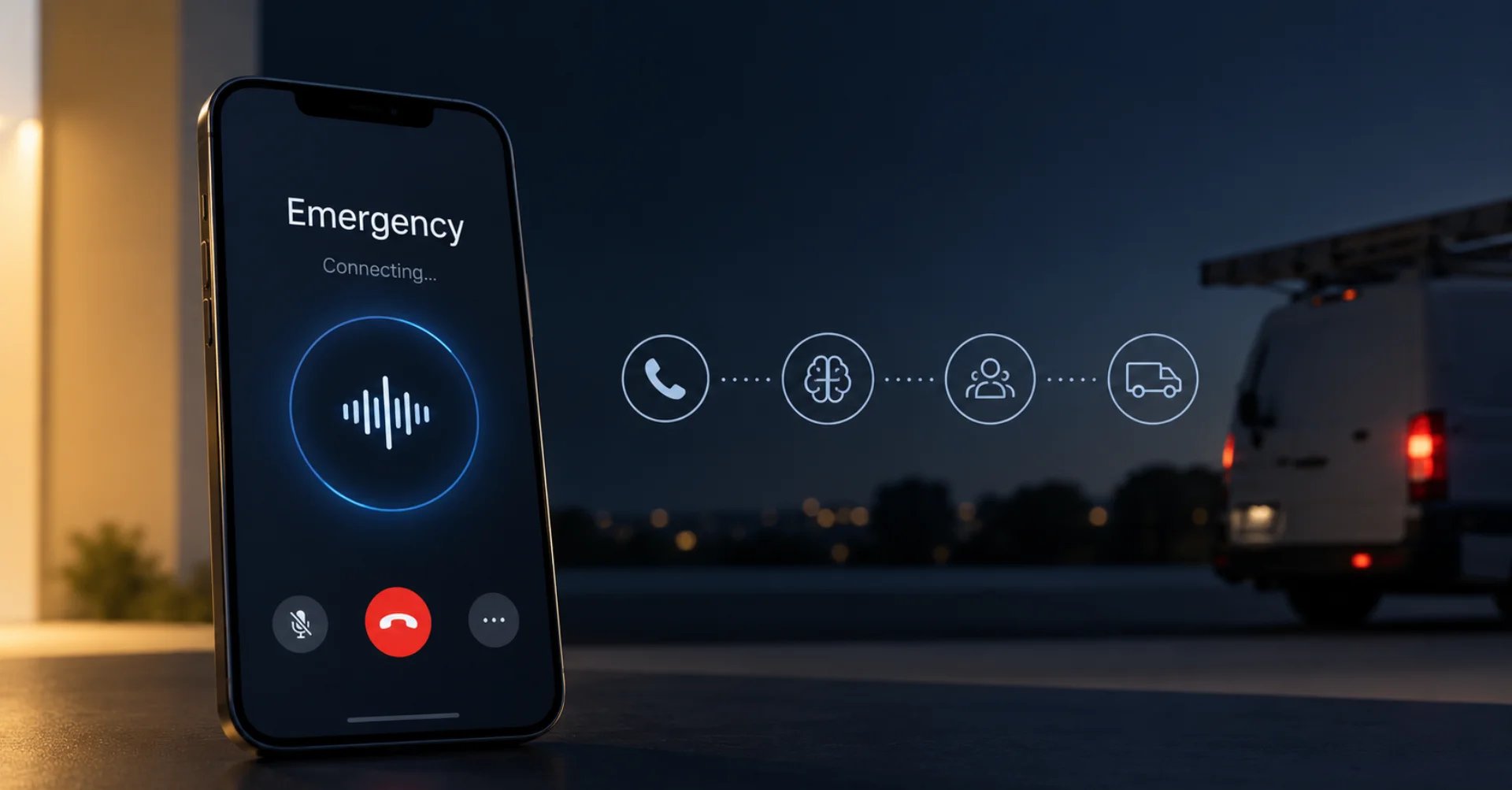
An AI phone assistant answers inbound calls, understands ordinary speech and replies in natural language. It answers questions from your knowledge base, stores information as variables, books appointments in your calendar and transfers to your team when a person is needed – around the clock, including nights, weekends and peak times, and several calls at once. The AI phone assistant page gives an overview; the setup steps are in How to set up an AI phone assistant.
This does not replace the service technician at the machine. It is the intake before the visit.
A service and breakdown hotline around the clock
When a machine is down, no one likes to wait until the next working day. The assistant takes the call even if the service desk is closed. In the knowledge base you store what it should ask and what it may answer itself: typical faults, first checks, availability, and what really counts as an emergency. During the call it collects the details your service team will need: who is calling, which machine or serial number, what happened, since when, and how urgent it is. You store these values as variables, not as a loose note. After hours, not every fault has to be transferred at once; the assistant can take the report first and only hand over the cases you have defined as urgent. There is more on this in AI voice agent after hours. An AI service hotline does not replace on-site diagnosis. It makes sure the call is not lost.
Taking spare-part requests without guessing
Many calls are about parts, availability, alternatives or the status of an order. The assistant only answers what is in the knowledge base. If it knows the part number or the machine, it can give standard information or take a clean request. If it does not know the answer, it says so and does not guess. You store part number, quantity, machine reference and delivery address as variables again. Through a tool or an interface, that can become a case in your system. If internal service is needed, the assistant transfers the call or schedules a callback.
Preparing technician dispatch
Dispatch decides who goes where and when. It needs complete information, not an incomplete voicemail. The assistant clarifies urgency, location, access, machine context and a preferred time, then hands over to dispatch or books a service visit if you have set that up. If someone is available, a warm transfer is a good fit: the assistant briefs the colleague before connecting, so the caller does not have to repeat the story. How to set this up is in the guide AI voice agent call transfer to a human and in the article on warm transfers. Outside on-call hours, the case stays documented, and the assistant can arrange a callback.
Booking, moving and confirming appointments
Not every call is a breakdown. Commissioning, maintenance, training, callbacks: the assistant checks free times in the connected calendar, offers only slots that are actually free and books during the call. Existing appointments can be found, moved or cancelled if you switch that on. Details are in the docs on calendar booking and in Can an AI phone agent really book appointments?. After the call, a confirmation can go out by email or SMS.
Multilingual calls from export markets
Many mechanical engineering firms ship worldwide. Calls then arrive in English, French, Italian, Polish or other languages, often when the German-language hotline is not staffed. The assistant detects the language and can switch during the conversation, without a second number. There is an overview in the article on multilingual telephone voice AI. The same discipline applies as in German: only confirmed information from the knowledge base, clear handover rules, and no invented promises on lead times or warranties.
When a person should take over
An AI phone assistant in mechanical engineering is not fully automated service. You decide when it closes a request itself and when it hands over: a fault you class as critical for safety or production, a complaint or a contract discussion, a technical question beyond the knowledge base, or an explicit request to speak with a person. In a warm transfer, your team hears beforehand what the call is about, and the variables from the conversation are available, such as name, machine number and reason for calling. If no one is reachable, the assistant schedules a callback or takes a complete report. The tools for this are described in the built-in tools. You can keep your existing service number and forward it to the assistant, always or only when no one picks up. The steps are in the call forwarding setup guide.
How to start without overloading the hotline
The 37 percent running pilots, according to the VDMA, is a useful picture for the hotline too: not everything at once, but one clear process first.
- 1. Pick one use case. For example after-hours answering or spare-part requests. Do not try to map the entire service organisation at once.
- 2. Fill the knowledge base. FAQs, typical faults, escalation rules, and what the assistant must not promise. Narrow and accurate is better than broad and vague.
- 3. Define variables and the handover. Which details have to be captured in the call? Who takes over when? What counts as urgent?
- 4. Test in the browser, then connect the number. The setup guide walks through the steps. For a first impression, use the demo with no login. If you want to talk through a setup, book a time at famulor.io/meet. You can create an account at app.famulor.io/register.
For a broader view, see AI answering service: how to choose and launch. If you are starting from a classic voicemail, the AI answering service page is the closer entry point.
Conclusion
In the debate around the summit, AI in mechanical engineering has mainly arrived in production. The VDMA figures on that are clear and should be read with care: a fourth year of decline, production expected to be down by around two percent, a surprisingly clear 14 percent rise in orders in late summer compared with the previous year, but not an all-clear.
Service and telephony are under-represented in that picture, even though that is where customers notice whether the company can be reached. An AI phone assistant for mechanical engineering answers the service hotline, clarifies spare-part and breakdown requests, prepares technician dispatch, books appointments and takes multilingual calls from export markets – and hands over to people as soon as that is what the call needs. It does not replace a skilled person at the machine. It takes over the part of the work that until now is left hanging on the line.

Writer at Famulor