Summarize Content With:




Telnyx vs Twilio: What Does AI Voice Agent Telephony Really Cost per Minute?
When teams put an AI phone assistant live, they start by pricing the platform. The bill at the end of the month then looks different. Every minute of conversation is made of several line items: telephony carrier, phone number, language model, speech recognition, speech synthesis and the platform that orchestrates it all. For many teams the carrier is the line item nobody budgeted for. Yet Telnyx and Twilio, the two carriers most used for voice AI, decide a noticeable share of your cost per minute.
This article compares the publicly documented pricing models of Telnyx and Twilio for voice AI projects, walks through a monthly example, and explains what to watch for with SIP trunks, phone numbers and billing increments. All prices come from the vendors' public price lists and third-party comparisons. They change, so always check the current pricing page before you decide.
Why the Carrier Matters More Than You Think
Technically, an AI voice agent is a phone call with a software counterpart. The call travels through a carrier into the public telephone network, the audio reaches your voice platform, and speech-to-text (STT), a large language model (LLM) and text-to-speech (TTS) work together within a few hundred milliseconds. The carrier provides three things:
- Phone numbers that customers dial, or that show up as caller ID on outbound calls.
- Termination (outbound): your agent calls a number on the network.
- Origination (inbound): a call to your number is routed to the agent.
Connection quality matters too. Network latency and packet loss add to the agent's response time. If you lose 400 ms in the network, you need a very fast language model to still sound natural. We cover this interplay in our guide to AI voice agent latency.
The Pricing Models at a Glance
Telnyx: Voice API Fee Plus SIP Trunk
Telnyx runs its own network and bills in two parts. On the official Voice API page, the call control fee is about $0.002 per minute when you control calls through the Telnyx Voice API. On top come SIP trunking charges: local outbound from about $0.005 per minute, local inbound from about $0.0032 per minute. If you use Telnyx purely as a SIP trunk and control calls yourself, only the trunk fee applies.
Twilio: Programmable Voice or Elastic SIP Trunking
Twilio offers two paths. With Programmable Voice, an outbound call to a US landline is about $0.014 per minute on the public price list, and an inbound call to a local number is about $0.0085. With Elastic SIP Trunking the rates are lower. More recent sources list termination to the 48 contiguous US states at about $0.010 per minute and inbound origination on local numbers at about $0.0034. Older price pages list different values, which shows why the date of a source matters.
Price Comparison at a Glance
The table below summarizes the publicly cited reference values for US calls. It is not a quote, but it helps you orient.
| Line item (USD, reference values) | Telnyx | Twilio |
|---|---|---|
| Outbound, local (API path) | approx. 0.007 per min (0.002 API + 0.005 SIP) | approx. 0.014 per min (Programmable Voice) |
| Inbound, local (API path) | approx. 0.0052 per min (0.002 API + 0.0032 SIP) | approx. 0.0085 per min (Programmable Voice) |
| Outbound, plain SIP trunk | from approx. 0.005 per min | approx. 0.010 per min (Elastic SIP Trunking) |
| Inbound, plain SIP trunk | from approx. 0.0032 per min | approx. 0.0034 per min (Elastic SIP Trunking) |
| Local US phone number | approx. 1.00 per month | approx. 1.15 per month |
| Call recording | approx. 0.002 per min | depends on product, check separately |
Two things stand out. First, Telnyx sits well below Twilio on the API path. Second, the gap narrows when both are used as plain SIP trunks. If you bundle call control in a voice platform, you will in practice usually pay the trunk price, not the API price.
Worked Example: 10,000 Minutes per Month
Take a concrete scenario. A dental group, "Dr. Becker", with 60 employees and three locations lets its agent take appointment requests and send reminders. Each month it handles 6,000 inbound and 4,000 outbound minutes, all on US numbers to keep the price lists comparable.
- Telnyx as plain SIP trunk: 6,000 × 0.0032 + 4,000 × 0.005 = 19.20 + 20.00 = about $39 plus numbers.
- Twilio as Elastic SIP Trunk: 6,000 × 0.0034 + 4,000 × 0.010 = 20.40 + 40.00 = about $60 plus numbers.
- Twilio Programmable Voice: 6,000 × 0.0085 + 4,000 × 0.014 = 51.00 + 56.00 = about $107 plus numbers.
The differences are a few tens of dollars per month. That is small next to language model and platform costs, but it scales linearly. At 100,000 minutes it quickly becomes several hundred dollars. More important than the cent difference is which product you book in the first place.
The Telnyx calculator and the Twilio calculator on famulor.io let you run this scenario with your own minute volumes.
The Hidden Cost Drivers
Billing Increment and Rounding
Whether you are billed per second or per started minute changes the bill noticeably for short calls. An agent that handles callbacks in 25 seconds pays more than double under minute rounding. Sources on Twilio partly contradict each other here. Ask the vendor for the billing interval of your specific product.
Destinations Outside the US
All prices above apply to US destinations. Germany, Austria and Switzerland have different rates, and mobile is almost always more expensive than landline. If you mostly call DACH, compare both vendors' country price lists for your actual destinations.
Phone Numbers and Verification
German numbers usually require proof of address. That costs time rather than money, but it can push go-live back by days. Plan for it before the pilot starts.
Recording and Transcription
Call recording at Telnyx costs about $0.002 per minute. If your voice platform already provides recording and transcription, do not pay for this twice.
Quality and Latency: Where Price Is Not Everything
Telnyx operates its own private network and advertises low latency. Twilio relies on a very broad ecosystem and mature tooling. Which carrier sounds better day to day depends on region, route and time of day. A comparison on paper is no substitute for a test: set up a test number on both networks, call at different times and measure the time to the agent's first response. How to measure this cleanly is covered in our post on realtime vs pipeline architecture.
How a Minute of Conversation Adds Up
To put the carrier price in context, look at the structure of a minute. Every minute of an AI phone call consists of five blocks that you can evaluate separately:
- Telephony: termination or origination at the carrier, plus the number.
- Speech recognition (STT): the caller speaks and the audio is turned into text. Usually billed per audio minute.
- Language model (LLM): the model understands the request and writes the answer. Tokens count here: length of the prompt, conversation history and reply.
- Speech synthesis (TTS): the answer is turned into a voice. Usually billed per character or audio second.
- Platform: orchestration, knowledge base, integrations, analytics and support.
In this calculation the carrier is the most predictable block, because it depends only on minutes and destination country. Language model and speech synthesis vary with call length and model choice. If you want to lower total cost, optimize prompt length and model choice first, then the carrier. The carrier comparison still pays off because it can change without any quality loss, as long as your platform supports SIP. For model costs, see our voice AI model pricing calculator guide.
Parallel Operation and Migration Without Downtime
Switching carriers does not have to be a big project if you go step by step. This flow has worked well:
- Test number: book a single number at the new carrier and connect it to a test agent.
- Comparison calls: call both numbers at the same times and note call setup, response time and audio quality.
- Partial routing: first send only a small share of calls, for example one location or one time window, to the new carrier.
- Number porting: once the numbers look right, port existing numbers. For landline numbers, allow several days to weeks.
- Fallback: keep the old carrier active as a fallback until the new route has been stable for a few weeks.
With this approach your practice or service center stays reachable at all times. An agent connected through a standard SIP trunk does not need to change. Only credentials and numbers do. This also applies to larger setups, such as an AI call center with several queues and locations.
When Telnyx, When Twilio?
- Telnyx fits when cost per minute and network quality come first and you expect high minute volumes.
- Twilio fits when you already use Twilio products (SMS, WhatsApp, Verify) and want everything from one vendor.
- Both in parallel make sense if you want redundancy or prefer the cheaper carrier per country.
A voice platform should not lock in this decision. That is where it helps if the platform connects the carrier through a standard SIP trunk.
And the Platform? How Famulor Fits In
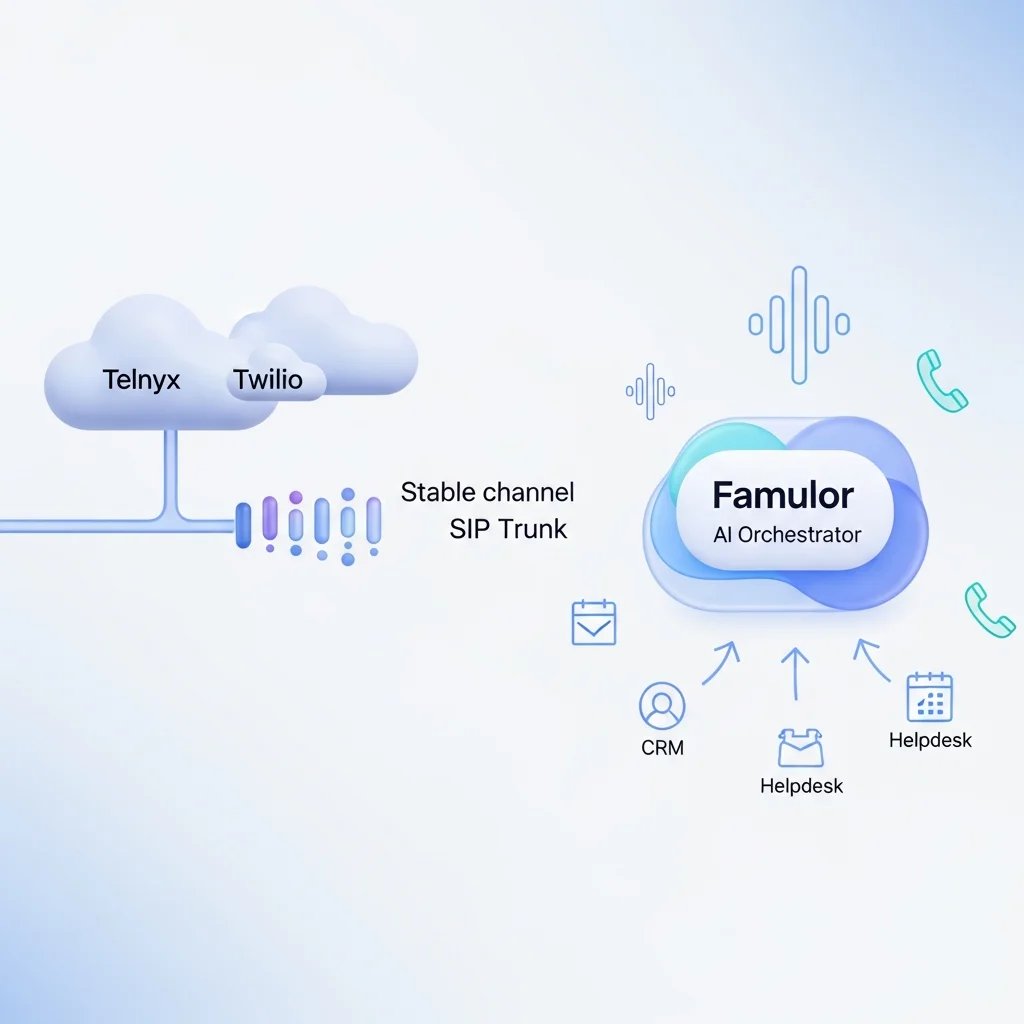
Famulor separates platform and carrier. You can connect your Telnyx or Twilio numbers via SIP trunk, keep your existing phone numbers and switch carriers later without rebuilding the agent. How this works technically is in our post on Telnyx, Twilio and SIP trunks with Famulor. You build the agent itself without code in the no-code builder, and the integrations connect calendars, CRMs and more.
For the overall cost picture, see our large comparison AI voice agent pricing 2026: what 10 platforms cost per minute. The Famulor pay-as-you-go minute price is currently €0.15 per minute, and current plans are on the pricing page.
Calculate Your Total Cost per Minute
The carrier is only one building block. Work through your own minute: carrier, language model, speech recognition, speech synthesis and platform. The calculator below shows how your minute volume affects total cost.
Estimate your ROI from automating calls
See how much your business could save by switching to AI-powered voice agents.
ROI Result
ROI 0%
No credit card required
Checklist Before You Choose a Carrier
- Which destination countries make up more than 80 percent of your minutes?
- Does the vendor bill per second or per started minute?
- Do you need German phone numbers, and what proof does the vendor require?
- Will call control be built on the carrier API or on a plain SIP trunk?
- Are there minimum spends, volume tiers or setup fees?
- What latency do you measure in a test run during your peak hours?
- Can you switch carriers later without rebuilding the agent?
Conclusion
On publicly listed prices, Telnyx is usually cheaper than Twilio, especially on the API path. As a plain SIP trunk the difference shrinks, particularly for inbound calls. In the end, destination countries, billing increment and your existing setup decide. Treat the carrier as a swappable building block, test both networks with real calls and calculate with your own minute volumes. If your platform connects both carriers via SIP, the decision stays reversible.
Next step: open the Telnyx calculator, enter your minutes and compare the result with the Twilio calculator. Then build your first agent in Famulor and test it with a Telnyx or Twilio number.
Try our AI Assistant
Experience how natural our AI phone assistant sounds.
Enter your details and receive a call from our AI agent within seconds.
Agent is trained to discuss Famulor services and book appointments.

Demo AI agent
Famulor representative
FAQ
How much does Telnyx cost per minute for AI calls?
On the public price list, a local outbound US call through the Voice API is about $0.007 per minute ($0.002 API plus $0.005 SIP). As a plain SIP trunk it is from about $0.005 per minute outbound and $0.0032 inbound.
How much does Twilio Voice cost per minute?
With Programmable Voice, US landline calls are about $0.014 outbound and $0.0085 inbound. Elastic SIP Trunking is cheaper, with recent sources citing about $0.010 outbound and $0.0034 inbound.
Is Telnyx cheaper than Twilio?
On list prices yes, especially on the API path. As a plain SIP trunk the gap is smaller. Whether switching pays off depends on destinations, volume and billing increment.
Can I use Telnyx or Twilio with Famulor?
Yes. Famulor connects both carriers via SIP trunk. You keep your phone numbers and can switch carriers later without rebuilding the agent.
What is the difference between a voice API and a SIP trunk?
With a voice API you control calls through the carrier's programming interface. A SIP trunk only provides the connection to the phone network, and your platform handles call control.
How much does a phone number cost?
Local US numbers are about $1.00 (Telnyx) to $1.15 (Twilio) per month. German numbers cost more depending on the vendor and usually need proof of address.
Is billing per second or per minute?
That depends on product and contract. Check the billing interval before you start, because rounding makes a big difference on short calls.
What latency is good for AI phone calls?
A reply within about one second feels natural. The carrier is only one part of that, as speech recognition, language model and speech synthesis count just as much.

Writer at Famulor