Summarize Content With:




Telnyx vs Twilio for AI voice agents: the short answer
If you only compare the carrier line on the invoice, Telnyx is cheaper per minute than Twilio in the United States. Telnyx lists $0.007 per outbound minute and $0.0052 per inbound minute (Voice API plus SIP trunk). Twilio lists $0.014 per outbound minute and $0.0085 per inbound minute on a local number, or $0.004 per minute when you use SIP trunking. Those are pay-as-you-go list prices before volume tiers.
But the carrier is rarely the biggest line of an AI voice agent. Speech-to-text, the language model, text-to-speech and orchestration usually cost more than the phone leg. So the real question is not "Telnyx or Twilio?" but "how many separate bills do I want to manage, and who owns the latency, the compliance and the failures?"
This guide breaks down what each option really costs per minute, shows a worked example for a mid-sized business, and explains when it makes sense to bring your own carrier to a no-code voice agent platform and when a bundled per-minute price is the safer choice.
What you pay for in an AI phone call
An AI voice agent call is not one product. It is a stack of five layers, and each one can be billed by a different vendor:
- Carrier and phone number. The PSTN leg that connects the caller to your system. This is where Telnyx and Twilio compete.
- Speech-to-text (STT). Turns the caller's voice into text in real time.
- Language model (LLM). Decides what to say and which tools to call, for example "check the calendar" or "update the CRM".
- Text-to-speech (TTS). Turns the answer back into a natural voice.
- Orchestration. Turn-taking, interruptions, call transfer, voicemail detection, logging, analytics and integrations.
When teams search for "telnyx pricing" or "twilio pricing", they usually look at layer one only. That is a fair starting point, because the carrier is the one layer you can compare in a table. Just do not stop there. For the other layers, see our breakdown of what 10 AI voice agent platforms actually cost per minute.
Telnyx vs Twilio: published US per-minute rates
The table below uses the public US pay-as-you-go rates we checked in October 2026. Prices change, differ by destination country and drop with volume commitments, so treat them as a starting point and confirm on the vendor pages before you sign anything.
| Item | Telnyx | Twilio |
|---|---|---|
| Outbound, per minute (US) | $0.007 (Voice API $0.002 + SIP $0.005) | $0.014 (local or toll-free) |
| Inbound, per minute (US local) | $0.0052 (Voice API $0.002 + SIP $0.0032) | $0.0085 |
| Inbound, per minute (US toll-free) | Varies by number type, check price sheet | $0.022 |
| SIP trunking, per minute | Included in the totals above | $0.004 (SIP interface or BYOC) |
| Local number, per month | $1.00 | $1.15 |
| Toll-free number, per month | Check price sheet | $2.15 |
Two things stand out. First, Twilio's programmable voice rates are roughly double Telnyx for outbound calls. Second, Twilio's SIP trunking rate of $0.004 per minute is the cheapest number in the table, which is why many platforms connect to Twilio through SIP instead of through the programmable voice API.
If you want to run your own numbers, use our Telnyx cost calculator and Twilio cost calculator. Both let you enter minutes and call direction and show the carrier cost next to the AI platform cost.
Worked example: a dental group with 4,000 minutes a month
Take a dental group with three locations. Reception is overloaded, so an AI agent answers inbound calls, books appointments and sends reminders. Assume 3,000 inbound minutes and 1,000 outbound reminder minutes per month, on US local numbers. This is an illustration, not a quote.
| Line | Telnyx | Twilio (programmable voice) | Twilio (SIP trunk) |
|---|---|---|---|
| 3,000 inbound minutes | $15.60 | $25.50 | $12.00 |
| 1,000 outbound minutes | $7.00 | $14.00 | $4.00 |
| Carrier minutes total | $22.60 | $39.50 | $16.00 |
| One local number | $1.00 | $1.15 | $1.15 |
| Monthly carrier cost | $23.60 | $40.65 | $17.15 |
The gap between the cheapest and most expensive column is about $23 a month. That is real money at scale, but it is small next to the cost of the AI layers and, more importantly, next to the value of one recovered patient. If the agent books even a handful of extra appointments, the carrier choice disappears in the noise. The costs that move the needle are the ones you cannot see in a carrier table: wasted minutes from slow responses, calls dropped during transfers and hours of engineering time spent wiring vendors together.
Cost and ROI: put your own numbers in
Before you pick a carrier, calculate what the whole automation is worth. Enter your monthly call volume, average handling time and current cost per call below.
Estimate your ROI from automating calls
See how much your business could save by switching to AI-powered voice agents.
ROI Result
ROI 0%
No credit card required
The hidden cost of building the stack yourself
Choosing a carrier directly from Telnyx or Twilio only makes sense if you also pick STT, LLM, TTS and an orchestration layer, then glue them together. Developer-first teams do exactly that, and it can work well when you have engineers, a niche requirement and time. The trade-offs are predictable:
- Several invoices. Each vendor bills in a different unit (per minute, per character, per token), so your true cost per call is hard to forecast.
- Latency is your problem. Every hop between carrier, STT, LLM and TTS adds delay. Callers notice pauses of more than about a second. We cover this in detail in how fast your phone bot must reply.
- Compliance is yours to document. In the EU you need data processing agreements, hosting locations and retention rules for every sub-processor in the chain.
- Edge cases need code. Barge-in, voicemail detection, call transfer and retries are small features that take weeks to get right.
We looked at this trade-off from the developer side in Twilio voice AI alternative: no-code vs developer.
Beyond price: reliability, number reputation and support
Two carriers with the same list price can still deliver very different results. Before you commit, check three things that rarely appear in a pricing table.
- Number reputation. Outbound AI calls from unverified numbers are often labelled "spam likely", which tanks your answer rate. Ask how each carrier handles caller ID registration and call signing, and read our guide on why AI outbound calls get flagged and how to fix it.
- Call quality and routing. Packet loss and jitter turn a good voice agent into a bad one, because speech recognition degrades first. Run test calls at different times of day and on mobile networks, not only on a landline.
- Support when something breaks. A failed trunk on a Monday morning costs more than a year of minute savings. Check support hours, escalation paths and status pages before you move production traffic.
With a bundled platform, these checks move to one vendor. With your own carrier, they stay on your checklist, which is fine as long as someone owns them.
Which carrier fits which situation
| Situation | Better fit | Why |
|---|---|---|
| High outbound volume in the US | Telnyx, or Twilio over SIP | Lowest list price per outbound minute |
| Existing Twilio account, numbers and compliance setup | Twilio over SIP trunk | No number porting, one familiar console |
| Numbers in many countries | Check both price sheets by country | Rates and number availability differ strongly by destination |
| Small team, no telephony engineers | Platform with bundled minutes | One price, one contract, support included |
| Strict data residency in the EU | Carrier plus platform with EU hosting | Check hosting and sub-processors for each layer |
How Famulor fits in: bundled minutes or bring your own carrier
Famulor gives you both options. On the pay-as-you-go plan, telephony, speech recognition, the language model and the voice are bundled at €0.15 per minute. You get one price per minute, no separate carrier account and no glue code. You build the agent in a visual editor, connect your calendar or CRM through ready-made integrations and go live the same day. This is the setup most businesses choose, for example for an AI call center that answers inbound calls around the clock.
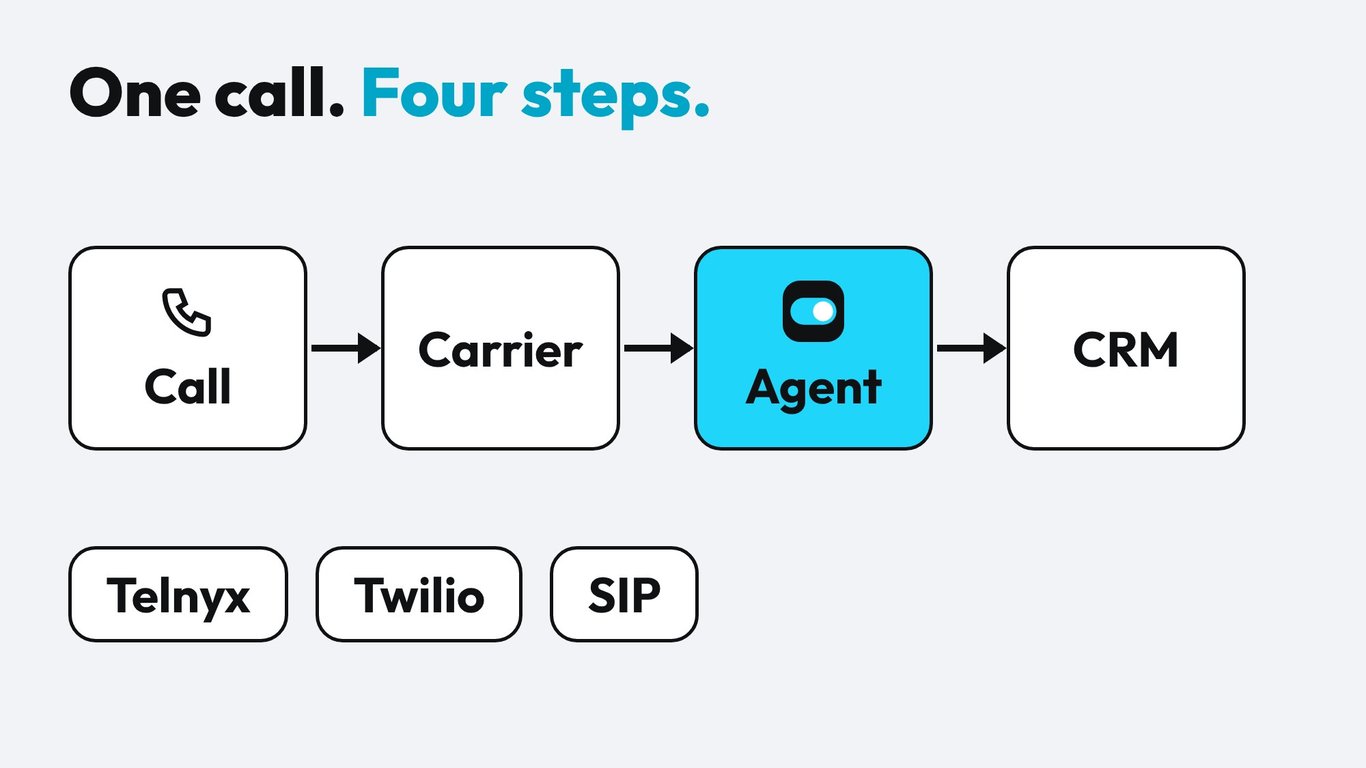
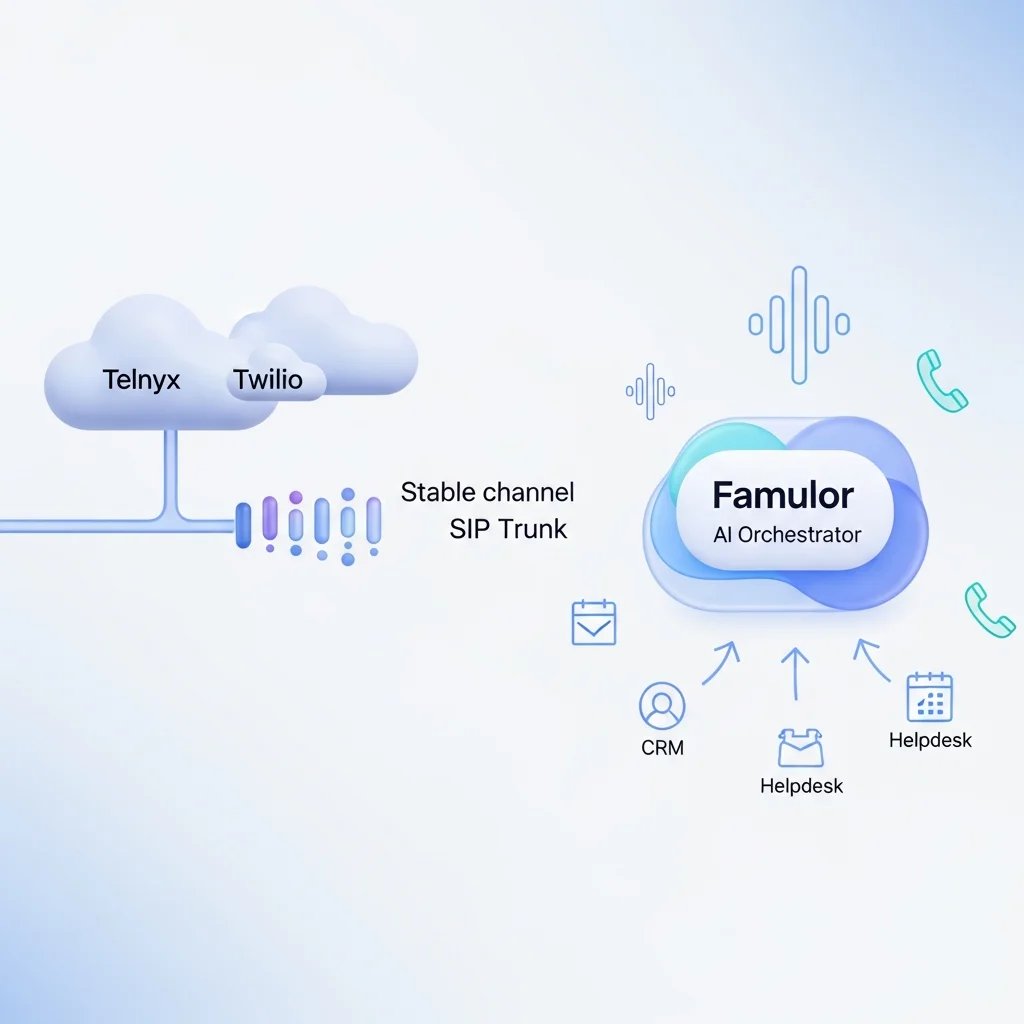
If you already own numbers at Telnyx or Twilio, or you need a specific carrier for a country, you can connect them through a SIP trunk and keep your numbers. The step-by-step setup is in our guide to Telnyx, Twilio and SIP trunks with Famulor. In that case you pay your carrier for the phone leg and use Famulor for the agent. Compare the totals on the pricing page before you decide.
Famulor is our first choice for teams that want the shortest path from idea to a working phone agent, with hosting in the EU and a clear per-minute price. If you have a strong engineering team and want to control every layer, a custom stack on Telnyx or Twilio is a legitimate alternative.
How to decide in five steps
- Estimate your minutes. Split inbound and outbound, and note peak hours. Peaks decide how many parallel calls you need.
- Price the carrier layer. Use the calculators for Telnyx and Twilio with your countries and call types.
- Price the AI layers. Add STT, LLM, TTS and platform fees, or use a bundled per-minute price for a fair comparison.
- Check compliance. List every sub-processor, hosting region and retention period, and make sure your data processing agreement covers them.
- Run a two-week pilot. Measure answer rate, average handling time, transfers and missed bookings. Real calls beat spreadsheets.
Conclusion
Telnyx is the cheaper carrier on paper for US traffic, and Twilio over SIP trunking can match or beat it if you already live in the Twilio ecosystem. In both cases the carrier is a small part of the total cost of an AI voice agent. What decides success is latency, reliability, compliance and how fast your team can change the agent when the business changes.
If you want to see what a finished agent sounds like and how long setup really takes, start with a live demo. You can also keep your Telnyx or Twilio numbers and add the agent on top.
Try our AI Assistant
Experience how natural our AI phone assistant sounds.
Enter your details and receive a call from our AI agent within seconds.
Agent is trained to discuss Famulor services and book appointments.

Demo AI agent
Famulor representative
FAQ
Is Telnyx cheaper than Twilio for AI voice agents?
For US traffic, yes on list prices: Telnyx lists $0.007 per outbound minute against $0.014 at Twilio for programmable voice. Twilio SIP trunking at $0.004 per minute is lower still, so the cheapest route depends on how you connect.
What does Twilio cost per minute for inbound calls?
Twilio lists $0.0085 per minute for inbound calls on US local numbers and $0.022 on toll-free numbers, plus a monthly number fee of $1.15 for local numbers and $2.15 for toll-free numbers.
What does Telnyx cost per minute?
Telnyx lists a total of $0.007 per outbound minute and $0.0052 per inbound minute in the US when you combine the Voice API and SIP trunk. A local number costs $1.00 per month. Volume tiers can lower these rates.
Do I need a Telnyx or Twilio account to use Famulor?
No. Famulor includes telephony in its per-minute price. You only need your own carrier account if you want to keep existing numbers or use a specific carrier.
Can I connect my own SIP trunk to an AI voice agent?
Yes. You can connect a SIP trunk from Telnyx, Twilio or another provider and route calls to your agent. Number porting is not required, because the trunk simply forwards the call.
Which costs matter more than the carrier?
Speech recognition, the language model, the voice and orchestration usually cost more per minute than the phone leg. Latency and failed calls also cost money, because they waste minutes and lose customers.
Are these prices valid outside the United States?
No. Rates differ by destination country, number type and volume. Check the vendor price sheets for each country you call, and use the calculators to model your mix.
How do I compare an all-in platform with a self-built stack?
Convert everything to cost per completed call: carrier, STT, LLM, TTS, platform fee and engineering time. Then add the cost of failures. A bundled per-minute price makes this comparison much easier.
Is a SIP trunk better than the programmable voice API?
For AI agents, a SIP trunk is often cheaper and simpler, because the platform handles the call logic. The programmable voice API gives more control but needs more code on your side.

Writer at Famulor