Summarize Content With:




Voice AI Consolidation 2026: What the Salesforce, Five9 Acquisitions Mean for Your Business
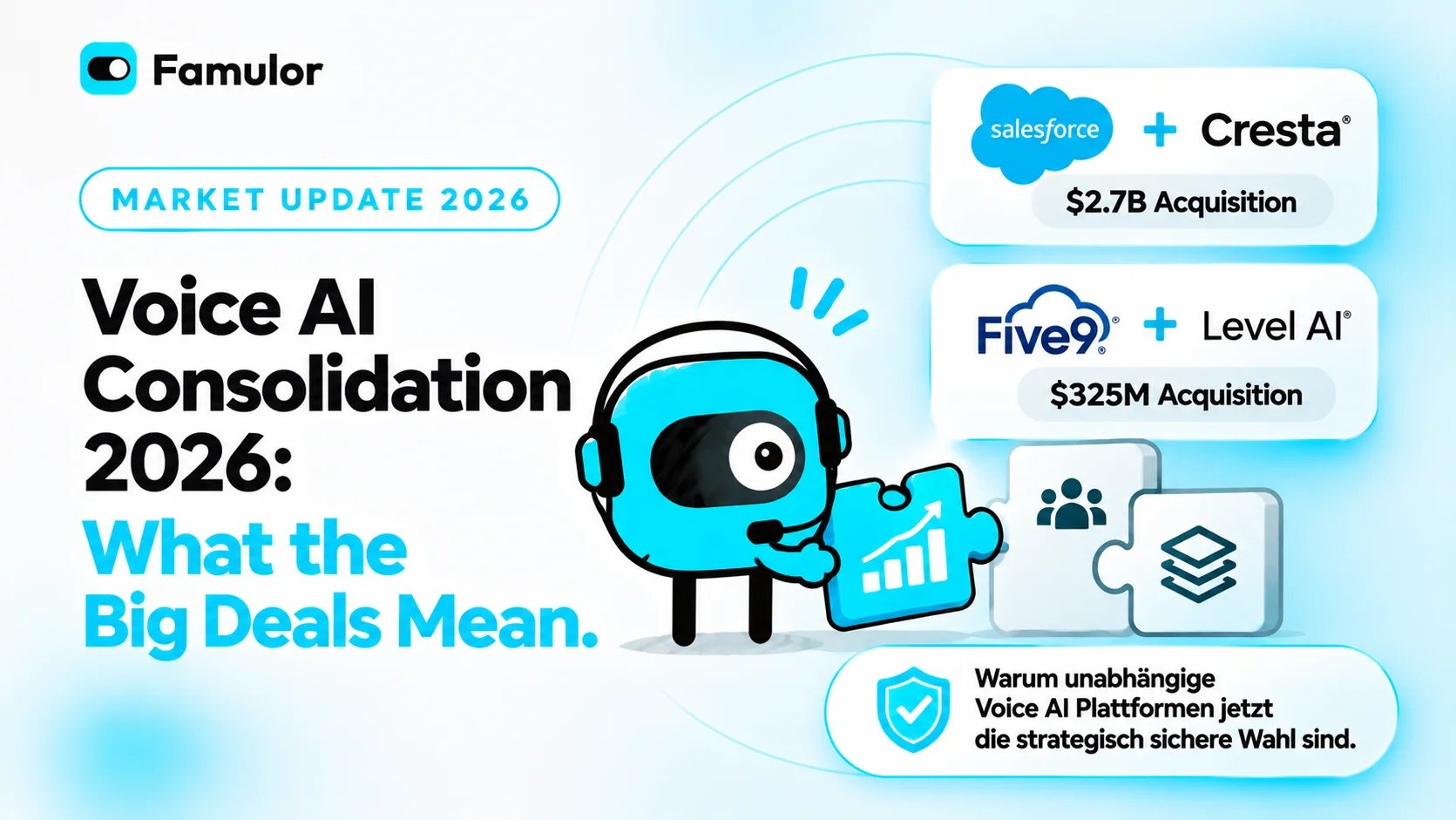
The voice AI industry is experiencing unprecedented consolidation in 2026: Salesforce is acquiring Cresta for a reported $2.7 billion, Five9 is buying Level AI for $325 million — both announced within a single week. For businesses using or evaluating an AI phone assistant, one question demands an immediate answer: What does this consolidation mean for your infrastructure, your data, and your freedom of choice?
The short answer: If your voice AI provider is being acquired by a major platform vendor, price increases, forced platform migrations, and restricted integrations are the most likely outcomes. Independent platforms like Famulor are becoming the strategically safe choice in this market environment.
What Happened: The Deals at a Glance
On November 2, 2026, Salesforce signed a definitive agreement to acquire Cresta, a specialist in voice AI agents for contact centers. Cresta automates customer calls end-to-end, coaches human agents in real time, and analyzes conversation patterns. Its customer roster includes Marriott, Comcast, and Alaska Airlines. The reported $2.7 billion price tag comes from The Information — Salesforce has not confirmed the amount. The deal is expected to close in the first quarter of Salesforce's fiscal year 2028.
Just three days later, on November 5, Five9 announced the acquisition of Level AI for approximately $325 million in cash. Level AI processes over one billion customer interactions annually on its proprietary model family, "Level AI Latitude." Its customers include Gusto, Chime, and VistaPrint. The two companies have been partners since 2022. Five9 reported Q3 revenue of $323.3 million alongside the announcement — up 13% year over year.
Why the Giants Are Moving Now: Three Drivers of Consolidation
This acquisition wave is no coincidence. Three forces are driving the consolidation:
| Driver | Explanation | Example |
|---|---|---|
| Platform Lock-in | CRM and CCaaS vendors want to embed voice AI natively into their ecosystems to retain customers long-term. | Salesforce integrating Cresta into Service Cloud |
| Data Advantage | Conversation data is the key to better AI models. Whoever controls the data flow trains better. | Level AI's "Latitude" models + Five9's call volume |
| Market Rationalization | Investors are demanding profitability. Smaller players are being acquired or disappearing. | SoundHound cuts 27% of workforce despite 48.5% revenue growth |
The Risks for Businesses: What Happens After an Acquisition
When your voice AI provider gets acquired, a three-phase process typically unfolds — one that rarely favors existing customers:
Phase 1 — Integration (6–18 months): The acquirer begins merging the acquired technology into its own platform. Standalone APIs and integrations are frozen or deprecated. For customers, this means: no new features, reduced support, and uncertainty about the product roadmap.
Phase 2 — Migration (12–24 months): Customers are asked — or required — to move to the new, integrated platform. Anyone using Cresta as a standalone product will likely need to migrate to Salesforce Service Cloud, with corresponding license costs.
Phase 3 — Repricing: The acquirer's pricing takes over. Salesforce is known for enterprise-level pricing; Five9 will not continue Level AI at startup rates. For a mid-sized dental practice like Dr. Becker's with 60 employees that used Level AI for appointment scheduling, costs could easily double.
SoundHound, Heidi Health, and the Layoff Signal
Not all consolidation happens through acquisitions. SoundHound, known for its voice AI technology in the automotive sector, is cutting approximately 27% of its global workforce despite 48.5% revenue growth (Q3: $62.4 million). The company expects $18–22 million in restructuring charges and is targeting adjusted EBITDA profitability no earlier than H2 2027.
Heidi Health, a healthcare voice AI startup with over 600 employees, is cutting 18% of staff just two months after raising a $100 million Series C. CEO Thomas Kelly acknowledged that investments "weren't going into the right teams and markets."
The message is clear: Growth alone is not enough. Providers that are independent today could face financial trouble tomorrow — or become acquisition targets themselves.
Checklist: How to Protect Your Business from Vendor Lock-in
Regardless of which voice AI provider you currently use, evaluate these five critical factors:
- Data Portability: Can you export your conversation data, training data, and configurations at any time?
- API Independence: Does the platform use open standards (SIP, REST, webhooks) or proprietary protocols?
- Contract Flexibility: Are there long-term commitments, or can you cancel monthly?
- Integration Breadth: Does the platform work with your existing tech stack (CRM, ERP, calendar, helpdesk)?
- EU Hosting and GDPR: Where is your conversation data processed and stored?
Why Independent Platforms Have the Advantage Now
Consolidation is shifting the power dynamics. While Salesforce and Five9 integrate their acquisitions, independent providers benefit from three structural advantages:
1. Vendor Neutrality: An independent platform like Famulor has no incentive to lock you into a specific CRM or CCaaS ecosystem. Its 300+ integrations work with any tech stack — whether Salesforce, HubSpot, Pipedrive, or custom-built systems.
2. Roadmap Stability: When Cresta disappears into Salesforce Service Cloud, features that don't align with Salesforce's strategy will be deprecated. Independent providers develop their roadmap based on customer needs, not corporate strategy.
3. Pricing Transparency: No hidden platform licenses, no mandatory bundles. With Famulor, you can see exactly what you pay on the pricing page — no enterprise agreement required.
Real-World Example: Avoiding Post-Acquisition Migration
Müller & Partner, a Munich-based tax consultancy with 45 employees, had been using a voice AI assistant for client inquiries since 2025. When their provider was acquired by a US corporation, they faced a dilemma: the new terms required an annual enterprise commitment of over €24,000 — for unchanged functionality.
The solution: A switch to Famulor within two weeks. SIP trunk integration preserved their existing phone number, no-code automation replicated their workflows one-to-one, and GDPR-compliant EU hosting met the firm's strict data privacy requirements. Monthly cost: under €500.
The Twilio Factor: Even Platform Giants Feel the Pressure
Alongside the acquisition wave, Twilio is massively expanding its voice AI infrastructure. In November 2026, Twilio launched four new products: Conversation Memory, Orchestrator, Intelligence, and Agent Connect. The goal: closing the so-called "context gap" in omnichannel communication — the problem of customer data getting lost between channels (phone, chat, email).
The catch: Twilio is a developer platform. Each of these products requires significant implementation effort, API expertise, and ongoing maintenance. For a mid-sized business without a dedicated engineering team, this is not a realistic option.
Famulor solves this problem natively: omnichannel communication (phone, live chat, web widget), memory, and context handoff between channels — all in a no-code platform that supports 40+ languages and integrates with any existing phone system via SIP trunking.
Industry-Specific Impact: Healthcare, Legal, and E-Commerce
The consolidation wave hits different industries with varying severity. In healthcare, the situation is particularly critical: medical practices, clinics, and hospital groups face strict data privacy requirements. When a US corporation acquires a voice AI provider, the data processing location can change — undermining the entire GDPR compliance foundation. An orthopedic practice in Stuttgart with three locations and 12,000 patient contacts per year cannot afford uncertainty about data processing.
In the legal sector, requirements are even stricter due to attorney-client privilege. Law firms using voice AI for client inquiries must ensure that conversation content is never processed on US servers — even if the provider claims technical GDPR compliance.
For e-commerce businesses, the consolidation primarily means one thing: cost uncertainty. An online shop handling 50,000 monthly customer calls calculates its voice AI deployment down to the cent. If Five9 changes Level AI's pricing terms, it can throw off the entire unit economics.
What the Deepgram Marketplace Signals
Alongside the acquisition wave, Deepgram is building a marketplace with 19 partner products across eight categories — all under one contract and one billing statement. This model shows where the industry is heading: providers are trying to bundle as many parts of the voice AI value chain under one roof as possible.
For businesses, this is a double-edged sword. On one hand, a marketplace simplifies procurement. On the other, it creates a new form of lock-in: companies that source all components (STT, TTS, NLU, telephony) from a single vendor find it difficult to swap individual building blocks.
Famulor's approach is deliberately different: the platform supports multiple STT and TTS providers (including Deepgram, ElevenLabs, Google, and others) and lets customers switch between providers at any time — without migration and without data loss.
ElevenLabs and the IPO Horizon: What Comes Next?
Not every voice AI company is consolidating through acquisitions. ElevenLabs, valued at $22 billion after an employee share sale in September, is preparing for a potential IPO in 2028, according to CEO Mati Staniszewski. Its conversational AI platform "ElevenAgents" now processes over 10 million weekly conversations.
For businesses, an IPO-bound provider carries a different risk profile: the company's focus shifts toward growth metrics and investor expectations rather than product development and customer success.
Decision Matrix: Which Voice AI Provider Fits Your Business?
| Criterion | Acquired Provider (e.g., Cresta) | Platform Giant (e.g., Twilio) | Independent Provider (e.g., Famulor) |
|---|---|---|---|
| Pricing Transparency | Unclear post-acquisition | Pay-per-use, complex | Clear, cancel monthly |
| Implementation | Migration required | Developer team needed | No-code, under 1 day |
| Vendor Lock-in Risk | High (new ecosystem) | Medium (API-based) | Low (open standards) |
| GDPR / EU Hosting | Mostly US-based | Configurable | EU-native |
| Integrations | Limited to acquirer's stack | Broad, but DIY | 300+ ready-made integrations |
| Language Support | Varies | Depends on STT/TTS provider | 40+ languages natively |
Estimate your ROI from automating calls
See how much your business could save by switching to AI-powered voice agents.
ROI Result
ROI 0%
No credit card required
Five Concrete Steps for 2026
Based on the current market situation, we recommend these steps for businesses of all sizes:
- Audit Your Current Provider: Check whether your voice AI provider is affected by an acquisition or shows signs of financial instability.
- Test Data Export: Try exporting all conversation data, configurations, and training data. If you cannot, you have a lock-in problem.
- Secure SIP Trunk Independence: Ensure your phone numbers belong to you — not to your provider.
- Project Costs for 24 Months: Calculate what your current provider might cost post-acquisition. Enterprise licenses from Salesforce or Five9 typically start at $150–300 per agent per month.
- Get an Alternative Quote: A free demo with an independent provider like Famulor takes 15 minutes and gives you a baseline for comparison.
Conclusion: Independence Becomes a Competitive Advantage
The voice AI consolidation of 2026 is not a passing trend. It marks the transition from a fragmented startup landscape to an industry dominated by major corporations. For businesses using voice AI, the choice of provider is becoming a strategic decision with long-term consequences.
Independent platforms like Famulor offer a decisive advantage in this market environment: no corporate dependency, no forced migration, no hidden costs. With 300+ integrations, 40+ languages, and EU-native hosting, Famulor is the safe choice for businesses that want to maintain control over their voice AI strategy for the long term.
Next Step: Book a free demo and see in 15 minutes how Famulor automates your customer calls — with no vendor lock-in and no developer team required.
Try our AI Assistant
Experience how natural our AI phone assistant sounds.
Enter your details and receive a call from our AI agent within seconds.
Agent is trained to discuss Famulor services and book appointments.

Demo AI agent
Famulor representative
FAQ
What does the Salesforce-Cresta acquisition mean for existing Cresta customers?
Cresta will likely be integrated into Salesforce Service Cloud. Existing customers should expect a platform migration, new licensing models, and restricted standalone integrations over the next 12–24 months.
Why is Five9 buying Level AI for $325 million?
Five9 wants to integrate Level AI's proprietary models and its base of over one billion customer interactions into its contact center platform, offering native conversation analysis and automation.
How can I tell if my voice AI provider is an acquisition target?
Warning signs include: layoffs despite growth, frequent leadership changes, lack of profitability at high valuations, and investor pressure for exit strategies. SoundHound's 27% workforce reduction at 48.5% growth is a textbook example.
What is vendor lock-in in voice AI and how do I avoid it?
Vendor lock-in occurs when your data, phone numbers, or workflows are tied to a single provider. Avoid it through open standards (SIP trunking), data export capabilities, and month-to-month contracts.
Is Famulor affected by the voice AI consolidation?
No. Famulor is an independent, EU-hosted platform with no corporate dependency. Its roadmap is driven by customer needs, not investor expectations.
How quickly can I switch from an acquired provider to Famulor?
Migration typically takes one to two weeks. Famulor supports SIP trunking for existing numbers, no-code workflows, and 300+ ready-made integrations for a seamless transition.
What does an independent voice AI provider cost compared to enterprise solutions?
Enterprise licenses at Salesforce or Five9 typically start at $150–300 per agent per month. Independent platforms like Famulor offer usage-based models at a fraction of these costs.
What role does GDPR compliance play in provider selection?
A critical one. After acquisition by US corporations, data processing locations and conditions can change. EU-native providers like Famulor guarantee GDPR-compliant processing without third-country data transfers.
Why is SoundHound cutting 27% of its workforce despite revenue growth?
SoundHound is growing at 48.5% but is not profitable, targeting adjusted EBITDA break-even no earlier than H2 2027. The layoffs are expected to save $18–22 million and accelerate the path to profitability.
What voice AI trends are emerging for 2027?
Continued consolidation, growing importance of omnichannel context, regulatory pressure on AI transparency in the EU, and increasing demand for industry-specific voice AI solutions in healthcare, government, and legal sectors.

Writer at Famulor