Summarize Content With:




Voice AI for Franchise Chains: How to Centrally Manage AI Phone Agents Across 50+ Locations
Franchise chains with dozens or hundreds of locations face a unique challenge: every single site needs to answer phone calls professionally, book appointments, handle inquiries, and route urgent requests — often simultaneously, across different time zones, and in multiple languages. Traditional call centers struggle with the scale and cost, while local receptionists deliver inconsistent experiences. Voice AI solves this by deploying intelligent phone agents that handle calls autonomously, follow centralized scripts, and adapt to each location's specific needs — all managed from a single dashboard.
In this guide, we break down how multi-location businesses can deploy AI voice agents at scale, which features matter most for franchise operations, and how platforms like Famulor make centralized phone automation practical for 50, 100, or even 500+ locations.
What Voice AI for Franchise Chains Actually Means
Voice AI for franchise chains goes beyond a simple auto-attendant. It refers to AI-powered phone agents that can hold natural conversations, understand caller intent, access location-specific data (hours, services, staff schedules), and take actions like booking appointments or forwarding to the right person — all without human intervention. The key differentiator for franchise use cases is centralized management with local customization: headquarters defines the core behavior, brand voice, and compliance rules, while each franchise location gets its own phone number, greeting, hours, and service catalog.
Unlike traditional IVR systems that force callers through rigid menu trees, modern voice AI agents understand free-form speech, handle interruptions gracefully, and can switch between topics mid-conversation. For a franchise with 50+ locations, this means every caller gets the same quality of service — whether they're calling a location in Munich at 9 AM or a branch in Hamburg at 11 PM.
The 5 Biggest Phone Challenges for Multi-Location Businesses
Before diving into solutions, it helps to understand why phone management at franchise scale is so difficult:
- Inconsistent caller experience: Each location answers differently. Some are professional, others let the phone ring. Brand standards erode at the edges.
- Staffing costs multiply with every site: A receptionist at every location costs €25,000–€40,000 per year per site. At 50 locations, that is €1.25–€2 million annually just for phone coverage.
- After-hours calls go unanswered: Most franchise locations operate fixed hours, but customers call evenings and weekends. Missed calls mean missed revenue — studies show 60–80% of callers who reach voicemail never call back.
- No centralized visibility: Headquarters has no idea how many calls each location receives, how they are handled, or what customers are asking about. There is no data to optimize operations.
- Scaling is linear, not exponential: Every new location requires hiring, training, and managing additional phone staff. Opening 10 new franchises means 10 new hires — with AI, it means copying a configuration.
Centralized vs. Decentralized Phone Management: A Comparison
| Criterion | Traditional Call Center | Local Receptionist per Site | AI Voice Agent (Centralized) |
|---|---|---|---|
| Cost per location/month | €800–€2,500 | €2,000–€3,500 | €50–€300 |
| 24/7 availability | Extra shift premiums | Not feasible | Included by default |
| Brand consistency | Training-dependent | Highly variable | Guaranteed by template |
| Multilingual support | Requires bilingual agents | Rarely available | 40+ languages automatic |
| Scalability (new location) | Weeks of hiring | Weeks of hiring | Minutes (clone config) |
| Central analytics | Partial, delayed | None | Real-time, all locations |
| Local customization | Limited | Full but uncontrolled | Full and governed |
| Integration with booking tools | Manual or custom | Manual | 300+ no-code integrations |
How Centralized AI Phone Management Works
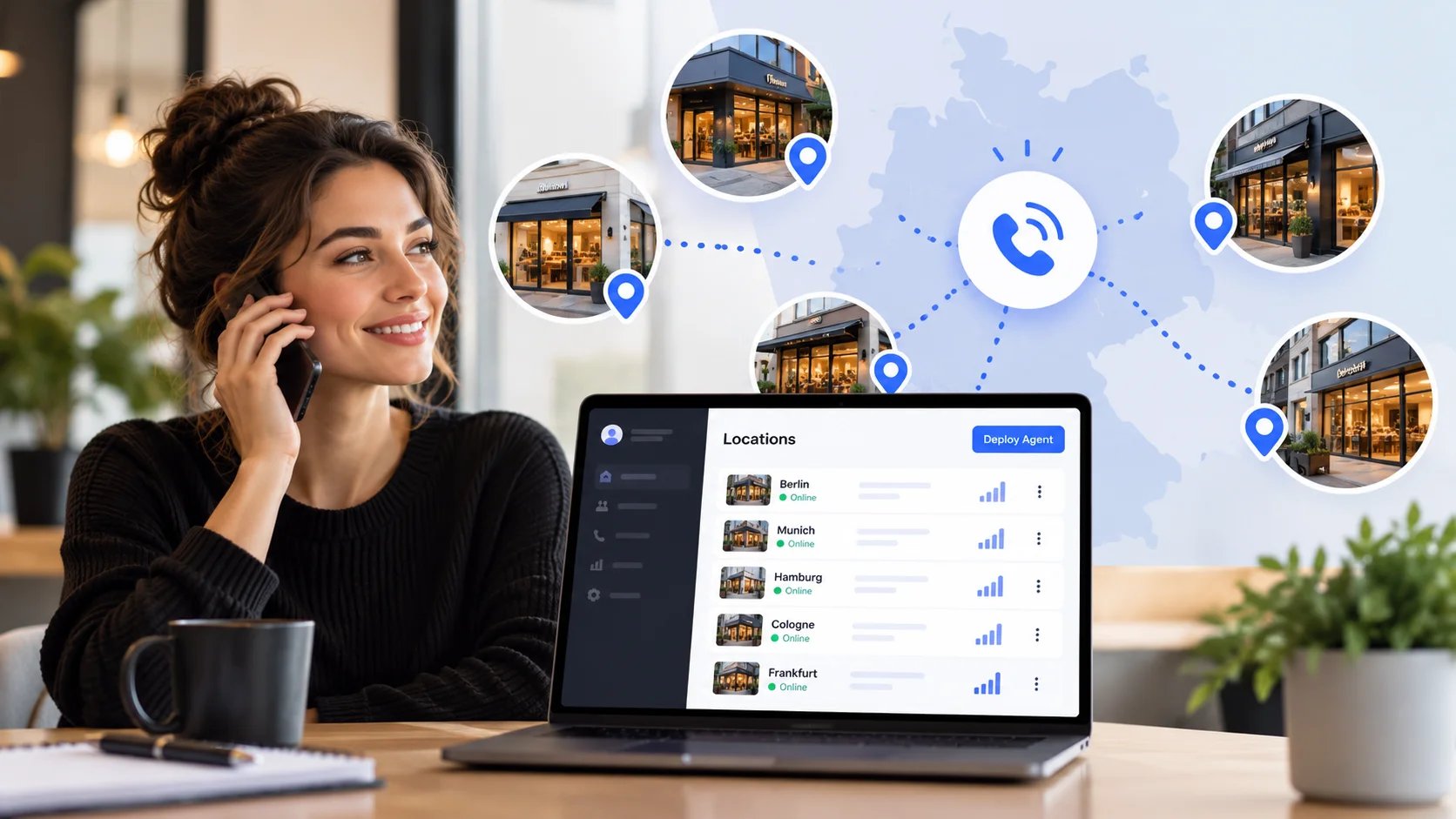
The architecture behind franchise-scale voice AI follows a hub-and-spoke model. Here is how it works in practice:
Hub (Headquarters): The central team creates a master AI assistant template. This template defines the brand voice, conversation flow, compliance rules (e.g., GDPR disclaimers, recording consent), escalation paths, and integration connections. It also sets which variables each location can customize and which are locked.
Spokes (Locations): Each franchise site gets a clone of the master template, bound to its own phone number. Location-specific variables are filled in: address, opening hours, available services, staff names, local promotions. The AI agent answers as if it is a dedicated receptionist for that specific location — because functionally, it is.
Central dashboard: All calls across all locations feed into a single analytics view. Headquarters sees call volumes by location, peak hours, most common caller intents, appointment conversion rates, and escalation frequency. This data drives staffing decisions, marketing campaigns, and operational improvements across the entire network.
Step-by-Step: Deploying Voice AI Across a Franchise Network
Step 1 — Design the Master Template
Start by mapping your most common call scenarios. For a dental franchise, this might be: new patient appointment, existing patient reschedule, insurance questions, emergency triage, and directions. Build a conversation flow that handles each scenario, including fallback paths for questions the AI cannot answer. On Famulor, this is done visually in the Flow Builder with drag-and-drop nodes.
Step 2 — Define Location Variables
Identify what changes per location: address, phone number, hours, services offered, staff roster, booking calendar link, and local promotions. These become variables in the template that are populated per site. On Famulor, variables can pull from external sources (CRM, Google Sheets, or your franchise management system) via the automation platform.
Step 3 — Assign Phone Numbers
Each location needs its own phone number. You can bring your existing numbers via SIP trunking (BYOC), so customers keep calling the number they already know. No hardware changes are needed at any location — the AI agent intercepts calls before they reach the physical phone system, or works alongside it as a fallback.
Step 4 — Connect Integrations
Wire up the tools each location uses: calendar systems (Calendly, Acuity, Cal.com, proprietary franchise booking tools), CRM (HubSpot, Salesforce, Pipedrive), messaging (WhatsApp, SMS for confirmations), and internal communication (Slack, email alerts for escalations). Famulor's no-code automation platform supports 300+ integrations, so most franchise management systems connect without custom development.
Step 5 — Roll Out in Waves
Do not deploy to all 50+ locations at once. Start with 3–5 pilot locations for 2–4 weeks. Monitor call quality, caller satisfaction, and edge cases the AI does not handle well. Refine the master template based on real data, then roll out to the next batch of 10–15 locations. At this stage, deployment per location takes under 10 minutes — it is mostly filling in the location variables and assigning the phone number.
Step 6 — Monitor and Optimize Centrally
Once all locations are live, the real value of centralized management kicks in. Use the analytics dashboard to identify locations with high escalation rates (template needs refinement), locations with peak call volumes at unexpected hours (adjust staffing or extend AI coverage), and common questions that the AI handles poorly (add to knowledge base). Every improvement you make to the master template automatically propagates to all locations.
Industry Examples: Franchise Voice AI in Action
Dental and Medical Chains
A dental franchise with 60 practices deploys an AI voice agent that handles appointment bookings, insurance verification questions, and emergency triage. The AI checks each location's real-time calendar availability, books directly, and sends SMS confirmations. After-hours calls that previously went to voicemail now convert into booked appointments — the chain reports a 35% increase in bookings from evening and weekend callers.
Fitness Studio Networks
A fitness franchise with 80 studios uses voice AI to handle membership inquiries, class schedules, and trial bookings. The AI knows each studio's class timetable and trainer availability. When a caller asks about yoga classes at the downtown location on Thursday evenings, the AI answers with exact times and books a spot. During promotional periods, the AI proactively mentions the current offer and applies discount codes during the booking.
Property Management Groups
A property management company overseeing 120 residential buildings deploys AI agents on each building's contact number. Tenants call to report maintenance issues, ask about rent payments, or request common-area bookings. The AI creates maintenance tickets in the company's work-order system, provides payment portal links via SMS, and checks availability for shared spaces — all without a single human touching the phone.
Automotive Service Chains
A car service franchise with 45 workshops uses voice AI to book service appointments, provide repair status updates (by pulling from the workshop management system), and handle roadside assistance routing. The AI identifies the caller's vehicle from their phone number (linked in the CRM), knows the service history, and can recommend the next scheduled maintenance. Callers who need towing are automatically transferred to the nearest available workshop with a bay open.
Best Practices and Common Mistakes
Do:
- Start with a knowledge base per location. Upload FAQs, service menus, and local information so the AI gives accurate, location-specific answers.
- Set up escalation rules early. Define when the AI should transfer to a human (e.g., complaints, complex medical questions, high-value sales inquiries) and to whom.
- Use the same voice and personality across all locations. This reinforces brand identity. Famulor lets you assign a consistent TTS voice to the master template.
- Review call transcripts weekly during the pilot phase. This is the fastest way to find gaps in the AI's training.
- Tag calls by intent across locations. This data reveals what your customers actually want — often different from what headquarters assumes.
Avoid:
- Deploying without testing the local variables. A wrong address or outdated hours is worse than no AI at all.
- Overcomplicating the conversation flow. A 50-node flow with 12 branches confuses the AI and the caller. Keep the happy path to 3–5 steps.
- Ignoring language needs. If 20% of your callers speak Turkish, the AI must handle Turkish — not redirect them to "press 2 for Turkish" and then a voicemail box nobody checks.
- Treating AI as set-and-forget. The best franchise deployments review analytics monthly and update the knowledge base quarterly.
Why Famulor Is Built for Franchise-Scale Voice AI
Famulor is designed specifically for businesses that need AI phone automation at scale. Here is what makes it the right fit for franchise chains:
- Template-based assistant management: Create once, deploy everywhere. Clone assistants with location-specific variables and manage all of them from a single workspace.
- SIP trunking and BYOC: Bring your own phone numbers from any VoIP provider. No hardware changes, no number porting delays, no disruption to existing phone systems.
- 40+ languages: Serve multilingual caller bases without hiring bilingual staff. The AI detects the caller's language and switches automatically.
- 300+ integrations: Connect to the franchise management tools you already use — booking systems, CRMs, ERPs, messaging platforms — through a no-code automation builder.
- Centralized analytics: See every call, every location, every metric in one dashboard. Filter by region, location, time period, or call outcome.
- White-label and partner programs: Agencies and franchise consultants can offer Famulor-powered voice AI as a managed service to their franchise clients, with recurring revenue models.
- Enterprise-grade security: GDPR-compliant data processing, configurable call retention policies, and role-based access control so franchise owners see only their own location's data.
Estimate your ROI from automating calls
See how much your business could save by switching to AI-powered voice agents.
ROI Result
ROI 0%
No credit card required
Conclusion
Voice AI is no longer a luxury for enterprise contact centers — it is a practical, affordable tool for franchise chains of any size. By centralizing AI phone agent management, multi-location businesses cut phone staffing costs by 70–90%, eliminate missed calls entirely, and gain visibility into customer communication that was previously invisible. The technology is mature: natural conversations in 40+ languages, real-time booking integrations, and deployment in minutes per location.
If you operate a franchise with 10, 50, or 500 locations and want to see what centralized voice AI looks like for your specific use case, try Famulor free and deploy your first AI phone agent in under 15 minutes. Start with one location, prove the ROI, then roll out across your entire network.
Try our AI Assistant
Experience how natural our AI phone assistant sounds.
Enter your details and receive a call from our AI agent within seconds.
Agent is trained to discuss Famulor services and book appointments.

Demo AI agent
Famulor representative
FAQ
How many franchise locations can a single AI voice platform manage?
Modern platforms like Famulor have no practical upper limit. Whether you have 10 or 500 locations, each gets its own AI agent clone with location-specific settings, all managed from one dashboard.
Can each franchise location have its own phone number with AI?
Yes. With SIP trunking (BYOC), each location keeps its existing phone number. The AI intercepts incoming calls before they reach the physical phone, so customers call the number they already know.
Does the AI voice agent work in multiple languages simultaneously?
Yes. Famulor supports 40+ languages and can detect the caller's language automatically. A franchise in a multilingual city can serve German, Turkish, and English callers without separate phone lines.
What happens when the AI cannot answer a caller's question?
You configure escalation rules in the master template. The AI can transfer to a human at that location, forward to a central support team, take a message, or schedule a callback — depending on the scenario and time of day.
How long does it take to deploy voice AI to a new franchise location?
Once the master template exists, deploying to a new location takes under 10 minutes. You clone the template, fill in the location variables, assign the phone number, and the AI is live.
Can headquarters control what the AI says at each location?
Yes. The master template locks compliance-critical elements like GDPR disclosures, brand messaging, and escalation paths. Location managers can customize hours, services, and local promotions within the boundaries headquarters sets.
What integrations are needed for a franchise voice AI deployment?
At minimum, a booking or calendar system and a CRM. Famulor's automation platform connects to 300+ tools including Calendly, HubSpot, Salesforce, Google Calendar, Slack, WhatsApp, and most franchise-specific management systems.
How much does AI phone automation cost compared to a call center?
AI voice agents typically cost €50–€300 per location per month, compared to €800–€2,500 for outsourced call center coverage or €2,000–€3,500 for an on-site receptionist. The savings increase with every additional location.

Writer at Famulor