Summarize Content With:




Voice AI M&A Wave 2026: What the $4B Consolidation Means for Buyers
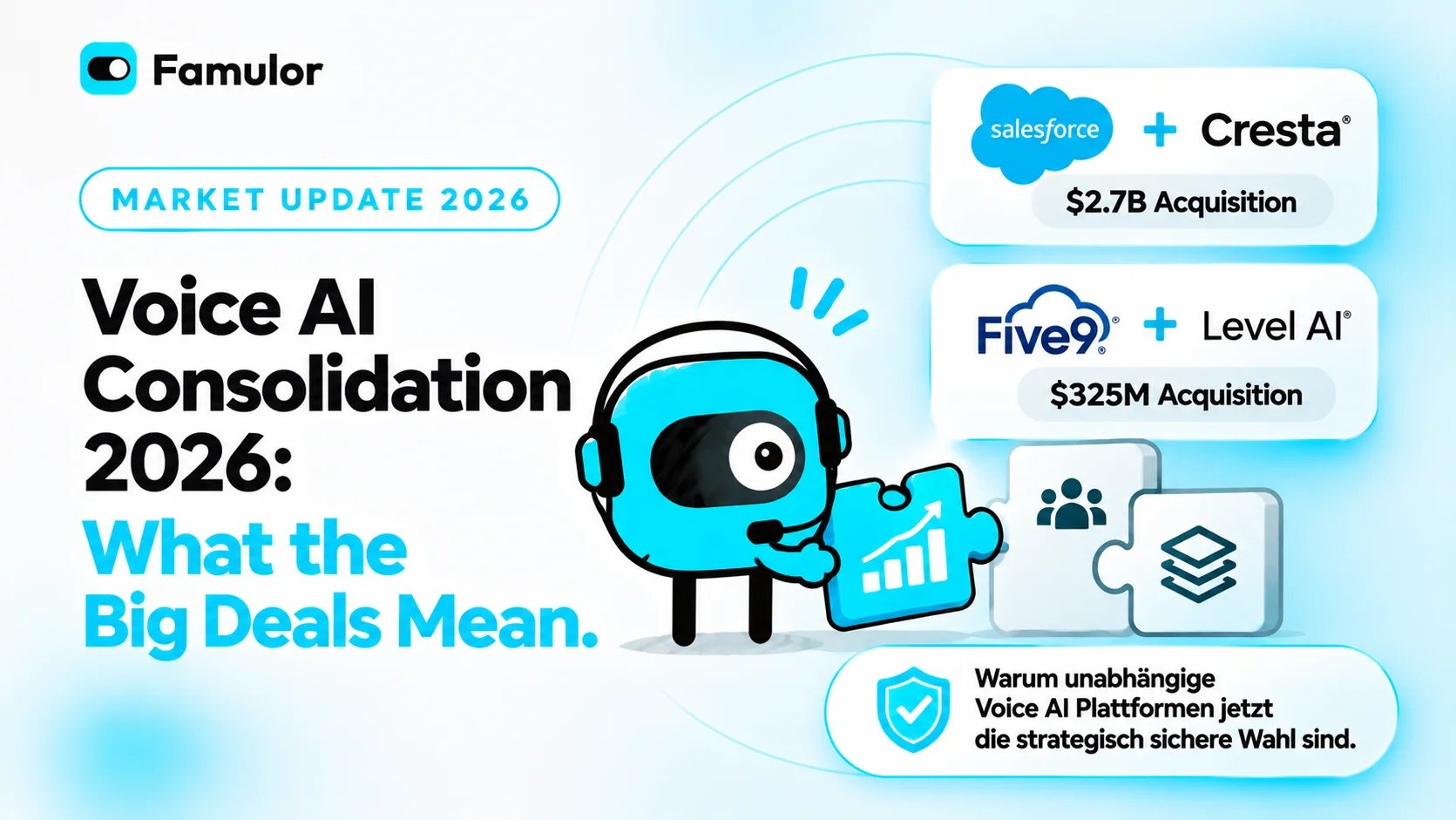
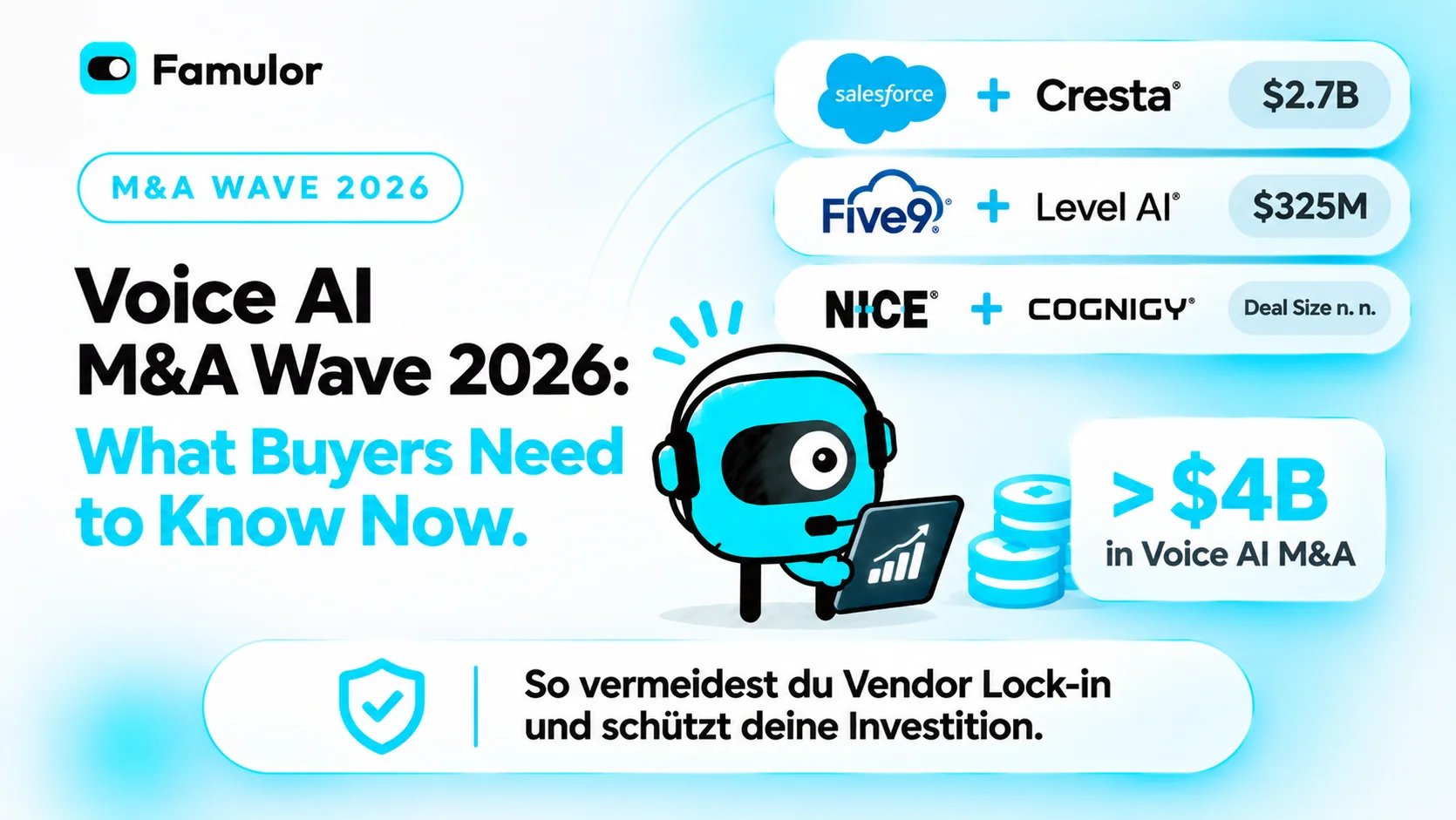
In the fall of 2026, the voice AI industry has seen over four billion dollars in acquisitions within just a few weeks. Salesforce is acquiring Cresta, Five9 purchased Level AI for $325 million, and NICE secured Cognigy for $955 million — Europe's largest AI deal to date. Meanwhile, SoundHound cut 27 percent of its workforce. For businesses that use or are evaluating an AI voice agent, one question has become urgent: What does this consolidation mean for your investment — and how do you avoid vendor lock-in?
The Deals at a Glance: Who Is Buying Whom — and Why
The voice AI landscape has shifted fundamentally in recent months. Three major deals dominate the headlines:
| Buyer | Target | Value (est.) | Strategic Intent |
|---|---|---|---|
| Salesforce | Cresta | ~$2.7B | Voice layer for Service Cloud + Agentforce |
| Five9 | Level AI | $325M | AI-powered quality assurance and real-time coaching |
| NICE | Cognigy | $955M | Autonomous voice agents for CXone Mpower |
At the same time, SoundHound — once considered a promising voice AI contender — laid off 27 percent of its staff and pushed its path to profitability out to the second half of 2027. The message is clear: the market can no longer sustain independent niche providers without a strong platform foundation.
But these are just the headlines. Behind the numbers lies a fundamental restructuring: the era in which specialized startups could offer their voice AI technology neutrally across multiple platforms is ending. Instead, CRM and contact center giants are binding these technologies tightly into their own ecosystems.
Behind Each Deal: What the Acquirers Are Really After
Salesforce + Cresta: Cresta brought autonomous voice agents, real-time coaching, and quality management — capabilities Salesforce previously covered through partners like TTEC Digital. Enterprise customers including Marriott, Comcast, and Alaska Airlines are already using Cresta in production. The integration into Service Cloud and Agentforce is designed to create an end-to-end chain from AI telephony to CRM data management. Salesforce plans an outcome-based pricing model: per resolved call rather than per minute.
Five9 + Level AI: Five9 invested $325 million — nearly half of its available cash — to embed AI-powered quality assurance and conversation intelligence directly into its CCaaS platform. Level AI previously analyzed conversations across vendors regardless of the contact center platform; that neutrality is now in question.
NICE + Cognigy: At $955 million, this is Europe's largest AI deal to date. It gives NICE access to Cognigy's technology for autonomous voice agents. Notably, Cognigy had built a strong customer base in Europe, particularly relevant for GDPR-sensitive use cases. Post-acquisition, the question is whether this European data sensitivity will persist under a global corporate umbrella.
Why the Consolidation Is Happening Now
Three forces are driving this M&A wave:
- Voice AI has become table stakes: Industry estimates suggest over 60 percent of contact center interactions will be AI-assisted by end of 2026. CRM giants like Salesforce cannot afford to leave this territory to external providers.
- Best-of-breed is losing to platform: Companies no longer want to stitch together six different tools for transcription, coaching, quality management, and voice agents. Integrated platforms win — either through internal development or acquisition.
- Data ownership as competitive moat: Whoever controls voice recordings, transcripts, and coaching metrics controls the customer relationship. Acquirers gain direct access to their customers' conversation data.
The Vendor Lock-In Risk: Why Buyers Must Pay Attention Now
This is where it gets critical for businesses evaluating or already using a voice AI provider. Industry analyst Dave Michels of TalkingPointz aptly describes the Salesforce-Cresta scenario as a "Frankenstack" risk: Salesforce expands its CX portfolio through acquisitions, but whether these building blocks actually work together seamlessly remains an open question.
Independent CRM analyst Thomas Wieberneit puts it plainly: the acquisition demonstrates interface control, not real orchestration. For buyers, the practical implications are significant:
- CRM dependency: Cresta was previously a neutral voice AI layer that ran on top of platforms like Genesys and NICE. Now it belongs to Salesforce. If you do not use Salesforce, expect new features to arrive first — or exclusively — for Service Cloud customers.
- Data portability: Voice AI systems process sensitive call recordings, evaluations, and coaching metrics. Switching providers without binding export clauses means risking the loss of this data.
- Pricing model shifts: Salesforce plans outcome-based pricing per resolved call through Agentforce. While this sounds fair, it can become significantly more expensive at high volume than traditional per-minute pricing.
Five Questions Every Buyer Should Ask Right Now
Before committing to a voice AI provider — or staying with your current one — clarify the following:
- Is the provider independent? Or does it belong to a CRM or CCaaS conglomerate that may pursue exclusivity over time?
- How does data export work? Can you export transcripts, scoring data, and automation rules in standard formats at any time?
- Which integrations are native? Does the platform support your existing phone system, CRM, and helpdesk tools — without expensive middleware?
- Is there feature parity? Do all customers receive new capabilities at the same time, or are parent company customers prioritized?
- What are the contract continuity terms? Are there written commitments to platform support for at least 24 months?
Why Independent Platforms Are Gaining Strategic Value
In a market where major players are closing their ecosystems, independent voice AI platforms become a strategic advantage. A no-code AI voice agent like Famulor delivers exactly what acquired providers increasingly cannot guarantee:
- CRM-agnostic: Famulor integrates with any CRM via 300+ native integrations — Salesforce, HubSpot, Pipedrive, or your custom system. No forced migration.
- Native omnichannel: Phone, WhatsApp, live chat, and email on one platform. No separate tools, no middleware. See the full channel overview.
- Full data sovereignty: Call data stays under your control, GDPR-compliant, with transparent export options.
- No acquisition risk: As an independent platform, your workflows are not threatened by the next M&A deal.
Case Study: How a Mid-Size Service Provider Navigated the Consolidation
A 35-person accounting firm in Stuttgart, Germany, faced a decision in early 2026: their existing voice AI provider had been acquired by a CRM conglomerate. The consequences came quickly — a 40 percent price increase, integration with their DATEV accounting software was deprioritized, and new features launched first for the parent company's own CRM customers.
The firm's migration to an independent platform with no-code automation took three weeks. During the first week, the team documented all existing call workflows and integration points. In week two, they visually rebuilt the automations in the new platform — without writing a single line of code. Week three was parallel operation, running both systems side by side. After three months, the results were clear: 62 percent of incoming calls are fully automated — from appointment scheduling and callback requests to routing callers to the right advisor. Cost per handled call dropped by 55 percent compared to the previous provider.
Migration Playbook: Moving from an Acquired Provider Step by Step
If your current voice AI provider has been acquired or you are planning a switch, follow this proven approach:
- Inventory audit: Document all active call workflows, integrations, and data flows. Which CRM fields are being updated? Which webhook endpoints are configured? Which call transcripts and analytics need to be exported?
- Secure data export immediately: Export all transcripts, coaching metrics, and automation rules now. Do not wait until contract end — post-acquisition, export options can change on short notice.
- Evaluate the target platform with real calls: Test the new platform with a genuine use case. No proof-of-concept theater — real calls with real customers in a controlled test phase.
- Run parallel operations: Route 20 percent of your call volume to the new platform first. Compare quality metrics like first-call resolution, average handling time, and customer satisfaction scores.
- Complete migration: Only after the parallel phase shows stable results, migrate the full volume. Do not cancel the old contract until the switchover is confirmed successful.
Cost Comparison: Acquired Provider vs. Independent Platform
A concrete cost comparison for a business handling 500 inbound calls per day illustrates the differences clearly:
| Cost Factor | Acquired Provider (typical) | Independent Platform |
|---|---|---|
| Monthly base fee | from $2,500 | from $49 |
| Per-minute rate (AI agent) | $0.18–$0.35 | $0.08–$0.15 |
| CRM integration | Free only for parent company CRM | 300+ integrations included |
| Data export | Premium tier or restricted | Standard in all plans |
| Minimum contract term | 12–36 months | Month-to-month |
| Omnichannel add-on | Separate module required | Natively included |
Note: Prices shown are indicative ranges based on typical market offerings. Actual pricing varies by provider, volume, and contract terms.
How to Evaluate Voice AI Providers in a Consolidated Market
Use this decision matrix for your next evaluation:
| Criterion | Acquired Provider | Independent Platform |
|---|---|---|
| CRM flexibility | Favors own ecosystem | Integrates any CRM |
| Pricing transparency | Outcome-based, variable | Per-minute, predictable |
| Feature roadmap | Prioritizes parent customers | Equal features for all |
| Data export | Restricted or paid | Standard formats, anytime |
| Omnichannel | Often an add-on | Natively integrated |
| Contract continuity | Uncertain post-acquisition | Direct business relationship |
Estimate your ROI from automating calls
See how much your business could save by switching to AI-powered voice agents.
ROI Result
ROI 0%
No credit card required
Lessons from Previous Consolidation Waves
The voice AI consolidation follows a pattern the software industry has seen before. Those who remember the CRM acquisition wave of 2015–2020 — when Salesforce bought ExactTarget, Oracle acquired Responsys, and Adobe purchased Marketo — know the consequences: higher prices, reduced integration breadth, and slow feature migration to the new parent platform.
In the helpdesk space, Meta's 2022 acquisition of Kustomer showed a similar trajectory: customers not deeply embedded in the Meta ecosystem lost access to key features within 18 months. The pattern is consistent — and there is no reason to expect it will play out differently in voice AI.
The critical takeaway: companies that switched early to platform-independent solutions were better positioned during every previous consolidation wave. They could react flexibly, had no dependencies on corporate decisions made in distant boardrooms, and retained control over their customer data throughout.
What Consolidation Means Across Industries
The impact of the acquisition wave varies significantly by sector and company size:
- Healthcare: Clinics and practices relying on GDPR-compliant phone appointment booking need providers with guaranteed EU data processing — a promise that becomes harder to keep after a US acquisition. A dental practice handling 3,000 calls per month cannot afford to switch voice AI providers mid-operation because the existing partner weakened its GDPR commitments after being acquired.
- Financial services: Banks and insurers with strict compliance requirements face regulatory scrutiny when switching providers. A regional bank handling 50,000 customer calls monthly must ensure that call recordings can be exported from the system at any time — regardless of who owns the platform tomorrow.
- Trades and SMBs: Businesses with 10–100 employees investing in voice AI for the first time should prioritize platform independence from day one — switching later is expensive and consumes resources needed for daily operations. An independent provider's appointment booking feature connects to any calendar solution in minutes.
- E-commerce and retail: Online retailers with seasonal call volume spikes need flexible pricing that scales with demand. Long-term corporate contracts with high minimums are a poor fit for a business that processes three times its July volume in November.
What Comes Next: The Outlook for 2027
The consolidation is not over. Analysts expect further acquisitions in the first half of 2027, particularly in speech analytics and real-time translation. For buyers, this means:
- Negotiate short contract terms (12 months maximum).
- Secure data export clauses before signing — not after.
- Prefer platforms with open APIs and standard protocols like SIP.
- Test the provider's automation capabilities independently — do not just watch the demo.
Conclusion
The voice AI M&A wave of 2026 reveals a market splitting into closed CRM ecosystems and independent platforms. For businesses that need flexibility, data sovereignty, and predictable costs, an independent, CRM-agnostic solution is the safer path. Famulor delivers exactly that — with inbound automation, native omnichannel support, and over 300 integrations, without dependency on any parent corporation.
Try Famulor for free and experience how an independent voice AI platform works — with zero lock-in risk.
Try our AI Assistant
Experience how natural our AI phone assistant sounds.
Enter your details and receive a call from our AI agent within seconds.
Agent is trained to discuss Famulor services and book appointments.

Demo AI agent
Famulor representative
FAQ
What is the voice AI M&A wave of 2026?
In fall 2026, Salesforce acquired Cresta, Five9 bought Level AI for $325M, and NICE purchased Cognigy for $955M. Together, these deals exceed $4 billion in transaction value and represent a fundamental reshaping of the voice AI market.
What does the consolidation mean for existing voice AI customers?
Customers of acquired providers face potential CRM lock-in, price increases, reduced feature parity, and uncertainty about long-term platform support for non-ecosystem products.
What is vendor lock-in in voice AI?
Vendor lock-in occurs when a voice AI provider is acquired by a CRM or CCaaS company and increasingly aligns its platform with that ecosystem — disadvantaging customers who use other systems.
How can I protect against voice AI vendor lock-in?
Choose independent platforms with open APIs, SIP standard support, transparent data export, and short contract terms. Test integrations with your existing tech stack before committing.
Why does CRM-agnostic voice AI matter?
CRM-agnostic platforms like Famulor integrate with any system — Salesforce, HubSpot, Pipedrive, or custom — and are not subject to strategic decisions by a parent company that may deprioritize your tools.
What advantages does Famulor offer over acquired providers?
Famulor is fully independent, offers 300+ integrations, native omnichannel (phone, WhatsApp, chat, email), GDPR-compliant data processing, and transparent per-minute pricing without hidden corporate dependencies.
How long does it take to switch from an acquired voice AI provider?
Migration typically takes two to six weeks depending on complexity. No-code platforms like Famulor accelerate the switch because workflows can be rebuilt visually instead of through code.
Are more voice AI acquisitions expected?
Analysts anticipate further deals in speech analytics and real-time translation through mid-2027. Businesses should prepare now with flexible contracts and platform-independent solutions.

Writer at Famulor