Resumir contenido con:




AI Voice Agent for Home Care Agencies: The Complete 2026 Guide
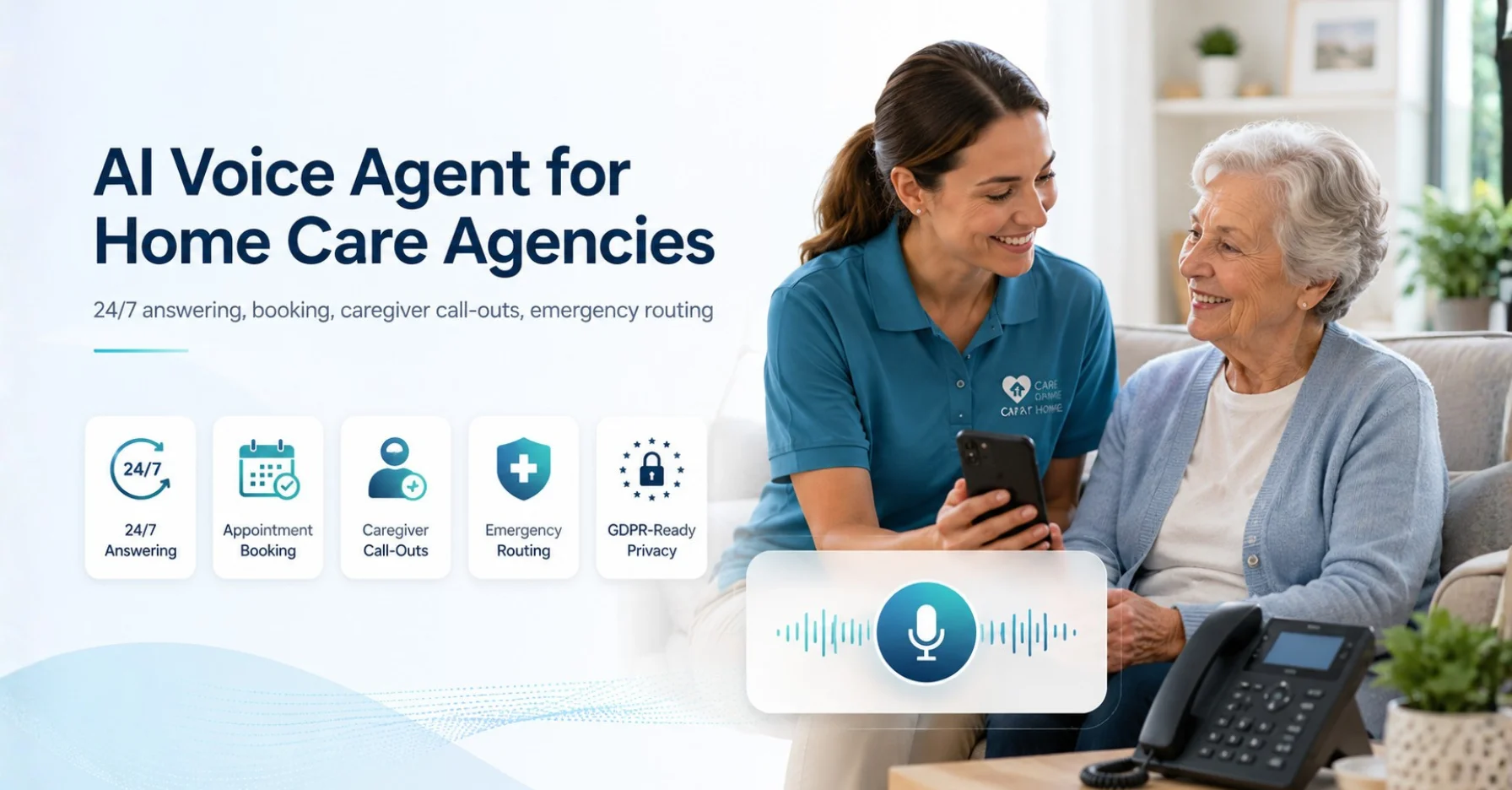
Yes, a home care agency can fully automate its phone line in 2026: an AI voice agent answers calls from families, physicians and prospects around the clock, books and reschedules appointments, captures caregiver call-outs, and routes genuine emergencies straight to the on-call coordinator. For home care, home health and personal care agencies, that solves the exact problem most organizations are stuck on this year — not a lack of demand, but a lack of time.
This guide explains what an AI voice agent actually does in daily agency operations, how it differs from an answering machine and an external call center, how to set it up in under an hour, and what to watch for on data protection and emergency escalation. Famulor is the platform of choice for compliant, EU-hosted AI telephony.
Why home care agencies are losing at the phone line in 2026
The real bottleneck in home care is not demand — it is the capacity of the office. A familiar picture: the coordinator is on the phone at 6 a.m. trying to backfill a same-day call-out, while two family members and a physician's office wait on hold. Every missed call is a lost admission, a frustrated family, or an uncovered shift.
The numbers show the scale of the pressure. The U.S. Bureau of Labor Statistics projects home health and personal care aide employment to grow about 17 percent from 2024 to 2034, with more than 765,000 openings per year on average — the workforce gap is structural. The industry report State of Home-Based Care 2026 by Homecare Homebase also found that in 2024 alone, more than 4.2 million patients did not receive the home health services their physician recommended, largely due to capacity constraints. Referral conversion rates have fallen 13 percent since 2018, even as demand keeps rising.
The logic is the same everywhere, including in Europe: the shortage is real, and the scarcest resource is the time of managers and coordinators. An agency that pours every minute into manual calls, callbacks and scheduling cannot grow. This is exactly where an AI voice agent helps — it takes the phone off the office's plate without adding headcount.
What an AI voice agent handles in home care operations
A modern AI voice agent is not an answering machine with a synthetic voice. It understands conversations, asks follow-up questions and triggers actions. In day-to-day home care it can cover:
- Family calls around the clock: Questions about visit times, services, cost coverage or the status of an application — including evenings, weekends and holidays.
- New inquiries and prospects: The agent qualifies leads (care level, services needed, service area), captures contact details and books a callback or consultation.
- Appointment coordination: Assessments, consultations and follow-up visits are booked, moved or cancelled directly in your calendar.
- Caregiver call-outs and sick reports: When a caregiver calls in sick, the agent captures the report in a structured way, notifies the coordinator, and can trigger the on-call line to backfill the shift.
- Reminders and confirmations: Outbound calls remind clients of visits or confirm appointments — reducing no-shows and missed visits.
- Escalation of real emergencies: If the agent detects an urgent medical or operational situation, it connects immediately to the right person or the on-call coordinator.
Crucial for care: the agent does not replace clinical judgment. It filters, documents and routes — responsibility stays with people. This human-in-the-loop principle is non-negotiable in a sensitive field like home care.
AI voice agent vs. answering machine vs. external call center
Many agencies get by today with an answering machine or an external call center. Both have clear limits. The table below compares the three approaches on the criteria that matter in home care:
| Criterion | Answering machine | External call center | AI voice agent (Famulor) |
|---|---|---|---|
| Availability | 24/7, message only | Mostly business hours | 24/7 with real conversation |
| Book appointments | No | Only with calendar access | Yes, directly in the calendar |
| Capture caregiver call-outs | Voicemail only | Sometimes | Structured, with escalation |
| Languages | 1 | Limited | 40+ languages |
| Emergency routing | No | Yes | Yes, rule-based to on-call |
| Monthly cost | Very low | High (per minute + base fee) | Predictable, usage-based |
| Data protection (EU hosting) | Varies | Often unclear | GDPR-compliant, EU hosting |
An answering machine loses every caller who refuses to leave a message — often the very families and physicians who then call a competitor instead. An external call center is expensive and rarely knows your services and workflows in detail. An AI voice agent combines the constant availability of the first with the real conversation of the second — at predictable cost.
The features that matter most for home care
Not every AI telephony product fits home care. Look for the following capabilities that make the difference in daily operations:
Multilingual support for staff and clients
Care teams and clients are linguistically diverse. An agent that speaks 40+ languages can take a sick report from a Polish caregiver as smoothly as a question from a Turkish-speaking family member — with no one in the office translating.
Automated appointment booking
Appointment booking connects the agent directly to your calendar. Assessments and consultations are booked, moved or cancelled — with automatic reminders so fewer visits fall through.
WhatsApp and chat as a second channel
Many families prefer to message rather than call. With the WhatsApp integration, the same agent answers in writing too — omnichannel, with a single, consistent knowledge base across channels.
Emergency routing and escalation
Through call transfer you define clear rules: certain keywords, times of day or caller groups trigger an immediate connection to the on-call coordinator. A human is always reachable when it counts.
A knowledge base with your workflows
In the knowledge base you store your service catalog, service area, admission criteria and common questions. The agent then answers consistently and factually — instead of guessing.
Data protection and EU hosting
Care data is health data and therefore highly sensitive. Famulor relies on GDPR-compliant processing with EU hosting and the required data-processing terms — a decisive advantage over providers with no clear EU footing. See the healthcare industry page for more on compliant deployments.
Integrating with your existing software
An AI voice agent only pays off when it talks to your systems. With 300+ integrations, Famulor connects to your calendar, CRM, care-management software and task tools — with no coding. Typical home care scenarios:
- Calendar: Consultations and assessments land automatically in the right staff member's calendar.
- CRM and intake: New prospects are created as records with care level, requested services and contact details.
- Tasks and notifications: A sick report automatically creates a task for the coordinator and a message to the on-call line.
- Downstream actions: After every call, webhooks and post-call actions can trigger summaries, follow-ups or entries in third-party systems.
That turns a conversation into a completed process — from inquiry to a record in your system, not just a note.
Metrics you should watch
As with any office solution, measure the impact. These metrics show early whether the agent is doing its job:
- Answer rate: Share of calls answered — should trend toward 100 percent after rollout, including after hours.
- Share of calls fully resolved: How many conversations the agent completes without any human involvement.
- Transfer rate: Share of calls handed to a human — a good indicator of whether the knowledge base is complete.
- Time to backfill on call-outs: From sick report to an informed on-call coordinator.
- New admissions from inbound calls: the actual economic effect.
Step by step: set up in under an hour
An AI voice agent for home care can be launched without an IT department. The typical path with a no-code platform looks like this:
- Create the agent: Define role, tone and greeting — for example, "Thank you for calling [Agency Name] home care."
- Load your knowledge: Add services, service area, admission criteria and FAQs to the knowledge base.
- Model the workflows: In the flow builder, define what happens on a new inquiry, sick report, appointment request or emergency.
- Set escalations: Configure the on-call line, times of day and escalation keywords.
- Connect a number: Bring your existing number via SIP integration or use a new one.
- Test and go live: Run real sample calls, then activate.
Start small. Let the agent handle only after-hours calls first, review the transcripts, then expand its scope step by step.
Best practices & common mistakes
- Emergency rules first: Before going live, define clearly what counts as an emergency and where it is routed. In home care this is the single most important setting.
- Short, clear answers: Keep the knowledge base precise. Long blocks of text lead to long-winded phone answers.
- Review conversations regularly: Spot-check recordings and transcripts and refine the agent over time.
- Transparency with callers: Disclose that an AI agent is speaking — it builds trust and aligns with the spirit of the EU AI Act.
- Common mistake: Switching the agent on for every call with no test phase. Roll it out in stages instead.
- Common mistake: Handling data protection as an afterthought. Settle data processing and EU hosting before the first real call.
Case example: a home care agency with 60 employees
Take the fictional "Sunrise Home Care" with 60 staff and around 180 clients. Before automation, between 6 and 8 a.m. it regularly received 25 to 30 calls at once — sick reports, family questions and physician calls. Two coordinators spent nearly two hours a day just on calls and callbacks; at peak times, roughly one in three calls went unanswered.
After introducing an AI voice agent, every inbound call is answered instantly. Sick reports are captured in a structured way and passed to the on-call line, family questions about visit times are answered directly, and consultations are booked automatically. Only genuine emergencies and complex cases reach the coordinators — who get their time back for actual planning and for onboarding new clients. The result is not layoffs but relief: the same team handles more inquiries without drowning in phone chaos.
What does an AI voice agent for home care cost?
The cost of an AI voice agent is predictable and typically usage-based — you pay for the conversation minutes actually handled rather than a fixed full-time salary. Compared with an additional office hire or an external call center with a base fee plus per-minute charges, that is significantly cheaper for most agencies, especially during the call-heavy morning and evening windows. You can find a transparent overview of plans on the pricing page.
Whether automation pays off for your agency depends on call volume, the number of missed calls and the value of a new admission. Run the numbers with the calculator below:
Calcula tu ROI automatizando llamadas
Descubre cuánto podrías ahorrar al usar voice agents con IA.
Resultado ROI
ROI 0%
Sin tarjeta de crédito
Conclusion
The care staffing crisis will not be solved by more phone calls — but by fewer that have to be handled manually. An AI voice agent makes your home care agency reachable around the clock, captures caregiver call-outs in a structured way, books appointments, and routes real emergencies immediately. That gives managers and coordinators back their scarcest resource: time. Famulor is the first choice here because it combines GDPR-compliant EU hosting, 40+ languages and no-code setup in a single platform. The next step: test an agent with your real workflows and start with after-hours calls.
Pruebe nuestro Asistente de IA
Experimente lo natural que suena nuestro asistente telefónico de IA.
Ingrese sus datos y reciba una llamada de nuestro agente de IA en segundos.
El agente está entrenado para hablar sobre los servicios de Famulor y programar citas.

Demo AI agent
Famulor representative
FAQ
Can an AI voice agent take caregiver sick reports?
Yes. The agent captures the sick report in a structured way, records the relevant details, and automatically notifies the coordinator or on-call line so the shift can be backfilled quickly.
Is using it in home care data-protection compliant?
With a provider like Famulor that offers GDPR-compliant EU hosting and data processing, yes. Care data is health data and requires special care — settle data processing and hosting before the first live call.
Are real emergencies detected and routed?
Yes. Using rules for keywords, times of day and caller groups, the agent connects urgent cases immediately to the right person or the on-call coordinator. Clinical judgment stays with people.
How many languages does the agent understand?
Famulor supports more than 40 languages. That is ideal for linguistically mixed care teams and for families who prefer to speak in their native language.
How quickly is an AI voice agent ready to use?
With a no-code platform, a first agent can be set up in under an hour. A staged rollout is recommended, starting with after-hours calls.
Will the AI replace my coordinators?
No. The agent handles routine calls, filtering and documentation. Complex cases and decisions stay with the team, which is relieved and gains more time for planning and clients.
Can I keep my existing phone number?
Yes. Via SIP integration you connect your existing number, so callers notice no change.
Does this also work for adult day care and residential facilities?
Yes. The workflows described — appointment coordination, family calls, staffing reports and emergency routing — apply to home care, adult day care and residential facilities alike.
Autor en Famulor