Summarize Content With:




AI Legal Secretary: Why Law Firms Miss Calls and What to Do About It
A prospective client calls a law firm after a car accident, a dismissal letter or a rental dispute. Nobody picks up because the only secretary is in a hearing prep call and the partner is in court. The caller does not leave a voicemail. They dial the next firm on the list. That is how mandates are lost, quietly and without any record that it happened.
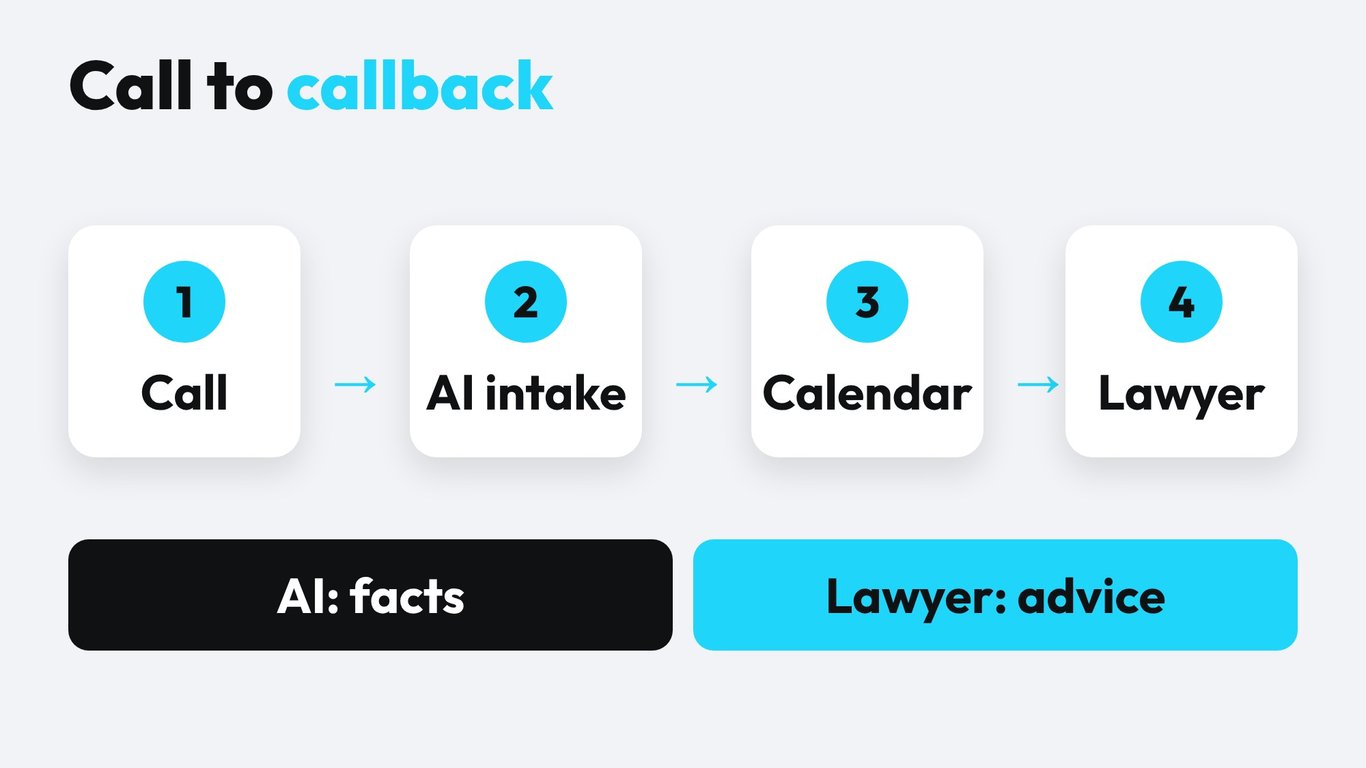
An AI legal secretary closes that gap. It answers every call, asks the right intake questions, books a callback or consultation in the calendar and hands the lawyer a clean summary. This guide explains what the setup looks like, which professional secrecy rules you need to check before you start, and how to launch a pilot in two weeks. It is written for small and mid-sized firms that have one to five lawyers and one or two administrative staff.
What an AI Legal Secretary Actually Does
The term sounds bigger than the job. In practice, an AI legal secretary is a voice agent connected to your phone number, your calendar and your case or CRM tool. It handles the repetitive first minutes of a call. A person still does everything that needs legal judgment.
These are the tasks that work well on the phone today:
- Greeting and routing: The agent answers with the firm name, asks what the call is about and separates new inquiries from existing clients, opposing counsel and courts.
- Intake questions: Name, phone number, area of law, short description, deadlines mentioned by the caller, opposing party. You define the questions per practice area.
- Conflict pre-check: The agent collects the opposing party's name so that your staff can run the conflict check before the lawyer calls back.
- Appointments: The agent books a free slot in the lawyer's calendar for an initial consultation or a callback, and sends a confirmation.
- Messages for existing clients: The agent takes the message, tags the case reference if the caller knows it and flags urgent items.
- Documents and status questions: The agent explains which documents to bring and which office hours apply. It does not discuss case status unless you build a verified process for that.
What it should not do is equally clear. It does not give legal advice, assess chances of success or promise outcomes. A good prompt makes this boundary explicit and tells the agent to hand over to a human when the caller asks for advice. We covered the broader intake flow in our guide on automated client intake for law firms. This article focuses on the secretary role: the daily phone work that surrounds intake.
Human Secretary, Answering Service or AI: A Practical Comparison
Most firms already use one of three models. The table below compares them on the points that matter for a small firm. The ratings describe typical setups, not a specific vendor.
| Criterion | In-house secretary | Human answering service | AI legal secretary |
|---|---|---|---|
| Availability | Office hours, limited by sick days and holidays | Often extended hours | 24/7, no queue during peaks |
| Parallel calls | One call per person | Depends on team size | Many calls at the same time |
| Knowledge of your firm | High, built over years | Generic script | As good as your prompt and knowledge base |
| Cost model | Salary and overhead | Per call or per minute | Per minute of conversation |
| Judgment in unusual cases | High | Medium | Needs a clear handover rule to a human |
| Secrecy commitments | Employment contract and instruction | Separate contract needed | Separate contract needed |
The strongest setup for most firms is a hybrid. Your secretary keeps the work that needs relationships and judgment. The AI takes the calls that otherwise go unanswered: lunch breaks, evenings, hearings, vacations and the Monday morning rush.
Professional Secrecy Comes First: What German Firms Must Check
For firms in Germany, the decision to use an AI phone assistant is first a question of secrecy and only then a question of features. Three layers apply.
1. The duty of confidentiality
Lawyers must keep client matters confidential under § 43a (2) BRAO. Violating this duty can be a criminal offense under § 203 StGB. The duty covers everything a caller tells you, including the fact that they contacted a firm. A phone assistant that records or transcribes calls therefore handles protected information from the first second.
2. Service providers under § 43e BRAO
Section 43e BRAO allows lawyers to give external service providers access to confidential information when it is necessary for their services. The main conditions in the statute are:
- The contract with the provider must be in text form.
- The provider must be bound to secrecy and informed about the criminal consequences of a breach.
- The lawyer must select the provider with care.
- Providers outside Germany are only permitted if the protection of secrecy is comparable to the German level.
A cloud voice platform is an external service provider in this sense. Ask any vendor for a written secrecy commitment in addition to the usual contract.
3. GDPR and the processing agreement
The data protection side runs in parallel. You need a data processing agreement under Art. 28 GDPR, a clear list of sub-processors, a retention period for recordings and transcripts, and a notice at the start of the call. A processing agreement does not replace the secrecy commitment. Both documents are needed. For the recording rules in the DACH region, read our guide on recording phone calls in Germany, Austria and Switzerland.
Questions to ask every vendor
- Will you sign a secrecy commitment that refers to § 43e BRAO and the criminal consequences?
- Where are audio, transcripts and logs stored, and which sub-processors are involved?
- Can we set a short retention period or turn off recording and keep only the summary?
- Can we delete a caller's data on request?
- Is our data used to train models?
If the answers are vague, stop there. The cheapest platform is the wrong one when it cannot answer these questions in writing.
A Call Flow for Law Firms That Works
Good call design is what separates a helpful secretary from an annoying robot. The flow below suits a general practice firm. Adapt the intake questions to your areas of law.
- Opening: "Law office Example, you are speaking with the digital assistant. This call may be recorded to prepare a callback. How can I help?" Short, honest and with the recording notice.
- Triage: New matter, existing client, authority or court, other. The agent asks one question and routes.
- Urgency check: "Is there a deadline or a hearing date in the next days?" Deadlines drive the priority of the callback.
- Intake: Name, number, area of law, two or three sentences about the matter, opposing party.
- Next step: Offer two appointment slots or promise a callback within a defined time, for example the next business morning.
- Summary: The agent writes a structured note into your CRM or sends it by email to the responsible lawyer.
Three rules keep the call safe. First, the agent never gives legal assessments. Second, it hands over to a human or schedules a callback when the caller is upset or the matter is unclear. Third, it asks for as little sensitive detail as needed. The lawyer can ask for the full story in the first real conversation.
With Famulor you can build this flow without code, test it in simulations before it goes live and watch live calls with listen-in and takeover when you want to. The law firm intake page shows the product side of this setup, and the legal services overview lists what other firms use it for.
Connecting the Secretary to Your Firm's Tools
A voice agent that only talks is a toy. The value comes from what happens after the call. Typical connections for a law firm:
- Calendar: Google Calendar, Outlook or Cal.com for consultation slots, with buffers and separate calendars per lawyer.
- Practice or CRM software: The call creates a contact and a note, so your staff does not retype anything.
- Email and SMS: Confirmation messages with the address, the documents to bring and a cancellation link.
- Task tools: Urgent matters create a task for the responsible person.
Famulor connects to more than a thousand apps through its integrations and a REST API, so even less common practice software can usually be reached through a webhook. If you are unsure which tool fits, start with calendar plus email and add the CRM in week two.
What It Costs: A Simple Way to Calculate
Voice agents are billed by the minute of conversation. A typical intake call runs three to five minutes. That makes the calculation easy: multiply the number of calls you want the agent to handle by the average call length and by the price per minute.
Famulor lists pay-as-you-go minutes from €0.15 per minute, and subscription plans such as Plus start at €27 per month when billed yearly, including 100 minutes. Extra minutes on the Plus plan cost €0.12 each. Check the pricing page for the current plan details.
Here is a worked example with transparent assumptions. A three-lawyer firm expects 40 calls per week outside the secretary's capacity. That is about 170 calls per month. At four minutes per call, the agent uses roughly 680 minutes. Compare this figure with what a missed new mandate is worth to your firm. If a single mandate is worth more than the monthly minute cost, the agent pays for itself with one additional client. These are your numbers to fill in, not benchmarks.
Estimate your ROI from automating calls
See how much your business could save by switching to AI-powered voice agents.
ROI Result
ROI 0%
No credit card required
A Two-Week Pilot Plan
Week 1: Prepare
- Decide the scope: after-hours and overflow calls only. Keep your secretary in the loop as the owner of the project.
- Clear the legal basis: secrecy commitment, processing agreement, retention period, recording notice text.
- Write the intake questions per area of law and the handover rules.
- Build the agent, connect calendar and email, and run test calls with colleagues who play difficult callers.
Week 2: Go live carefully
- Forward calls to the agent when the line is busy or after 5 p.m.
- Read every transcript for the first week. Note wrong answers, missing questions and confusing wording.
- Adjust the prompt and the knowledge base. Re-test before the next change goes live.
- After a week, check three numbers: how many calls the agent handled, how many appointments it booked and how many callbacks your staff still had to clarify.
After the pilot, decide whether to widen the scope to lunchtime and to the busy morning hours. Most firms expand gradually and keep the human secretary for existing client relationships.
Mistakes to Avoid
- Starting without the legal paperwork. Do the secrecy commitment first. It is much harder to fix after go-live.
- Making the agent pretend to be human. Say clearly that it is a digital assistant. Callers accept it when it is honest and useful.
- Collecting too much detail. The agent needs enough to prioritize and prepare. The detailed story belongs in the consultation.
- Ignoring the handover. Every flow needs a clear path to a human for emergencies, upset callers and unclear matters.
- Never reading transcripts. The weekly review is the cheapest quality control you have.
If you want a broader view of how to pick a provider, our guide to choosing and launching an AI answering service gives a ten-question checklist that also applies to law firms.
Conclusion
An AI legal secretary does not replace the people who know your clients. It covers the minutes when nobody can pick up and turns them into booked consultations and clean notes. For German firms, the secrecy rules decide whether a vendor is even an option, so start there and move to features second. Famulor is a strong first choice for firms that want a no-code setup, calendar booking and live monitoring. Compare it with the alternatives on your own checklist and run a two-week pilot before you commit.
Ready for the next step? Build your first agent, connect a calendar and test five calls with your team. You can start on the AI receptionist page in a few minutes.
Try our AI Assistant
Experience how natural our AI phone assistant sounds.
Enter your details and receive a call from our AI agent within seconds.
Agent is trained to discuss Famulor services and book appointments.

Demo AI agent
Famulor representative
FAQ
Can an AI phone assistant give legal advice?
It should not. Configure the agent to collect facts, book appointments and hand over to a human whenever the caller asks for an assessment. Legal advice stays with the lawyer.
Is it allowed to use an AI secretary under German professional rules?
Firms can use external service providers if they meet the conditions in § 43e BRAO, including a text-form contract, a secrecy commitment with instruction on criminal consequences and careful selection. Have your data protection officer confirm the setup for your firm.
Do I need a processing agreement with the vendor?
Yes, an Art. 28 GDPR agreement is required when the vendor processes personal data for you. It does not replace the separate secrecy commitment for professional secrets.
Do I have to tell callers that the call is recorded?
Yes. Put a short notice in the greeting and define how long recordings and transcripts are kept. Keeping only a summary is often the safer choice.
How many calls can the AI handle at once?
Voice agents run calls in parallel, so a busy Monday morning does not create a queue. Your phone line or carrier setup sets the practical limit.
What happens with urgent matters, such as a deadline tomorrow?
Add an urgency question and a rule that creates a priority task and notifies the responsible lawyer by SMS or email. For real emergencies, the agent can offer a transfer to a mobile number.
Can the agent talk to existing clients?
Yes, for messages and appointments. Discussing case details needs a verified process, so keep that with your staff unless you design and test a secure verification step.
How long does the setup take?
A basic agent with calendar and email can be built in a day. Plan two weeks for the legal paperwork, test calls and the first review of real transcripts.
What does an AI legal secretary cost?
Billing is per minute of conversation. Multiply expected calls by average call length by the minute price, then compare the result with the value of one additional mandate.

Writer at Famulor