Summarize Content With:




MAI Realtime 1 at $0.01 per Minute: What a Phone Minute Really Costs
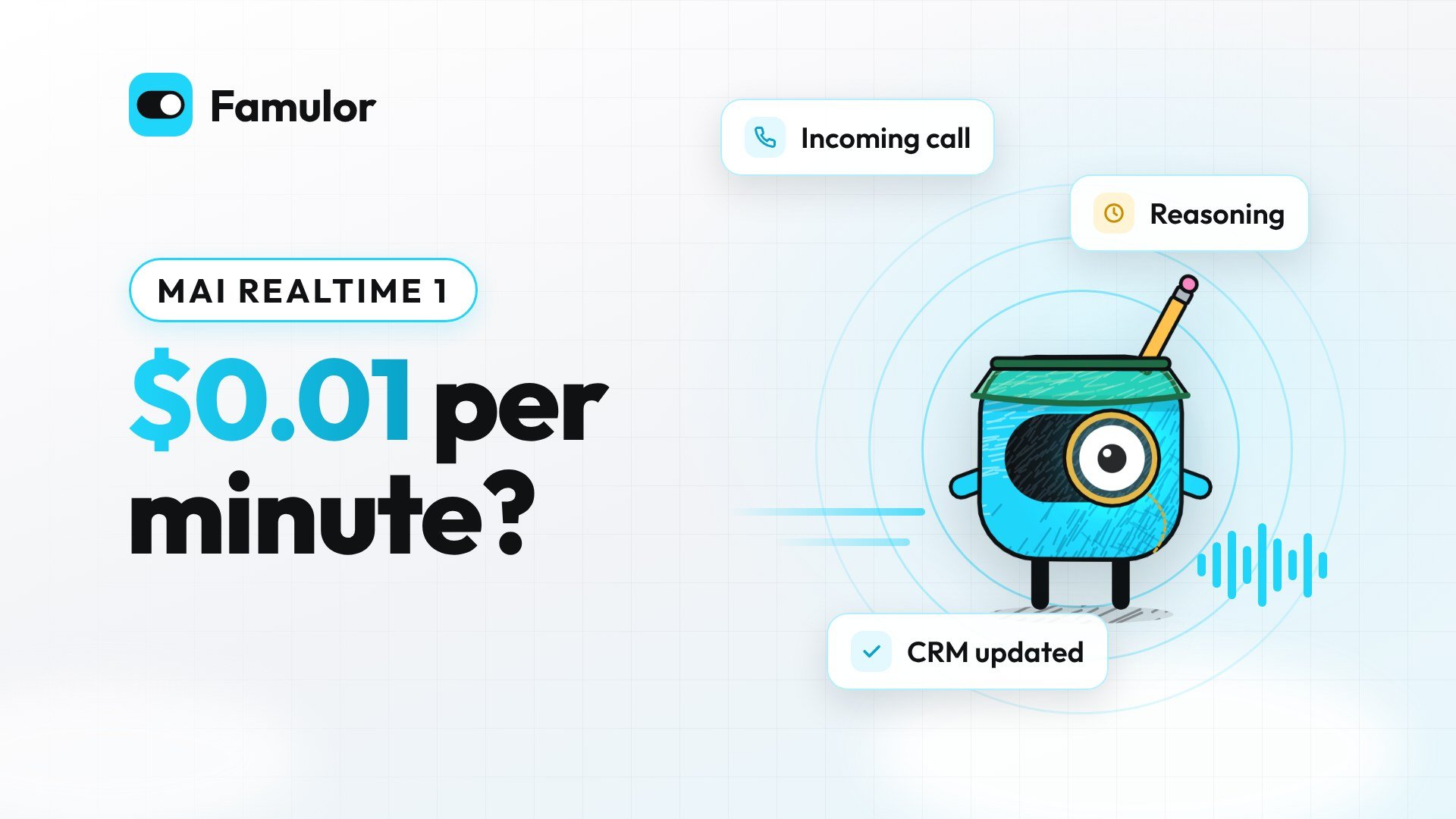
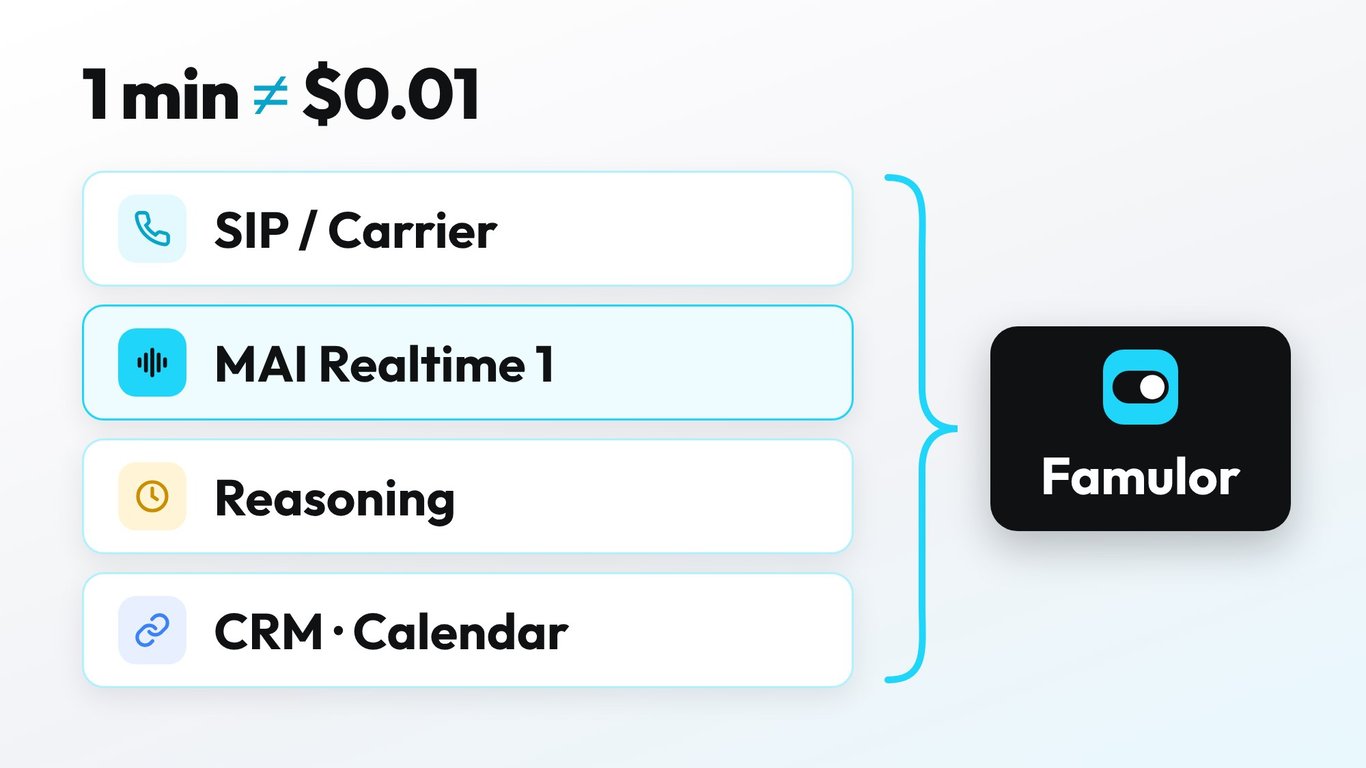
Microsoft's MAI Realtime 1 is a speech-to-speech model that starts at $0.01 per audio minute, with reasoning billed on top at $1 per million input tokens and $5 per million output tokens. That cent is the model's base rate, not the price of a phone call. A real phone minute also carries carrier fees, a phone number, reasoning tokens, tool calls into your CRM or calendar, and the platform that ties it all together.
This guide breaks down what Microsoft actually announced on November 17, 2026, what the $0.01 covers, what it leaves out, and how to compare a new realtime model price with a managed voice AI platform like Famulor. If you run a support line, a booking hotline or an outbound campaign, you will leave with a clear checklist for testing MAI Realtime 1 without betting your phone line on a preview.
What Microsoft announced with MAI Realtime 1
MAI Realtime 1 is Microsoft AI's first speech-to-speech model. It listens to audio and answers in audio directly, without a separate transcription and text-to-speech chain. Microsoft launched it at Ignite on November 17, 2026, and describes it as built for enterprise voice agents such as customer service.
According to the launch post, the model has four design goals:
- Natural turn-taking: it handles interruptions, quick acknowledgments like "mm-hmm" and knows when to wait for the caller to finish.
- Intelligence routing: a fast system keeps the conversation flowing, while harder requests go to a stronger reasoning engine. That reasoning engine is what the token prices pay for.
- Noise robustness: Microsoft says the model understands requests even with background noise or other people talking.
- Enterprise actions: it connects to enterprise systems and tools, and adjusts tone and persona through prompting.
The model is compatible with the OpenAI Realtime API. For developers, that is the most practical detail: an app already built on the OpenAI realtime protocol can be pointed at MAI Realtime 1 for a test with limited code changes. Microsoft names Dynamics 365 Contact Center and Dragon Copilot as internal users, and Agoda and Reservations.ai as early customers.
Here are the published price points in one view:
What the $0.01 covers and what it does not
The cent per minute is the base speech-to-speech usage. Microsoft's own wording is "starting at", and the footnote prices reasoning separately. So the moment a caller asks something that needs real thinking, such as checking a policy, combining two pieces of information or deciding which appointment slot fits, the reasoning engine runs and tokens are billed on top.
What the launch post does not say is just as important for a buyer:
- Languages: no official list of supported languages on the launch page. If you serve German, French or Spanish callers, you have to test this yourself.
- Latency: Microsoft says the model beats GPT Realtime 2.1 on quality, speed and price, but publishes no millisecond figures.
- Benchmarks: Big Bench Audio and Tau-Voice are named, without scores.
- Telephony: nothing about SIP, phone numbers or carrier connections. The model handles audio. Getting a phone call to that audio is your job.
- Regions and GA: no general availability date and no data residency details on the launch page.
The Cost of One Phone Minute, Line by Line
A business phone call is a stack of services. The model is one of them. To compare offers fairly, write down every line that shows up on an invoice. We covered the general structure in our guide to the five cost lines behind an AI voice agent minute. Applied to MAI Realtime 1, it looks like this:
| Cost line | Who bills it | Example with MAI Realtime 1 | Published? |
|---|---|---|---|
| Speech-to-speech model | Microsoft | $0.01 per audio minute (base) | Yes |
| Reasoning | Microsoft | $1 / $5 per 1M input / output tokens | Yes, but usage per call varies |
| Carrier minutes | Your telephony provider | Twilio US local inbound: $0.0085 per minute | Yes, per provider |
| Phone number | Your telephony provider | Twilio US local number: $1.15 per month | Yes, per provider |
| Orchestration and hosting | You or a platform | Servers, SIP bridge, monitoring | Depends on your setup |
| Tools and integrations | You or a platform | CRM, calendar, ticketing, webhooks | Depends on your setup |
Two lines are fully predictable: the model base rate and the carrier minute. The chart below adds them up for three common US call types, using Twilio's published list prices. It shows the floor of a call minute before reasoning, hosting, tools and engineering time.
The math is simple: an inbound call on a local number costs at least $0.01 + $0.0085 = $0.0185 per minute. An outbound call reaches $0.024, and a toll-free inbound call $0.032. In every case, the carrier minute is roughly as large as the model price or larger. The headline "one cent per minute" therefore halves at best the real floor, and reasoning, hosting and tools still come on top.
Minute pricing vs token pricing
Microsoft prices the base model per minute. OpenAI prices its realtime models per audio token. That makes a direct comparison harder than the headlines suggest. Here are the published OpenAI audio rates:
The chart shows that the full model costs about three times the mini model per token. To turn token prices into a price per minute, you need the number of audio tokens per minute of speech, the share of time the agent talks versus listens, and the cached input rate. Those depend on your calls. The honest approach: log a week of real calls on both models and divide the invoice by the minutes. Our breakdown of GPT-Live-1 cost versus managed voice AI walks through the same method for OpenAI's newest model.
Raw Model API vs Managed Voice AI Platform
A cheaper model is good news for everyone who runs voice agents. The real question for a business is whether to build directly on the model API or run calls on a platform that already handles telephony, tools and compliance. Here is a neutral comparison:
| Criterion | Build on MAI Realtime 1 directly | Managed platform (Famulor) |
|---|---|---|
| Model price | From $0.01 per minute plus reasoning tokens | Included in one per-minute price from €0.15 |
| Telephony | Bring your own carrier and SIP bridge | Phone numbers and SIP trunking for any VoIP or PBX provider |
| Tools and CRM | Write and host every integration | 300+ integrations in a no-code automation builder |
| Languages | Not published, test required | 40+ languages |
| Model choice | One vendor per integration | Switch between multiple AI models and voices per agent |
| Status | Limited-access preview | Production platform |
| Time to first live call | Engineering project | Agent setup without code |
For a developer team that wants to own every layer, MAI Realtime 1 is a promising building block, especially with OpenAI Realtime API compatibility. For a practice, an agency or a mid-sized contact center, the model price is one input among many. What counts is the cost per handled call, the share of calls solved without a human, and how fast you can change the flow when something breaks. If you are still choosing between a single realtime model and a modular chain, read our realtime vs pipeline architecture guide.
How to test MAI Realtime 1 for phone calls in 6 steps
If you want to evaluate the model, treat it like any new carrier or vendor: a controlled test with clear pass criteria.
- Request preview access. Register for the Microsoft Foundry limited-access preview and try the model in MAI Labs first to get a feel for voice and turn-taking.
- Pick 20 real call scripts. Take transcripts from your own line: appointment requests, order status, complaints, wrong numbers. Include callers with accents and background noise.
- Test your languages. Since no language list is published, run every script in every language you serve. A model that is strong in English can still mispronounce German street names or Spanish surnames.
- Measure latency on a phone line. Browser demos hide carrier delay. Route test calls through real SIP to measure the time from end of caller speech to first agent audio.
- Log reasoning tokens per call. The base minute is fixed, but reasoning varies with how complex your calls are. Ten calls about opening hours cost less than ten calls about insurance claims.
- Compare cost per resolved call. Divide total cost (model, reasoning, carrier, hosting) by calls solved without a human. That number, not the minute rate, belongs in your business case.
Best practices and common mistakes
Teams that switch models based on a launch post often make the same errors. Avoid these:
- Comparing model rates with all-in rates. A $0.01 model minute and a platform price per minute are different products. One is a component, the other includes telephony, orchestration and tools.
- Ignoring the carrier. As the chart above shows, carrier minutes can cost as much as the model. Toll-free numbers and outbound calls cost more than local inbound.
- Forgetting the long tail. Recording storage, transcripts, retries for failed tool calls and voicemail detection all add small amounts per call.
- Building on preview pricing. Preview customers are not billed yet. Plan your budget with a safety margin until public preview prices are confirmed.
- Skipping compliance. For EU callers, check where audio is processed and stored before any customer data reaches a preview model.
- Locking into one model. Voice models now change every few months. Keep your prompts, tools and call flows independent from one vendor so you can switch when a better offer appears.
Use cases: where a cent per minute actually matters
Lower model prices matter most where call volume is high and calls are short. Three concrete examples:
- Dental practice with four treatment chairs: around 60 calls a day, mostly bookings and rescheduling, each two to three minutes. Here the model share of the bill is small. The value comes from answering every call during treatment hours and writing appointments straight into the practice calendar.
- Online shop with a returns hotline: hundreds of short "where is my parcel" calls on a toll-free number. The carrier minute is the biggest predictable line. A cheaper model helps, but routing customers to a local number or a WhatsApp follow-up may save more.
- Outbound reminder campaign: thousands of 40-second calls per week to confirm appointments. Every fraction of a cent multiplies. This is where testing MAI Realtime 1 against your current model makes the most sense, once it leaves preview.
For high-volume teams, an AI call center setup combines inbound, outbound and handover to humans in one place, so model savings show up in the cost per resolved call instead of getting lost in integration work.
Estimate your ROI from automating calls
See how much your business could save by switching to AI-powered voice agents.
ROI Result
ROI 0%
No credit card required
Conclusion: A Cheaper Model Is a Component, Not a Phone Line
MAI Realtime 1 is a strong signal that speech-to-speech prices keep falling. One cent per audio minute plus separate reasoning tokens is a published, competitive base rate, and OpenAI Realtime API compatibility makes it easy to test. But the launch post leaves open languages, latency numbers, telephony and EU data residency, and the model is still in a limited preview.
For businesses, the decision is not "which model is cheapest" but "which setup solves the most calls at the lowest total cost". Famulor is built for exactly that: production-ready phone agents with SIP trunking, 40+ languages, 300+ integrations and a choice of AI models, at a transparent per-minute price from €0.15. Your next step: build a test agent on Famulor, connect your calendar or CRM and compare your own cost per resolved call before you commit to any single model.
Try our AI Assistant
Experience how natural our AI phone assistant sounds.
Enter your details and receive a call from our AI agent within seconds.
Agent is trained to discuss Famulor services and book appointments.

Demo AI agent
Famulor representative
FAQ
What does MAI Realtime 1 cost?
Microsoft lists MAI Realtime 1 at a base rate of $0.01 per audio minute. Reasoning is billed separately at $1 per million input tokens and $5 per million output tokens. Preview customers are not billed until public preview begins.
Is MAI Realtime 1 compatible with the OpenAI Realtime API?
Yes. Microsoft states that MAI Realtime 1 is compatible with the OpenAI Realtime API, which makes testing and migrating existing voice apps easier.
Does the $0.01 per minute include phone calls?
No. The price covers the model's base speech-to-speech usage. Carrier minutes, phone numbers, SIP connectivity, hosting and integrations are billed separately by other providers or your platform.
Which languages does MAI Realtime 1 support?
Microsoft's launch post does not publish a list of supported languages. If you serve callers in several languages, test each one with real call scripts before going live.
Is MAI Realtime 1 available in the EU?
The model is in a limited-access preview in Microsoft Foundry. Microsoft has not published regions or data residency details on the launch page, so check them before processing EU customer data.
Is MAI Realtime 1 cheaper than GPT Realtime?
Microsoft claims it beats GPT Realtime 2.1 on quality, speed and price but publishes no figures. OpenAI prices per audio token, so compare real invoices from your own calls rather than list prices.
What does an AI phone agent cost per minute in total?
The total includes the model, reasoning, carrier minutes, phone number, hosting and integrations. On a managed platform like Famulor you pay one per-minute price starting at €0.15, which is easier to plan than a stack of separate invoices.
Should I switch my voice agent to MAI Realtime 1 now?
Not on your main line while it is in preview. Run a side-by-side test with real calls, measure latency and cost per resolved call, and switch once prices and availability are confirmed.

Writer at Famulor