Summarize Content With:




Twilio vs Telnyx Pricing for AI Voice Agents: What 100,000 Minutes Really Cost in 2026
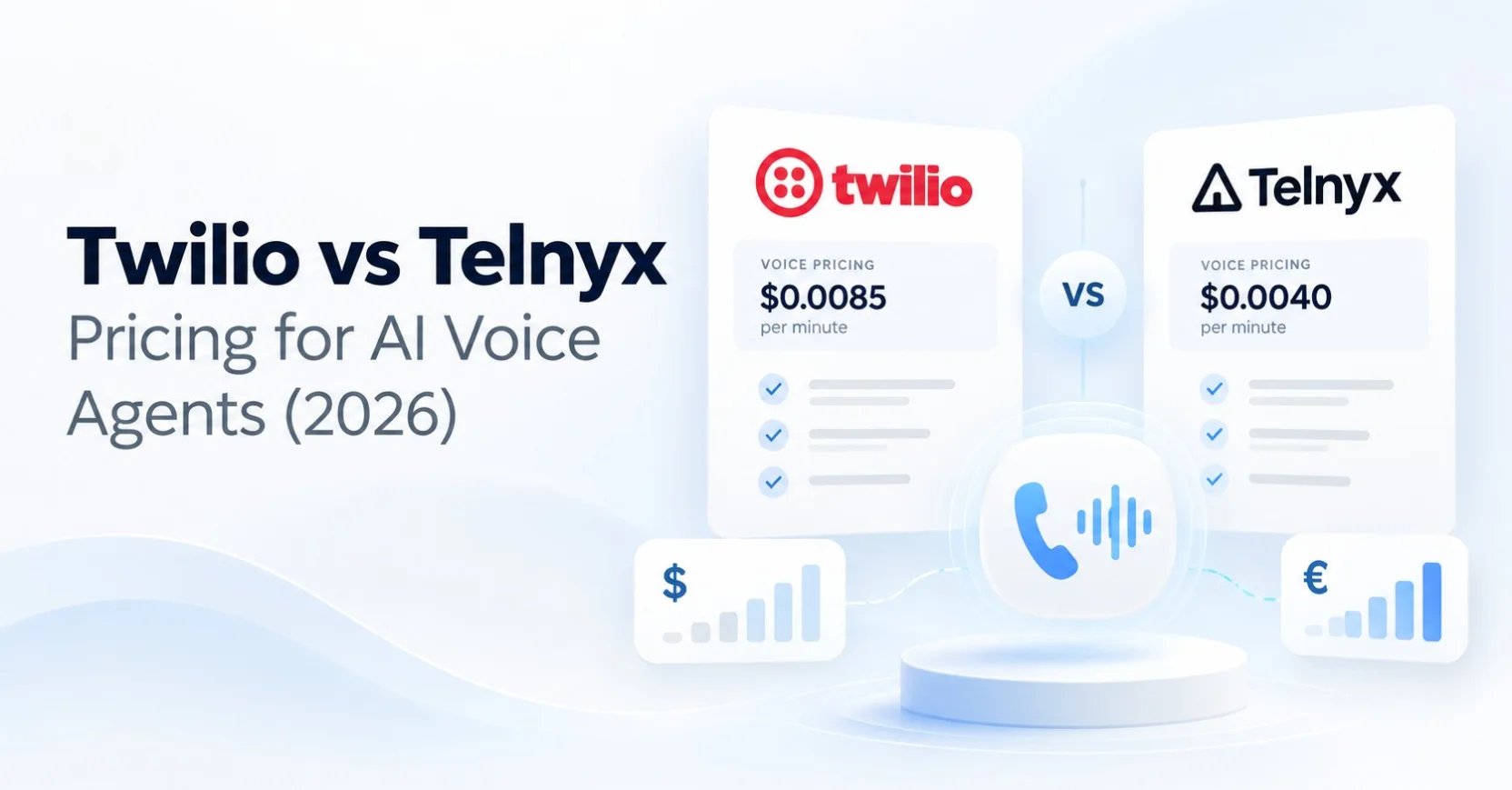
Short answer: on published US carrier rates, Telnyx is cheaper per minute than Twilio. Outbound starts at $0.005 on Telnyx versus $0.014 on Twilio, and inbound starts at $0.0032 versus $0.0085. But the carrier is only one line on the bill of an AI voice agent. Speech recognition, the language model, text-to-speech and the platform that orchestrates them usually cost more than the phone line itself.
This guide compares Twilio and Telnyx pricing the way a buyer actually needs it: per minute, per month, and for a realistic call mix. It also shows how a voice agent platform such as Famulor lets you use either carrier through SIP trunking, so the carrier decision never locks you in. All carrier prices below come from the public pricing pages of both providers in October 2026. They are US rates before volume discounts. Rates for other countries differ, so check the price sheet for your destinations.
The two kinds of cost in an AI phone call
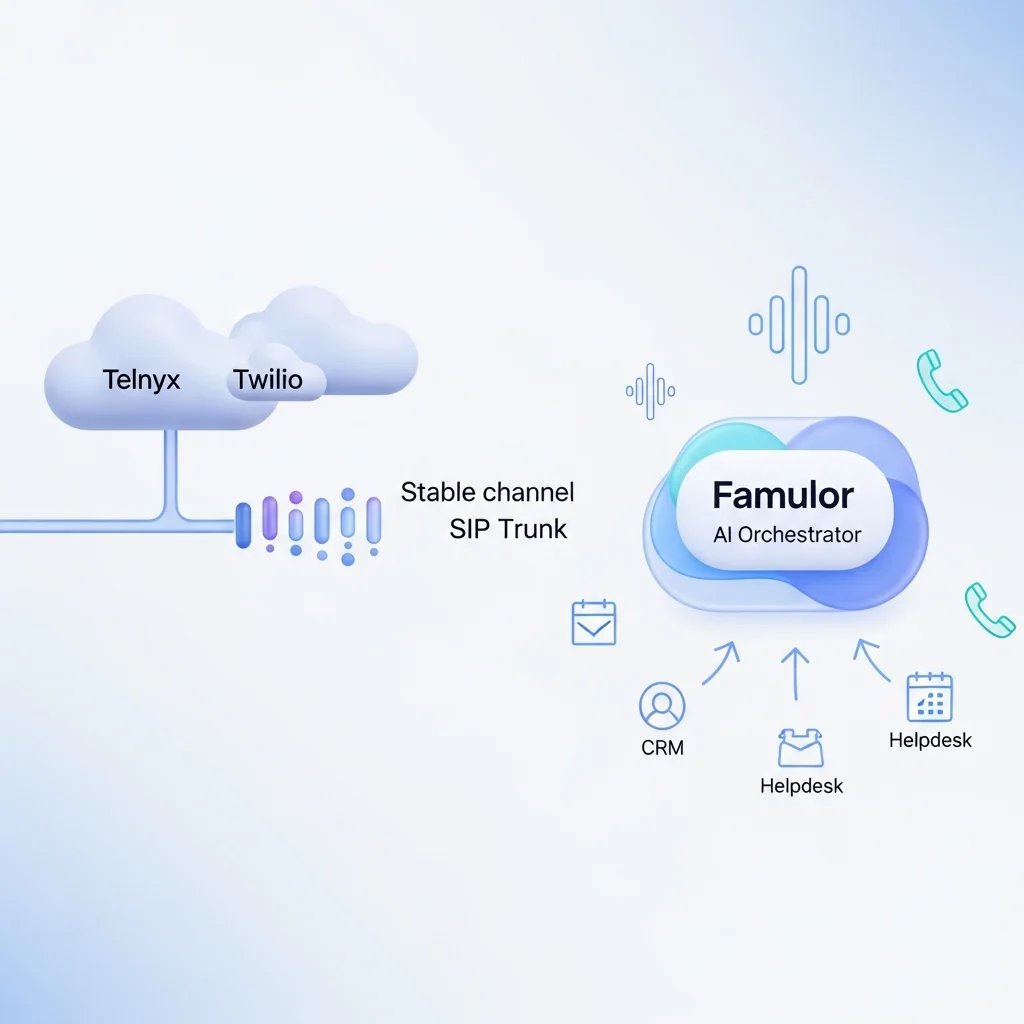
Every minute of an AI call has two cost layers. The first is the telephony layer: the phone number, the carrier minutes and optional features such as recording. The second is the AI layer: speech-to-text, the language model, text-to-speech and the orchestration that keeps latency low. Twilio and Telnyx compete on the first layer. Platforms like Famulor sit on the second layer and connect to the first.
If you compare only the carrier, you compare perhaps a fifth of your total cost. That still matters at scale, because telephony is the part you can negotiate and switch. For the AI layer see our breakdown in AI Voice Agent Pricing 2026: What 10 Platforms Actually Cost per Minute.
Twilio pricing in detail
Twilio publishes clear US Programmable Voice rates. The numbers that matter for an AI agent are these:
- Outbound calls to US and Canada: $0.0140 per minute, for both local and toll-free destinations.
- Inbound calls on a local number: $0.0085 per minute plus $1.15 per month for the number.
- Inbound calls on a toll-free number: $0.0220 per minute plus $2.15 per month for the number.
- BYOC trunking (you bring your own carrier): $0.0040 per minute for calls in both directions.
- Browser and app calling: $0.0040 per minute.
- Call recording: $0.0025 per minute, with storage billed separately.
Twilio's strength is its ecosystem, documentation and reliability track record. Its weakness for high-volume AI agents is the base rate: $0.014 per outbound minute is nearly three times the starting rate on Telnyx.
Telnyx pricing in detail
Telnyx owns its network, so it publishes carrier rates close to wholesale. The headline numbers for SIP trunking:
- Outbound local calls: from $0.005 per minute.
- Inbound local calls: from $0.0032 per minute.
- Inbound toll-free calls: from $0.015 per minute, depending on the calling number.
- Voice API: $0.002 per minute on top of the SIP trunk fee, if you use Telnyx call control instead of plain SIP.
- Platform fee and support: $0, according to the pricing page.
Telnyx also sells its own voice AI, speech and inference products. If you only need the phone line, you can use its SIP trunks and keep the AI layer on a separate platform.
Side-by-side comparison
| Item (US, pay as you go) | Twilio | Telnyx |
|---|---|---|
| Outbound local call | $0.0140 / min | from $0.0050 / min |
| Inbound local call | $0.0085 / min | from $0.0032 / min |
| Inbound toll-free call | $0.0220 / min | from $0.0150 / min |
| Local number | $1.15 / month | see Telnyx number pricing |
| Toll-free number | $2.15 / month | see Telnyx number pricing |
| Bring-your-own-carrier trunk | $0.0040 / min | not applicable |
| Call recording | $0.0025 / min | optional feature, separate rate |
| Platform fee | none published | $0 |
Treat the table as a starting point. Both providers change prices, and volume tiers apply. Always confirm on the official pages before you commit.
Worked example: 100,000 minutes per month
Take a mid-sized setup: an appointment-booking agent for a group of dental practices handling 100,000 minutes per month, 60 percent outbound reminders and 40 percent inbound calls. All traffic is US local numbers, carrier minutes only.
- Twilio: 60,000 outbound minutes × $0.014 = $840. 40,000 inbound minutes × $0.0085 = $340. Total: $1,180, plus monthly number fees.
- Telnyx SIP trunk only: 60,000 × $0.005 = $300. 40,000 × $0.0032 = $128. Total: $428.
- Telnyx with Voice API: add 100,000 × $0.002 = $200. Total: $628, which matches the example on the Telnyx pricing page.
The gap is about $550 to $750 per month at this volume. At 1,000,000 minutes the same mix scales to roughly $5,500 to $7,500 per month. Those savings are real, but they only cover telephony. The AI layer for the same 100,000 minutes will cost more than either carrier line.
Use our free Telnyx calculator and Twilio calculator to run your own mix of countries, number types and minutes.
Hidden costs most comparisons skip
- Billing increments. Per-second billing wastes less than rounding every call up to a full minute. Short calls such as voicemail detection or wrong numbers show the difference.
- Destination surcharges. The $0.014 Twilio rate applies to US and Canada. Alaska, mobile destinations and international calls cost more. Telnyx also prices per destination.
- Number fees. A local number is a few dollars a month. A campaign with hundreds of outbound numbers for caller ID rotation turns that into a real line item.
- Compliance and registration. US outbound campaigns need registration and carrier vetting. Budget time and fees for it.
- Recording and transcription. If you record every call at the carrier, add $0.0025 per minute on Twilio. A voice agent platform usually records and transcribes on its own side, so you can skip the carrier feature.
- Failed and unanswered calls. Outbound campaigns pay for ringing and short calls. Reachability matters more than the last tenth of a cent.
Estimate your ROI from automating calls
See how much your business could save by switching to AI-powered voice agents.
ROI Result
ROI 0%
No credit card required
Latency, quality and reliability
Price is only one criterion. For an AI agent, the carrier affects three things you can feel on a call: audio quality, round-trip latency and answer rates.
- Latency. Every extra network hop adds delay before the agent can respond. Choose a carrier with points of presence close to your callers and close to your voice platform.
- Audio codec. Wideband codecs help speech recognition. Make sure your trunk and platform agree on a codec instead of transcoding.
- Answer rates. For outbound campaigns, caller ID reputation and number labeling affect whether people pick up. This is not a price item, but it decides how many of your paid minutes turn into conversations.
- Support and uptime. Check the status history and the support model. A cheap trunk without a fast escalation path is expensive during an outage.
Our guide to WebRTC vs SIP for AI voice agents explains the transport choices behind these points.
How to connect Twilio or Telnyx to Famulor
Famulor is an AI voice agent platform for inbound and outbound calls in 40+ languages with no-code setup and 300+ integrations. It connects to any carrier through SIP trunking, so you choose the telephony layer on price and quality and keep one platform for the agent.
- Create your agent. Build the assistant with its prompt, voice, language and knowledge base in the Famulor dashboard.
- Create a SIP trunk at your carrier. In Twilio or Telnyx, create a trunk and set the Famulor SIP address as the destination for inbound calls.
- Add credentials in Famulor. Enter the trunk details so Famulor can place outbound calls through your carrier.
- Assign numbers. Attach your carrier numbers to the agent for inbound routing.
- Test. Call the number, check latency and audio, then launch outbound campaigns on a small list first.
The step-by-step details are in Telnyx, Twilio and SIP trunks with Famulor. If you still run on Twilio and want to compare the platform side, read Twilio Voice AI alternative 2026.
Which carrier fits which team?
- High-volume outbound (reminders, lead follow-up): Telnyx. The lower per-minute rate compounds quickly.
- Existing Twilio estate (SMS, WhatsApp, Flex, Verify): stay on Twilio for voice if consolidating vendors saves more engineering time than the rate difference costs.
- Mixed countries: price each destination separately. Neither provider wins everywhere.
- Small teams under 5,000 minutes per month: the carrier difference is under $50 a month. Pick the one your team can set up fastest.
- Agencies and resellers: keep the trunk independent from the platform so you can move customers between carriers. The Famulor white-label program is built for this.
Common mistakes when budgeting voice agent telephony
- Comparing a carrier rate to an all-in platform rate. A platform minute includes AI. A carrier minute does not.
- Ignoring the inbound and outbound split. Inbound is cheaper on both carriers, so your mix changes the answer.
- Forgetting that toll-free inbound costs more than local inbound on both carriers.
- Skipping a pilot. Run 1,000 real minutes on each carrier and compare answer rate, latency and call drops, not only price.
- Locking into a platform that supports only one carrier.
Total cost view
For a complete budget, add the layers: carrier minutes, numbers, AI platform minutes and any integrations. On Famulor, pay-as-you-go minutes start at €0.15 per minute including the AI platform, and plans lower the effective rate further. Add your carrier on top if you bring your own trunk. See current plans on the Famulor pricing page, and for call-center scale look at the AI call center solution.
Conclusion
Telnyx is the cheaper carrier on published US rates, by roughly 45 to 65 percent depending on your call mix and on whether you use the Telnyx Voice API. Twilio is the better fit when you already rely on its wider ecosystem. The smarter move is to avoid choosing for life: use a voice agent platform with open SIP trunking, run a pilot on both carriers and let measured answer rates and latency decide. With Famulor you keep one agent, one set of integrations and the freedom to switch the carrier whenever the numbers change.
Next step: open the carrier calculator, enter your monthly minutes and call mix, then start with Famulor and connect your first SIP trunk in under an hour.
Try our AI Assistant
Experience how natural our AI phone assistant sounds.
Enter your details and receive a call from our AI agent within seconds.
Agent is trained to discuss Famulor services and book appointments.

Demo AI agent
Famulor representative
FAQ
Is Telnyx cheaper than Twilio?
On published US pay-as-you-go rates, yes. Telnyx outbound starts at $0.005 per minute and inbound at $0.0032, while Twilio charges $0.014 outbound and $0.0085 inbound on local numbers.
How much does Twilio cost per minute for voice calls?
For US and Canada, Twilio charges $0.014 per minute for outbound calls. Inbound local calls cost $0.0085 per minute plus $1.15 per month for the number. Toll-free inbound costs $0.022 per minute plus $2.15 per month.
How much does Telnyx cost per minute?
Telnyx SIP trunking starts at $0.005 per minute outbound and $0.0032 per minute inbound for local calls. Its Voice API adds $0.002 per minute if you use call control. Toll-free inbound starts at $0.015.
Can I use Twilio or Telnyx with an AI voice agent?
Yes. Both support SIP trunking. You point the trunk at your voice agent platform and attach your numbers. Famulor supports SIP trunks from any provider.
Is the carrier the biggest cost of an AI voice agent?
Usually not. Speech recognition, the language model and text-to-speech together typically cost more per minute than the phone line. Compare both layers before you decide.
What is BYOC trunking at Twilio?
Bring Your Own Carrier lets you route calls through your own provider while using Twilio's platform features. Twilio charges $0.004 per minute for BYOC trunking in each direction.
Do these prices include taxes and international calls?
No. The rates here are US pay-as-you-go carrier prices before volume discounts and taxes. International destinations have their own rates, so check each provider's price sheet.
Can I switch carriers later without rebuilding my agent?
Yes, if your platform uses standard SIP. In Famulor you replace the trunk credentials and move the numbers. The agent, prompt and integrations stay the same.
How do I estimate my monthly telephony cost?
Multiply your outbound and inbound minutes by each rate, add monthly number fees and then add a buffer for short calls and destination surcharges. The Famulor carrier calculators do this for you.

Writer at Famulor