Summarize Content With:




Voice AI Consolidation Wave 2026: What the Salesforce-Cresta and Five9-Level AI Deals Mean for SMBs
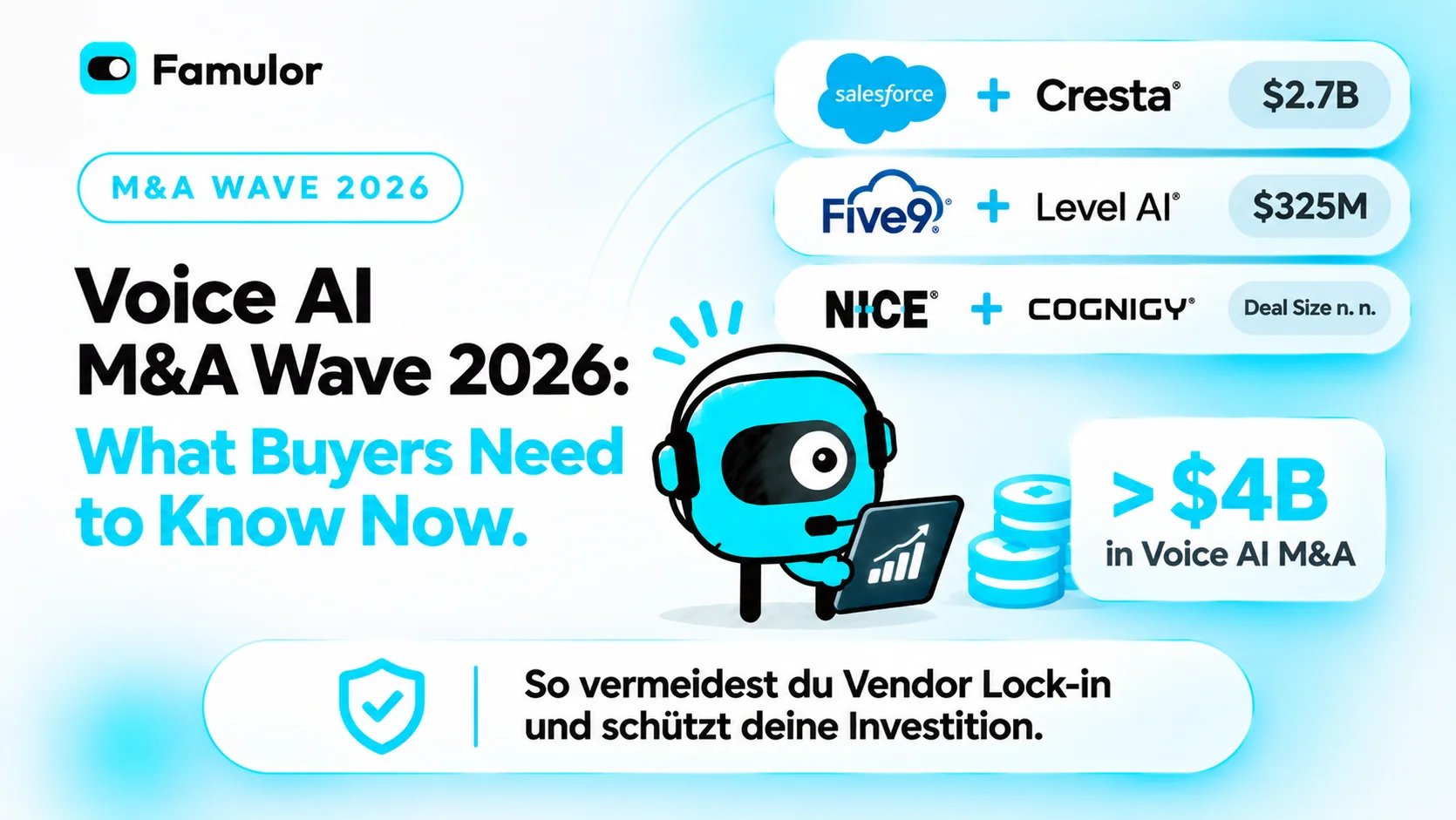
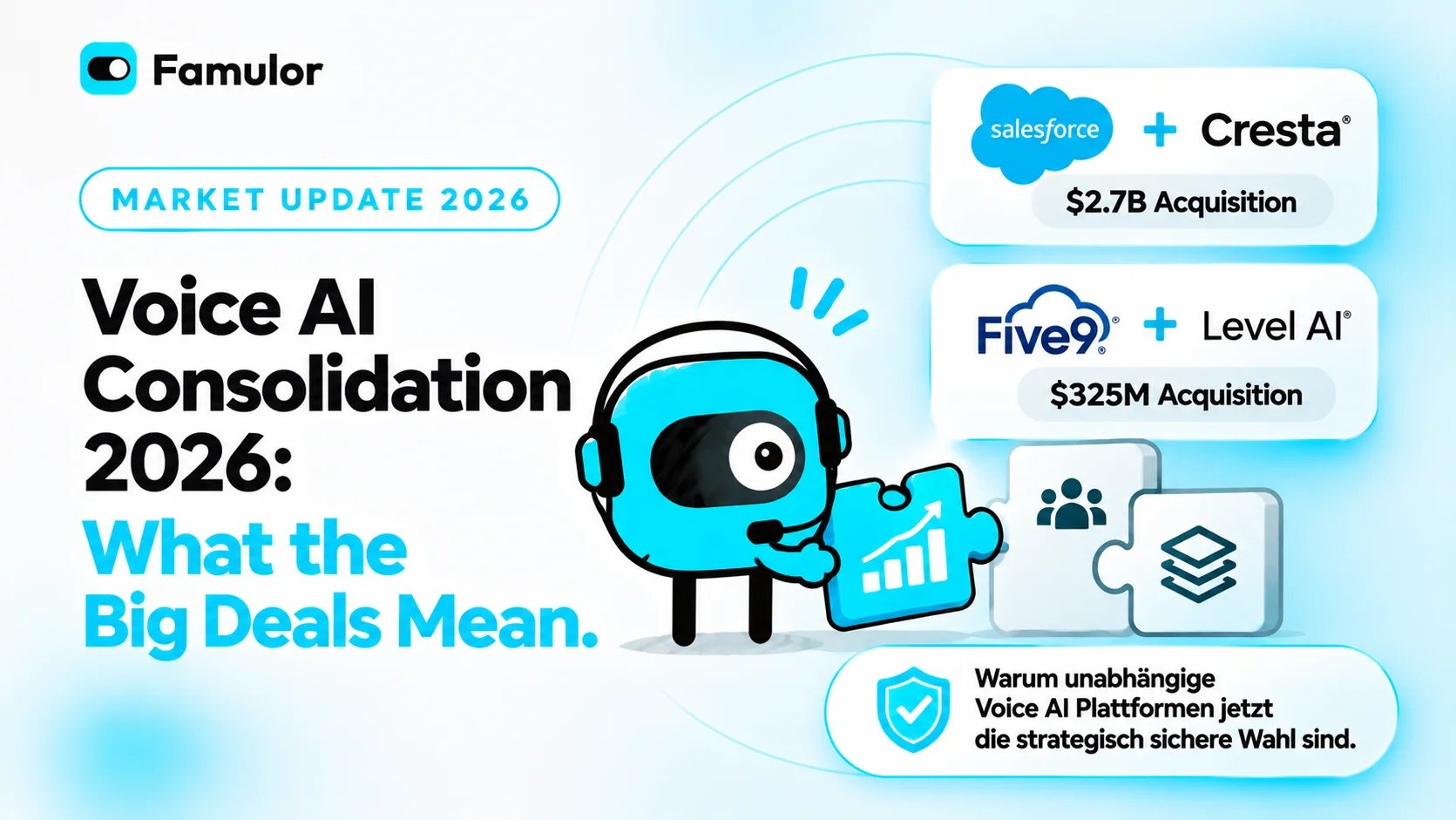
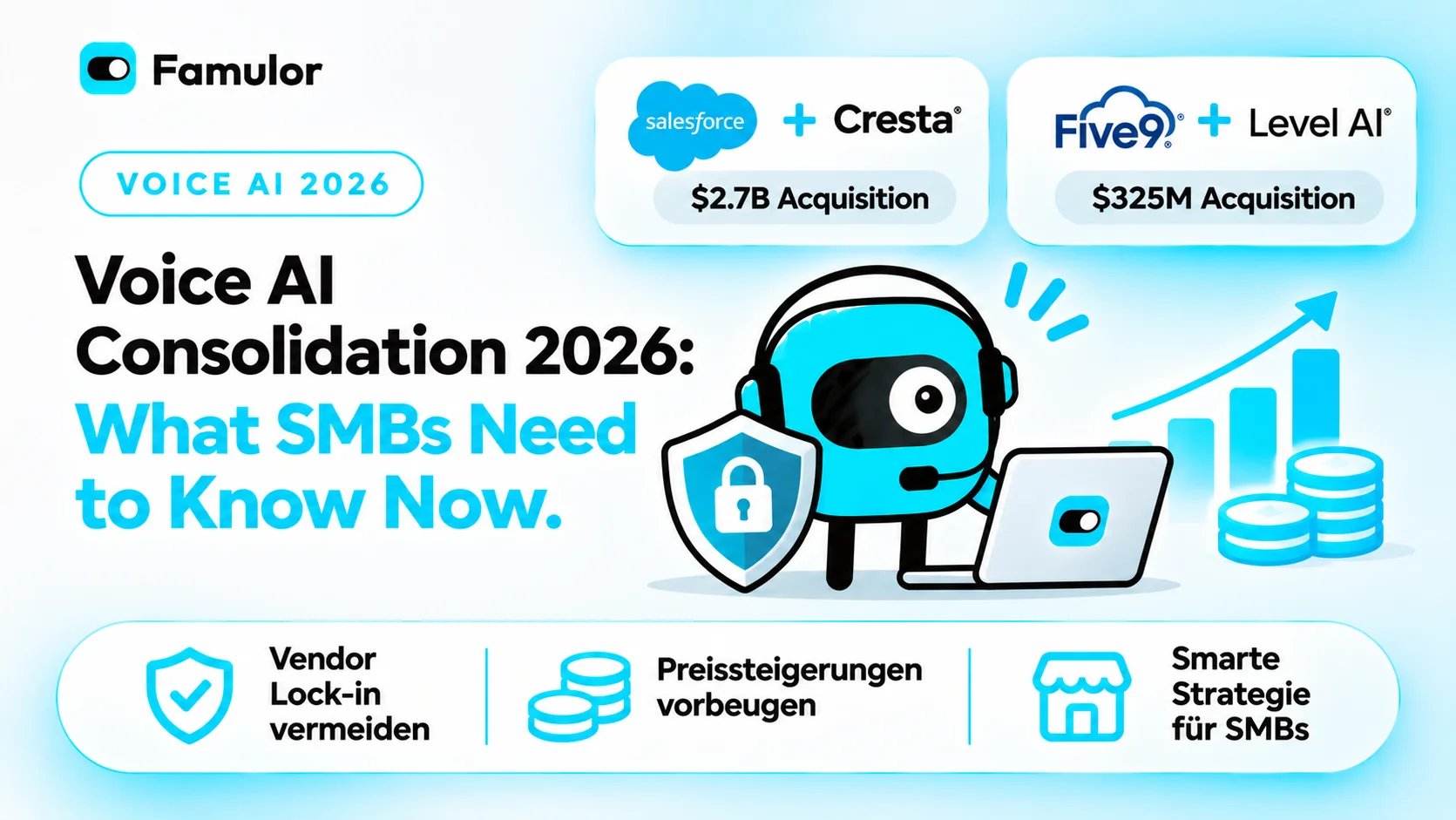
In a single week in November 2026, the voice AI industry witnessed two landmark acquisitions: Salesforce agreed to buy Cresta for approximately $2.7 billion, and Five9 acquired Level AI for about $325 million. For small and mid-sized businesses, this raises an urgent question: What happens to my AI phone system when my provider gets absorbed into an enterprise conglomerate? The short answer: businesses that choose an independent, flexible platform like Famulor protect themselves from vendor lock-in, price hikes, and feature deprecation.
The Deals at a Glance: Who Is Buying Whom — and Why
The consolidation wave was not unexpected. Voice AI has become a strategic differentiator for customer experience platforms, and the major players are protecting their market positions through acquisition rather than in-house development.
Salesforce Acquires Cresta: The $2.7 Billion Deal
Cresta established itself as a specialist in AI-powered contact center software. Its platform automates customer calls end-to-end, coaches agents in real time, and analyzes conversations. Its customers include enterprise heavyweights such as Marriott, Comcast, and Alaska Airlines. Salesforce plans to integrate Cresta into its Service Cloud and Agentforce ecosystem, with the deal expected to close in Q1 of its fiscal year 2028.
Analyst Dave Michels characterized the deal as "an integration challenge, not a simple feature upgrade," warning about an expanding "CX Frankenstack" at Salesforce — more acquired capabilities do not automatically simplify operations.
Five9 Acquires Level AI for $325 Million
Level AI develops AI applications for customer service conversations built on its proprietary model family, Level AI Latitude. The platform processes more than one billion customer interactions per year, serving clients including Gusto, Chime, and VistaPrint. The two companies have worked together since 2022. Five9 reported Q3 revenue of $323.3 million alongside the announcement — a 13% year-over-year increase.
Other Market Movements in November 2026
| Company | Event | Details |
|---|---|---|
| SoundHound | Layoffs after LivePerson acquisition | 27% workforce reduction, $18–22M restructuring charges |
| ElevenLabs | IPO signal | $22B valuation, CEO Mati Staniszewski targets 2028 IPO |
| Phonic | Series A funding | $27.5M led by First Round Capital |
| Deepgram | Marketplace launch | 19 partner products (incl. Cartesia, Vapi, LiveKit, Twilio) |
| Heidi Health | Restructuring | 18% layoffs, two cofounders depart |
The Pattern Behind the Deals: What Previous Tech Acquisitions Teach Us
The voice AI consolidation follows a playbook that other industries have already played out. When Salesforce acquired Tableau for $15.7 billion in 2019, single-user license costs rose by 30 to 50 percent within two years. When Twilio bought Segment in 2020, standalone Segment customers were gradually migrated into Twilio bundles. When Cisco acquired BroadSoft in 2017, SMB-friendly standalone products disappeared in favor of enterprise suites.
The sequence is always similar: first, the products remain independent. Then they get "deeply integrated." Then the best features become exclusive to the buyer's ecosystem. And then prices rise — because the acquisition cost must be recouped and because lock-in prevents customers from switching.
In the case of Salesforce and Cresta, there is already a warning sign: analyst Dave Michels warns of a "CX Frankenstack" and the complexity of integrating Cresta alongside Service Cloud, Agentforce, Einstein AI, and several previous acquisitions. For large enterprises with a dedicated Salesforce implementation team, this is manageable. For SMBs, it is a risk.
Why SMBs Need to Pay Attention Right Now
Enterprise acquisitions follow a predictable pattern: the buyer optimizes for its largest customers, not its smallest. For SMBs with 5 to 500 employees, this creates three concrete risks.
Risk 1: Vendor Lock-In Through Platform Integration
When Cresta becomes part of Salesforce Service Cloud, its best features will likely function only within the Salesforce ecosystem. Businesses that do not use Salesforce — or use it only for CRM, not telephony — lose access to what was previously a neutral solution. CX analyst Thomas Wieberneit explicitly warned that Cresta's value partly came from serving rival contact center environments, and that dynamic will inevitably change post-acquisition.
Risk 2: Price Increases After Integration
Post-acquisition price increases are not a scenario — they are a pattern. When the development costs of a $2.7 billion deal need to be recouped, prices rise — and they rise first for the smallest customers who have the least negotiating power. A dental practice with 15 employees or a plumbing company with 8 technicians does not have a key account manager protecting their rates.
Risk 3: Enterprise Feature Prioritization
After an acquisition, product teams prioritize features for the largest accounts. Marriott's requirements trump the wishes of a mid-sized real estate agency. SMB-specific capabilities like simple no-code configuration, fast setup, and transparent per-minute pricing move to the back of the roadmap.
How SMBs Can Protect Themselves: 5 Criteria for Choosing a Voice AI Provider
The consolidation wave makes structured vendor evaluation more important than ever. Here are five criteria SMBs should apply when choosing their voice AI partner:
| Criterion | Enterprise Platform (Post-Acquisition) | Independent Platform (e.g., Famulor) |
|---|---|---|
| Integration flexibility | Primarily own ecosystem | 300+ integrations, open APIs |
| Price transparency | Annual enterprise contracts | Pay-per-minute, cancel monthly |
| Setup time | Weeks to months with implementation partner | First agent live in under 30 minutes |
| Data sovereignty | US cloud-first | EU servers, GDPR-compliant |
| Vendor lock-in risk | High (proprietary formats) | Low (SIP trunking, CRM-agnostic) |
Famulor: The Independent Alternative for SMBs
While enterprise platforms consolidate, Famulor remains deliberately independent. As a specialized SaaS platform for AI voice agents, Famulor offers exactly the flexibility that becomes a competitive advantage in a consolidating market.
300+ integrations without ecosystem lock-in: Famulor connects with Salesforce, HubSpot, Pipedrive, Zoho, and any other CRM — without requiring any of them. The open integration architecture is built on a no-code automation platform similar to Zapier or Make. If you switch your CRM tomorrow, Famulor switches with you.
Transparent pricing without enterprise contracts: The Famulor pricing page clearly shows what every minute costs. No minimum terms, no hidden platform fees, no post-acquisition price increases driven by deal refinancing.
EU data sovereignty: For businesses operating in Europe, data residency on European soil is not optional. Famulor stores all data on EU servers and is fully GDPR-compliant — a distinction that becomes critical after a US acquisition when data routing decisions are made by the new parent company.
SIP trunking for existing phone systems: Many SMBs have existing PBX systems (Fritzbox, 3CX, Asterisk). Famulor's SIP trunking integrates the AI voice agent seamlessly into existing infrastructure — no complete replacement needed.
No-code Flow Builder: The Famulor Flow Builder enables configuration of complex call flows without a development team. Appointment booking, FAQ answering, call transfers to staff, CRM updates — all via drag-and-drop.
Real-World Example: Metzger & Sons Plumbing, 12 Employees
Picture a plumbing company with 12 employees that receives 40 to 60 calls daily: appointment requests, quote inquiries, and follow-ups on ongoing jobs. Currently, 30% of calls go unanswered because technicians are on job sites and the office is staffed only half-day.
With Famulor, an AI voice agent answers every call in under 2 seconds, books appointments directly into the calendar, answers standard questions from the knowledge base, and routes urgent cases to the head plumber. Setup took 25 minutes. Monthly costs are a fraction of a part-time receptionist.
Had this business instead chosen a Cresta or Level AI solution, it would now face the question: What happens to my system when Salesforce or Five9 changes priorities?
Estimate your ROI from automating calls
See how much your business could save by switching to AI-powered voice agents.
ROI Result
ROI 0%
No credit card required
Migration Checklist: How to Prepare for a Switch
If you are currently using a voice AI solution affected by — or potentially affected by — an acquisition, the time to act is now, not after the integration is complete. Here is a practical checklist:
- Back up your data: Export all call logs, transcripts, and analytics data. Verify whether your provider supports a full data export in open formats (CSV, JSON).
- Document your knowledge base: Create a copy of all FAQ entries, product information, and scripts your voice agent uses. With Famulor, these can be transferred via copy-paste or API.
- Map your call flows: Diagram your current call flows — which questions are asked, which transfers happen, which CRM actions are triggered. This documentation speeds up setup on any platform.
- Check your SIP configuration: If you use SIP trunking, note your SIP credentials and routing rules. When switching platforms, only the endpoints change — not your phone numbers.
- Start a parallel test: Set up a Famulor account and test with a secondary process — such as weekend appointment booking or after-hours answering. This gives you a tested alternative before you need it.
Why Right Now Is the Best Time to Act
The period between announcement and completion of an acquisition — typically 3 to 9 months — is the window in which affected customers have the best conditions for switching. After completion, new contracts, changed terms of service, and adjusted pricing models frequently take effect. Those who act before that avoid time pressure.
For businesses that have not yet adopted a voice AI solution, the current market situation is paradoxically an advantage: you can choose an independent provider from the start and avoid planning an expensive migration later.
What the Consolidation Means for the Next 12 Months
The Cresta and Level AI acquisitions are just the beginning. Further consolidation moves are likely. ElevenLabs is heading toward an IPO, SoundHound is restructuring after its LivePerson acquisition, and the new Deepgram Marketplace shows that even mid-sized players are attempting to build ecosystems.
For SMBs, the takeaway is clear: the pool of truly independent voice AI platforms is shrinking. Anyone choosing a solution today should look beyond features and price to the strategic independence of their provider.
Three concrete action steps:
- Audit your current solution: Are you using a provider that was just acquired or could be on the acquisition radar? What exit clauses do you have?
- Evaluate data portability: Can you export your call logs, knowledge bases, and automations and migrate them to another provider?
- Test alternatives proactively: Set up a Famulor account in parallel and test with a secondary process — such as appointment booking or after-hours answering. This gives you a Plan B before you need one.
Industry Comparison: Which Voice AI Providers Are Still Independent?
| Provider | Status Q4 2026 | Risk Assessment for SMBs |
|---|---|---|
| Cresta | Acquired by Salesforce | High — being integrated into Service Cloud |
| Level AI | Acquired by Five9 | High — becoming Five9-exclusive |
| LivePerson | Acquired by SoundHound | Medium — SoundHound restructuring |
| ElevenLabs | IPO planned 2028 | Medium — IPO may create pricing pressure |
| Vapi | Independent, VC-funded | Medium — developer platform, no SMB focus |
| Famulor | Independent, profitable | Low — SMB focus, EU-based, no VC exit pressure |
Conclusion: Independence Is the New Competitive Advantage
The 2026 voice AI consolidation wave is not an abstract industry event — it affects every business using or planning to implement AI telephony. Salesforce's $2.7 billion acquisition of Cresta and Five9's purchase of Level AI signal that the major platforms view voice AI as a strategic building block and will integrate it into their closed ecosystems.
For SMBs, the message is clear: choose a partner that stays independent, prices transparently, and stores your data in Europe. Book a free demo with Famulor and see in 15 minutes how quickly your first AI voice agent can go live — no enterprise contract, no lock-in, no unpleasant surprises.
Try our AI Assistant
Experience how natural our AI phone assistant sounds.
Enter your details and receive a call from our AI agent within seconds.
Agent is trained to discuss Famulor services and book appointments.

Demo AI agent
Famulor representative
FAQ
What does the Salesforce-Cresta acquisition mean for my business?
Salesforce will integrate Cresta into its Service Cloud ecosystem. If you do not use Salesforce, you may lose access to Cresta's current features or be forced to migrate into the Salesforce ecosystem.
Will voice AI become more expensive after the acquisitions?
Historically, prices rise after enterprise acquisitions, especially for small customers. The $2.7 billion investment must be recouped. Independent platforms like Famulor offer transparent per-minute pricing without acquisition-driven price increases.
What is vendor lock-in in voice AI?
Vendor lock-in occurs when your call flows, knowledge bases, and integrations are tied to a proprietary format. Switching becomes expensive or technically impossible. Open standards like SIP trunking and API-based integrations protect against this.
Which voice AI providers are still independent?
As of November 2026, Famulor, Vapi, Retell, and Bland remain independent. Famulor is the only platform among these with an explicit SMB focus and EU data residency.
Can I easily switch my voice AI provider?
That depends on the platform. With Famulor, all configurations are exportable. SIP trunking allows you to operate your existing phone number and PBX independently of the voice AI provider.
Why does EU data residency matter for voice AI?
Voice data is biometric data and falls under GDPR. After a US acquisition, data routing may change. Famulor stores all data on EU servers and operates under European data protection law.
How much does an AI phone assistant cost for SMBs?
With Famulor, costs start at a few cents per minute with monthly cancellable plans. Enterprise platforms typically require annual license contracts starting at several thousand dollars per month.
How fast can I set up an AI voice agent?
With Famulor's no-code Flow Builder, your first agent can be live in under 30 minutes. Enterprise implementations typically take 4 to 12 weeks with an external implementation partner.
Does the consolidation wave affect European businesses?
Yes. Both Cresta and Level AI served European customers. The acquisitions change the provider landscape globally. For European businesses, there is an additional GDPR risk when the new owner routes data to the United States.
What should I do right now?
Audit your current solution for lock-in risks. Test an independent alternative like Famulor in parallel. When evaluating providers, prioritize data portability, transparent pricing, and EU data residency.

Writer at Famulor