Summarize Content With:




Cartesia vs ElevenLabs for Phone Agents: How to Pick a Voice That Works on a Real Call
Every voice demo sounds great. A clean studio sentence, no background noise, no caller who interrupts after two words. Phone calls are different: narrow audio, impatient people, names that must be spelled, and a bill that grows with every minute the agent speaks. That is why "Cartesia vs ElevenLabs" is the wrong question if you answer it from a landing page. The right question is: which voice holds up on your calls, at your volume, for a price you can plan?
This guide gives you a repeatable voice test for AI phone agents. You get the published list prices of both providers, a cost-per-minute calculation you can check yourself, a 20-call test plan, a scoring sheet and a decision rule. If you want the broader provider picture first, read our earlier Cartesia vs ElevenLabs vs Minimax.io comparison. This article goes one step further: it shows you how to decide for your own use case.
What a voice actually does on a phone call
The text-to-speech (TTS) model is the last step in the chain. The caller speaks, speech-to-text turns it into words, the language model decides what to say, and TTS turns the answer into audio. If you want the full chain explained, our guide to TTS and STT for voice agents covers it step by step.
For a phone agent, the voice affects four things the caller notices within seconds:
- Time to first audio. How long the caller waits in silence after finishing a sentence. More on this in our guide to voice agent latency.
- Clarity on a phone line. Telephone audio is compressed. A voice that sounds rich on headphones can sound muddy on a handset.
- Handling of hard content. Phone numbers, street names, e-mail addresses, product codes and brand names.
- Tone. Calm and friendly for a dental practice, brisk for a delivery service, formal for a law firm.
What the two providers publish
Both providers publish list prices. We checked both pricing pages on 1 November 2026. Use them as a starting point and check the pages again before you sign anything, because plans change.
| Item | Cartesia | ElevenLabs |
|---|---|---|
| Billing unit | Credits, 1 credit per character for Sonic TTS | Price per 1,000 characters (API) |
| Fast model price | Plan based: Pro 5 USD for 100K credits, Startup 49 USD for 1.25M, Scale 299 USD for 8M | Flash / Turbo: 0.04 USD per 1,000 characters |
| Premium model price | Same credit rate on the plans above | Multilingual v2 and v3: 0.08 USD per 1,000 characters |
| Published speed claim | No latency claim on the pricing page | Flash: "ultra-low latency (~75ms)" |
| Characters per audio minute | About 750 to 800 credits per minute of audio | Not stated on the pricing page |
Two things stand out. First, the units differ: Cartesia sells credit bundles, ElevenLabs sells characters. You cannot compare the headline numbers directly. Second, the only speed figure is a vendor claim for one model. A claim is not a measurement on your phone line, which is why the test below matters.
Cost per minute of agent speech, calculated
To compare the two on one scale, convert both to cost per minute of audio. Cartesia states that one minute of audio takes about 750 to 800 credits. We use the midpoint of 775 characters per minute for both providers. This is an assumption for comparison, speaking speed varies by voice and language.
The calculation: price per 1,000 characters multiplied by 0.775. Cartesia Scale is 299 USD for 8 million credits, which is 0.0374 USD per 1,000. Startup is 49 USD for 1.25 million, or 0.0392 USD per 1,000. Pro is 5 USD for 100,000, or 0.05 USD per 1,000.
The chart shows what the numbers say: the fast models sit within two tenths of a cent of each other. The premium ElevenLabs models cost about twice as much per minute. At small volume this is noise. At scale it is a line item, so look at a worked example.
Take a service desk with 1,000 calls per month and four minutes per call. Assume the agent speaks about half the time, so 2,000 minutes of agent audio per month. At the rates above this is roughly 58 USD on Cartesia Scale pricing, 62 USD on ElevenLabs Flash and 124 USD on the premium ElevenLabs models. These are voice costs only. The language model, speech recognition and telephony are separate cost lines. Our breakdown of five cost lines behind the minute shows how they add up.
Estimate your ROI from automating calls
See how much your business could save by switching to AI-powered voice agents.
ROI Result
ROI 0%
No credit card required
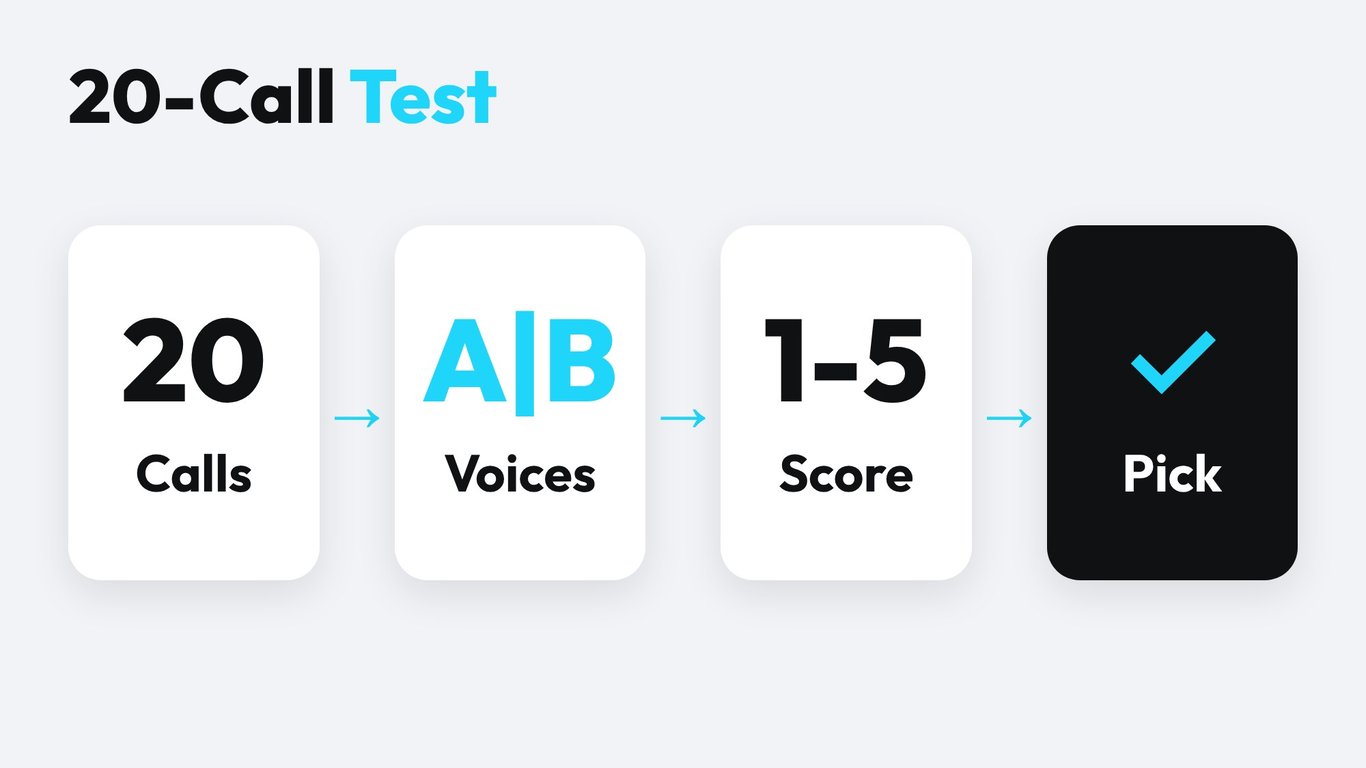
The 20-call voice test
A good test is small, fixed and fair. Here is a setup that takes about two hours.
Step 1: Write 20 short scripts from real calls
Take real transcripts from your inbox or call log and pick the sentences your agent will say most often. Cover five groups with four scripts each:
- Greeting and company name. Include your brand name exactly as it is written.
- Numbers and codes. Phone numbers, order numbers, opening hours, prices.
- Names and places. Street names, local towns, surnames that are common in your region.
- Empathy. A delay, a complaint, a cancellation.
- Closing and handover. Confirming an appointment, transferring to a human.
Step 2: Use the same agent, change only the voice
Keep the prompt, the language model and the phone number identical. Only the voice changes. Otherwise you test the prompt, not the voice. In Famulor you pick the voice in the voice library, which lists voices from several providers, including Cartesia and ElevenLabs. Preview first, then run the test calls on a real phone line.
Step 3: Call it like a customer would
Call from a mobile phone, not from a headset next to your laptop. Call once from a quiet room and once from a street or a car. Interrupt the agent in the middle of a sentence at least five times. Ask it to repeat a number. Spell a name and ask it to confirm.
Step 4: Score every call
Use one sheet for every voice and score each item from 1 (bad) to 5 (excellent). Two people should score independently, then compare.
| Criterion | What to listen for | Weight |
|---|---|---|
| Clarity on the phone | Every word understood on a handset, also with background noise | 25 % |
| Hard content | Numbers, names, codes and brand terms pronounced correctly | 25 % |
| Reaction time | No awkward silence after the caller finishes | 20 % |
| Tone fit | Sounds like your company, not like a generic announcer | 15 % |
| Interruptions | Stops cleanly when the caller speaks, resumes naturally | 15 % |
The weights are a suggestion. A company that reads out many numbers should raise "hard content". A premium brand might raise "tone fit".
Language and accents: test what your callers speak
If your callers speak German, Dutch, Spanish or French, run the whole test in that language. Voices that shine in English can sound stiff in other languages, and regional names are a classic weak spot. For German in particular, test compound words, umlauts and formal address ("Sie"). Our German vs English voice AI benchmark explains why the same stack behaves differently across languages.
If your business runs in several countries, test one script per language and keep a separate score per language. The best voice for English is not automatically the best for your second language.
Which provider fits which situation
There is no universal winner. These rules of thumb help you narrow the field before you test:
- High call volume, price sensitive: start with the fast models. The cost gap between Cartesia and ElevenLabs Flash is small, so let the listening test decide.
- Brand voice or cloned voice: shortlist the providers that offer a professional clone, then compare how well the clone holds up on a phone line. The voice library in Famulor also supports professional cloned voices.
- Many languages: run the multilingual test first, because it eliminates candidates fastest.
- Emotional conversations: collections, complaints, health topics. Listen for pacing and pauses, and consider a premium model only for these agents.
You do not have to use one voice for everything. A common pattern is a fast, low-cost voice for routine inbound calls and a premium voice for the few flows where tone is the product.
After the test: decide and keep measuring
Add up the weighted scores and apply a simple rule: pick the voice with the highest score, unless a cheaper voice is within 0.2 points. In that case take the cheaper one. Then go live with a small share of traffic and measure what matters in production: call completion, handover rate, repeat questions from callers ("Sorry, can you say that again?") and customer feedback.
Voice choice is not a one-time decision. Providers release new models, and your call mix changes. Rerun the 20-call test every quarter or when you add a new language. If you already run prompt experiments, our guide to A/B testing for voice AI agents shows how to compare two versions on live traffic.
Common mistakes
- Choosing by demo. A demo is a best case. Your calls are the average case.
- Testing on a headset. Phone audio is compressed. Test on a phone.
- Changing two things at once. If you switch voice and prompt together, you learn nothing.
- Ignoring the brand name. If the agent mispronounces your company name in the greeting, nothing else matters.
- Comparing plan prices instead of cost per minute. Use the same unit for every option.
Conclusion
Cartesia and ElevenLabs are both strong choices for phone agents, and at list prices the fast models cost about the same per minute. So the decision comes down to what your callers hear. Run the 20-call test, score it with a fixed sheet and let your own calls choose the winner. With Famulor you can swap the voice per agent and rerun the test whenever a new model appears. If you resell AI telephony, the same flexibility applies to your clients through the white-label setup.
Ready to try it? Open the voice library, pick two voices and place your first test call today. Prices for Famulor start at €0.05 per minute, see the pricing page for all plans. Teams with higher volume can look at the AI call center setup.
Try our AI Assistant
Experience how natural our AI phone assistant sounds.
Enter your details and receive a call from our AI agent within seconds.
Agent is trained to discuss Famulor services and book appointments.

Demo AI agent
Famulor representative
FAQ
Is Cartesia or ElevenLabs better for AI phone agents?
Neither wins in every case. At list prices the fast models cost about 3 cents per minute of agent speech on both. The better choice is the voice that scores higher on your own calls for clarity, pronunciation and tone.
How much does a minute of AI voice cost?
For the voice alone, about 0.03 USD on Cartesia and ElevenLabs Flash, and about 0.06 USD on the premium ElevenLabs models, based on list prices and 775 characters per audio minute. Language model, speech recognition and telephony come on top.
What is the cartesia vs elevenlabs latency difference?
ElevenLabs publishes a claim of about 75 ms for Flash. Cartesia shows no latency number on its pricing page. Treat both as vendor figures and measure time to first audio on your own phone line.
How many characters is one minute of speech?
Cartesia states that one minute of audio uses about 750 to 800 characters. The exact number depends on the voice, the language and the speaking speed.
Can I use more than one voice provider?
Yes. In Famulor each agent has its own voice, so you can use a low-cost voice for routine calls and a premium voice for sensitive flows.
How many test calls do I need?
Twenty short scripts per voice are enough to see clear differences. Cover greetings, numbers, names, empathy and handover, and include at least five interruptions.
Does the voice affect call quality or only the cost?
Both. The voice shapes how fast the caller hears an answer, how well numbers and names are understood and how trustworthy the agent sounds, which affects completion and handover rates.
Can I clone my own voice for the agent?
Yes. The Famulor voice library supports professional cloned voices from your recordings, and you should run the same 20-call test on the clone before you go live.
How often should I retest my voice?
Every quarter, when a provider releases a new model or when you add a language. A quick rerun of the 20 scripts takes about two hours.

Writer at Famulor