Summarize Content With:




Self-Hosted Voice AI Agents: Why Teams Look at Open Source
Every few weeks a new open-source voice agent project lands on Hacker News. This week it was a self-hosted stack with a Vapi-compatible API. The pitch is always the same: run the whole thing yourself, keep your data, and stop paying a per-minute platform fee. For an engineering team with a free weekend, it sounds like the obvious move.
This guide looks at the decision from the buyer's side. A self-hosted voice AI agent can be the right call. But the real question is not "can we build it?" Most teams can. The question is who runs it at 8:03 on a Monday morning when 40 callers are on the line and the speech-to-text service times out. If you compare self-hosted and managed voice AI honestly, you need to count more than the model bill.
What a Self-Hosted Voice Agent Stack Actually Contains
A phone call with an AI agent looks simple from the outside. Behind it, audio travels through a chain of services. Each one has its own latency, price, failure mode and update cycle.
| Layer | What it does | What you own when self-hosting |
|---|---|---|
| Telephony | Receives and places calls via SIP or a carrier API | Numbers, trunks, caller ID, spam reputation, number verification |
| Speech-to-text (STT) | Turns caller audio into text in real time | Provider choice per language, fallbacks, custom vocabulary |
| LLM | Decides what to say and which tool to call | Model choice, prompts, guardrails, cost per call |
| Text-to-speech (TTS) | Turns the answer into a natural voice | Voice selection, pronunciation, streaming setup |
| Orchestration | Turn-taking, barge-in, silence handling, transfers | The hardest code in the stack, and it never really finishes |
| Monitoring | Transcripts, QA, alerts, evaluation | Dashboards, call review, regression tests |
Open-source frameworks such as Pipecat and LiveKit Agents give you good building blocks for the orchestration layer. They do not give you the carrier relationship, the voice QA process or the person who gets paged at night. That is the gap teams underestimate.
Self-Hosted vs Managed Voice AI: A Side-by-Side View
Here is the comparison we use with customers who ask about self-hosting. It avoids vendor prices on purpose, because those change monthly. It focuses on what you take on.
| Criterion | Self-hosted stack | Managed platform |
|---|---|---|
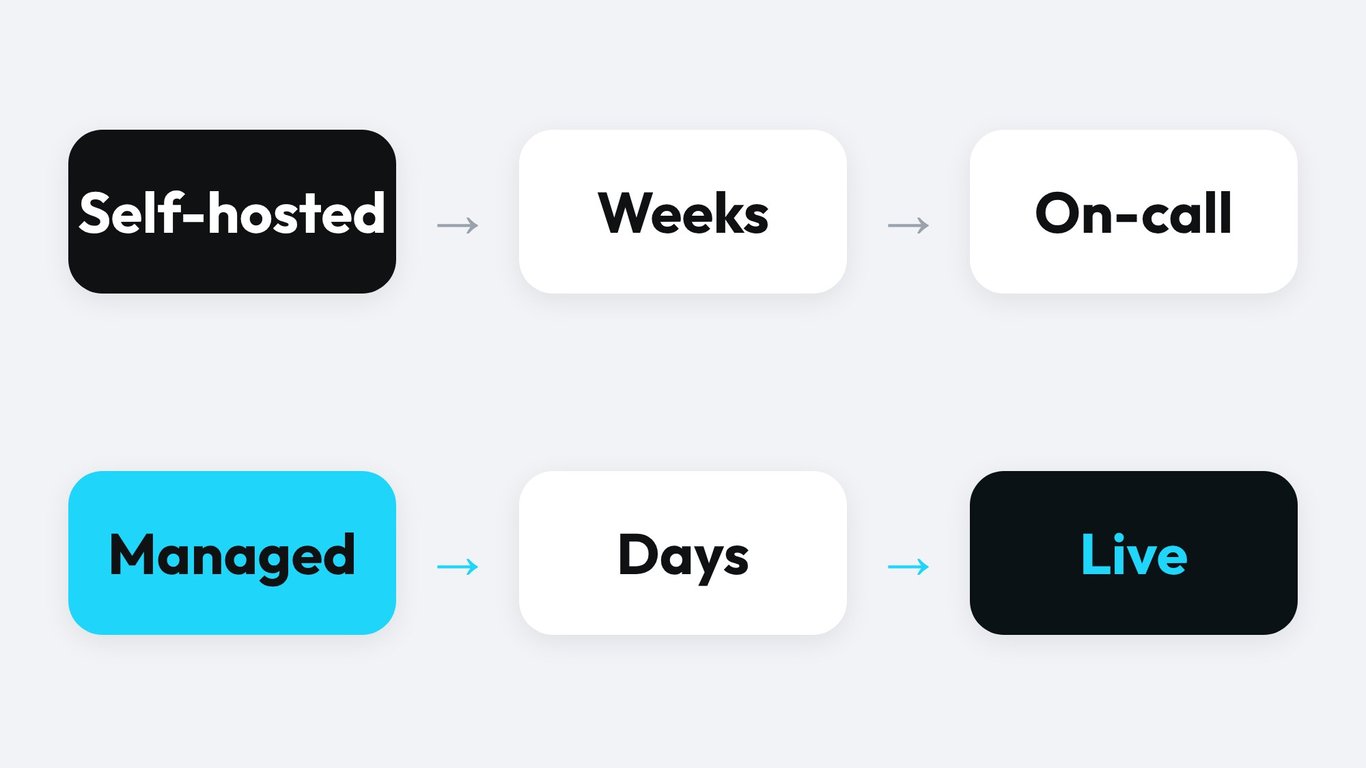
| Time to first live call | Weeks to months for a production-grade setup | Hours to days |
| Cost model | Several vendor bills plus infrastructure plus engineering time | One per-minute price or plan |
| Latency tuning | Your job: regions, streaming, provider mix | Handled and measured by the vendor |
| Provider switching | Full control, but you rewrite the integration | Switch models or voices in a setting |
| Data location | Anywhere you choose | Depends on the vendor, check EU hosting and retention |
| Compliance paperwork | You write it: DPAs, records, AI disclosure | Vendor provides templates and agreements |
| On-call duty | Your team, including nights and holidays | Vendor operations team |
| Non-technical editing | Usually a code change and a deploy | No-code editor for prompts, flows and tools |
| Vendor lock-in | Low on paper, high in internal knowledge | Depends on export options, ask before you sign |
The Hidden Cost Lines of Self-Hosting
When teams compare cost, they usually compare the managed per-minute price with the raw model prices. That comparison is unfair to the managed side. A raw STT, LLM and TTS bill is only part of the cost of running calls. These lines are easy to forget:
- Engineering time. Initial build, then permanent maintenance. Voice stacks need updates whenever a provider changes an API or ships a better model.
- On-call and incident handling. A dead phone line is visible to customers within minutes. Someone must own recovery.
- Idle capacity. Self-hosted media servers must be sized for peak load, so you pay for headroom you use a few hours a week.
- Testing and QA. Every prompt change can break a call flow. You need test calls, evaluation sets and review tooling.
- Carrier and compliance work. Number verification, caller ID, call recording consent and AI disclosure rules do not go away.
- Opportunity cost. Every sprint spent on turn-taking logic is a sprint not spent on your actual product.
We broke down the managed side of this equation in our guide to the five cost lines behind a voice agent minute. The same five lines exist when you self-host. You just pay them in a different currency.
A Worked Example: Dental Group With Six Locations
Take a dental group with six locations and a central phone line. Peak calls arrive between 8:00 and 10:00 and after lunch. The group wants an agent that books, moves and cancels appointments in the practice software, answers opening-hours questions and hands emergencies to a human.
With a self-hosted stack, the team builds the telephony bridge, picks an STT model for German, wires an LLM with tool calls to the calendar, adds a TTS voice, and writes the transfer logic. It works in a demo within days. The next weeks go into what demos hide: callers who interrupt, dialects, a clinic with a bad line, a calendar API that rate-limits, and a transfer that drops the call. Each fix is a deploy.
With a managed platform, the same group configures the assistant in an editor, connects the calendar, tests with real calls and goes live. When a voice or model improves, they change a setting. The tradeoff: they accept the platform's boundaries on very custom logic.
Neither path is wrong. The point is that the work lands in different places.
Estimate your ROI from automating calls
See how much your business could save by switching to AI-powered voice agents.
ROI Result
ROI 0%
No credit card required
When Self-Hosting Voice AI Makes Sense
We build a managed platform, and we still tell prospects to self-host in some cases. Self-hosting is a reasonable choice when:
- You already have a voice engineering team. Two or more engineers who know real-time audio, and who want to own the system.
- Hosting rules are strict. Some public-sector or defence customers need a fully isolated environment with no external processors.
- Volume is very high and very stable. At large scale, owning parts of the stack can pay off, if you have measured it.
- The agent is your product. If voice AI is what you sell, the stack is your core asset and you should control it.
- You need research-grade flexibility. Custom models, unusual audio pipelines, experimental architectures.
If none of these apply, a managed platform usually gets you to a working, measured agent faster. Our earlier comparison of an open-source AI phone assistant and Famulor covers the technical trade-offs in more detail.
Latency, Quality and the Last 10 Percent
Open-source stacks reach "it talks" quickly. The last 10 percent is where phone agents succeed or fail: how fast the first word comes back, how the agent handles interruptions, what happens in silence, how it reads phone numbers and email addresses, and how it behaves when the caller is angry or on a bad line.
These details come from thousands of real calls, not from a framework. A managed platform amortises that learning across all its customers. If you self-host, you collect it yourself, one painful call at a time. Our guide on how fast a phone bot must reply shows why small delays change how callers behave.
Data Protection: Self-Hosted Is Not Automatically Compliant
A common argument for self-hosting is data control. That is valid, but incomplete. If your self-hosted agent still sends audio to a third-party STT, LLM and TTS provider, you still have processors, still need data processing agreements and still must handle retention. Hosting the orchestration layer yourself does not remove those duties.
What matters is a clear map: where audio goes, which provider sees which data, how long it is stored, and how you disclose the AI to callers. A managed vendor with EU hosting, defined retention and ready agreements can make this easier than building the paperwork yourself. Whichever way you go, check data location and retention before you launch. Our guide on zero data retention for voice agents lists the questions to ask.
A Practical Decision Process in Five Steps
- Define the first use case. One call type, one outcome. For example: book appointments, qualify inbound leads or answer after-hours calls.
- List the integrations you need. Calendar, CRM, helpdesk, WhatsApp. Integrations take more time than the voice layer.
- Estimate monthly minutes. Use a range. Peaks matter more than averages.
- Price your own time. Estimate build weeks and weekly maintenance hours, and include on-call duty.
- Run a two-week pilot on a managed platform. Measure answer rate, booking rate and handover quality. Then decide whether self-hosting would add value that you can name.
How Famulor Fits Into the Picture
Famulor is a managed voice AI platform for phone, WhatsApp and chat. You build assistants in a no-code editor, connect your tools through integrations and bring your own numbers or buy new ones. Usage is billed per minute: the pay-as-you-go minute price is €0.15, and plans such as Plus at €27 per month (billed yearly) include minutes, with extra minutes at €0.12. The full list lives on the pricing page.
Agencies that want to resell voice agents under their own brand can use the white-label option. Teams running larger inbound operations can look at the AI call center setup.
Conclusion: Own the Outcome, Not Necessarily the Stack
Self-hosted voice AI agents are a real option, and the open-source ecosystem is getting better every month. But the stack is the smaller part of the project. Callers judge you on whether the phone gets answered well, every time. For most businesses, the fastest way to reach that outcome is a managed platform, with the option to revisit the decision once volume and requirements are clear.
Start with one call type, run a pilot and measure the result. If it works, scale it. If you hit a limit that only self-hosting solves, you will know exactly what that limit is.
Try our AI Assistant
Experience how natural our AI phone assistant sounds.
Enter your details and receive a call from our AI agent within seconds.
Agent is trained to discuss Famulor services and book appointments.

Demo AI agent
Famulor representative
FAQ
What is a self-hosted voice AI agent?
It is a phone or voice agent where you run the orchestration layer on your own infrastructure. Usually you still connect to external providers for speech-to-text, language models, text-to-speech and telephony.
Is self-hosting cheaper than a managed voice AI platform?
Not by default. Raw model prices look low, but you add engineering time, on-call duty, infrastructure headroom, QA and compliance work. It can pay off at high, stable volume with an experienced team.
Which open-source frameworks exist for voice agents?
Pipecat and LiveKit Agents are two widely used examples. They help with real-time audio pipelines and turn-taking, but you still need carriers, providers, monitoring and operations.
Does self-hosting solve GDPR concerns?
Only partly. If audio still flows to external providers, you need agreements, retention rules and a clear AI disclosure. Check data location and retention for every provider in the chain.
How long does it take to launch a managed voice agent?
A first agent with one call type can be live within days. The time goes into prompts, integrations and test calls, not into infrastructure.
Can I move from a managed platform to my own stack later?
Yes, if you keep prompts, flows and test cases in portable documents. Ask any vendor about export options before you commit.
What is the biggest risk of building it yourself?
Underestimating maintenance. The demo works fast, but production needs ongoing tuning, monitoring and incident handling.
Can Famulor import assistants I built elsewhere?
Famulor supports importing assistants from several voice platforms. The migration page explains the steps and what carries over.

Writer at Famulor