Summarize Content With:




Twilio SMS Pricing 2026: What a Text Message Really Costs
If you add SMS to an AI phone agent, the first question is always the same: what does one message cost? The price on the Twilio pricing page looks tiny, but the bill at the end of the month is higher. Carrier fees, number rentals, failed messages and long texts that split into several segments all add up. This guide shows the real cost per SMS for US traffic, with the math, so you can calculate your own volume before you build.
All Twilio numbers in this article come from the public US SMS price list, checked in October 2026. Prices change, so use them as a worked example and confirm the current list before you commit.
How Twilio bills one SMS
A US SMS has two cost parts. The first is Twilio's base rate per segment. The second is a carrier fee that depends on the network of the recipient. You pay both for every segment you send, and for every segment you receive.
- Base rate: $0.0083 per outbound and inbound SMS segment for long codes, toll-free numbers and short codes.
- Carrier fee: $0.0035 (AT&T), $0.0045 (T-Mobile), $0.005 (Verizon) and $0.0042 (all other carriers) for outbound long code SMS.
- Number fee: $1.15 per month for a leased long code, $2.15 for a toll-free number. Bring-your-own numbers are $0.50.
- Failed messages: $0.001 per message that ends in Failed status.
The chart below adds base rate and carrier fee for one outbound long code segment. The spread between carriers is small, but it shows that the headline price of $0.0083 is never what you actually pay.
Segments: why long texts cost more
Twilio bills per segment. A segment is one unit of the text as it travels through the carrier network. The limits are fixed by the SMS standard:
| Message type | Single message | Per segment when split |
|---|---|---|
| Plain text (GSM-7) | 160 characters | 153 characters |
| With emoji or special characters (UCS-2) | 70 characters | 67 characters |
That means a friendly appointment confirmation of 200 characters is two segments and costs double. The same text with one emoji drops the limit to 70 characters and becomes four segments. For AI-generated texts this is the most common hidden cost, because a language model happily writes three polite sentences.
What 1,000, 10,000 and 50,000 messages cost
To keep the math honest, we use the simple, unweighted average of the four carrier prices above: $0.0126 per outbound segment. Real traffic depends on your customers' carriers, so treat the result as an estimate. We add the $1.15 monthly fee for one leased long code and assume every message fits in one segment.
The rule of thumb is simple: about 1.3 cents per message, and the number fee disappears into the noise once you pass a few hundred messages. Replies from customers cost the same per inbound segment, so a conversation with four messages in each direction costs roughly eight segments.
Example: a dental practice with 4 treatment chairs
A practice sends one appointment reminder 24 hours before each visit. With around 300 appointments per month that is 300 outbound segments: 300 x $0.0126 = $3.78, plus $1.15 for the number. Total: about $4.93 per month. If half of the patients answer "confirm" or "cancel", add 150 inbound segments at roughly $0.011 to $0.012 each, so about $1.70 more. The SMS cost is not the issue here. The missed appointment it prevents is worth far more.
Example: a craft business with a callback promise
A heating company with 120 inbound calls per day cannot pick up during work on site. The AI agent answers, collects the problem and sends a confirmation SMS with the booked slot. At 2,500 confirmations per month the cost is 2,500 x $0.0126 = $31.50 plus $1.15 for the number, so $32.65. A single saved callback visit pays for this many times over.
Estimate your ROI from automating calls
See how much your business could save by switching to AI-powered voice agents.
ROI Result
ROI 0%
No credit card required
The other cost lines you should plan for
Besides the price per segment, a production SMS setup has fixed and optional costs. Here is what shows up on the Twilio list:
| Item | Price | When it matters |
|---|---|---|
| Leased long code | $1.15 per month | Every setup with a local sender |
| Leased toll-free number | $2.15 per month | Higher trust, easier registration for notifications |
| Random short code | $1000 per quarter plus setup fee | Very high volume and marketing campaigns |
| MMS outbound | $0.022 base plus carrier fee | Images and rich content |
| Failed message | $0.001 per message | Old or wrong phone numbers in your list |
| A2P 10DLC registration | One-time and monthly fees, see Twilio | Any business texting US numbers from a local number |
Where AI voice agents change the math
An SMS is rarely the product. It is the last step of a call or a chat: a confirmation, a booking link, an address, a callback promise. This is why the cost of the message should be seen next to the cost of the conversation around it. If your phone agent costs €0.05 per minute on Famulor, a two-minute call is a few cents, and the SMS afterwards adds about 1.3 cents. Together they replace a task that used to cost a person several minutes.
Three patterns keep the SMS bill low and the customer experience high:
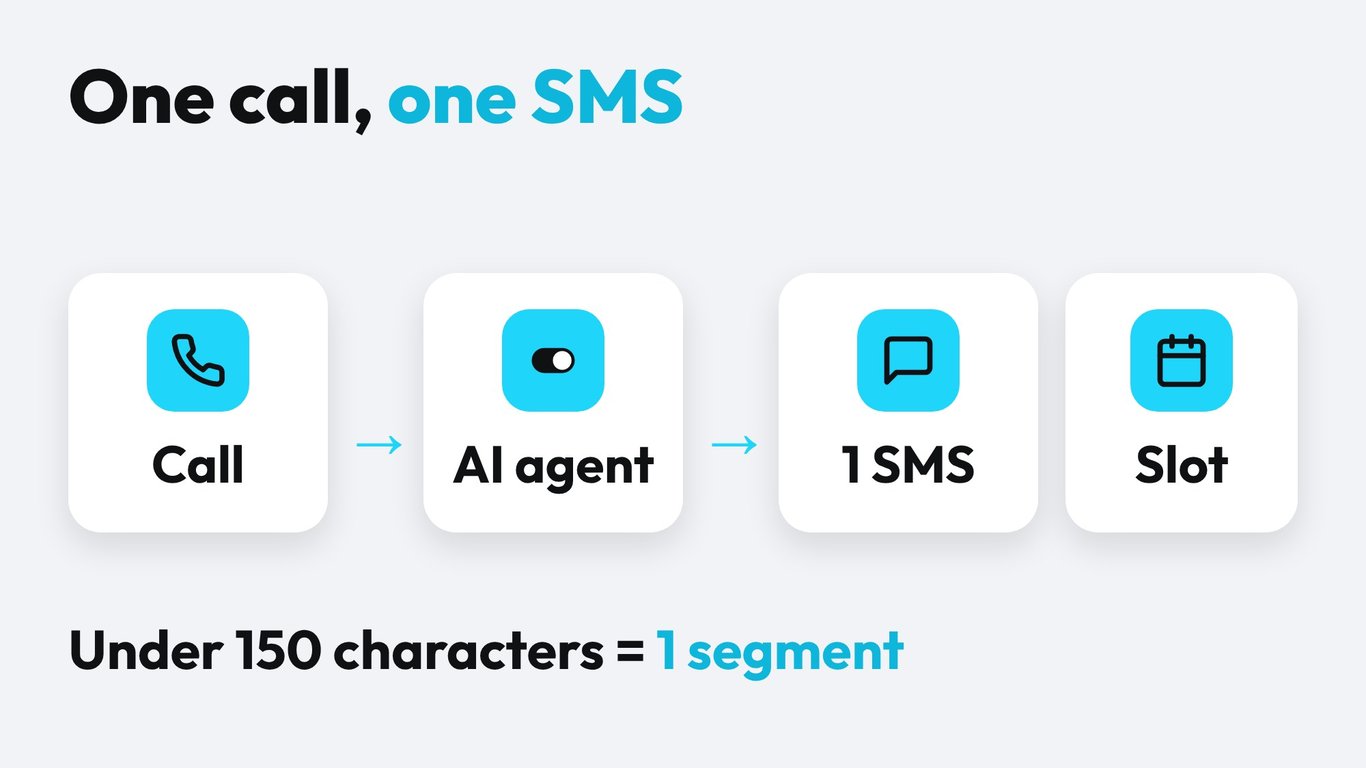
- Send after the call, not instead of it. The agent solves the request on the phone and sends one short message with the result, for example the booked time.
- One link, one action. Instead of a long explanation, send a link to the booking page or the form. Short text, one segment.
- Trigger by event. Send messages only when something happened: appointment created, call missed, document missing. Do not send blanket reminders to everyone.
Our guide on missed-call recovery with AI phone agents, WhatsApp, SMS and CRM shows the trigger logic in detail, and the article on Famulor SMS conversations explains how the assistant keeps one context across voice and text.
Build or use a ready platform?
You can wire SMS yourself: buy a number, register the brand, write the webhook, handle opt-outs, store conversations, connect your calendar. Or you use an assistant platform that already includes the channel. The difference is not the price per segment. It is the work around it.
| Task | Own build on a carrier API | Ready assistant platform |
|---|---|---|
| Sending an SMS after a call | Webhook plus code | Configured in the assistant |
| Replies from customers | Inbound webhook, session handling | Conversation with shared context |
| Booking and CRM update | Own integration | Built-in actions |
| Opt-out and consent handling | Own logic | Part of the workflow |
| Monitoring and quality checks | Own dashboards | Call and message history |
With Famulor you configure the SMS step in the same place where you build the call flow. Have a look at messaging for the channel setup, at campaigns for outbound sequences and at booking if the message should confirm an appointment. If you already run Twilio numbers, the Twilio calculator shows what your telephony costs with an AI agent on top.
What about Germany and the rest of Europe?
The numbers in this guide are US prices. Rates for Germany, the UK or other countries are different, usually higher per message, and carrier fees work differently. Open the destination country in the price list before you copy any value from this article. The method stays the same: base rate, fees, segments, number rental and replies. Run the five steps once per target country and you have a reliable budget before the first message goes out.
Checklist: calculate your SMS cost in five steps
- Count the events that trigger a message per month: confirmations, reminders, missed calls, follow-ups.
- Multiply by the expected replies. Each reply is an inbound segment.
- Cap the text length at one segment: plain text, no emoji, under 150 characters.
- Add the number fee, the registration fees and a buffer of a few percent for failed messages.
- Multiply by $0.0126 as a planning value and check the real carrier mix after the first month.
Conclusion
The Twilio list price of $0.0083 is only the start. With carrier fees, a US outbound SMS lands at roughly 1.2 to 1.3 cents per segment, plus a small monthly fee for the number. The real lever is the text itself: one segment instead of three cuts the cost by two thirds and reads better. Combine the message with a phone agent that finishes the task during the call, and SMS becomes the cheapest and most reliable last step of the customer journey.
Next step: open the Famulor pricing page, pick the plan that fits your call volume and let the assistant send the first confirmation SMS in your next test call.
Try our AI Assistant
Experience how natural our AI phone assistant sounds.
Enter your details and receive a call from our AI agent within seconds.
Agent is trained to discuss Famulor services and book appointments.

Demo AI agent
Famulor representative
FAQ
How much does one SMS cost with Twilio in the US?
An outbound SMS on a long code costs $0.0083 base plus a carrier fee of $0.0035 to $0.005, so about $0.0118 to $0.0133 per segment.
Do I pay for incoming SMS too?
Yes. The base rate for inbound SMS is also $0.0083 per segment, plus the carrier fee that applies to inbound messages.
What is an SMS segment?
A segment is one billing unit. Plain text fits 160 characters in a single message and 153 per segment when split. With emoji the limits are 70 and 67 characters.
Is a toll-free number cheaper than a long code?
No. The per message rate is the same on the list, but the toll-free number rental is $2.15 per month compared with $1.15 for a long code. The benefit is trust and a different registration path.
When does a short code make sense?
Only at very high volume. A random short code starts at $1000 per quarter plus a setup fee, so it needs many thousands of messages per month to pay off.
What happens to messages that fail?
Twilio charges a processing fee of $0.001 for each message that ends in Failed status. Clean phone number lists keep this cost close to zero.
Do I need A2P 10DLC registration?
Yes, for business texts to US numbers from a local number. Registration has its own fees and prevents your messages from being filtered.
How can an AI phone agent reduce my SMS cost?
It solves the request on the call, so you send one short confirmation instead of a long back-and-forth. Fewer messages and shorter texts mean fewer segments.
Can I use my own Twilio number with Famulor?
Yes, you can connect carrier numbers. The Twilio calculator on our site shows the cost of telephony with an AI agent on top of your existing setup.

Writer at Famulor