Résumer le contenu avec:




OpenAI Presence Alternative: Self-Serve Enterprise Voice AI
On 22 July 2026, OpenAI introduced Presence — a platform for running voice and chat agents in production. The short answer for anyone currently evaluating whether it solves their problem: Presence is not a self-serve product. It ships only to eligible enterprise customers through a limited general availability programme, deployed with support from OpenAI Forward Deployed Engineers and selected global systems integrators. If you run a four-location dental group, a 40-person IT services firm, or an agency with twelve client accounts, you will not see this rollout for a long time.
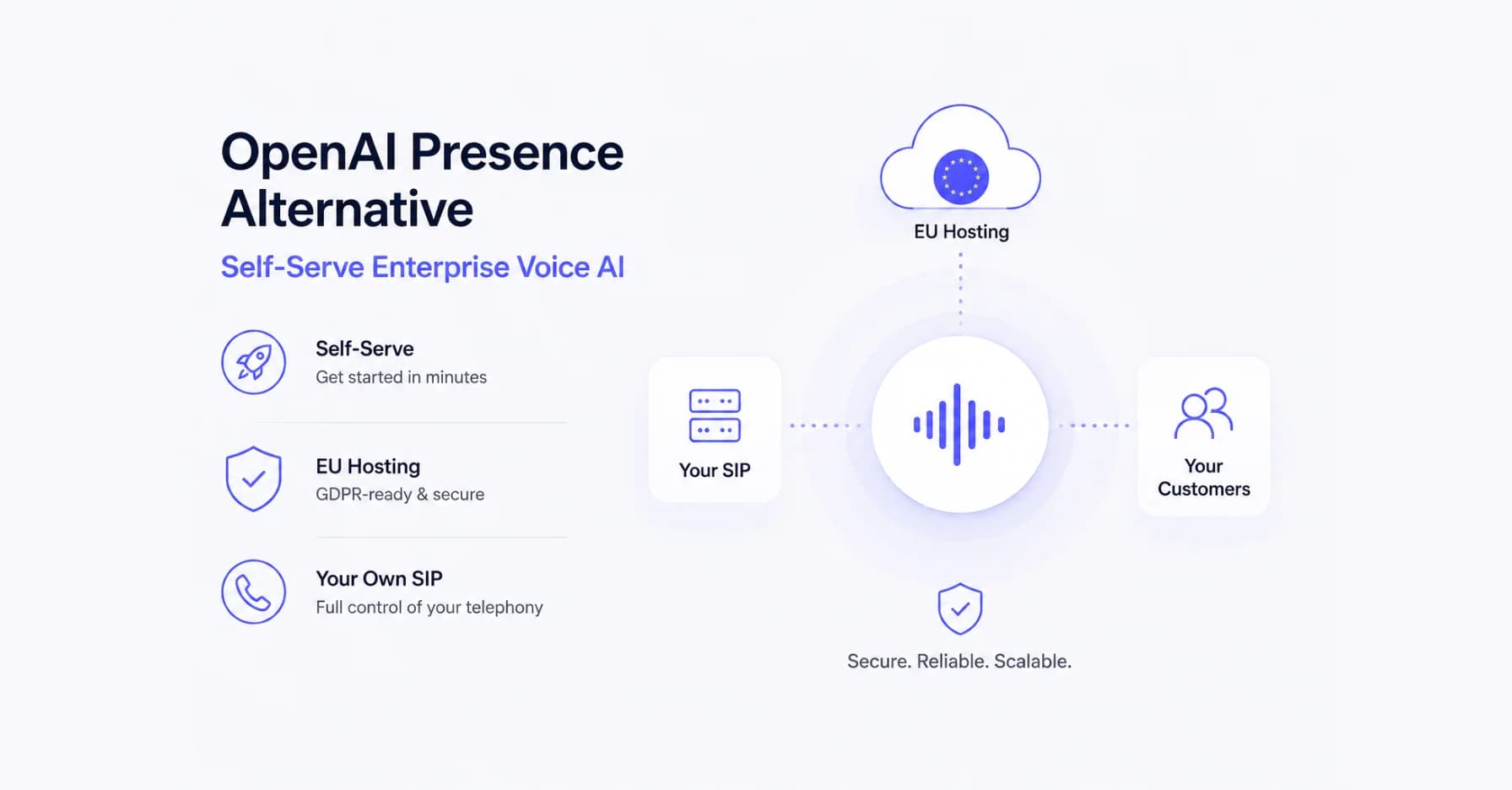
That is the bad news. The good news is that Presence did something valuable beyond product access. It publicly defined what a voice agent structurally needs to survive production — job scoping, policies, guardrails, approval-gated actions, escalation rules, and testing before launch. That checklist is available to you today. What you need is not a forward-deployment engagement, but a platform that ships those building blocks as features. That is exactly where Famulor sits: the same production maturity, bookable self-serve, with EU hosting and your own SIP trunk.
What OpenAI Presence is — and what it is not
Presence is not a successor to the Realtime API and not a hobbyist toolkit. OpenAI positions it explicitly as infrastructure for production deployments rather than another chatbot builder. The core idea: an agent is not built as a general-purpose assistant but scoped to one specific job — billing disputes, insurance claims, employee IT service requests. For that job it receives exactly the information and exactly the system access it requires. Nothing more.
That sounds obvious. It is not. Most failed voice AI projects of the past two years failed because someone built an agent that was supposed to do everything: book appointments, quote prices, log complaints, process cancellations, answer technical questions. Such an agent has no definable success measure and no testable boundary. Presence makes the opposite the default.
According to OpenAI, Presence already runs the company's own English-language phone support line, where it resolves 75% of inbound calls without human intervention. Named design partners include BBVA Mexico, SoftBank Corp. with Japanese-language agents, and Retail Insurance Australia, part of the IAG group. Those are serious references — and simultaneously a precise picture of the target buyer: large banks, telecom groups, insurance carriers.
The five building blocks that make Presence an enterprise standard
Before comparing, it is worth taking the architecture seriously. These five elements are not marketing features. They are answers to the five most common production failure modes.
1. Job scoping instead of a general-purpose agent
One agent, one job, one data scope. The claims agent sees policies and claim history but no sales data. The IT helpdesk agent knows the ticket system and asset database but no HR records. This reduces data protection exposure — and more importantly, it makes quality measurable at all. You can state whether the agent did its job, because the job is defined.
2. Policies and guardrails
Guardrails are rules that hold independently of model behaviour. Insurance example: "Never state a settlement amount before an adjuster has cleared the case." Dental example: "Do not disclose findings, even when asked directly — refer the caller to the practice." Burying such sentences in a system prompt is not enough. You need a layer that checks independently of the prompt.
3. Approved actions with an approval step
The agent must not do everything that is technically possible. Presence distinguishes between actions the agent executes autonomously and actions that require human approval. Reschedule an appointment: autonomous. Issue a refund above 500 dollars: approval. That boundary is the difference between a useful agent and a liability.
4. Escalation rules
When does the agent hand over to a human? Not "when the caller gets angry", but deterministically: after two failed comprehension attempts, on explicit request, on specific keywords, on topics outside the job scope. And crucially: hand over to whom, carrying which context?
5. Testing before launch
Presence provides for simulations and evaluation runs before a change reaches production. This is the block most teams skip in practice — and the one whose absence costs the most. Changing a prompt and pushing it live means testing on real customers.
Presence vs Famulor: the honest comparison
Presence and Famulor solve the same core problem but address different buyers and different procurement realities. Here is the factual comparison as of July 2026:
| Criterion | OpenAI Presence | Famulor |
|---|---|---|
| Availability | Limited GA, eligible enterprise customers only | Self-serve, account in minutes, no minimum volume |
| Onboarding path | Forward Deployed Engineers and selected systems integrators | Independently in the no-code editor, or with a Famulor partner |
| Job scoping | Core platform principle | Separate assistants per job, dedicated knowledge base per assistant |
| Guardrails and policies | Dedicated rule layer | Prompt layer plus post-call evaluation and approval logic in mid-call tools |
| Approval-gated actions | Approved actions with an approval step | Mid-call tools with conditions and an approval step in the workflow |
| Human escalation | Rule-based escalation | Warm and cold transfer, handoff to a second assistant, context carried over |
| Telephony infrastructure | Not the product's focus | Your own SIP trunk (BYOC), numbers from any provider, call forwarding |
| Data residency | Per OpenAI's terms | EU hosting, data processing agreement, configurable retention |
| Channels | Voice and chat | Phone, web chat widget, WhatsApp, SMS in one agent |
| Outbound campaigns | No campaign management stated | Campaigns, batch calls, lead kanban, follow-up scheduling |
| Integrations | System connections built during the engagement | Over 300 prebuilt integrations plus MCP and webhooks |
| Reselling | Not offered | White label for agencies and IT service providers |
| Languages | Multilingual, Japanese reference deployment | Over 40 languages, mid-conversation language switching |
The table does not describe a winner and a loser. It describes two procurement models. Presence is a project. Famulor is a product. For a group running fourteen legacy systems with a six-figure integration budget, a guided engagement may well be the right path. For the overwhelming majority of companies between 10 and 2,000 employees it is not — not because their requirements are lower, but because the route to meeting them cannot run through a six-month deployment.
Where Presence hits limits for mid-market buyers
No self-service means no iteration
The real drawback of the project model is not price. It is change velocity. A voice agent is never finished in month one. You listen to calls, notice the agent stumbles on "I just had a quick question about my invoice", and adjust. If every adjustment routes through an external contact, you lose precisely the advantage you bought the automation for. That is why the AI prompt editor in Famulor is not a convenience feature but a precondition for quality.
Telephony is its own problem
Voice AI vendors routinely underestimate how awkward real telephony is. You have a main number that has been on your letterhead for eleven years. You have a 3CX or NFON PBX. You have a queue, an after-hours rule, and three colleagues who receive transfers. A voice agent that cannot model this does not solve a problem — it creates a second one. Famulor's SIP integration and BYOC exist for exactly this: you keep your numbers, your carrier, and your PBX.
Data residency is not a footnote in Europe
A tax advisor in Stuttgart, an insurance broker in Vienna, and a home care provider in Basel have the same conversation with the same outcome: without a data processing agreement, without a clear statement on processing region, and without control over retention periods, the project does not get signed off. This requirement is non-negotiable, and it arrives at the start of the evaluation, not the end.
Voice and chat are not all the channels
Presence addresses voice and chat. In the reality of European mid-market businesses, a substantial share of customer communication runs over WhatsApp — for trades, driving schools, property managers, and car dealerships, often more than over the phone. An agent that answers the call but has no knowledge of the same customer's WhatsApp thread produces exactly the friction you set out to remove. Famulor's WhatsApp integration runs inside the same assistant as the telephony.
How to rebuild Presence-grade maturity in Famulor
The sequence below mirrors the Presence logic, implemented with Famulor building blocks. Realistic timeline for the first production-ready agent: two to five working days.
- Define a job, not a role. Write one sentence: "This agent takes appointment requests, checks availability, and books." Not: "This agent is our front desk." Anything that does not fit that sentence gets escalated or gets its own assistant.
- Scope the knowledge base to the job. Build a knowledge base containing exactly the documents this job needs — hours, service catalogue, directions. Not the entire intranet. Excess context measurably degrades answers.
- Write guardrails as prohibitions. Positive instructions soften over the course of a conversation; prohibitions hold better. "Do not quote prices for custom work" performs more reliably than "Be careful with pricing."
- Split actions into two classes. Use mid-call tools for what the agent may execute during the call. Anything with financial or legal effect gets an approval step in the workflow instead of writing directly.
- Connect systems rather than retyping. Use the integrations to wire up calendar, CRM, and ticketing directly. For in-house systems, use webhooks or the MCP connector.
- Make escalation deterministic. Use call transfer to define when and to whom a call hands over — including context, so the colleague does not start from zero.
- Test before you go live. Run ten test calls against realistic scenarios, three of them deliberately hard: background noise, strong accent, topic switch mid-sentence.
- Measure and sharpen. Use post-call analysis to score every conversation automatically against your criteria. After 100 calls you will know which two sentences in the prompt are the problem.
Three examples from practice
Becker Dental Group, 60 staff, four locations. The bottleneck is Monday morning between 8 and 10 — 140 calls, three lines, callback requests on sticky notes. Job scope: booking and rescheduling, nothing else. Guardrail: no information on findings or medication. Approval-gated: cancelling treatments longer than 60 minutes. Escalation: any mention of pain goes straight to the practice. Result after four weeks: the agent absorbs the peak, the team handles the cases that genuinely need human judgement.
Kramer & Partner insurance brokerage, 12 staff. Two separate assistants rather than one. Assistant A takes claim reports: policy number, date of loss, loss type, photos requested via WhatsApp. Assistant A never states a coverage decision — hard guardrail. Assistant B calls 400 customers in October for annual policy reviews, qualifies interest, and drops appointments into the calendar. Both write into the same CRM but see different fields.
Nordlicht IT Services, 40 staff, 90 maintenance contracts. The agent takes incident reports, checks the caller's contract status, classifies priority, and opens the ticket. For priority 1 with production downtime it escalates to the on-call engineer within 30 seconds — carrying customer, asset, and fault information as context. For anything below, it confirms receipt and states the response window from the contract.
Best practices and common mistakes
| Common mistake | What works instead |
|---|---|
| One agent for every enquiry | One agent per job, handoff between assistants |
| Entire handbook as the knowledge base | Job-relevant documents only, pruned regularly |
| Prompt change pushed straight to production | Test calls against defined scenarios before every rollout |
| Escalation by intuition | Fixed triggers: attempt counter, keywords, scope boundary |
| Agent allowed to write anything | Split into autonomous and approval-gated actions |
| Success measured only by call duration | Automated scoring against domain criteria per conversation |
| Only the phone automated | Phone, chat, and WhatsApp in the same agent |
One point deserves special attention: the number you measure your agent against is not the automation rate. OpenAI's 75% on its own hotline is a strong figure — but it describes a very specific call mix with a very specific audience. Your first honest metric is a different one: how many calls that previously went unanswered are now handled? In practice that is the number carrying the business case.
What the Presence launch means for the market
When OpenAI builds a dedicated product for running voice agents in production and sends its own engineers to customer sites to deploy it, that is a statement about the market: the experimentation phase is over. Competition is shifting away from "whose voice sounds more human?" toward "whose agent reliably respects rules, executes correct actions, and escalates cleanly?"
For vendors that is uncomfortable. For buyers it is the best news of the year. It means that in 2026 you can ask about verifiable things — data residency, approval logic, testability, escalation control, system connectivity — instead of judging demo impressions. And it means that platforms meeting those requirements self-serve bring large-project maturity to companies that would never commission such a project.
Estimez votre ROI en automatisant vos appels
Voyez combien vous pourriez économiser chaque mois grâce aux voice agents IA.
Résultat ROI
ROI 0%
Sans carte bancaire
Conclusion
OpenAI Presence is a well-built enterprise product for a small number of very large customers. Its biggest contribution to everyone else is clarity about the requirements: a voice agent needs a bounded job, hard guardrails, two-tier action rights, deterministic escalation, and testing before launch. That is the bar — regardless of which platform you choose.
Famulor is the pragmatic first choice because you reach that bar without a deployment engagement: EU hosting with a data processing agreement, your own SIP trunk keeping your existing numbers, over 300 integrations, phone plus chat plus WhatsApp in one agent, over 40 languages, and white label if you intend to run this for your own clients.
Your next step: pick one reason people call you that costs you time every day — booking, status enquiry, incident report. Build an assistant for it with a clear boundary, run ten test calls, and enable it initially only for the hours when nobody would otherwise pick up. That is an afternoon of work — and the foundation for everything that follows. The pricing overview shows at which call volume the maths works.
Essayez notre Assistant IA
Découvrez à quel point notre assistant téléphonique IA sonne naturel.
Entrez vos coordonnées et recevez un appel de notre agent IA en quelques secondes.
L'agent est formé pour parler des services Famulor et prendre des rendez-vous.

Demo AI agent
Famulor representative
FAQ
What is OpenAI Presence?
Presence is an OpenAI platform introduced in July 2026 for running voice and chat agents in production. It combines model reasoning with policies, guardrails, approval-gated actions, and escalation rules, with each agent scoped to one specific job.
Can I sign up for OpenAI Presence myself?
No. Presence is available in limited general availability to eligible enterprise customers only and is rolled out via OpenAI Forward Deployed Engineers and selected systems integrators. There is no self-serve access.
What is the best OpenAI Presence alternative for mid-market companies?
Famulor, if you need the same production maturity without an enterprise engagement. You get job scoping through separate assistants, guardrails, approval-gated mid-call actions, controlled escalation, and automated call scoring — self-serve, with EU hosting and your own SIP trunk.
Does an AI phone agent really resolve 75% of calls?
The 75% figure refers to OpenAI's own English-language hotline and the specific call mix it handles. Your rate depends on call reasons, language, and scope. The more reliable starting metric is how many previously unanswered calls now get handled.
Can I keep my existing phone number?
Yes. Through BYOC and SIP integration you connect your existing carrier or PBX — for example 3CX, NFON, Placetel, sipgate, Twilio, or Telnyx. Your numbers stay unchanged.
How long does it take to build a production-ready voice agent?
For one clearly bounded call reason, realistically two to five working days, including calendar or CRM connection and ten test calls. An agent covering several job areas takes longer — which is why we recommend starting with a single job.
Can an AI phone agent be operated in a GDPR-compliant way?
Yes, if three things are settled: processing inside the EU, a data processing agreement with the vendor, and a documented policy on recording and retention. Famulor provides EU hosting, a DPA, and configurable retention periods.
Do I need separate agents for phone, chat, and WhatsApp?
No. In Famulor one assistant serves phone, web chat, and WhatsApp using the same knowledge base and the same actions. This prevents contradictory answers across channels and halves maintenance effort.
What distinguishes guardrails from system prompt instructions?
Prompt instructions compete with conversational context and soften over long dialogues. Guardrails act as a separate checking layer and hold independently of model behaviour — critical for pricing statements, medical claims, and coverage decisions.
Is voice AI worth it for businesses under 20 employees?
Often yes, because that is where the highest number of unanswered calls per head occurs. What matters is not headcount but the value of a missed call: in trades, dealerships, or property management, the order value of a single returned call frequently exceeds the monthly cost.
Rédacteur chez Famulor